OM Week 12
 Call Kai
 Learn
Learn Practice Test
 Spaced Repetition
 Match
Match Flashcards
 Knowt Play
1/15

There's no tags or description
Looks like no tags are added yet.
Name | Mastery | Learn | Test | Matching | Spaced | Call with Kai |
|---|
No analytics yet
Send a link to your students to track their progress
16 Terms
What are the four reasons to hold inventory?
Meet customer demand immediately
Buffer against supplier or demand uncertainty
Order or produce in larger, cheaper batches
Prepare for predictable peaks
What are the four reasons to reduce inventory?
Cash gets trapped in stock
Storage, handling, and insurance cost money
Products can expire or become obsolete
Excess inventory can hide bad forecasts and bad processes
What are the four types of Inventory?
Pipeline
Safety Stock
Cycle Inventory
Seasonal Inventory
Pipeline Inventory
Items moving though transportation or processing
Safety Stock
Extra inventory held because demand or lead time is uncertain
Cycle Inventory
Inventory created because we replenish in batches rather than one unit at a time
Seasonal Inventory
Inventory built in advance of a known future surge
Bigger orders mean fewer setups but also
More inventory sitting around
Purchasing Cost Formula
Purchasing Cost = Cost x Demand
Purchasing Cost
If the unit price does not depend on order size then you still buy the same annual demand D no matter what Q is and PC does not change with Q
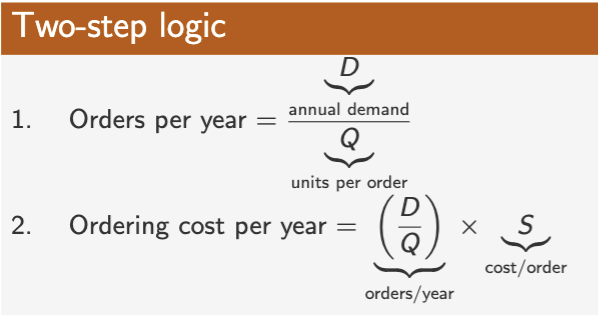
Ordering Cost Formula
Annual ordering cost depends on how many orders you place in a year
Each order costs S
Holding Cost
Which two costs does EOQ balance?
Ordering Cost
Holding Cost
If unit price is constant, purchasing constant is
Flat in Q
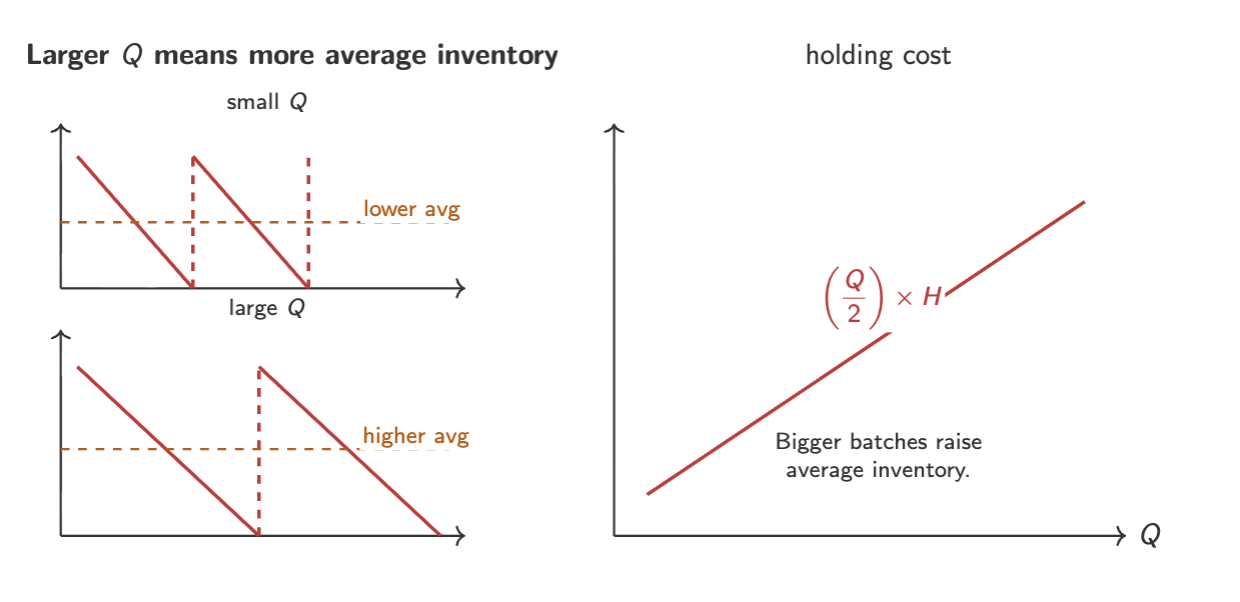
Why does Average Inventory = Q/2
In the basic EOQ model, inventory falls steadily from Q to 0 and is then replenished instantly
The average over the cycle is therefore:
Average Inventory = Q + 0 / 2 = Q /2