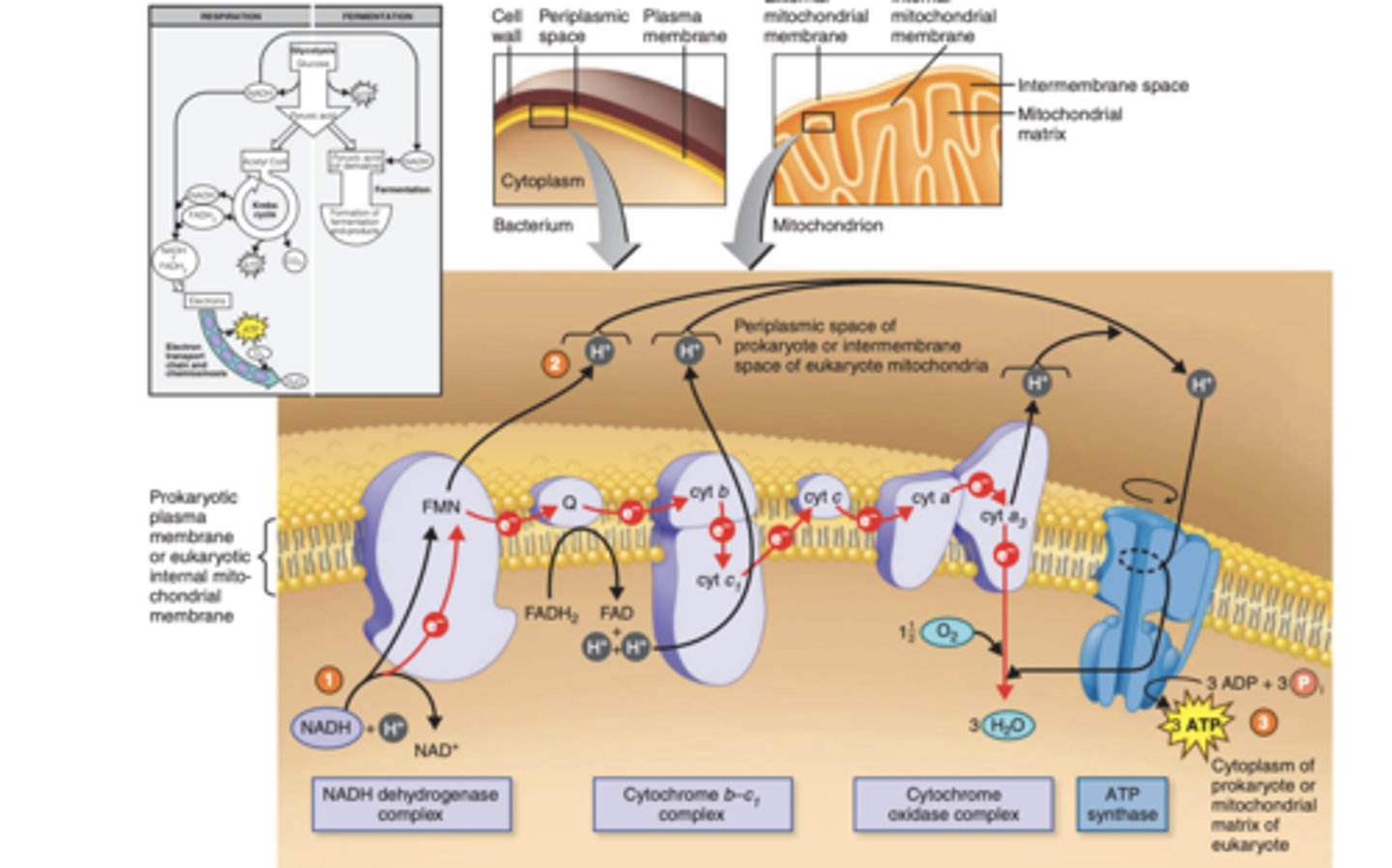
CH 5 end of chapter questions Multiple Choice
 Call Kai
 Learn
Learn Practice Test
 Spaced Repetition
 Match
Match Flashcards
 Knowt Play
1/16

There's no tags or description
Looks like no tags are added yet.
Name | Mastery | Learn | Test | Matching | Spaced | Call with Kai |
|---|
No analytics yet
Send a link to your students to track their progress
17 Terms
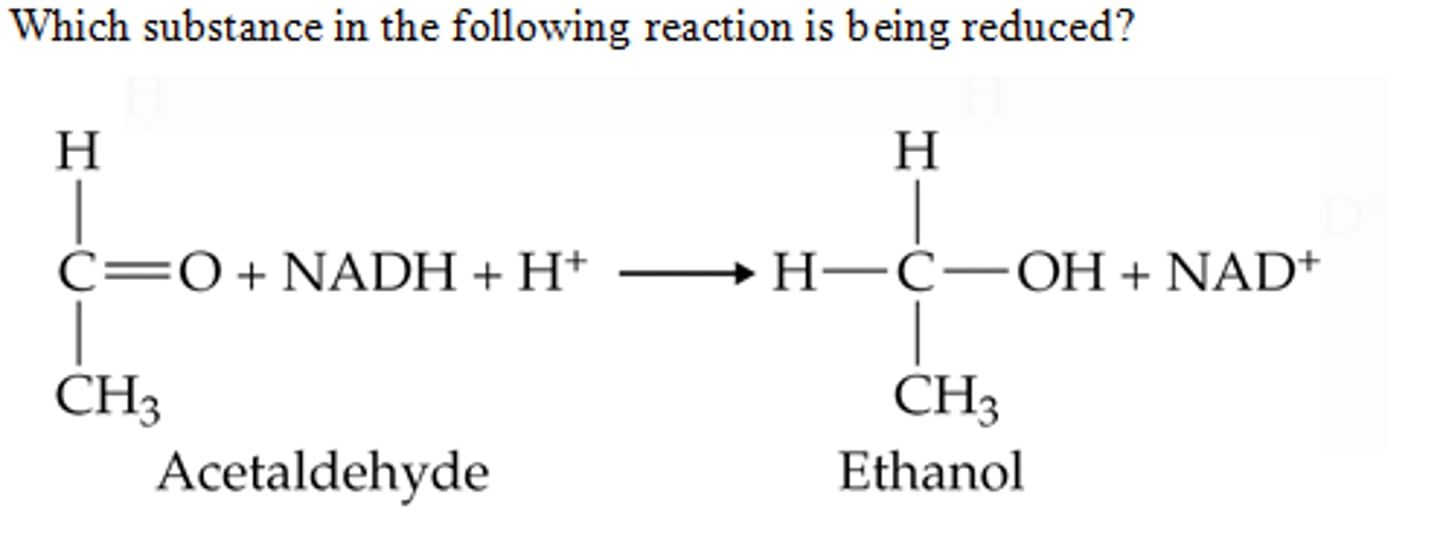
1. Which substance in the following reaction is being reduced?
a. acetaldehyde
b. NADH
c. ethanol
d. NAD+
acetaldehyde
2. Which of the following reactions produces the most molecules of ATP during aerobic metabolism?
a. glucose → glucose 6-phosphate
b. phosphoenolpyruvic acid → pyruvic acid
c. glucose → pyruvic acid
d. acetyl CoA → CO2 + H2O
e. succinic acid → fumaric acid
acetyl CoA → CO2 + H2O
3. Which of the following processes does not generate ATP?
a. photophosphorylation
b. the Calvin-Benson cycle
c. oxidative phosphorylation
d. substrate-level phosphorylation
e. All of the above generate ATP
the Calvin-Benson cycle
4. Which of the following compounds has the greatest amount of energy for a cell?
a. CO2
b. ATP
c. glucose
d. O2
e. lactic acid
glucose
5. Which of the following is the best definition of the Krebs cycle?
a. the oxidation of pyruvic acid
b. the way cells produce CO2
c. a series of chemical reactions in which NADH is produced from the oxidation of pyruvic acid
d. a method of producing ATP by phosphorylating ADP
e. a series of chemical reactions in which ATP is produced from the oxidation of pyruvic acid
a series of chemical reactions in which NADH is produced from the oxidation of pyruvic acid
6. Which of the following is the best definition of cellular respiration?
- a sequence of carrier molecules with O2 as the final electron acceptor
- a sequence of carrier molecules with the final electron acceptor from the environment
- a method of generating ATP
- the complete oxidation of glucose to CO2 and H2O
- a series of reactions in which pyruvic acid is oxidized to CO2 and H2O
a sequence of carrier molecules with the final electron acceptor from the environment
7. Which culture produces the most lactic acid?
a. E. coli growing in glucose broth at 35°C with O2 for 5 days
b. E. coli growing in glucose broth at 35°C without O2 for 5 days
c. both a and b
d. neither a nor b
E. coli growing in glucose broth at 35°C without O2 for 5 days
8. Which culture produces the most ATP?
a. E. coli growing in glucose broth at 35°C with O2 for 5 days
b. E. coli growing in glucose broth at 35°C without O2 for 5 days
c. both a and b
d. neither a nor b
E. coli growing in glucose broth at 35°C with O2 for 5 days
9. Which culture uses NAD+?
a. E. coli growing in glucose broth at 35°C with O2 for 5 days
b. E. coli growing in glucose broth at 35°C without O2 for 5 days
c. both a and b
d. neither a nor b
both a and b
E. coli growing in glucose broth at 35°C with O2 for 5 days
E. coli growing in glucose broth at 35°C without O2 for 5 days
10. Which culture uses the most glucose?
a. E. coli growing in glucose broth at 35°C with O2 for 5 days
b. E. coli growing in glucose broth at 35°C without O2 for 5 days
c. both a and b
d. neither a nor b
E. coli growing in glucose broth at 35°C without O2 for 5 days
All of the energy-producing biochemical reactions that occur in cells, such as photophosphorylation and glycolysis, are reactions.
oxidation
Why must NADH be reoxidized? How does this happen in an organism that uses respiration? Fermentation?
NAD+ is needed to pick up more electrons. NADH is usually reoxidized in respiration. NADH can be reoxidized in fermentation.
What nutritional type is a colorless microbe that uses the Calvin-Benson cycle, uses H2 as the electron donor to its ETC, and uses elemental S as the final electron acceptor in the ETC?
Chemoautotroph
Write your own definition of the chemiosmotic mechanism of ATP generation.
Protons are pumped from one side of the membrane to the other; transfer
of protons back across the membrane generates ATP.
In chemiosmosis, what do a and b represent on Figure 5.16?
a. the acidic side of the membrane
b. the side with a positive electrical charge
Outer portion is acidic and has a positive electrical charge.
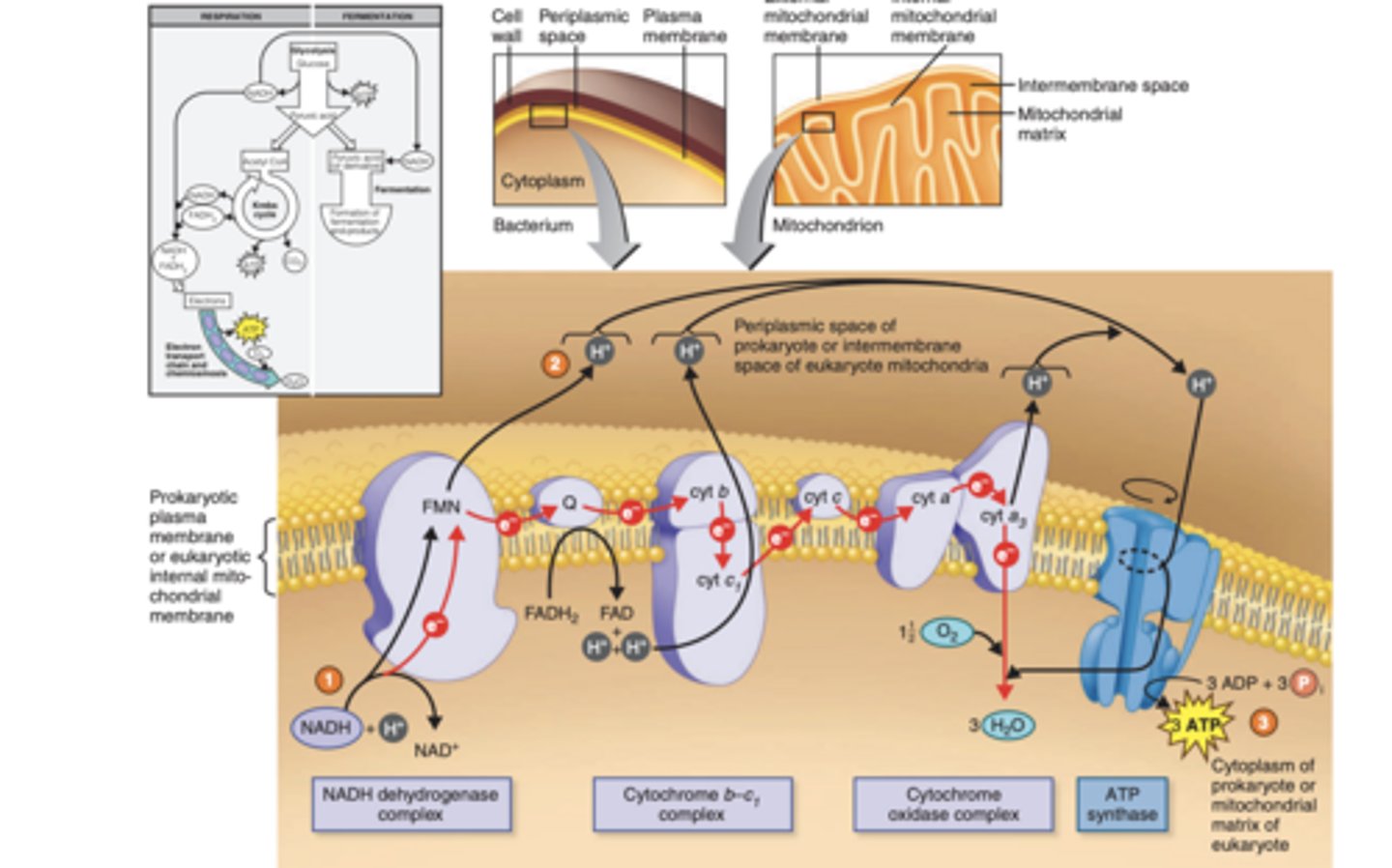
In chemiosmosis, what does c represent on Figure 5.16?
c. potential energy
Energy-conserving sites are the three loci where protons are pumped out.
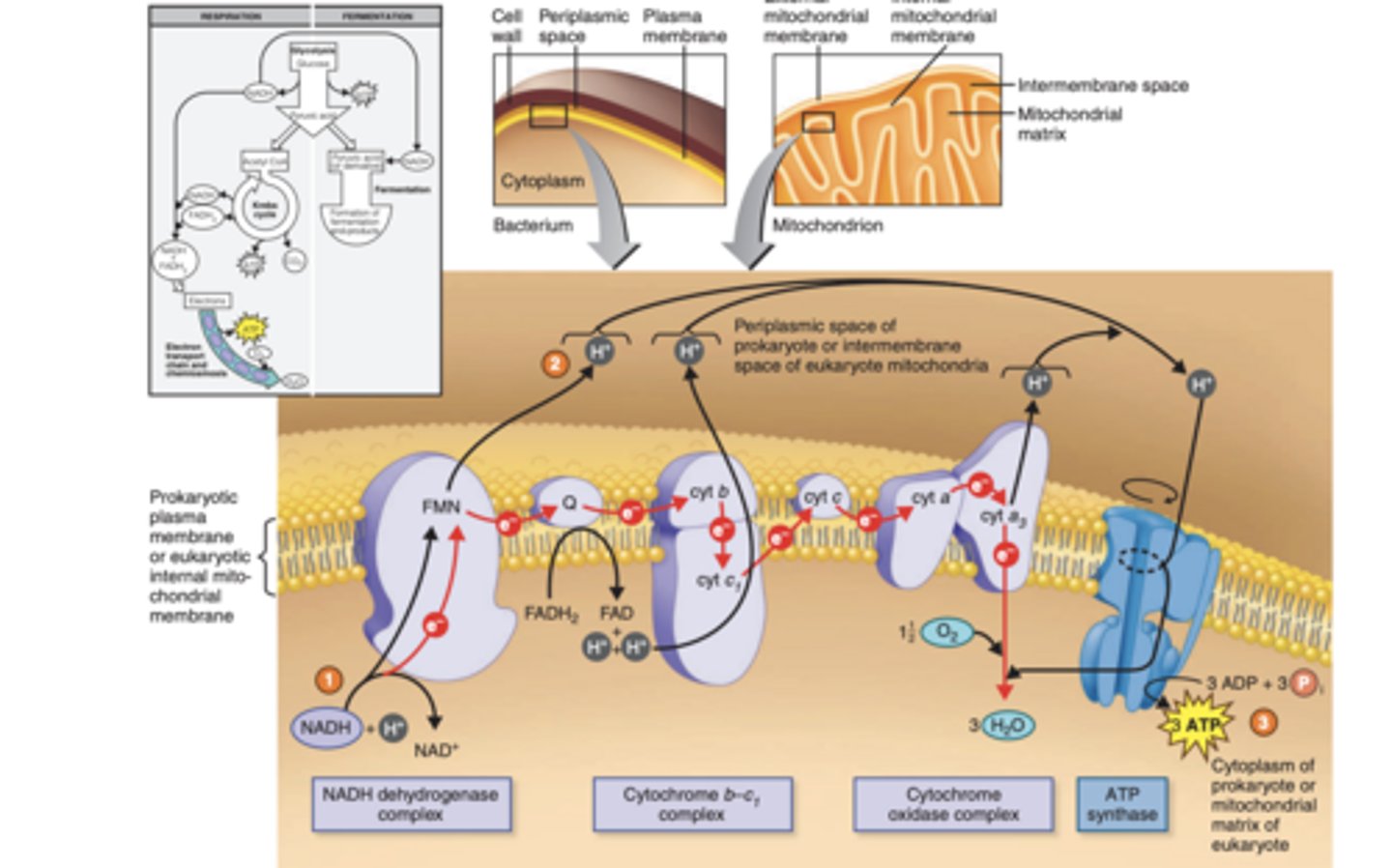
In chemiosmosis, what does d represent on Figure 5.16?
d. Kinetic energy
Kinetic energy is realized at ATP synthase.