Part 2- MANAGEMENT OF POISONED PATIENT
 Call Kai
 Learn
Learn Practice Test
 Spaced Repetition
 Match
Match Flashcards
 Knowt Play
1/101

There's no tags or description
Looks like no tags are added yet.
Name | Mastery | Learn | Test | Matching | Spaced | Call with Kai |
|---|
No analytics yet
Send a link to your students to track their progress
102 Terms
MANAGEMENT OF POISONED PATIENT
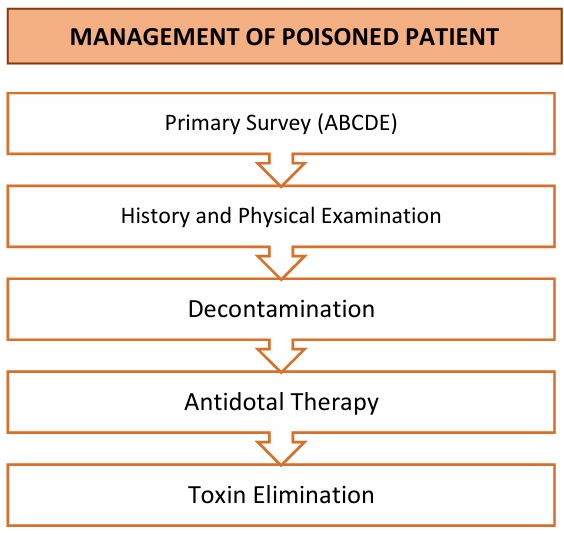
ABCDE
a. PRIMARY SURVEY
b. SECONDARY SURVEY
a. PRIMARY SURVEY
AIRWAY
BREATHING
CIRCULATION
DEPRESSED MENTAL STATUS
EXPOSURE
MAPLE
a. PRIMARY SURVEY
b. SECONDARY SURVEY
b. SECONDARY SURVEY
Medication
Allergy
Past Medical History / Pregnancy
Last Meal
Events or Environment Related to Injury
[PRIMARY SURVEY]
In airway management, the airway should first be:
a. Obstructed to prevent aspiration
b. Cleared of obstruction or vomitus
c. Positioned upright
d. Left untouched
b. Cleared of obstruction or vomitus
[PRIMARY SURVEY]
Which position is recommended to optimize the airway?
a. Trendelenburg position
b. Sniffing position
c. Supine with neck flexed
d. Standing position
b. Sniffing position
[PRIMARY SURVEY]
Which maneuver is used to help open the airway?
a. Jaw-thrust maneuver
b. Heimlich maneuver
c. Valsalva maneuver
d. Babinski maneuver
a. Jaw-thrust maneuver
[PRIMARY SURVEY]
A poisoned patient should be positioned:
a. Upright with head elevated
b. Flat prone position
c. Head-down and left-sided position
d. Sitting with neck flexed
c. Head-down and left-sided position
[PRIMARY SURVEY]
Neck manipulation should be avoided when:
a. Vomiting is present
b. Respiratory depression occurs
c. Neck injury is suspected
d. Airway obstruction exists
c. Neck injury is suspected
[PRIMARY SURVEY]
Which of the following is part of airway management?
a. Remove airway obstruction
b. Increase gastric emptying
c. Administer insulin
d. Induce vomiting routinely
a. Remove airway obstruction
[PRIMARY SURVEY]
An artificial airway may be provided by:
a. Nasal spray or endotracheal tube insertion
b. Oral airway or endotracheal tube insertion
c. Intramuscular injection and oral airway
d. Rectal suppository and oral airway
b. Oral airway or endotracheal tube insertion
[PRIMARY SURVEY]
Oxygen saturation (O₂ sat) is commonly assessed using a:
a. Thermometer
b. Glucometer
c. Sphygmomanometer
d. Pulse oximeter
d. Pulse oximeter
[PRIMARY SURVEY]
The normal oxygen saturation range is:
a. 50–70%
b. 70–80%
c. 80–89%
d. 95–100%
d. 95–100%
[PRIMARY SURVEY]
The normal respiratory rate (RR) in adults is:
a. 4–10 breaths/min
b. 12–21 breaths/min
c. 22–35 breaths/min
d. 40–60 breaths/min
b. 12–21 breaths/min
hindi ba 12-20 lang??
[PRIMARY SURVEY]
Arterial blood gas (ABG) analysis is used to determine:
a. Blood glucose levels
b. Kidney function
c. Acidosis or alkalosis
d. Bone density
c. Acidosis or alkalosis
[PRIMARY SURVEY]
The normal blood pH on ABG is:
a. 6.80–7.00
b. 7.10–7.20
c. 7.40–7.45
d. 7.60–7.80
c. 7.40–7.45
[PRIMARY SURVEY]
Oxygen supplementation is recommended when oxygen saturation is:
a. >100%
b. <95%
c. >95%
d. <40%
b. <95%
[PRIMARY SURVEY]
Which oxygen delivery device is commonly used for O₂ saturation of 90–94%?
a. Non-rebreather oxygen mask
b. Endotracheal tube
c. Nasal cannula
d. Face mask only for intubation
c. Nasal cannula
[PRIMARY SURVEY]
A patient with oxygen saturation of 80–89% may require:
a. Nasal cannula
b. Oxygen face mask
c. Non-rebreather oxygen mask
d. No oxygen support
b. Oxygen face mask
[PRIMARY SURVEY]
Which oxygen delivery device is appropriate for 70–80% oxygen saturation?
a. Nasal cannula
b. Oxygen face mask
c. Non-rebreather oxygen mask
d. Room air
c. Non-rebreather oxygen mask
[PRIMARY SURVEY]
If oxygen saturation falls below 70%, management should include:
a. Nasal cannula
b. Oxygen face mask
c. Intubation and manual/mechanical ventilation
d. Non-rebreather oxygen mask
c. Intubation and manual/mechanical ventilation
[PRIMARY SURVEY]
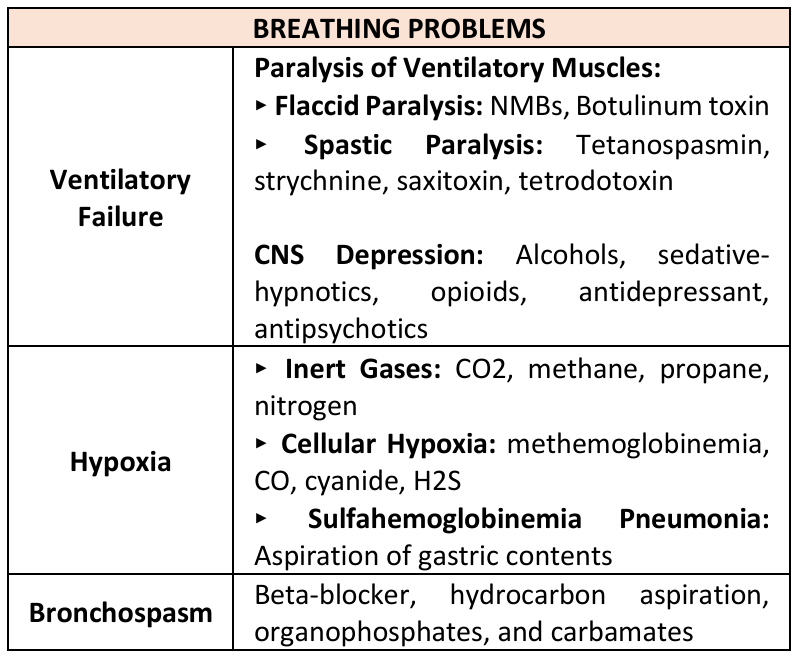
Paralysis of Ventilatory Muscles: Flaccid or Spastic
a. Tetanospasmin =____
b. Tetrodotoxin =____
c. NMBs =____
d. Saxitoxin =____
e. Strychnine =____
f. Botulinum toxin =____
a. Tetanospasmin = Spastic
b. Tetrodotoxin = Spastic
c. NMBs = Flaccid
d. Saxitoxin = Spastic
e. Strychnine = Spastic
f. Botulinum toxin = Flaccid
[PRIMARY SURVEY]
Ventilatory failure due to CNS depression may occur with:
a. Alcohols, sedative-hypnotics, opioids, antidepressants, antipsychotics
b. Sulfa drugs
c. Methane and nitrogen
d. Organophosphates
a. Alcohols, sedative-hypnotics, opioids, antidepressants, antipsychotics
[PRIMARY SURVEY]
Hypoxia: Inert Gases or Cellular Hypoxia
a. Methemoglobinemia = ____
b. CO2 = ____
c. Propane = ____
d. CO = ____
e. Methane = ____
f. Cyanide = ____
g. H2S = ____
h. Nitrogen = ____
a. Methemoglobinemia = Cellular Hypoxia
b. CO2 = Inert Gases
c. Propane = Inert Gases
d. CO = Cellular Hypoxia
e. Methane = Inert Gases
f. Cyanide = Cellular Hypoxia
g. H2S = Cellular Hypoxia
h. Nitrogen = Inert Gases
[PRIMARY SURVEY]
Sulfahemoglobinemia Pneumonia may result from:
a. Bronchospasm
b. Carbamate
c. Beta-blocker use
d. Aspiration of gastric contents
d. Aspiration of gastric contents
[PRIMARY SURVEY]
Bronchospasm is associated with:
a. Sedative-hypnotics, antidepressant, hydrocarbon aspiration, and organophosphates
b. Methemoglobinemia, CO, cyanide, organophosphates, and carbamates
c. CO2, methane, propane, nitrogen, methemoglobinemia, CO, and cyanide
d. Beta-blocker, hydrocarbon aspiration, organophosphates, and carbamates
d. Beta-blocker, hydrocarbon aspiration, organophosphates, and carbamates
[PRIMARY SURVEY]
Normal BP is:
a. >90/60 mmHg
b. <90/60 mmHg
c. 65–100 mmHg
d. 30 comp/min
a. >90/60 mmHg
[PRIMARY SURVEY]
Normal pulse rate is:
a. 30 comp/min
b. 65–100 bpm
c. >90/60 mmHg
d. 200 mL PNSS IV bolus
b. 65–100 bpm
[PRIMARY SURVEY]
For HTN management:
a. Start chest compression
b. Check pulse rate and blood pressure
c. Give 200mL PNSS IV bolus to consume 1L
d. Initial: 30 comp/min and start chest compression
c. Give 200mL PNSS IV bolus to consume 1L
[PRIMARY SURVEY]
For HTN management:
a. Check breath sounds
b. Start chest compression
c. Initial: 30 comp/min
d. Pulse rate: 65–100 bpm
a. Check breath sounds
[PRIMARY SURVEY]
Pulseless / bradycardic management includes:
a. Give 200mL PNSS IV bolus
b. Check breath sounds
c. Start chest compression
d. Check BP
c. Start chest compression
[PRIMARY SURVEY]
Initial chest compression:
a. 65–100 bpm
b. >90/60 mmHg
c. 30 comp/min
d. 200mL PNSS IV bolus
c. 30 comp/min
[PRIMARY SURVEY]
Assessment for depressed mental status includes:
a. Check for responsiveness (tap / sternal rub)
b. Start chest compression
c. Give 200mL PNSS IV bolus to consume 1L
d. Check breath sounds
a. Check for responsiveness (tap / sternal rub)
[PRIMARY SURVEY]
Normal capillary blood glucose for depressed mental status includes:
a. 65–100 g/dL
b. 70–200 g/dL
c. >90/60 mmHg
d. 0.4–2 mg IV
b. 70–200 g/dL
[PRIMARY SURVEY]
Hypoglycemia for depressed mental status includes management includes:
a. Naloxone 0.4–2 mg IV
b. Vit B1 100 mg IV
c. Dextrose 50/50
d. Flumazenil
c. Dextrose 50/50
[PRIMARY SURVEY]
Alcohol intoxication management includes:
a. Dextrose 50/50
b. Naloxone 0.4–2 mg IV
c. Vit B1 100 mg IV
d. NaHCO3
c. Vit B1 100 mg IV
[PRIMARY SURVEY]
Vit B1 100 mg IV is given for prevention of:
a. SJS
b. Wernicke Korsakoff Syndrome
c. Bradycardia
d. Salicylism
b. Wernicke Korsakoff Syndrome
[PRIMARY SURVEY]
Opioid toxicity management includes:
a. Naloxone 1–2 mcg PO
b. Naloxone 2–4 mg PO
c. Naloxone 0.4–2 mg IV
d. Naloxone 2–4 mg IV
c. Naloxone 0.4–2 mg IV
[PRIMARY SURVEY]
Sedative/hypnotic toxicity management includes:
a. Naloxone 0.4–2 mg IV
b. Flumazenil or alkalinization using NaHCO3
c. Vit B1 100 mg IV
d. Dextrose 50/50
b. Flumazenil or alkalinization using NaHCO3
[PRIMARY SURVEY]
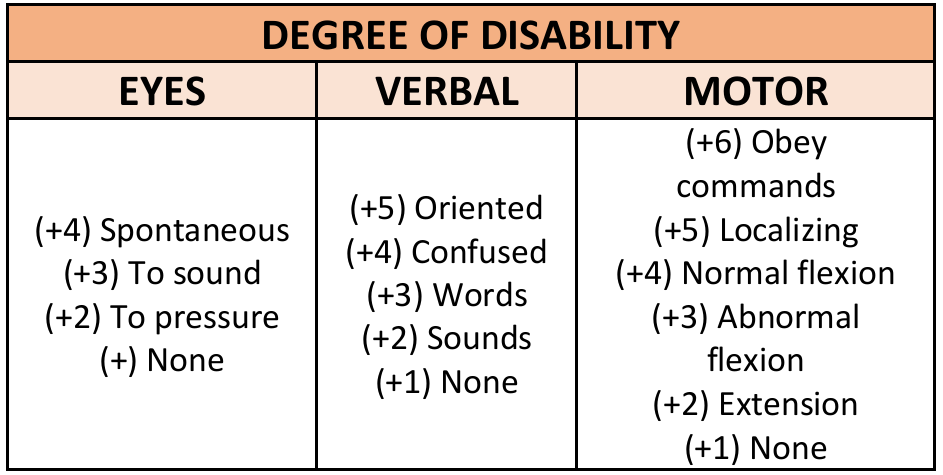
Matching Type Quiz: Degree of Disability
Column A (Descriptions)
Spontaneous eye opening
Eye opening to sound
Eye opening to pressure
No eye opening
Oriented verbal response
Confused verbal response
Verbal response: words only
Verbal response: sounds only
No verbal response
Obeys commands (motor)
Localizing pain (motor)
Normal flexion (motor)
Abnormal flexion (motor)
Extension (motor)
No motor response
Column B (Scores)
+6
+5
+4
+3
+2
+1
1 → C (+4)
2 → D (+3)
3 → E (+2)
4 → F (+1)
5 → B (+5)
6 → C (+4)
7 → D (+3)
8 → E (+2)
9 → F (+1)
10 → A (+6)
11 → B (+5)
12 → C (+4)
13 → D (+3)
14 → E (+2)
15 → F (+1)
[PRIMARY SURVEY]
Remove clothing for better evaluation
a. Circulation
b. Airway
c. Breathing
d. Exposure
d. Exposure
[SECONDARY SURVEY]
MANAGEMENT includes:
a. Diagnostics and therapeutics
b. Medication and allergy
c. Past medical history and pregnancy
d. Events related to injury
a. Diagnostics and therapeutics
[SECONDARY SURVEY]
Passage of tube via mouth or nose down to stomach followed by sequential administration of warm saline solution and removal of small volume of liquids
a. Emesis
b. Dilution / Neutralization
c. Lavage
d. Diagnostics and therapeutics
c. Lavage
[SECONDARY SURVEY]
Lavage is used for:
a. Rapid onset coma / convulsion
b. Massive ingestion
c. Alkali and acids
d. Aspiration of gastric contents
b. Massive ingestion
[SECONDARY SURVEY]
Contraindication of lavage:
a. Massive ingestion
b. Unconscious patients
c. Medication allergy
d. Warm saline solution
b. Unconscious patients
[SECONDARY SURVEY]
Contraindication of lavage:
a. Ingestion of corrosive substances
b. Last meal
c. Events related to injury
d. Diagnostics
a. Ingestion of corrosive substances
[SECONDARY SURVEY]
Contraindication of lavage:
a. Ingestion of noncorrosive substances
b. Ingestion of SR and enteric-coated tablets
c. Conscious patients
d. Hypoxia
b. Ingestion of SR and enteric-coated tablets
[SECONDARY SURVEY]
Dilution / Neutralization is for:
a. Massive ingestion
b. CI in alkali and acids
c. Sedative toxicity
d. Na in alkali and acids
b. CI in alkali and acids
[SECONDARY SURVEY]
Emesis includes:
a. Naloxone / Flumazenil
b. Syrup of Ipecac / Apomorphine
c. PNSS / NaHCO3
d. Methane / propane
b. Syrup of Ipecac / Apomorphine
[SECONDARY SURVEY]
Emesis includes:
a. Naloxone
b. Methane
c. PNSS
d. Apomorphine
d. Apomorphine
[SECONDARY SURVEY]
Emesis is used when toxin:
a. Does not cause rapid onset coma / convulsion → aspiration
b. Causes rapid onset coma / convulsion → aspiration
a. Does not cause rapid onset coma / convulsion → aspiration
[SECONDARY SURVEY]
Children younger than 6 years old are contraindicated for emesis because of:
a. Increased metabolism
b. Underdeveloped airway protection mechanism
c. Increased gastric emptying
d. Faster toxin elimination
b. Underdeveloped airway protection mechanism
[SECONDARY SURVEY]
4C’s contraindications for emesis
Children <6 yrs old
Agents which may cause comatose
Agents causes rapid onset convulsions
Agents that are corrosives and hydrocarbons
Agents which may cause comatose – alcohol; short acting barbiturates; nonbarbiturates; hypnotics; TCA
Agents causes rapid onset convulsions – β blockers; CCBs; chloroquine; camphor; codeine; TCA; organophosphate; mefenamic acid; strychnine; phencyclidine (angel’s dust)
[SECONDARY SURVEY]
Activated charcoal primarily works by:
a. Neutralizing acids directly
b. Adsorbing toxins
c. Stimulating renal excretion
d. Inducing vomiting immediately
b. Adsorbing toxins
[SECONDARY SURVEY]
The recommended ratio of activated charcoal to toxin by weight is:
a. 1:1
b. 2:1
c. 5:1
d. 10:1
d. 10:1
[SECONDARY SURVEY]
Activated charcoal is contraindicated in:
a. Conscious patients
b. Unconscious patients
c. Patients with fever
d. Patients with hypertension
b. Unconscious patients
[SECONDARY SURVEY]
Substance is poorly absorbed by activated charcoal (ewan na basahin mo nalang)
Fe, Li, K, F, cyanide, alcohol, acids, alkali, ethylene glycol
✅ Quick Recall Trick
Fierce Lions Keep Fangs → Fe, Li, K, F
Cyanide Attacks → Cyanide, Alcohol
Alkali Eats → Acids, Alkali, Ethylene glycol
[SECONDARY SURVEY]
GI dialysis commonly uses:
a. Repeated doses of charcoal
b. IV hypertonic saline
c. Endotracheal intubation
d. Antiemetic medications
a. Repeated doses of charcoal
[SECONDARY SURVEY]
The mechanism of GI dialysis is based on:
a. Increased renal excretion to remove toxins from the blood
b. Neutralization of toxins in blood to immediately remove from the circulation
c. Creation of a concentration gradient between intestinal lumen and plasma
d. Immediate induction of vomiting
c. Creation of a concentration gradient between intestinal lumen and plasma
[SECONDARY SURVEY]
Which type of cathartic is commonly used in poisoning management?
a. Stimulant cathartics
b. Bulk-forming cathartics
c. Saline cathartics
d. Lubricant cathartics
c. Saline cathartics
[SECONDARY SURVEY]
Which of the following is a contraindication to cathartic use?
a. Presence of bowel sounds
b. Foreign body ingestion
c. Absence of bowel sounds
d. Enteric-coated tablets ingestion
c. Absence of bowel sounds
[SECONDARY SURVEY]
Cathartics are contraindicated in patients with:
a. Intestinal obstruction
b. Mild dehydration
c. Hypertension
d. Fever
a. Intestinal obstruction
[SECONDARY SURVEY]
Which patient condition is a contraindication to saline cathartics?
a. Pre-existing electrolyte imbalance
b. Controlled diabetes mellitus
c. Hypothyroidism
d. Mild headache
a. Pre-existing electrolyte imbalance
[SECONDARY SURVEY]
Which organ dysfunction makes cathartic use contraindicated?
a. Cardiac dysfunction
b. Hepatic dysfunction
c. Renal dysfunction
d. Thyroid dysfunction
c. Renal dysfunction
[SECONDARY SURVEY]
GI bleeding is considered:
a. An indication for cathartics
b. A contraindication to cathartics
c. A sign of improved detoxification
d. An indication for emesis
b. A contraindication to cathartics
[SECONDARY SURVEY]
Cathartics are indicated in ingestion of:
a. Fever
b. Foreign bodies
c. Fractures
d. Fat embolism
b. Foreign bodies
“FFED”
[SECONDARY SURVEY]
Cathartics are indicated in ingestion of:
a. Iron (Fe) tablets
b. Levothyroxine
c. Insulin
d. Antibiotics
a. Iron (Fe) tablets
“FFED”
[SECONDARY SURVEY]
Which tablet formulation is an indication for cathartics?
a. Immediate-release tablets
b. Crushed tablets
c. Enteric-coated tablets
d. Sublingual tablets
c. Enteric-coated tablets
“FFED”
[SECONDARY SURVEY]
Cathartics may be used for patients who ingest:
a. Illicit drug packets/fillers
b. Beta blockers only
c. Sedative-hypnotics only
d. Oxygen supplements
a. Illicit drug packets/fillers
“FFED”
[SECONDARY SURVEY]
Whole bowel irrigation (WBI) is performed using:
a. Activated charcoal only
b. PEG with electrolytes
c. IV hypertonic saline
d. Syrup of ipecac
b. Polyethylene glycol (PEG) with electrolytes
[SECONDARY SURVEY]
The goal of whole bowel irrigation is to continue administration until:
a. Vomiting occurs with partial suppression of bowel movement
b. Bowel sounds disappear
c. The effluent is the same color as the infusate
d. Urine output decreases
c. The effluent is the same color as the infusate
[SECONDARY SURVEY]
Whole bowel irrigation is indicated for substances that are:
a. Rapidly absorbed
b. Poorly absorbed
c. Completely metabolized in the liver
d. Lipid-soluble
b. Poorly absorbed
[SECONDARY SURVEY]
Which toxic metal poisoning may warrant whole bowel irrigation?
a. Iron (Fe)
b. Lead (Pb)
c. Lithium (Li)
d. Mercury (Hg)
a. Iron (Fe)
b. Lead (Pb)
c. Lithium (Li)
[SECONDARY SURVEY]
Whole bowel irrigation is indicated for ingestion of:
a. Slow-release preparations
b. Immediate-release medications
c. Injectable drugs
d. Topical medications
a. Slow-release preparations
[SECONDARY SURVEY]
A patient presenting 2–4 hours after ingestion may still benefit from:
a. Emesis
b. Whole bowel irrigation
c. Cathartic
d. GI Dialysis
b. Whole bowel irrigation
[SECONDARY SURVEY]
The kidneys primarily function through:
a. Ventilation, secretion, absorption
b. Filtration, reabsorption, secretion
c. Digestion, metabolism, circulation
d. Oxygenation, excretion, ventilation
b. Filtration, reabsorption, secretion
[SECONDARY SURVEY]
Which poison is treated with urinary alkalinization using sodium bicarbonate?
a. Amphetamine
b. Salicylates
c. Lithium
d. Carbon monoxide
b. Salicylates
[SECONDARY SURVEY]
Amphetamine poisoning may be managed with urinary acidification using:
a. Vitamin C
b. Sodium bicarbonate
c. Ammonium chloride (NH₄Cl)
d. Naloxone
a. Vitamin C &
c. Ammonium chloride (NH₄Cl)
[SECONDARY SURVEY]
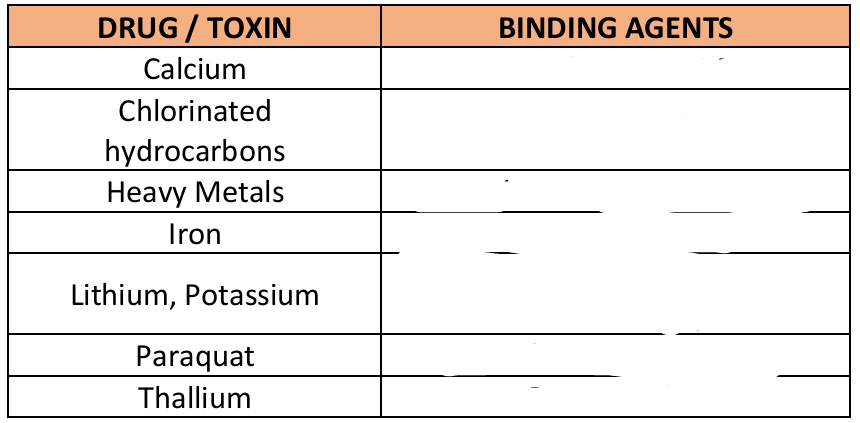
Choices:
Na polystyrene sulfonate (Kayexalate®)
Cellulose Na PO4
Na bicarbonate
Fuller's Earth, Bentonite
Egg white, milk (demulcents)
Prussian Blue
Cholestyramine
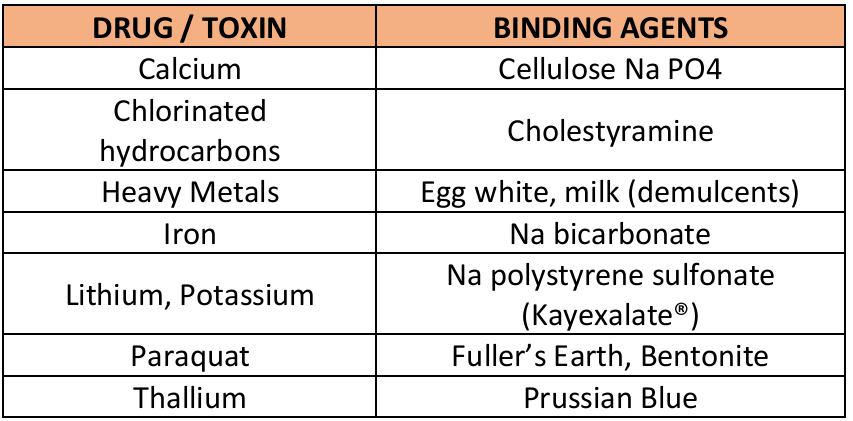
[SECONDARY SURVEY]
The first step in managing inhalation poisoning is to:
a. Give activated charcoal immediately
b. Remove the patient from the hazardous environment
c. Induce emesis
d. Perform gastric lavage
b. Remove the patient from the hazardous environment
[SECONDARY SURVEY]
A patient with inhalation poisoning should receive:
a. 50% dry oxygen
b. 100% humidified oxygen
c. Room air only
d. Nitrogen supplementation
b. 100% humidified oxygen
[SECONDARY SURVEY]
Which intervention may be necessary if breathing is inadequate in inhalation poisoning?
a. Cathartics
b. Assisted ventilation
c. Whole bowel irrigation
d. GI dialysis
b. Assisted ventilation
[SECONDARY SURVEY]
A patient exposed to toxic inhalants with bronchospasm may benefit from:
a. Bronchodilators
b. Activated charcoal
c. Sodium bicarbonate
d. Cathartics
a. Bronchodilators
[SECONDARY SURVEY]
The first step in managing dermal exposure is to:
a. Induce vomiting
b. Remove exposed clothing
c. Give activated charcoal
d. Perform intubation
b. Remove exposed clothing
[SECONDARY SURVEY]
After removing contaminated clothing, the affected area should be:
a. Covered immediately without washing
b. Rinsed with copious water and soap
c. Treated with alcohol
d. Rinsed with clean water
b. Rinsed with copious water and soap
[SECONDARY SURVEY]
Which topical agent is used for skin exposure to hydrofluoric acid?
a. Mineral oil
b. 1% copper sulfate
c. Calcium soaks
d. Isopropyl alcohol
c. Calcium soaks
[SECONDARY SURVEY]
Exposure to oxalic acid on the skin is managed with:
a. Calcium soaks
b. Mineral oil
c. Isopropyl alcohol
d. Activated charcoal
b. Mineral oil
[SECONDARY SURVEY]
Which topical agent is recommended for phenol skin exposure?
a. Soap and water only
b. Isopropyl alcohol
c. 1% copper sulfate
d. PEG with electrolytes
b. Isopropyl alcohol
[SECONDARY SURVEY]
Skin exposure to white phosphorus is treated with:
a. Mineral oil
b. Sodium bicarbonate
c. Calcium soaks
d. 1% copper sulfate
d. 1% copper sulfate
[SECONDARY SURVEY]
The primary management for ocular exposure is:
a. Induce vomiting
b. Apply bronchodilators
c. Give activated charcoal
d. Irrigate the eye with saline solution
d. Irrigate the eye with saline solution
[SECONDARY SURVEY]
The recommended duration of eye irrigation after ocular exposure is:
a. 1–5 minutes
b. 5–10 minutes
c. 15–20 minutes
d. 1 hour
c. 15–20 minutes
[SECONDARY SURVEY]
EXTRACORPOREAL METHODS
Hemodialysis
Hemoperfusion
Peritoneal Dialysis
[SECONDARY SURVEY]
Passing of blood through a semi permeable membrane with counter current dialysate flow, allowing passage of solute
a. Hemodialysis
b. Hemoperfusion
c. Peritoneal Dialysis
a. Hemodialysis
[SECONDARY SURVEY]
Defined as blood passing through an adsorbent such as charcoal
a. Hemodialysis
b. Hemoperfusion
c. Peritoneal Dialysis
b. Hemoperfusion
[SECONDARY SURVEY]
Least invasive because it does not require anticoagulation
a. Hemodialysis
b. Hemoperfusion
c. Peritoneal Dialysis
c. Peritoneal Dialysis
[SECONDARY SURVEY]
10-15% as effective as hemodialysis
a. Hemodialysis
b. Hemoperfusion
c. Peritoneal Dialysis
c. Peritoneal Dialysis
[SECONDARY SURVEY]
Which characteristic makes a toxin more likely to be dialyzable?
a. Lipid soluble
b. Highly protein bound
c. Water soluble
d. High molecular weight
c. Water soluble
[SECONDARY SURVEY]
Which characteristic makes a toxin more likely to be dialyzable?
a. Lipid soluble
b. Highly protein bound
c. High Vd - >1L/kg
d. Low Vd - <1L/kg
d. Low Vd - <1L/kg
[SECONDARY SURVEY]
Which characteristic makes a toxin more likely to be dialyzable?
a. Lipid soluble
b. Highly protein bound
c. High Vd - >1L/kg
d. Protein binding – <50%
d. Protein binding – <50%
[SECONDARY SURVEY]
Which characteristic makes a toxin more likely to be dialyzable?
a. Low MW – <500 Daltons
b. Highly protein bound
c. High Vd - >1L/kg
d. High MW – >500 Daltons
a. Low MW – <500 Daltons
[SECONDARY SURVEY]
EXTRACORPOREAL METHOD that requires Supportive Measure (AEIOU)
a. Hemodialysis
b. Hemoperfusion
c. Peritoneal Dialysis
a. Hemodialysis
Supportive Measure (AEIOU)
Acid-base disturbances that are unresponsive (Severe)
Electrolyte disturbances that are unresponsive (Refractory hyperkalemia)
Intoxication (Salicylates, methanol, ethylene glycol) lithium,
Overhydration / Overload (Volume)
Uremia (Bleeding, altered mental status)