13 Respiratory System

0.0(0)
Studied by 0 people
call kaiCall Kai
learnLearn
examPractice Test
spaced repetitionSpaced Repetition
heart puzzleMatch
flashcardsFlashcards
GameKnowt Play
Card Sorting

1/26

flashcard set

Earn XP

Description and Tags

13.3

Last updated 10:48 PM on 5/16/26
Name
Mastery
Learn
Test
Matching
Spaced
Call with Kai

No analytics yet

Send a link to your students to track their progress

27 Terms

1
New cards

functions

__ of respiratory system

  • provides oxygen

  • eliminates CO2

  • regulates H+ conc. (pH) with kidneys

  • speech

  • defends against inhaled microbes

  • influences arterial concentrations of chemical messengers

  • traps/dissolves blood clots from systemic veins

2
New cards

alveoli

site of gas exchange with blood

3
New cards

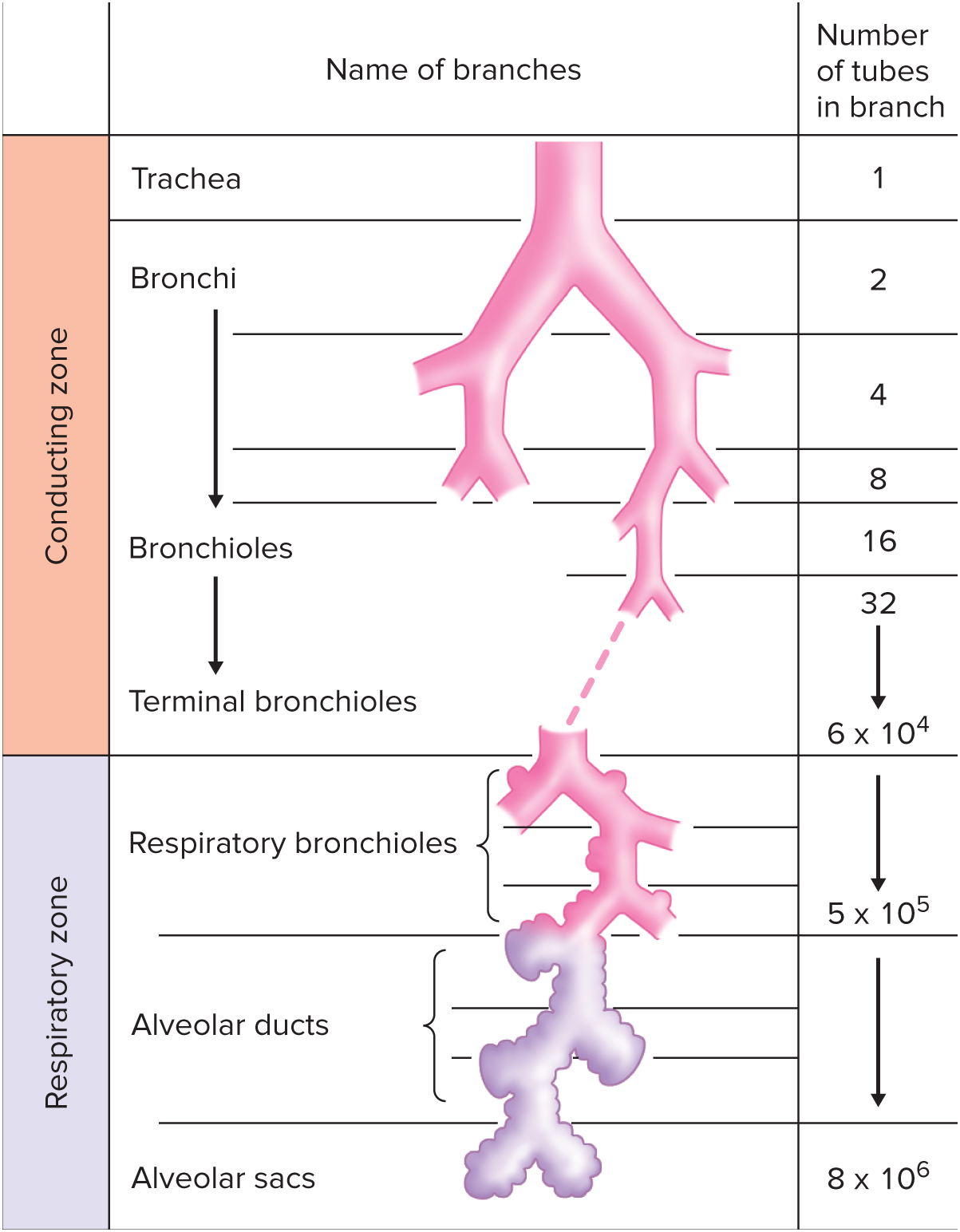
Airways

Tubes where air flows from external environment to the alveoli and back

Structures that make up the __ are:

  • nose

  • nasal cavity

  • pharynx →common to both air + food

    • branches into the esophagus (digestive system) and the larynx

  • larynx →houses the vocal cords

  • trachea →branches into two bronchi

  • bronchi (singular: bronchus)

  • bronchioles →first airway branches that no longer contain cartilage

    • branches into terminal bronchioles → respiratory bronchioles

  • alveoli →first appears in respiratory bronchioles
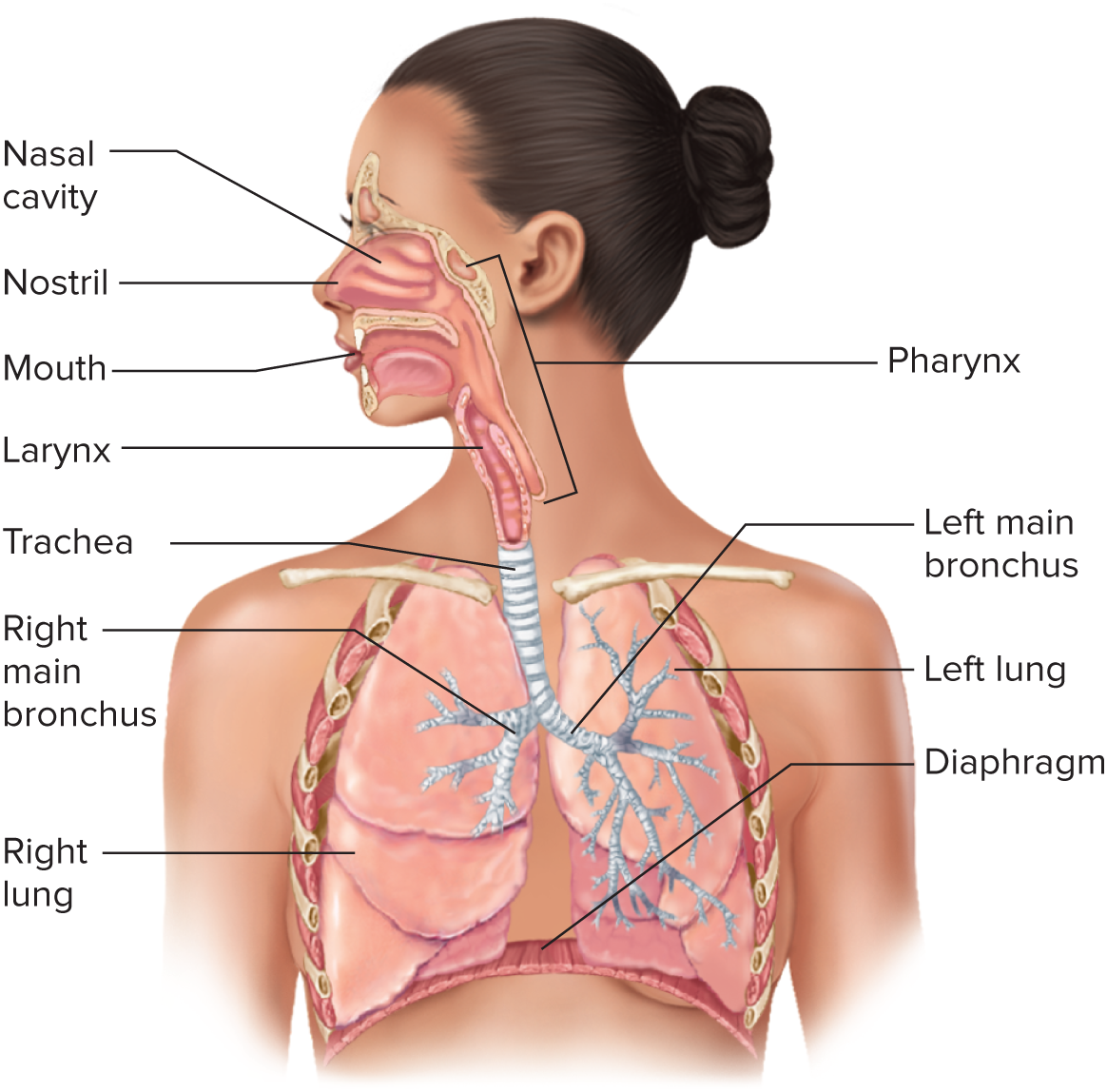
The upper __ include only the mouth, pharynx, larynx

<p><strong>Tubes where air flows from external environment to the alveoli and back</strong></p><p>Structures that make up the __ are:</p><ul><li><p class="has-focus"><mark data-color="purple" style="background-color: purple; color: inherit;">nose</mark></p></li><li><p class="has-focus"><mark data-color="purple" style="background-color: purple; color: inherit;">nasal cavity</mark></p></li><li><p class="has-focus"><mark data-color="purple" style="background-color: purple; color: inherit;">pharynx</mark> →common to both air + food</p><ul><li><p class="has-focus"><span style="color: rgb(145, 143, 143);">branches into the esophagus (digestive system) and the larynx</span></p></li></ul></li><li><p class="has-focus"><mark data-color="purple" style="background-color: purple; color: inherit;">larynx</mark> →houses the vocal cords</p></li><li><p class="has-focus"><mark data-color="purple" style="background-color: purple; color: inherit;">trachea</mark> →branches into two bronchi</p></li><li><p class="has-focus"><mark data-color="purple" style="background-color: purple; color: inherit;">bronchi</mark> (singular: bronchus)</p></li><li><p class="has-focus"><mark data-color="purple" style="background-color: purple; color: inherit;">bronchioles</mark> →first airway branches that no longer contain cartilage</p><ul><li><p class="has-focus"><span style="color: rgb(145, 143, 143);">branches into terminal bronchioles → respiratory bronchioles</span></p></li></ul></li><li><p class="has-focus"><mark data-color="purple" style="background-color: purple; color: inherit;">alveoli</mark> →first appears in respiratory bronchioles</p></li></ul><img src="https://assets.knowt.com/user-attachments/c761277c-39ae-44db-9c31-64af59b5c9c3.png" data-width="50%" data-align="center" alt="The upper __ include only the mouth, pharynx, larynx"><p></p>
4
New cards

Conducting zone

Airways beyond the larynx can be subdivided into (1/2) zones


__ extends from top of trachea to end of terminal bronchioles. Contains no alveoli.

The __ provides low-resistance pathway for airflow

resistance regulated by:

  • bronchiolar smooth muscle. constricts to prevent further particulate matters/irritants from entering site of gas exchange

  • physical forces acting upon airways

Defends against microbes, toxic chemicals, and other foreign matter

  • cilia, mucus, macrophages

Warms and moistens air

& Participates in sound production
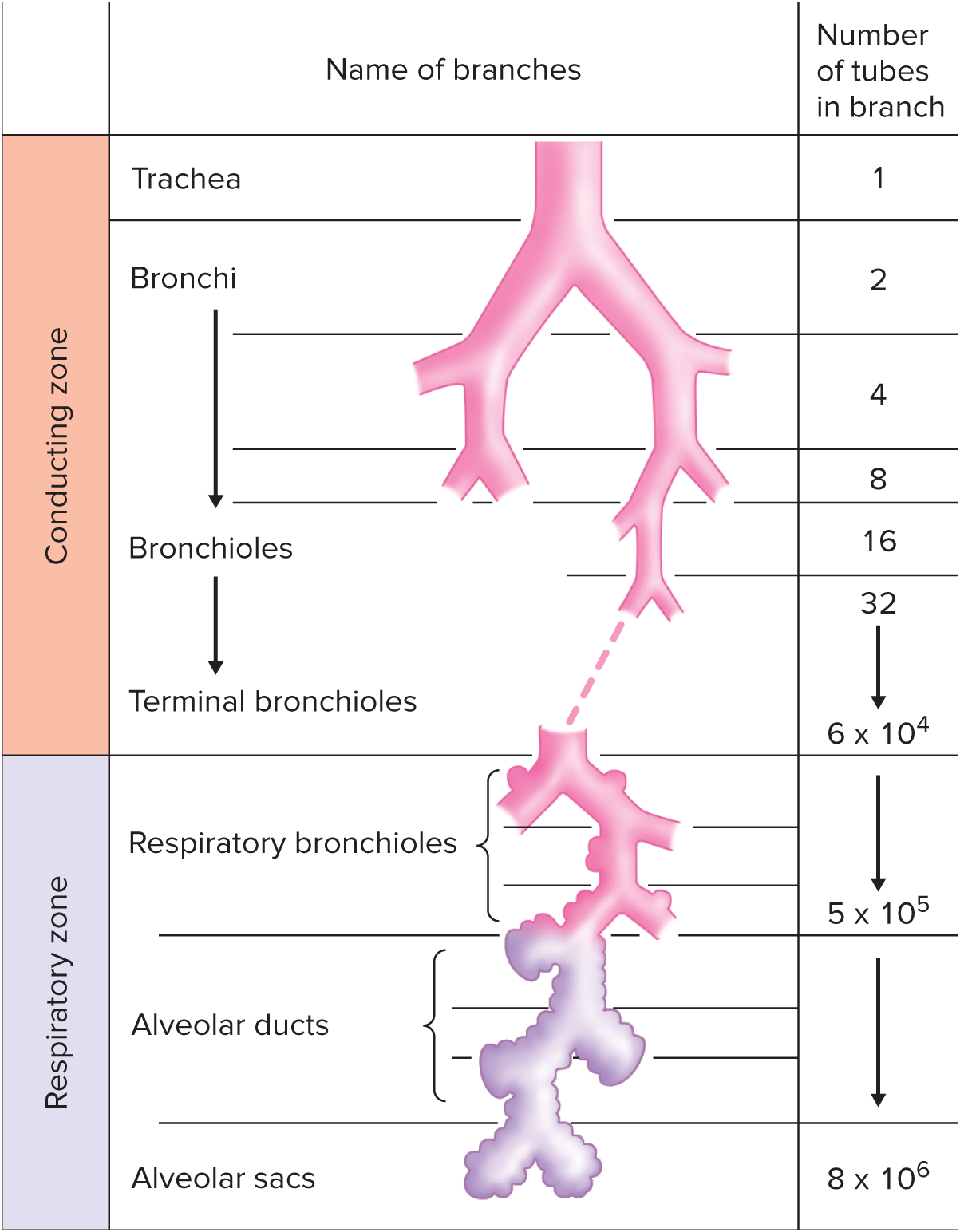
<p><span style="color: purple;">Airways beyond the larynx can be subdivided into (1/2) zones</span></p><p class="has-focus"><br>__ extends <mark data-color="purple" style="background-color: purple; color: inherit;">from top of trachea to end of terminal bronchioles</mark>. <strong>Contains no alveoli.</strong></p><p class="has-focus"></p><p class="has-focus is-empty"><strong><mark data-color="purple" style="background-color: purple; color: inherit;">The __ provides low-resistance pathway for airflow</mark></strong></p><p class="has-focus is-empty"><u>resistance regulated by:</u></p><ul><li><p><span style="color: purple;">bronchiolar smooth muscle</span>.<span style="color: rgb(145, 143, 143);"> constricts to prevent further particulate matters/irritants from entering site of gas exchange</span></p></li><li><p><span style="color: purple;">physical forces</span> acting upon airways</p></li></ul><p><strong><mark data-color="purple" style="background-color: purple; color: inherit;">Defends against microbes, toxic chemicals, and other foreign matter</mark></strong></p><ul><li><p>cilia, mucus, macrophages</p></li></ul><p class="has-focus"><strong><mark data-color="purple" style="background-color: purple; color: inherit;">Warms and moistens air</mark></strong></p><p class="has-focus"><strong><mark data-color="purple" style="background-color: purple; color: inherit;">&amp; Participates in sound production</mark></strong></p>
5
New cards

Respiratory zone

Airways beyond the larynx can be subdivided into (1/2) zones

__ extends from respiratory bronchioles and down.

Where alveoli exchange gases with the blood.
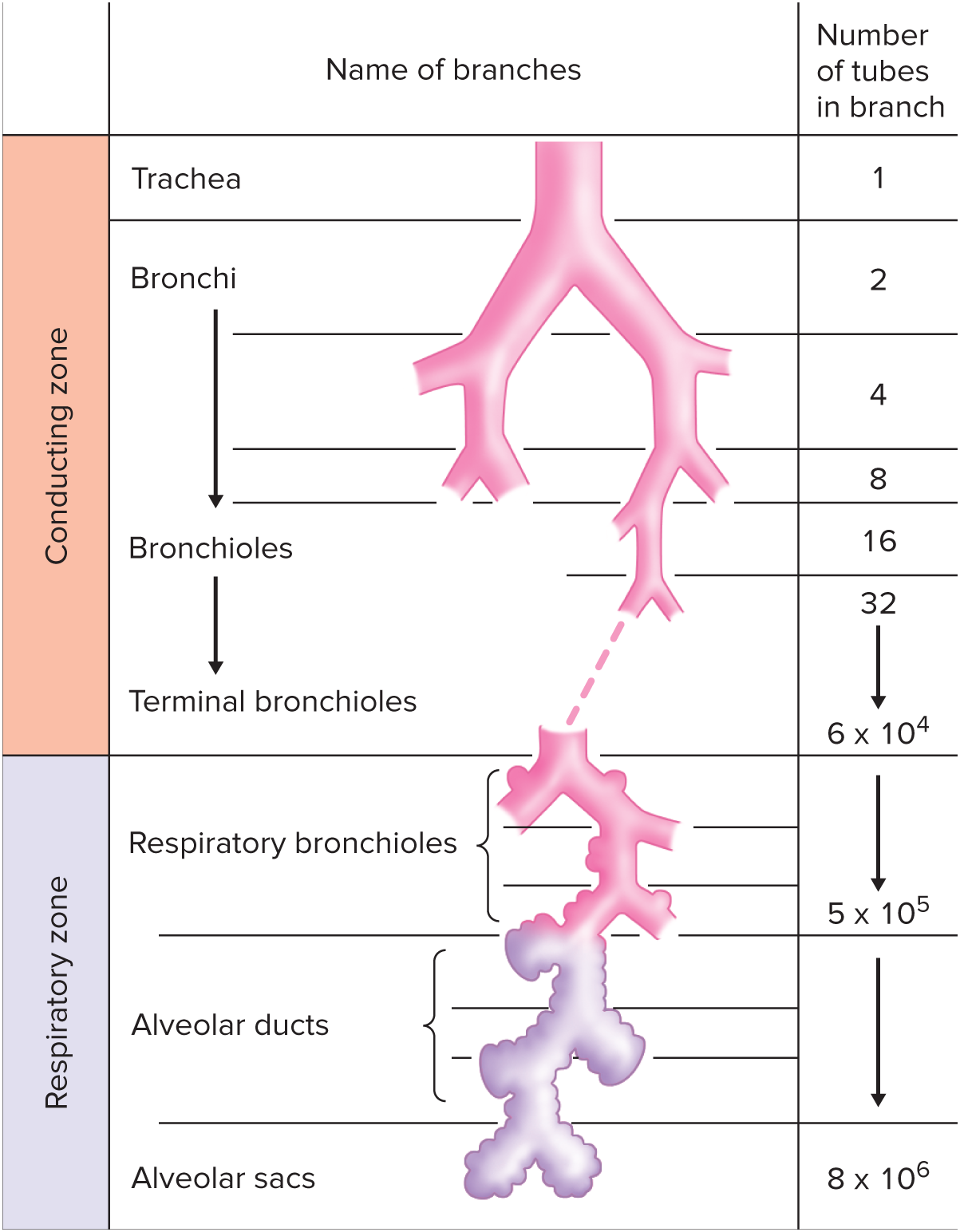
<p><span style="color: purple;">Airways beyond the larynx can be subdivided into (1/2) zones</span></p><p class="has-focus"></p><p class="has-focus is-empty">__ extends<mark data-color="purple" style="background-color: purple; color: inherit;"> from respiratory bronchioles and down</mark>. </p><p class="has-focus is-empty"><strong><mark data-color="purple" style="background-color: purple; color: inherit;">Where alveoli exchange gases with the blood.</mark></strong></p><p></p>
6
New cards

Ciliary Mucuous escalator

Refers to the cilia (present from the airways to the end of the respiratory bronchioles) that constantly beat upward towards the pharynx

  • mucous secreting glands + epithelial cells are present in oral and nasal cavities

    • particulate matter gets stuck in mucus; gets moved towards the pharynx by a “__” = Keeps lungs clear of matter and bacteria

  • macrophages → phagocytize inhaled pathogens

A/N: Cilia is killed by noxious agents like tobacco smoke → smokers often cough up mucus

7
New cards

Alveoli

Tiny, hollow sacs whose open ends are continuous with the airways

  • Type 1 alveolar cells: thick, flat epithelium. Lines the air-facing surface of alveolar wall

  • Type 2 alveolar cells: specialized cells (produces a detergent-like surfactant: important for preventing collapse of alveoli) interspersed between the epithelial cells.

The following leads to a rapid oxygen-CO2 exchange by diffusion in the __:

Large SA of __ and capillary contact

as large as a tennis court

Thin interstitial space

sometimes absent altogether between capillary and __

Additionally, pores permit flow between adjacent __
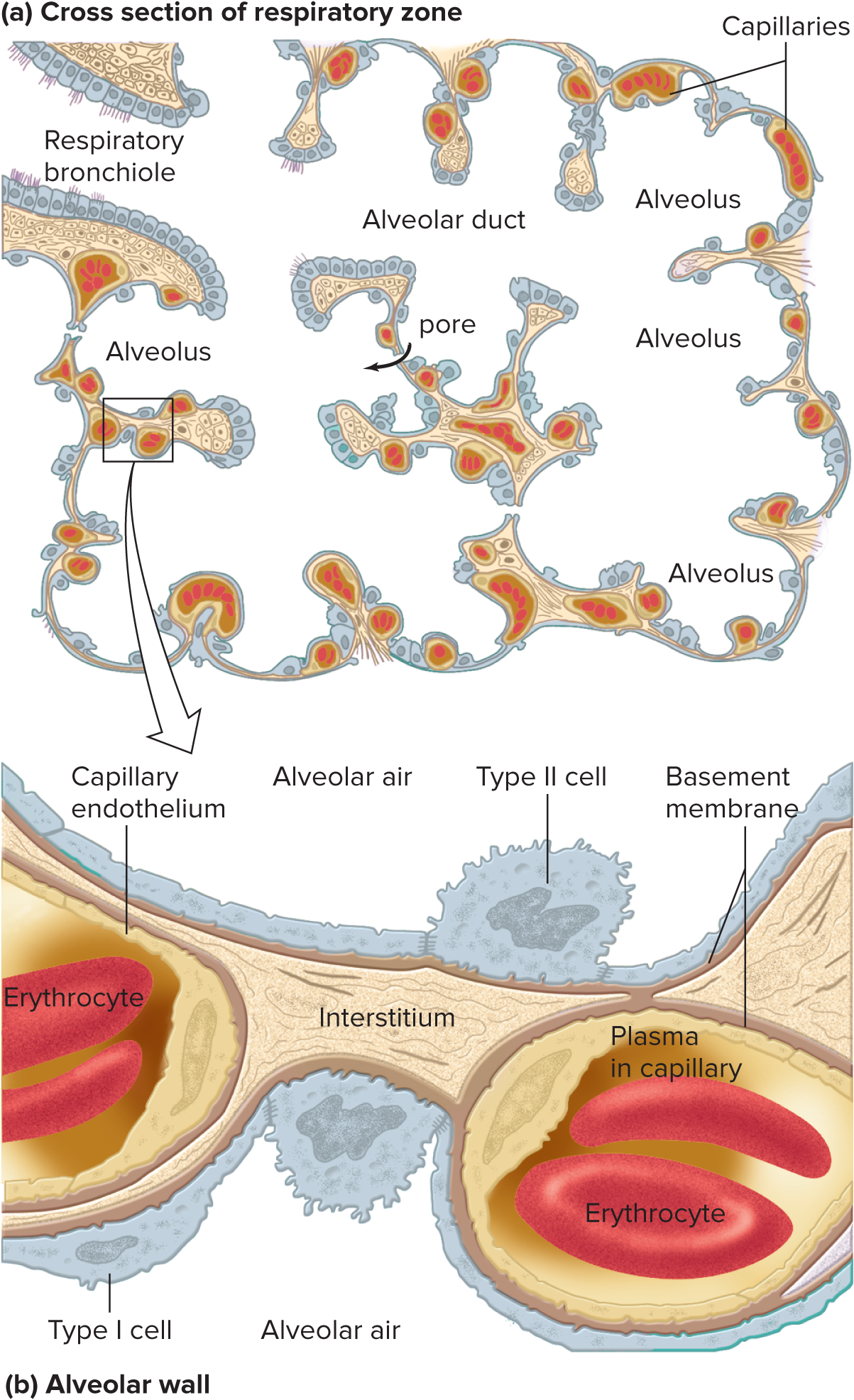
<p><mark data-color="purple" style="background-color: purple; color: inherit;">Tiny, hollow sacs whose open ends are continuous with the airways</mark></p><ul><li><p class="has-focus is-empty"><strong><mark data-color="yellow" style="background-color: yellow; color: inherit;">Type 1 alveolar cells</mark></strong>: thick, flat <u>epithelium</u>. <em>Lines </em>the air-facing surface of alveolar wall</p></li><li><p class="has-focus is-empty"><strong><mark data-color="yellow" style="background-color: yellow; color: inherit;">Type 2 alveolar cells</mark></strong>: <u>specialized cells</u> (produces a detergent-like <span style="color: purple;"><strong><em>surfactant</em></strong></span><em>:</em> important for preventing collapse of alveoli) interspersed <em>between</em> the epithelial cells. </p></li></ul><p class="has-focus is-empty"></p><p class="has-focus is-empty">The following leads to a rapid oxygen-CO2 exchange by diffusion in the __:</p><p class="has-focus is-empty"><strong><mark data-color="purple" style="background-color: purple; color: inherit;">Large SA of __ and capillary contact</mark></strong></p><p class="has-focus is-empty"><span style="color: rgb(145, 143, 143);">as large as a tennis court</span></p><p class="has-focus is-empty"><strong><mark data-color="purple" style="background-color: purple; color: inherit;">Thin interstitial space</mark></strong></p><p class="has-focus is-empty"><span style="color: rgb(145, 143, 143);">sometimes absent altogether between capillary and __</span></p><p class="has-focus is-empty"></p><p class="has-focus is-empty">Additionally<strong>, <mark data-color="purple" style="background-color: purple; color: inherit;">pores permit flow between adjacent __ </mark></strong></p><p></p>
8
New cards

pleura

Each individual lung is surrounded by a completely closed sac known as the pleural sac; it is made up of sheet cells known as __

  • Visceral [__]: portion coating the surface of lung

  • Parietal [__]: portion enclosing the (thoracic) cavity around lung

  • has thin layer of intrapleural fluid in between → surrounds lungs and lubricates pleural surfaces to slide over each other during breathing

9
New cards

Respiratory cycle

constituted by a single

  • inspiration: inhalation, movement of air from external environment to alveoli during breathing

  • expiration: exhalation, movement of air from alveoli towards external environment

During the entirety of a __:

  • 4L of air enters and leaves alveoli per minute

    • inc. 20 fold during heavy exercise

  • 5L of blood (cardiac output) flows through pulmonary capillaries

    • inc. 5-6 fold

10
New cards

Respiration

__ has 4 steps:

1⃣ Pulmonary ventilation: exchange of air between atmosphere and alveoli by bulk flow

2⃣ Exchange of O2 and CO2 between alveoli and capillaries by diffusion packaging of oxygen in pulmonary circulation

3⃣ Transport of O2 and CO2 thru pulmonary & systemic circulation by bulk flow

4⃣ Exchange of O2 and CO2 between capillaries and tissue cells by diffusiondrop off of oxygen in systemic circulation

11
New cards

760

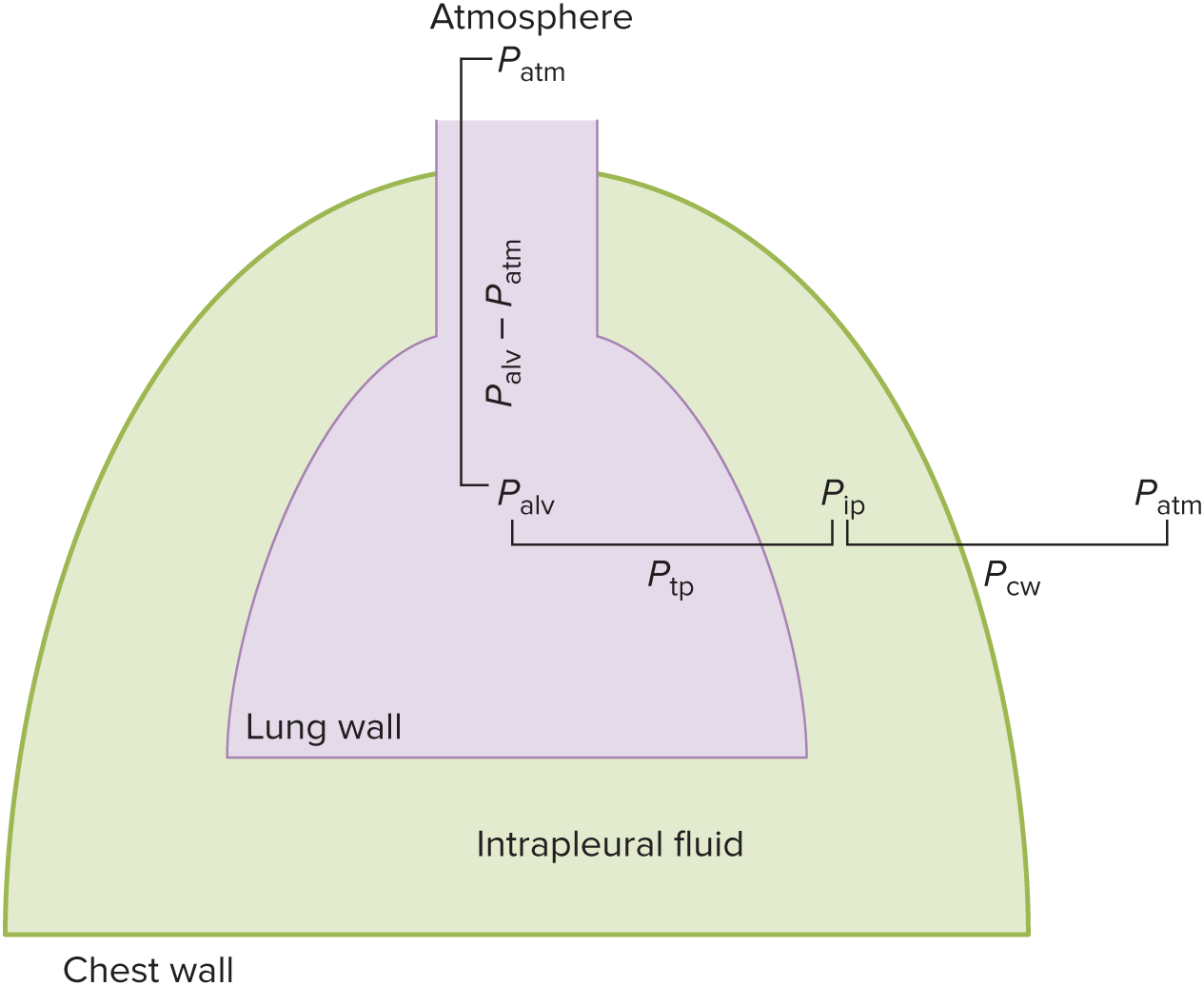
All pressures in respiratory system are given relative to atmospheric pressure, which is __ mmHg at sea level

eg. when Palv= 0 mmHg, Palv = Patm

Patm = atmospheric pressure

  • pressure surrounding body.

  • decreases as altitude increases

Pip= intrapleural pressure

  • pressure outside lungs / intrapleural fluid surrounding lungs

Palv= alveolar pressure

  • pressure inside lungs / alveoli

<p><strong><mark data-color="yellow" style="background-color: yellow; color: inherit;">All</mark></strong><mark data-color="yellow" style="background-color: yellow; color: inherit;"> </mark><strong><mark data-color="yellow" style="background-color: yellow; color: inherit;">pressures in respiratory system are given relative to atmospheric pressure, </mark></strong><mark data-color="yellow" style="background-color: yellow; color: inherit;">which is __ mmHg </mark>at sea level</p><p></p><p><u><mark data-color="yellow" style="background-color: yellow; color: inherit;">eg.</mark></u><mark data-color="yellow" style="background-color: yellow; color: inherit;"> when P<sub>alv</sub>= 0 mmHg, P<sub>alv </sub>= P<sub>atm</sub></mark></p><p></p><p><mark data-color="purple" style="background-color: purple; color: inherit;">P<sub>atm</sub> = atmospheric pressure</mark></p><ul><li><p>pressure surrounding body. </p></li><li><p><strong>decreases as altitude increases</strong></p></li></ul><p><mark data-color="purple" style="background-color: purple; color: inherit;">P<sub>ip</sub>= intrapleural pressure</mark></p><ul><li><p>pressure <span style="color: purple;"><u>outside </u>lungs </span>/ intrapleural fluid surrounding lungs</p></li></ul><p><mark data-color="purple" style="background-color: purple; color: inherit;">P<sub>alv</sub>= alveolar pressure</mark></p><ul><li><p>pressure <span style="color: purple;"><u>inside </u>lungs</span> / alveoli</p></li></ul><p></p>
12
New cards

flow

__ is directly proportional to pressure difference and inversely proportional to airway resistance

F = ( Palv - P atm) / R

A/N: equations comparing pressures follow pattern of Pinner- Pouter

  • negative value (Palv< Patm) inward flow (into) → inspiration

for transmural: inward pressure direction across lung/thorax (not into) = depression

  • positive value (Palv > Patm) → outward flow (out of) → expiration

for transmural: outward pressure direction across lung/thorax = expansion
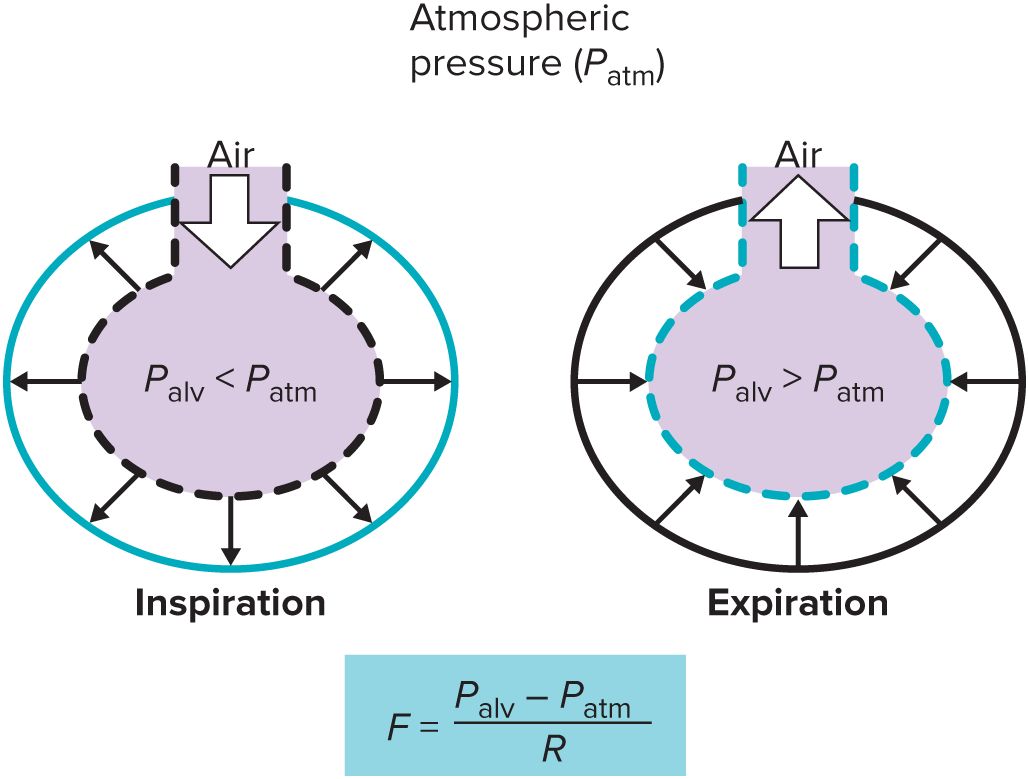
<p>__ is directly proportional to pressure difference and inversely proportional to airway resistance</p><p></p><p><mark data-color="yellow" style="background-color: yellow; color: inherit;">F = ( P<sub>alv</sub> - P<sub> atm</sub>) / R</mark></p><p><span style="color: rgb(145, 143, 143);">A/N: equations comparing pressures follow pattern of P<sub>inner</sub>- P<sub>outer</sub></span></p><ul><li><p>negative value (P<sub>alv</sub>&lt; P<sub>atm</sub>)<sub> </sub>→ <em>inward</em> flow (into) → <strong>inspiration</strong></p></li></ul><p><span style="color: rgb(145, 143, 143);">for transmural: inward pressure direction <em><u>across </u></em>lung/thorax (<u>not </u><em><u>into</u></em>) = <strong>depression</strong></span></p><ul><li><p>positive value (P<sub>alv</sub> &gt; P<sub>atm</sub>) → <em>outward</em> flow (out of) → <strong><u>ex</u>piration</strong></p></li></ul><p><span style="color: rgb(145, 143, 143);">for transmural: outward pressure direction <em>across</em> lung/thorax = <strong><u>ex</u>pansion</strong></span></p>
13
New cards

Transmural

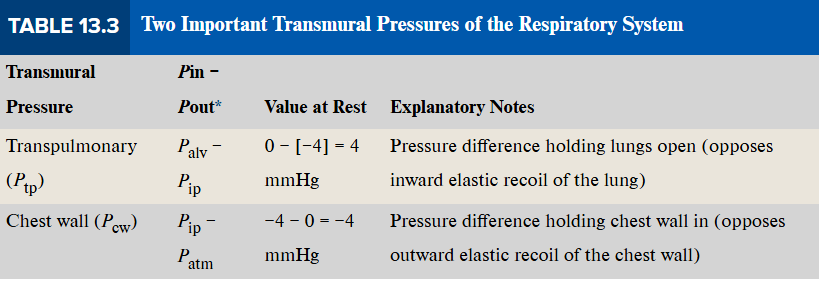
Differences in pressures “across a wall” refer to “__” pressures.

Ptp: transpulmonary pressure = Palv - Pip

  • __ pressure acting upon lung, opposing intrinsic collapsing of lung

  • positive at rest → expansion of lungs. Normal (Ptp= -4 mmHg)

  • negative → depression of lungs

Pcw: chest wall pressure = Pip - Patm

  • __ pressure acting upon chest wall. opposing intrinsic expansion of thorax

  • positive → expansion of thorax.

  • negative at rest → depression of thorax. Normal (Pcw = 4 mmHg)
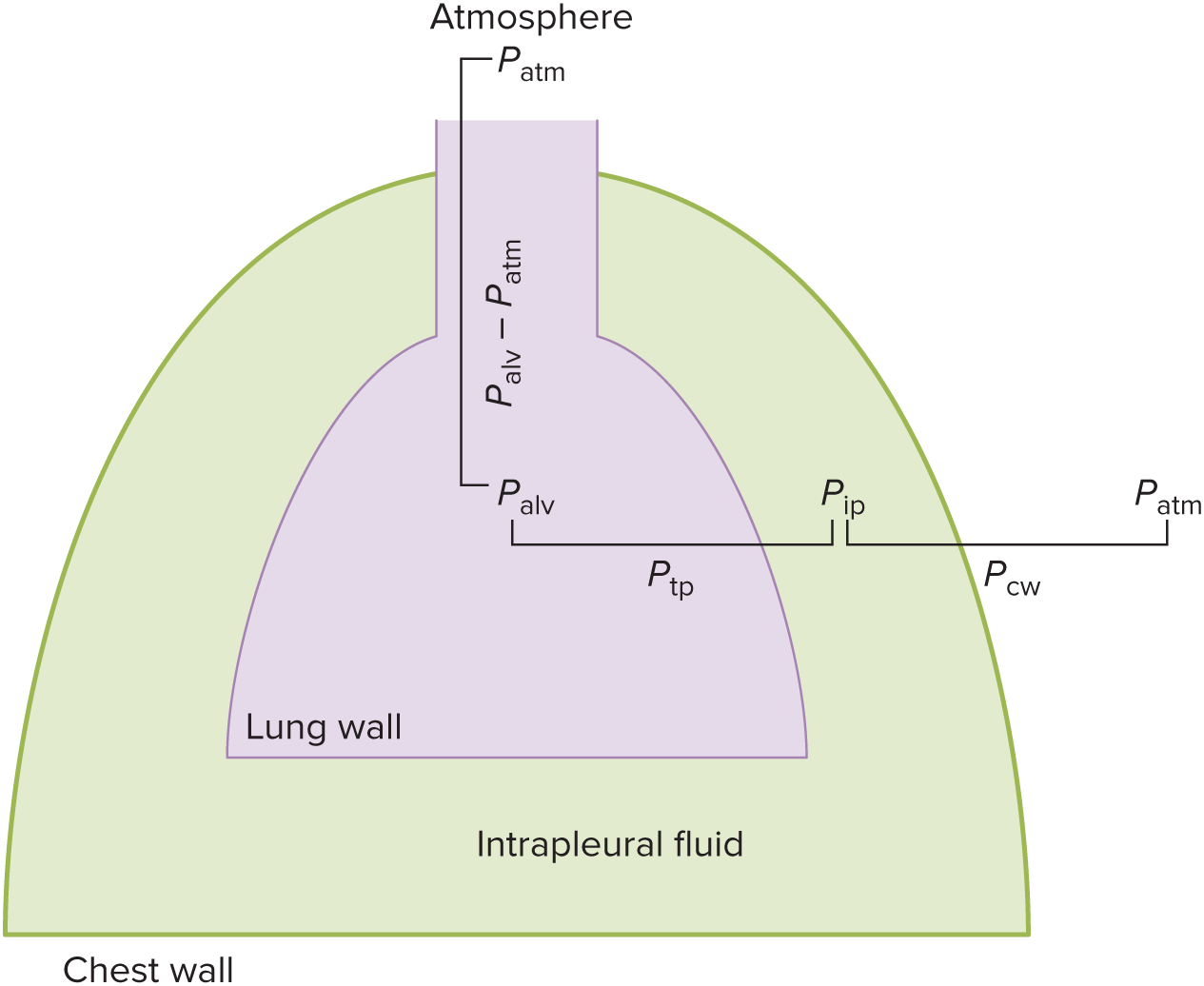
<p>Differences in pressures “<u>across</u> a wall” refer to “__” pressures.</p><p><mark data-color="purple" style="background-color: purple; color: inherit;">P<sub>tp</sub>: </mark><strong><mark data-color="purple" style="background-color: purple; color: inherit;">transpulmonary pressure</mark></strong><mark data-color="purple" style="background-color: purple; color: inherit;"> = P<sub>alv </sub>- P<sub>ip</sub></mark></p><ul><li><p>__ pressure <strong>acting upon lung</strong>, opposing intrinsic <em>collapsing </em>of lung</p></li><li><p><span style="color: green;">positive at rest → expansion of lungs. Normal (P<sub>tp</sub>= -4 mmHg)</span></p></li></ul><ul><li><p><span style="color: red;">negative → depression of lungs</span></p></li></ul><p></p><p><mark data-color="purple" style="background-color: purple; color: inherit;">P<sub>cw</sub>: </mark><strong><mark data-color="purple" style="background-color: purple; color: inherit;">chest wall pressure</mark></strong><mark data-color="purple" style="background-color: purple; color: inherit;"> = P<sub>ip</sub> - P<sub>atm</sub></mark></p><ul><li><p>__ pressure <span style="color: purple;"><strong>acting upon chest wall</strong></span>. opposing intrinsic <em>expansion</em> of thorax</p></li></ul><ul><li><p><span style="color: red;">positive → expansion of thorax.</span></p></li><li><p><span style="color: green;">negative at rest → depression of thorax. Normal (P<sub>cw</sub> = 4 mmHg)</span></p></li></ul><img src="https://assets.knowt.com/user-attachments/eadb29d3-5783-4188-a34f-6df67e36cbfd.png" data-width="75%" data-align="center"><p></p>
14
New cards

Intrapleural Pressure

__ (Pip), or hydrostatic pressure of the intrapleural fluid causes lungs and thorax to move in and out together during normal breathing

15
New cards

Pneumotharx

Collapsing of lungs that occurs during surgery or trauma when chest wall is pierced without damaging lung and atmospheric air enters intrapleural space (Pip= -4 mmHg → 0 mmHg)

i.e. Pip = Patm or Pip becomes positive/higher pressure than Palv

Ptp = Palv - Pip = + -(+) = 0 (eliminated)

→ moves across wall towards lower pressure (Palv) → collapsing of lungs
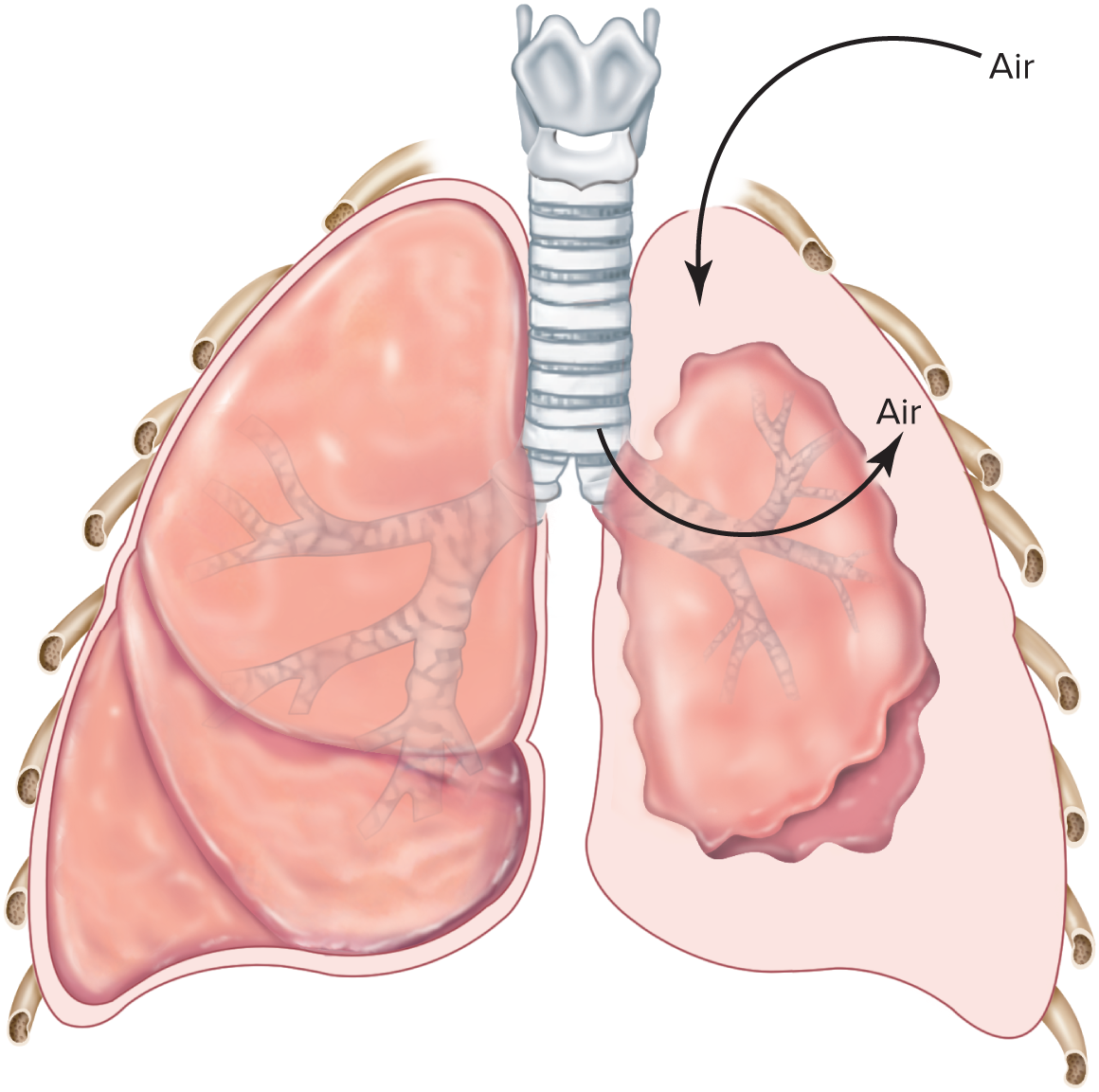
<p><span style="color: red;"><strong>Collapsing of lungs </strong></span>that occurs during surgery or trauma when chest wall is pierced without damaging lung and<span style="color: purple;"> </span><mark data-color="yellow" style="background-color: yellow; color: inherit;">atmospheric air enters intrapleural space</mark> (P<sub>ip</sub>= -4 mmHg → 0 mmHg)</p><p></p><p><u>i.e.</u> <mark data-color="yellow" style="background-color: yellow; color: inherit;">P<sub>ip</sub> = P<sub>atm</sub></mark> <u>or</u><span style="color: purple;"> </span><strong><mark data-color="yellow" style="background-color: yellow; color: inherit;">P<sub>ip</sub> becomes positive</mark>/higher pressure <em>than</em> P<sub>alv</sub></strong></p><p><strong>→ </strong><span style="color: red;"><strong>P<sub>tp</sub></strong></span><strong> = P<sub>alv </sub><mark data-color="yellow" style="background-color: yellow; color: inherit;">- P<sub>ip</sub></mark> = +</strong><span style="color: red;"><strong> </strong></span><strong><mark data-color="yellow" style="background-color: yellow; color: inherit;">-(+)</mark></strong><span style="color: red;"><strong> = 0 </strong></span><span style="color: red;"><strong>(eliminated)</strong></span></p><p>→ moves across wall towards lower pressure (P<sub>alv</sub>) → <span style="color: red;"><em>collapsing of lungs</em></span></p>
16
New cards

elastic recoil

Defined as the tendency of an elastic structure to oppose stretching or distortion.

Why:

  • lungs at rest/stretch tend to collapse.

  • chest wall at rest/compression tends to expand

Tendencies of collapsing/expanding causes enlargement of intrapleural space between lung & chest wall

Maintained Pip= -4 mmHg counteracts their tendency to collapse/expand

17
New cards

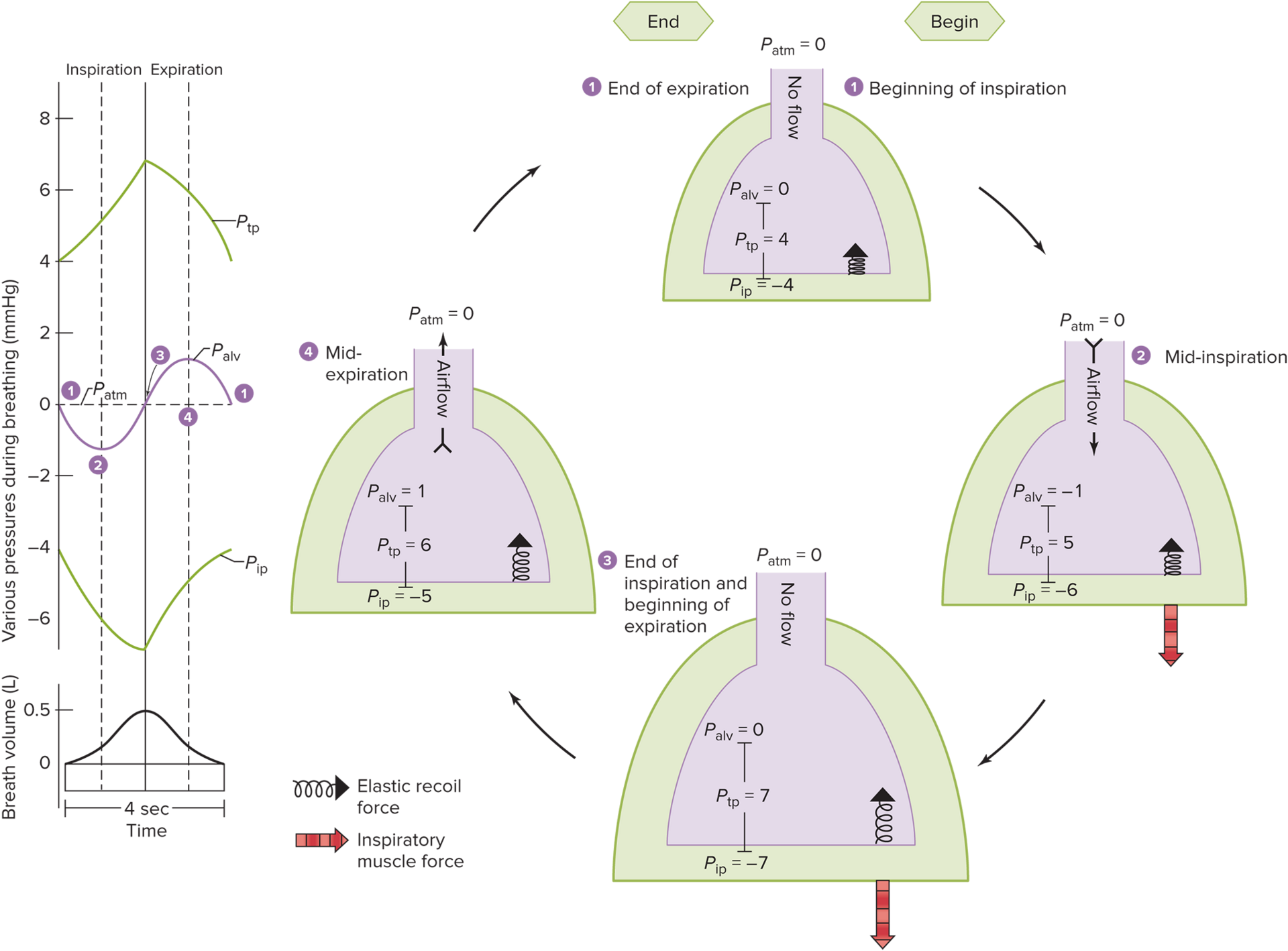
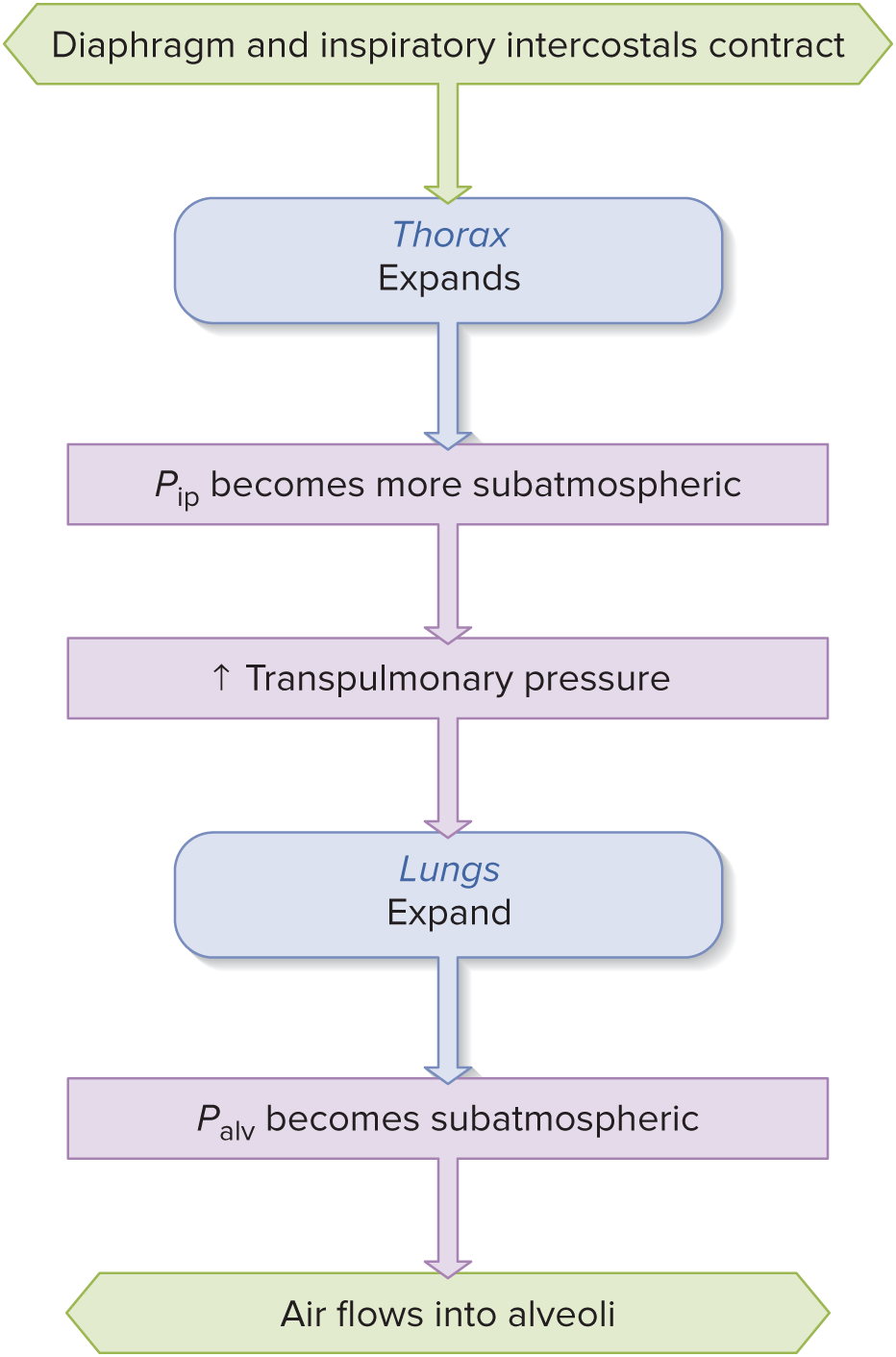
Inspiration

__ is initiated by contraction of diaphragm (phrenic nerve) and external intercostal muscles (motor neurons)

  1. Enlargement of thorax

  2. Pip decreases due to Boyle’s law

  3. Ptp = Palv -( -Pip) = more positive/inc.

  4. Lungs expand

  5. Palv decreases

  6. Air flows into lungs (as Palv < Patm )
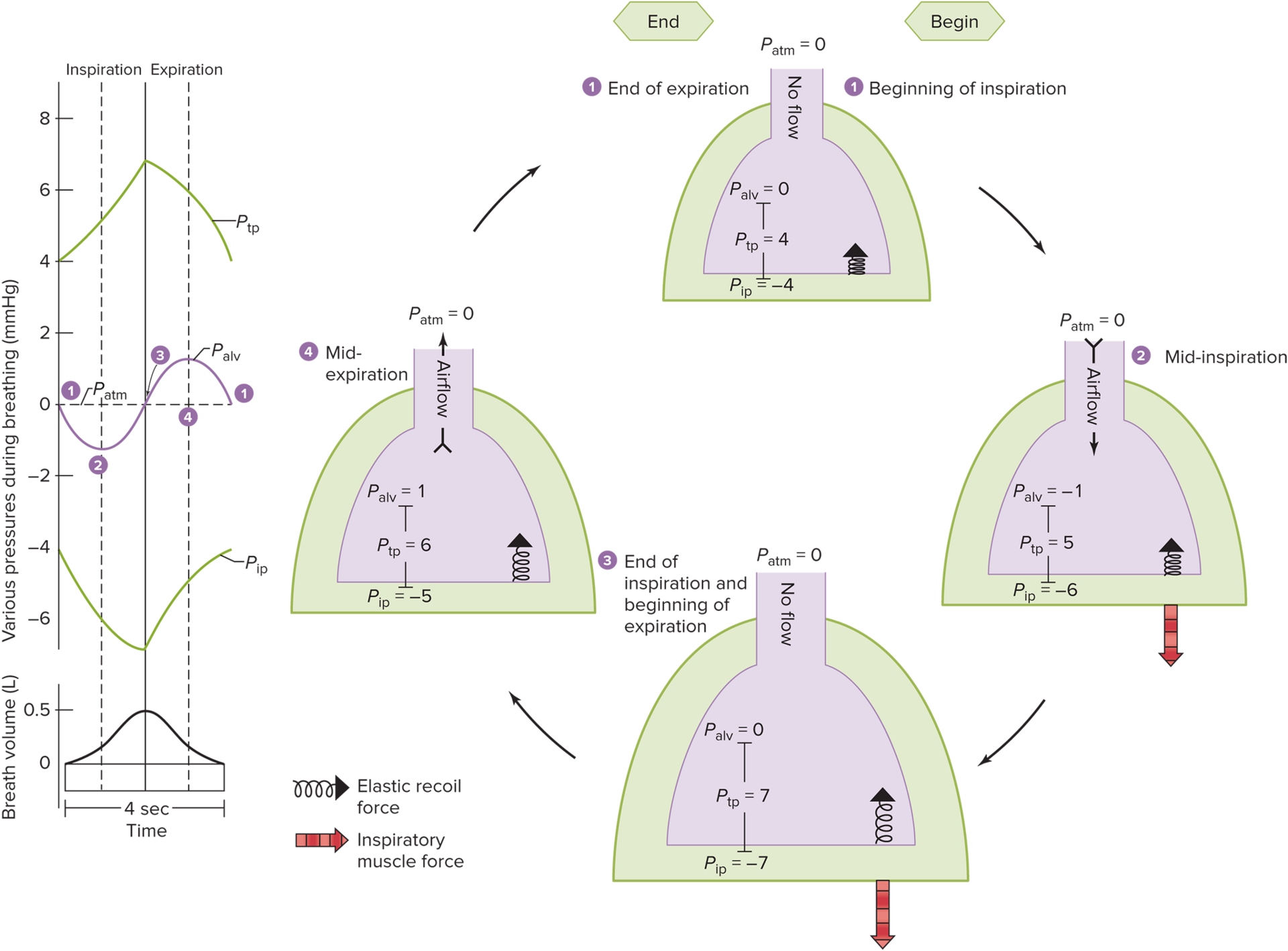
Ceases __ when:

  • Palv = P atm (equilibrium; no more pressure change needed for flow)

  • Ptp= elastic recoil opposing it (can no longer expand lungs)
<p><mark data-color="yellow" style="background-color: yellow; color: inherit;">__ is initiated by </mark><u><mark data-color="yellow" style="background-color: yellow; color: inherit;">contraction</mark></u><mark data-color="yellow" style="background-color: yellow; color: inherit;"> of diaphragm </mark><span style="color: rgb(145, 143, 143);"><mark data-color="yellow" style="background-color: yellow; color: inherit;">(phrenic nerve)</mark></span><mark data-color="yellow" style="background-color: yellow; color: inherit;"> and external intercostal muscles</mark><span style="color: rgb(145, 143, 143);"><mark data-color="yellow" style="background-color: yellow; color: inherit;"> (motor neurons)</mark></span></p><p></p><ol><li><p><u>Enlargement of thorax</u></p></li><li><p><span style="color: red;"><u>P<sub>ip</sub> decreases</u></span> due to Boyle’s law</p></li><li><p><span style="color: green;"><strong>P<sub>tp</sub></strong> </span>= P<sub>alv </sub>-( <span style="color: red;">-P<sub>ip</sub></span>) = <span style="color: green;"><strong>more positive/inc.</strong></span></p></li><li><p><u>Lungs expand</u></p></li><li><p><u>P<sub>alv</sub> decreases</u></p></li><li><p>Air flows into lungs (as P<sub>alv </sub>&lt; P<sub>atm</sub> )</p></li></ol><img src="https://assets.knowt.com/user-attachments/37629c3c-c268-46de-b13a-d40f74ed44cb.png" data-width="100%" data-align="center"><p>Ceases __ when:</p><ul><li><p>P<sub>alv</sub> = P<sub> atm </sub>(equilibrium; no more pressure change needed for flow)</p></li><li><p>P<sub>tp</sub>= elastic recoil opposing it (can no longer expand lungs)</p></li></ul><p></p>
18
New cards

Expiration

__ is initiated by relaxation of diaphragm and external intercostal muscles (decreased firing of motor neurons)

  1. Shrinking of thorax and diaphragm

  2. Pip increases

  3. Ptp = Palv -( + Pip) = more negative/dec.

  4. Lungs shrink as Ptp < elastic recoil of lungs

  5. Palv increases

  6. Air moves out (as Palv > Patm)

19
New cards

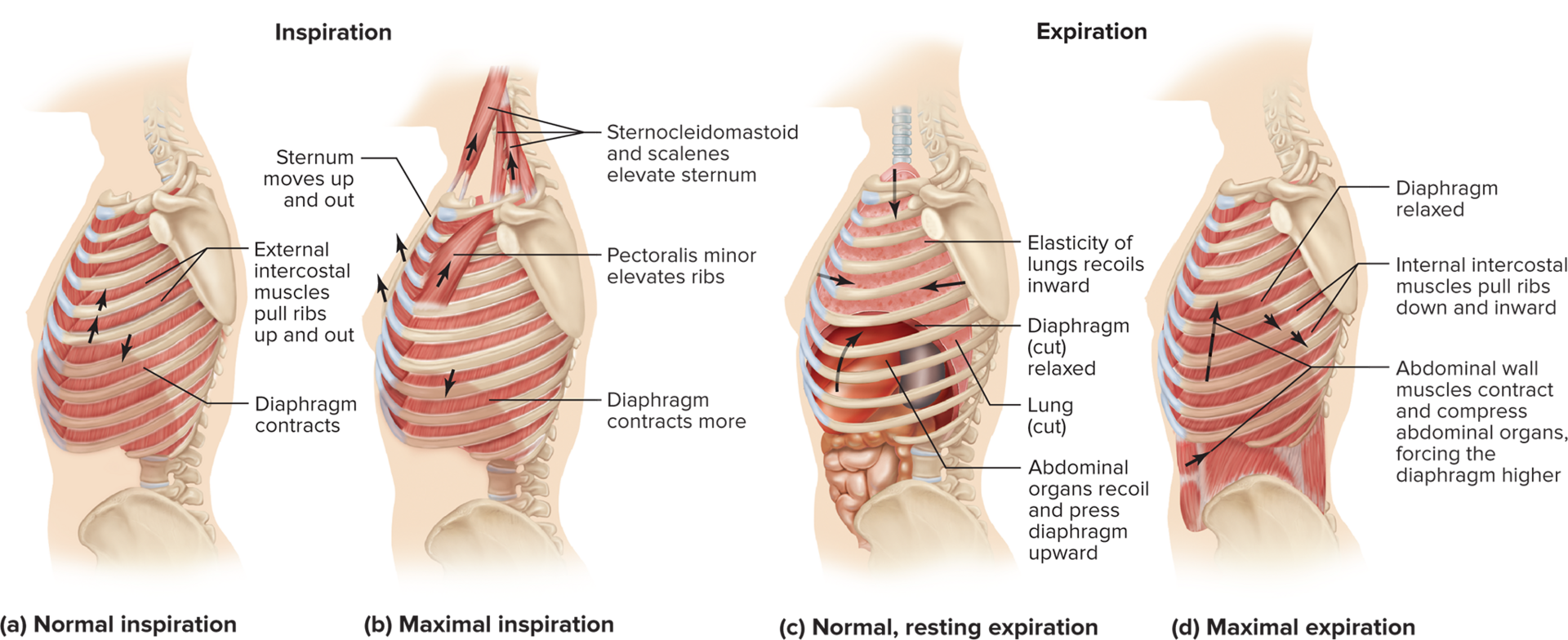
Abdominal

During inspiration:

  • diaphragm contracts down

  • external intercostals (+pectoralis minor) pull ribs upwards and out

  • Sternum is elevated by sternocleidomastoid and scalenes

During exhalation:

  • diaphragm is relaxed and __ organs/wall/muscles press against diaphragm

  • internal intercostals pull ribs downwards and inwards

  • elasticity of lungs causes inward recoil
20
New cards

passive

Lungs are __ elastic structures and their volume depends on:

  1. transpulmonary pressure Ptp: difference in pressure inside and outside lung

  2. Lung compliance: how stretchable lungs are, determining how much they expand for given change in Ptp. proportional to Ptp

21
New cards

Lung Compliance

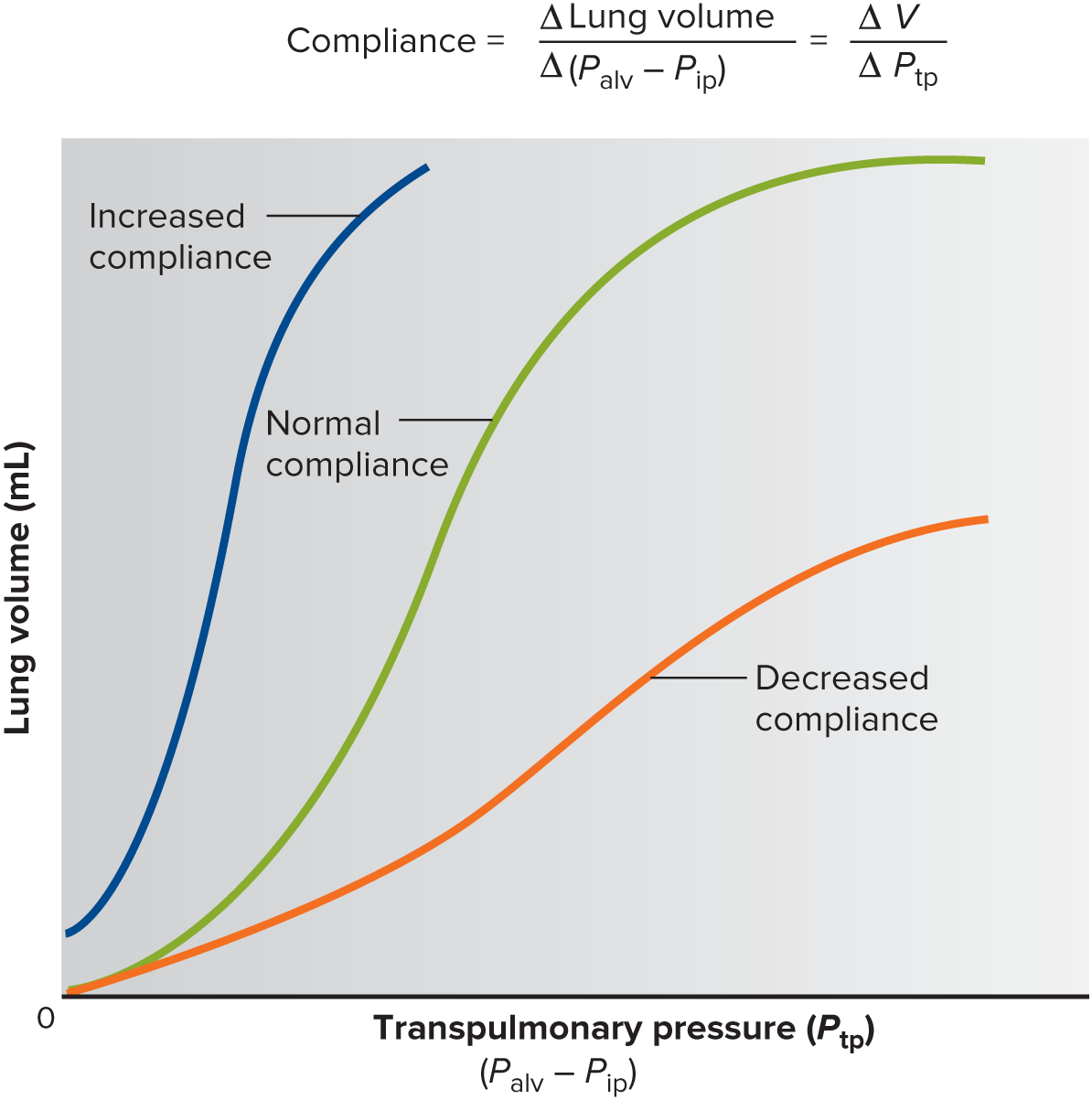
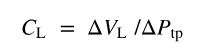
CL and or __: magnitude of change in lung volume produced by given change in transpulmonary pressure.

Impacted by:

(1) stretchability of lung tissue

(2) surface tension of air-water interfaces in alveoli

  • the greater the __, the easier it is to expand the lungs

→ more change in vol. with lesser pressure change (lungs not fully expanded)

  • the lower the __, the harder (stiffer) it is for lung expansion

→ less change in vol. with greater Ptp (lungs already expanded from high Ptp)

  • need more subatmospheric/smaller Pip to make lung move overall

→ i.e,, it needs a smaller intrapleural pressure to cause the movement needed for further expansion (greater Ptp = Palv -(-Pip) = more expansion)

→ does NOT mean that it will make compliance higher (again, increased denominator makes lung less compliant because it is fully expanded!)
<p><strong>C<sub>L</sub></strong><sub> </sub>and or __: <span style="color: purple;"><strong>magnitude of change in lung volume produced by given change in transpulmonary pressure</strong>. </span></p><p><u>Impacted by:</u> </p><p><mark data-color="yellow" style="background-color: yellow; color: inherit;">(1) stretchability of lung tissue</mark> </p><p><mark data-color="yellow" style="background-color: yellow; color: inherit;">(2) surface tension of air-water interfaces</mark> in alveoli</p><p></p><ul><li><p><mark data-color="purple" style="background-color: purple; color: inherit;">the greater the __, the easier it is to expand the lungs</mark></p></li></ul><p><span style="color: rgb(145, 143, 143);">→ more change in vol. with lesser pressure change (lungs not fully expanded)</span></p><ul><li><p><mark data-color="purple" style="background-color: purple; color: inherit;">the lower the __, the harder (stiffer) it is for lung expansion</mark></p></li></ul><p><span style="color: rgb(145, 143, 143);">→ less change in vol. with greater P<sub>tp</sub> </span><span style="color: purple;">(lungs already expanded from high P<sub>tp</sub>)</span></p><ul><li><p><span style="color: purple;"><strong>need more subatmospheric/smaller P<sub>ip</sub> to make lung move overall</strong></span></p></li></ul><p><span style="color: rgb(145, 143, 143);">→ i.e,, <strong>it <em>needs</em> a smaller intrapleural pressure to cause the movement needed for further expansion</strong> (</span><span style="color: purple;">greater P<sub>tp</sub></span><span style="color: rgb(145, 143, 143);"> = P<sub>alv</sub> -(-P<sub>ip</sub>) </span><span style="color: purple;">= more expansion</span><span style="color: rgb(145, 143, 143);">)</span></p><p><span style="color: rgb(145, 143, 143);">→ does NOT mean that it will make compliance higher (again, increased denominator makes lung less compliant <strong><em>because </em></strong>it is fully expanded!)</span></p><img src="https://assets.knowt.com/user-attachments/c960dd1e-9665-4613-b6dd-cae10a41e4fd.png" data-width="75%" data-align="center"><p></p>
22
New cards

surface tension

inner alveolar cells’ moist water molecules attraction to each other.

  • adds on additional force lungs have to overcome in order to stretch.

Surfactant (produced by Alveolar Type 2 Cells): detergent-like substance that lowers the __ → increases lung compliance

  • mixture of lipids and proteins

  • deep breaths stretch type II cells → increased surfactant secretion

  • production occurs in late gestation in the fetal lung. stim. by increase of cortisol (glucocorticoid)

23
New cards

Law of Laplace

This law describes the relationship between:

r = alveolus radius

  • decreased r → increased pressure

P = pressure

T= surface tension

  • affected by presence of surfactant or not. more effective in small alveoli

    • with surfactant: no air flow. surfactant reduced T in smaller alveoli (b) such that Tb < Ta & small alveoli matches larger radius alveoli pressures (a)

    • without surfactant: air flow goes from high pressure (b) to low (a); small alveoli would be unstable and collapse
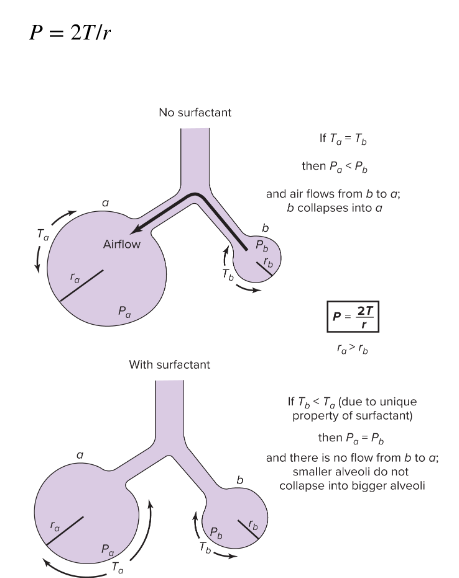
<p><u>This law describes the relationship between:</u></p><p><span style="color: purple;"><mark data-color="yellow" style="background-color: yellow; color: inherit;">r = alveolus radius</mark></span></p><ul><li><p>decreased r → increased pressure</p></li></ul><p></p><p><span style="color: purple;"><mark data-color="yellow" style="background-color: yellow; color: inherit;">P = pressure</mark></span></p><p></p><p><span style="color: purple;"><mark data-color="yellow" style="background-color: yellow; color: inherit;">T= surface tension</mark></span></p><ul><li><p>affected by presence of surfactant or not. <strong>more effective in small alveoli</strong></p><ul><li><p><span style="color: purple;"><u>with surfactant</u>: <strong>no air flow</strong>.</span> <strong><mark data-color="purple" style="background-color: purple; color: inherit;">surfactant reduced T in smaller alveoli</mark></strong> (b) such that T<sub>b</sub> &lt; T<sub>a </sub>&amp;<sub> </sub><strong><mark data-color="purple" style="background-color: purple; color: inherit;">small alveoli matches larger radius alveoli pressures</mark></strong> (a)</p></li><li><p><u>without surfactant</u>: air flow goes from high pressure (b) to low (a); small alveoli would be unstable and collapse</p></li></ul></li></ul><p></p>
24
New cards

Respiratory distress syndrome of the newborn

Surfactant deficient disease when newborn is premature

  • lacks developed Type 2 alveolar cells → can’t breath without strenous efforts

  • Leading cause of death in premature infants

25
New cards

Asthma

Disease characterized by intermittent episodes of contracted smooth airway muscles from inflammation causing hyperresponsiveness → inc. airway resistance

Therapy for __ aims to:

  • reduce inflammation with anti-inflammatory drugs (leukotriene inhibitors + glucocorticoids)

  • reduce excessive muscle contraction with bronchodilator drugs

    • one class mimics epinephrine action on B-2 adrenergic receptor

    • another class blocks muscarinic cholinergic receptors → bronchoconstriction

26
New cards

chronic obstructive pulmonary disease

COPD. refers to either the following, or a combination of the two:

  • emphysema: destruction and collapse of smaller airways

    • when there’s too much compliance, a decrease in Ptp can lead to lungs to collapse

  • chronic bronchitis: excessive mucus production in bronchi; inflammation in airways → blockage by accumulation of mucus in airways; thickening of airways

27
New cards

last left off of 13.3 / L29