Nervous System: Autonomics & Cranial Nerves
 Call Kai
 Learn
Learn Practice Test
 Spaced Repetition
 Match
Match Flashcards
 Knowt Play
1/180

There's no tags or description
Looks like no tags are added yet.
Name | Mastery | Learn | Test | Matching | Spaced | Call with Kai |
|---|
No analytics yet
Send a link to your students to track their progress
181 Terms
somatic is __ while autonomic is __ (voluntary/involuntary)
somatic is voluntary while autonomic is involuntary
sympathetic and parasympathetic pathways are ___ (autonomic or somatic)
autonomic
describe somatic neuron chain (CNS, PNS, Effector)
single neuron chain, myelinated, releases ACh, always stimulates skeletal muscle
describe somatic neuron chains (CNS, PNS, Effector)
can be a two neuron chain (preganglionic, postganglionic) or a neuron chain connected to adrenal medulla that releases hormones into blood; stimulates or inhibits smooth muscle, cardiac muscle, or epithelia
describe sympathetic vs parasympathetic chains
parasympathetic: pre-ganglionic is short and releases acetylcholine, post-ganglionic is long and releases norepinephrine (or if adrenal medulla, releases norepinephrine and epinephrine into blood)
sympathetic: pre-ganglionic is long and releases acetylcholine, post-ganglionic (intramural ganglion) is short and releases acetylcholine
pre-ganglion of sympathetic releases ___, which causes release of ___ in post-ganglion
acetylcholine, norepinephrine
pre-ganglion of sympathetic releases ___, which causes release of ___ by adrenal medulla
acetylcholine, norepinephrine and epinephrine
pre-ganglion of parasympathetic releases ___, which causes release of ___ in post-ganglion (intramural ganglion)
acetylcholine, acetylcholine
___ are innervated by sympathetic neurons that secrete ___, not norepinephrine
eccrine sweat glands, acetylcholine
parasympathetic neurons in cranial nerves III, VII, and IX end in ___ ganglia, not intramural ganglion
terminal
what is the origin of parasympathetic neurons?
craniosacral
__ nerve is most parasympathetic innervation
vagus
what is the origin of sympathetic neurons?
thoracolumbar
what is only innervated by sympathetic neurons?
skin, peripheral blood vessels, adrenal glands, kidneys
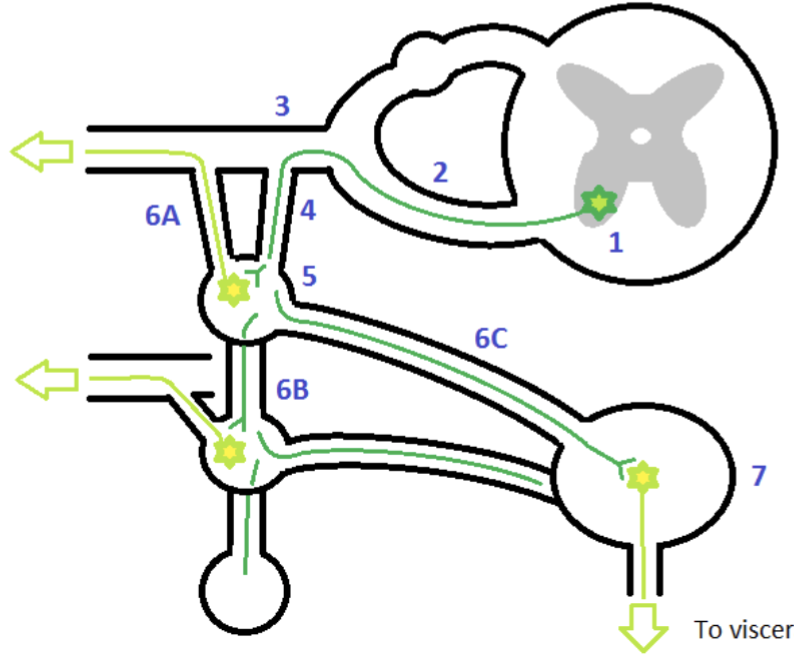
The cell bodies of sympathetic presynaptic neurons originate in the ___ region of the ___
thoracolumbar, spinal cord
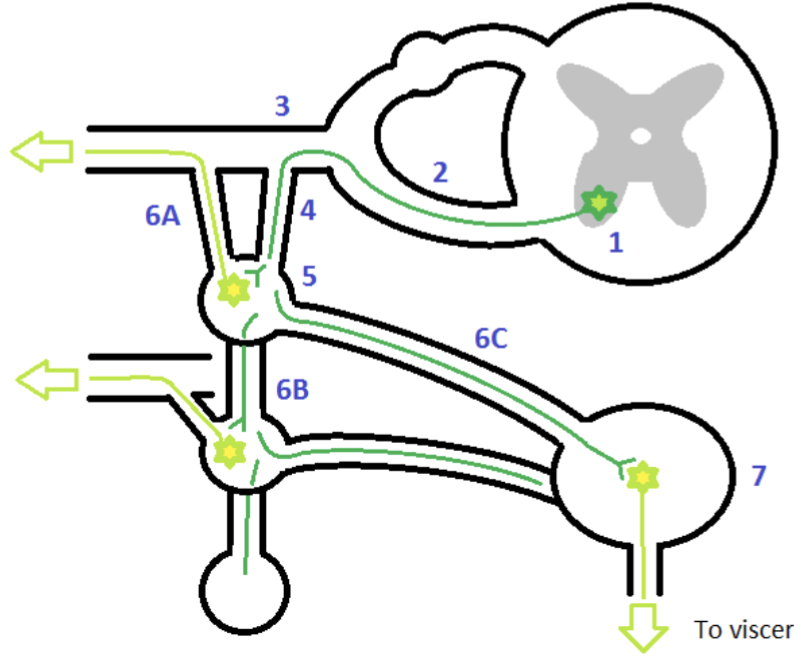
Axons exit the spinal cord via the ___, which merges with the dorsal root to form ___
ventral root, spinal nerve
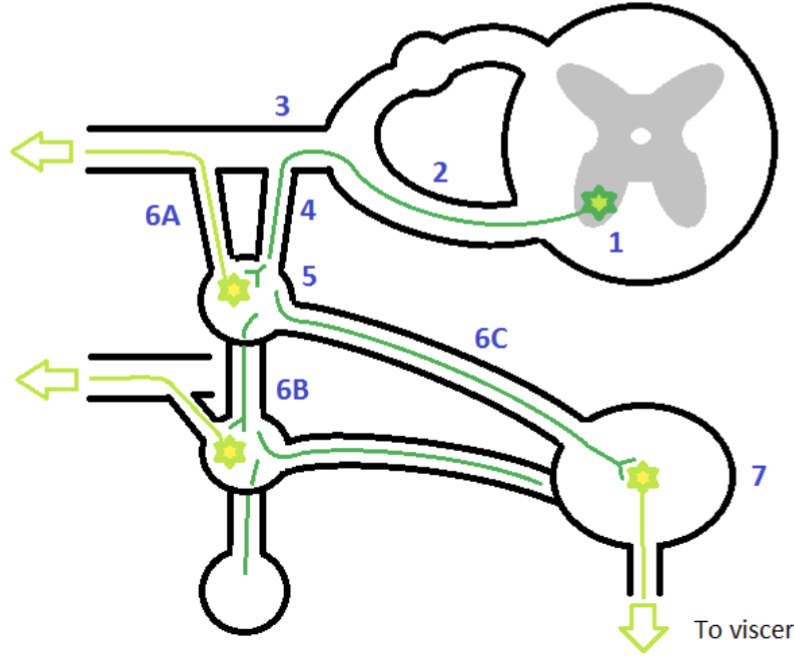
In the thorax, these nerves travel laterally between the ribs, and so are called ___
intercostal nerves
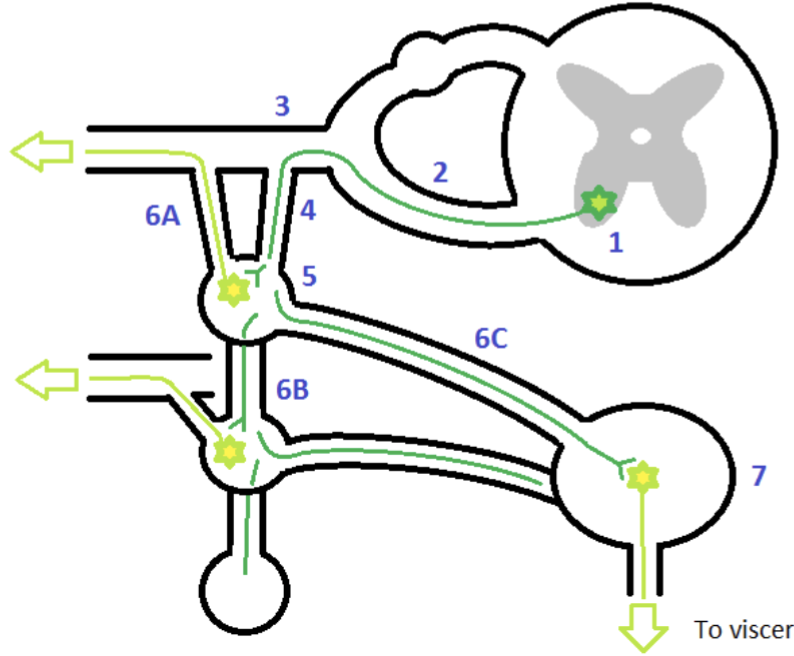
Sympathetic presynaptic neurons exit the spinal nerves via the white __.
rami communicantes
why are presynaptic neurons white?
myelinated
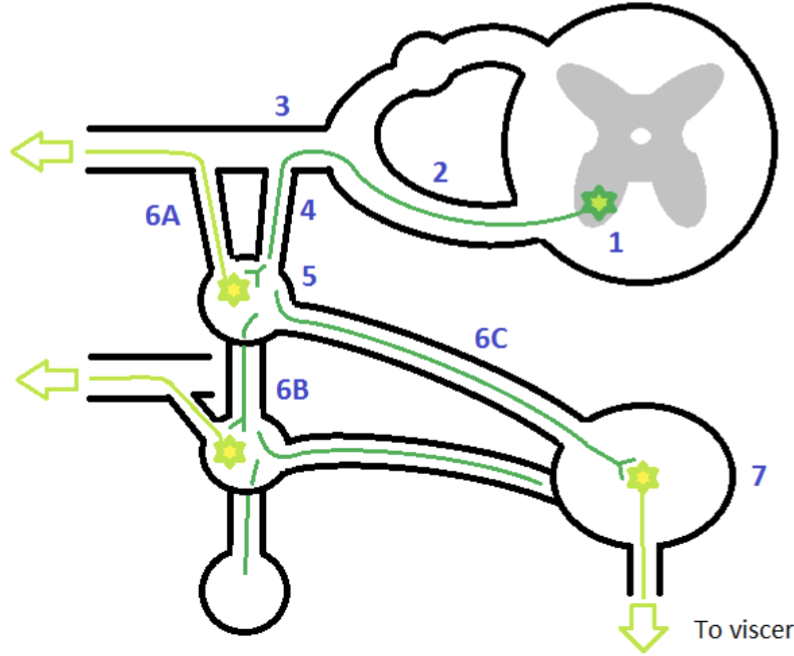
The white rami communicantes each connect to a ___ in the ___
sympathetic chain ganglion, sympathetic chain
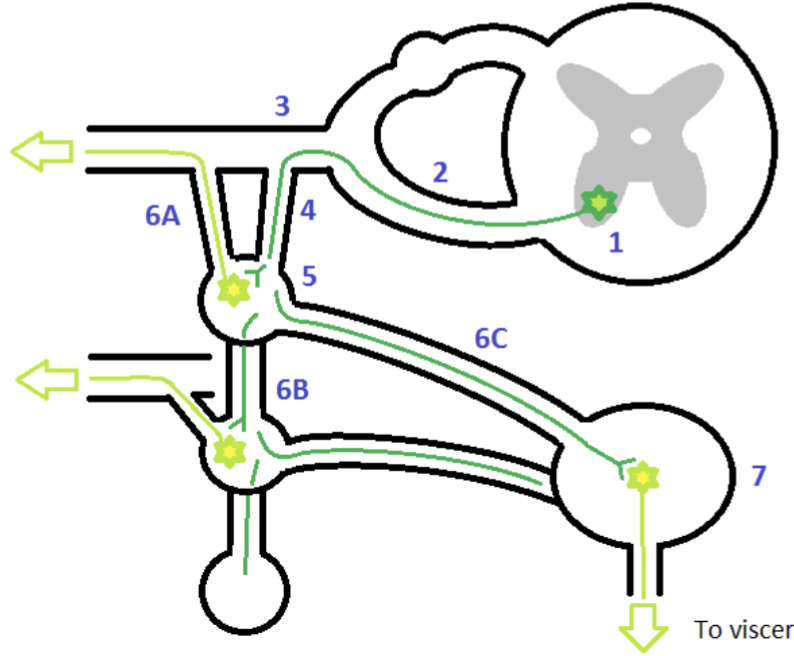
describe 6A: End at its synapse with the postsynaptic neuron. The postsynaptic neuron then returns to the spinal nerve via a ___, then proceeds to ___
grey ramus communicans, peripheral targets (like skin or blood vessels to skeletal muscles)
postsynaptic neurons are ___, giving a ___ appearance
unmyelinated, grey
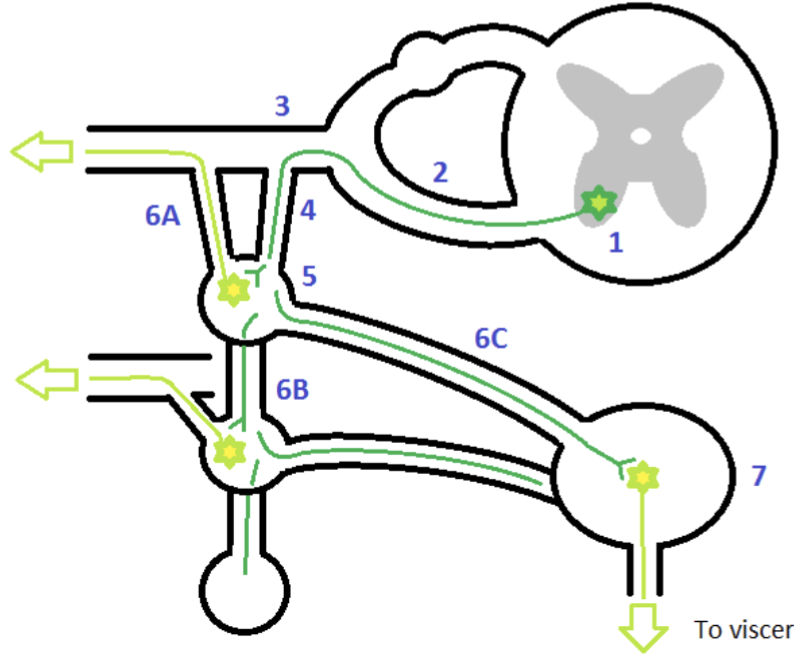
describe 6B: Continue superiorly or inferiorly along the __ to the next ganglion
sympathetic chain
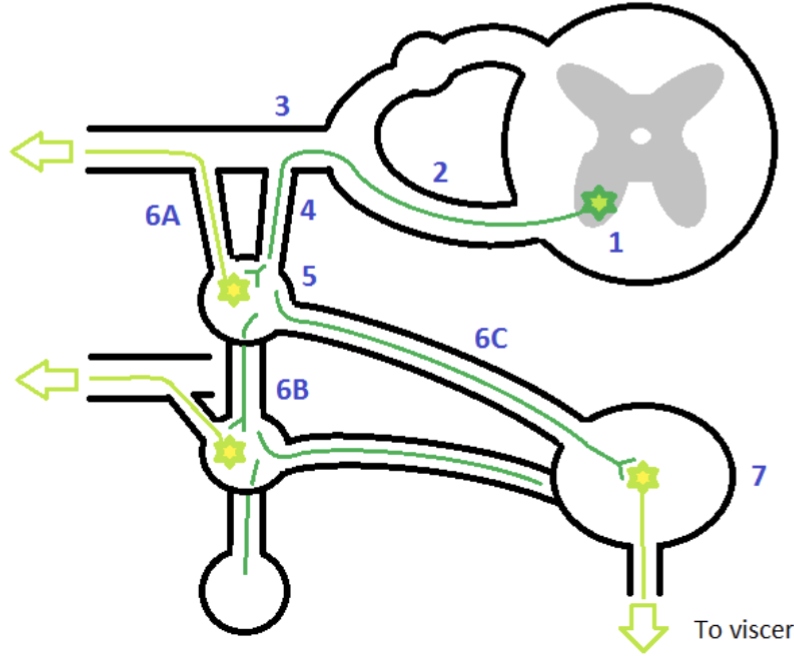
describe 6C: continue medially into __
splanchnic nerve
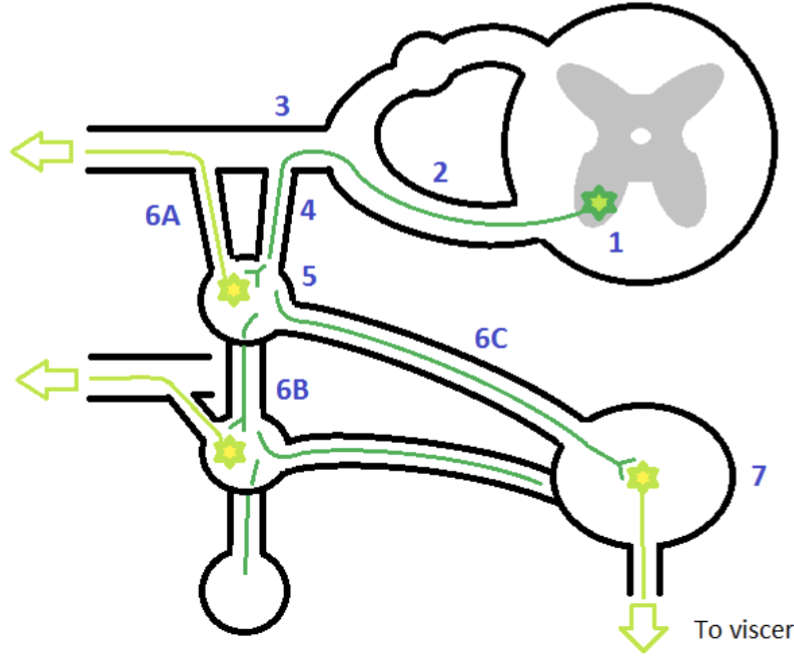
Splanchnic nerves connect to the ___, where presynaptic neurons end at their synapses with postsynaptic neurons to ___.
prevertebral ganglia, visceral organs
Found inferior to the intercostal vein and artery running below each rib.
intercostal nerve
___ carry axons of presynaptic sympathetic neurons from the intercostal nerve to the sympathetic chain. These neurons are ___, giving them a __ appearance
White rami communicantes, myelinated, white
___ carry axons of postsynaptic sympathetic neurons from the sympathetic chain back to the intercostal nerve. These neurons are ___, giving a __ appearance
Grey rami communicantes, unmyelinated, grey
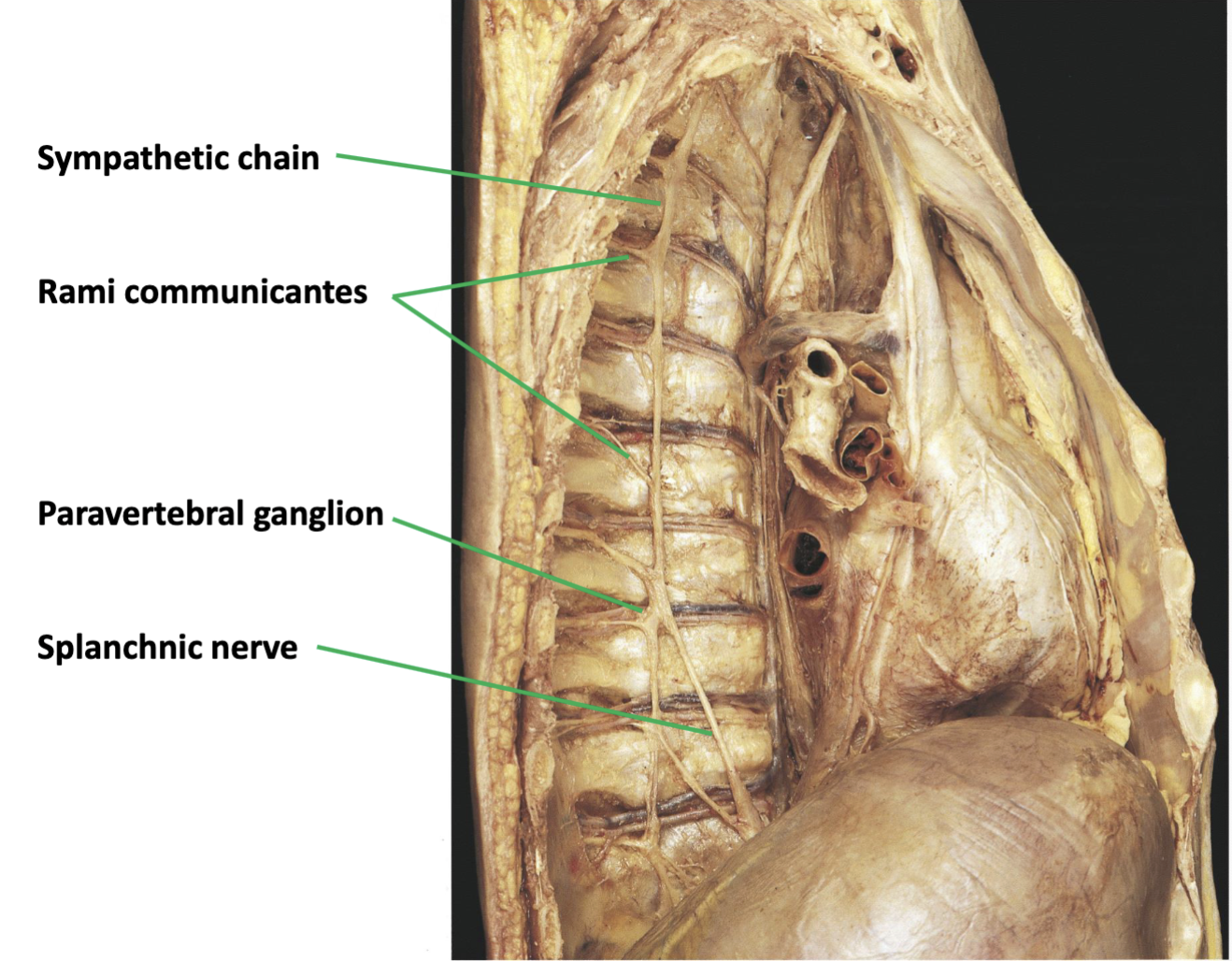
a band of nerve fibers that runs vertically along the side of the vertebral column
sympathetic chain
swellings on the sympathetic chain, connected to one or two rami communicantes
sympathetic chain ganglia
traveling from their origins at the sympathetic chain ganglia medially and inferiorly across the vertebral column towards their destinations at the prevertebral ganglia
splanchnic nerves
__ are nerves that carry autonomic neurons to visceral organs
splanchnic nerves
Splanchnic nerves from the thoracolumbar spinal cord carry __. In contrast, pelvic splanchnic nerves from the sacral spinal cord carry __
sympathetic neurons, parasympathetic neurons
The cell bodies of parasympathetic presynaptic neurons originate in the __
brain and the sacral region of the spinal cord
Presynaptic neurons in cranial nerves III, VII, and IX end in __
ganglia in the head (parasympathetic ganglia)
postsynaptic neurons from cranial nerves III, VII, and IX innervate the __
eye, lacrimal glands, salivary glands, and mucosa of the nasal and oral passages
Presynaptic neurons in ___ travel directly to their target organs and synapse at microscopic intramural ganglia.
vagus nerve
The vagus nerve thus provides the parasympathetic innervation for all visceral organs from the ___ to the ___
superior airway, midgut
Presynaptic neurons from the sacrum travel through ___ to ___ in their target organs.
pelvic splanchnic nerves, intramural ganglia
The source of parasympathetic innervation from the neck to the midgut is the ___
vagus nerve
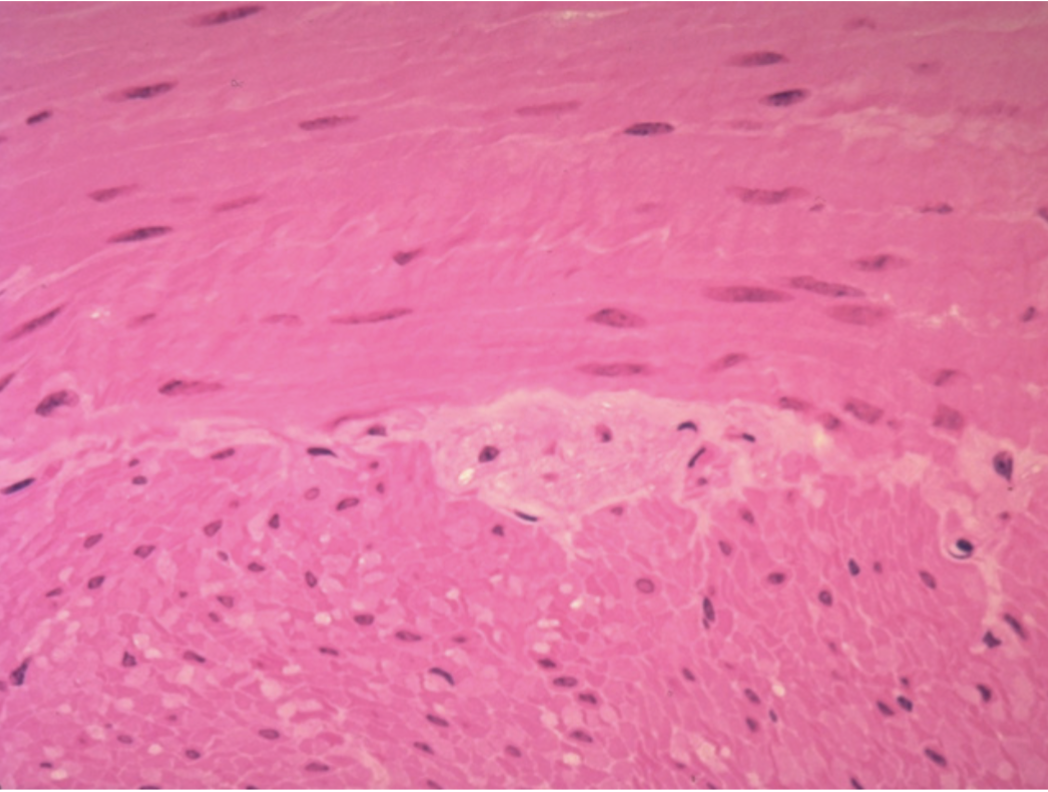
this is an image of
intramural ganglion
CNI
olfactory nerve
A structure of the central nervous system often confused with CNI
olfactory bulb
functions of olfactory bulb
smell (ability to detect odor)
if delicate fibers of olfactory nerve broken, may result in __
loss of smell (anosmia)
CNII, travels from __ to __
optic nerve, travels from optic chiasm to the optic canal
CNII targets
retina
function of CNII
visual acuity
lesion of CNII
loss of visual acuity, blindness
CNII is vulnerable to __
disorders of the CNS (ex. multiple sclerosis) because an outgrowth of CNS (tract of axonx in CNS)
CNIII, travels from ___ to ___
oculomotor nerve, travels from brainstem to superior orbital fissure
functions of CNIII
somatic motor to most extraocular muscles (moving the eye), parasympathetic motor to the pupillary sphincter and ciliary muscle, eye movements, pupillary light reflex
lesion of CNIII can cause
diplopia (double vision), mydriasis (dilated or blown pupil), photophobia, cycloplegia (blurred near vision due to flattened lens)
CNIV, very thin and delicate, emerges from ___ and wraps along ___
trochlear nerve, emerges from posterior brainstem and wraps anteriorly along the fold of dura mater at the medial edge of middle cranial fossa
CNIV function
somatic motor to superior oblique muscle, eye movements
lesion of CNIV
diplopia (double vision)
CNV, emerges from ___ and pierces the ___
trigeminal nerve, emerges from anterior brainsterm and pierces the dura mater
three branches of the trigeminal nerve
V1 (ophthalmic), V2 (maxillary), V3 (mandibular)
CNV functions
somatosensation (sense of touch) from face, motor to muscles of mastication (chewing) and some muscles of the pharynx, bite strength
___ is a condition in which the trigeminal nerve transmits intense pain impulses to the brain
Trigeminal neuralgia
lesion of CV
(-) numbness or (+) pain, tingling, and difficulty chewing
CNVI
Abducens nerve
CNVI functions
somatic motor to lateral rectus muscle
CNVII, travels together with ___, from the ___ to the ___
facial nerve, travels together with CNVIII, from the lateral brainstem to the internal auditory meatus
CNVII function
facial expressions
lesion of CNVII
weakness/paralysis, xerophthalmia (dry eye), loss of taste, Bell’s palsy (drooping facial expression due to weakness or paralysis)
CNVIII
vestibulocochlear nerve
CNVIII functions
hearing from cochlea, balance and equilibrium from vestibular apparatus
lesion of CNVIII
loss of hearing and balance, tinnitus and vertigo, nausea
CNIX
glossopharyngeal nerve
CNIX functions
taste and touch from posterior 1/3rd of the tongue and pharynx, also visceral sensation from carotid baro and chemoreceptors, some motor to the throat and parotid gland, swallowing and gag reflex
lesion of CNIX
numbness at pharynx, loss of sensation & taste from post. tongue
CNX
vagus nerve
CNX functions
parasympathetic motor to the heart, airways, foregut, and midgut; also somatosensation (touch) and motor innervation to pharynx and larynx, visceral sensation from aortic baro and chemoreceptors, some taste from pharynx, swallowing
lesion of CNX
dysphagia (difficulty swallowing), dysphonia (hoarseness), tachycaria (increased heartrate)
CNXI
accessory nerve
CNXI functions
somatic motor to sternocleidomastoid and trapezius muscles (shrugging), ability to shrug and turn head v. resistance
lesion of CNXI
atrophy of trapezius, weakness in elevation of scapula & rotation of neck
CNXII, starts ___ and travels to ___
hypoglossal nerve, starts deep down brainstem and travels to hypoglossal canal
CNXII functions
somatic motor to tongue, movement of tongue
lesion of CNXII
dysarthria (slurred speech)
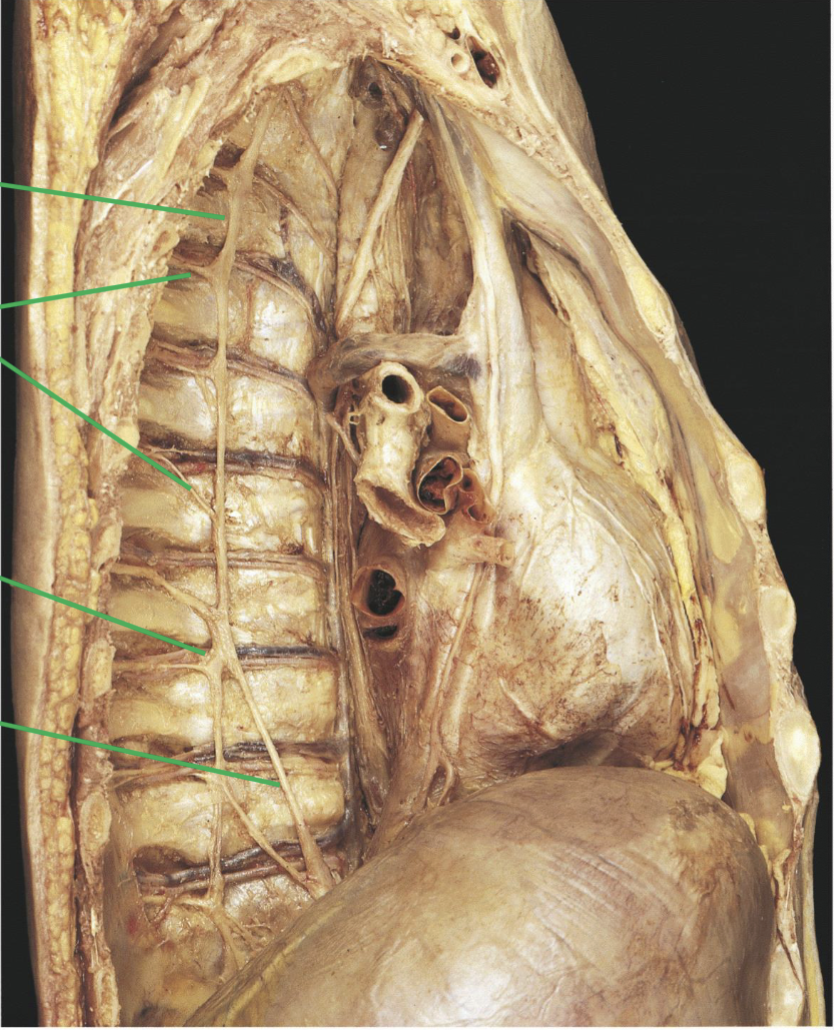
identify
intramural ganglion is ___ (parasympathetic or sympathetic)
parasympathetic
rest and digest
parasympathetic
fight or flight
sympathetic
parasympathetic or sympathetic: when eye constricts pupil & lens (near vision)
parasympathetic
parasympathetic or sympathetic: eye dilates pupil and relaxes lens
sympathetic
parasympathetic or sympathetic: salivary glands stimulates secretion
parasympathetic
parasympathetic or sympathetic: salivary glands stimulates secretion (direct effect), overwhelmed by decreased blood flow
sympathetic
parasympathetic or sympathetic: constrict airways
parasympathetic
parasympathetic or sympathetic: dilates airways
sympathetic
parasympathetic or sympathetic: decreases heart rate and contractility
parasympathetic
parasympathetic or sympathetic: increases heart rate & contractility
sympathetic
parasympathetic or sympathetic: increases secretion and motility of the GI organs
parasympathetic
parasympathetic or sympathetic: decreases secretion and motility of the GI organs
sympathetic
parasympathetic or sympathetic: increases liver glucose uptake
parasympathetic
parasympathetic or sympathetic: stimulates liver glucose release
sympathetic
parasympathetic or sympathetic: stimulates bladder contraction and urination
parasympathetic
parasympathetic or sympathetic: inhibits bladder contraction and urination
sympathetic
parasympathetic or sympathetic: stimulates erection
parasympathetic