AVI101 - Visual Arts - 2024 - Unit 2

0.0(0)
Studied by 19 people
call kaiCall Kai
learnLearn
examPractice Test
spaced repetitionSpaced Repetition
heart puzzleMatch
flashcardsFlashcards
GameKnowt Play
Card Sorting

1/61

encourage image

There's no tags or description

Looks like no tags are added yet.

Last updated 11:03 PM on 4/9/24
Name
Mastery
Learn
Test
Matching
Spaced
Call with Kai

No analytics yet

Send a link to your students to track their progress

62 Terms

1
New cards

How does the eye see color?

(1) When light hits an object, such as a lemon, the object absorbs some light and reflects the rest

(2) Reflected light enters the cornea

(3) The cornea bends light towards the pupil

(4) The pupil controls the amount of light that hits the lens

(5) The lens focuses the light on the retina

(6) The Cones and Rods then send a signal along the optic nerve to the visual cortex of the brain

(7) After the color is processed, you see color, in this case, yellow

2
New cards
What is the Cornea?
The cornea is the outermost layer of the eye
3
New cards
What is the Pupil?
The pupil controls the amount of light that hits the lens
4
New cards
What is a Lens?
The lens focuses the light on the retina
5
New cards
What is the Retina?
The retina is a layer of nerve cells in the back of the eye
6
New cards
What are Rod cells?
Rod cells are cells used to see in dim/low light
7
New cards
What are Cone cells?
Cone cells are cells used to see in bright environments
8
New cards
How many colors can the human eye see?
The human eye can see about 10 million colors
9
New cards
Are dogs color blind?

Dogs are not color blind. They can see color but their chromatic ability is worse than humans. This is for two reasons

(1) dogs have fewer cone cells than humans in their retinas

(2) dogs are dichromatic (they only see two primary colors such

as blue, and yellow) whereas humans are trichromatic (they

see 3 primary colors such as red, yellow, and blue)

10
New cards
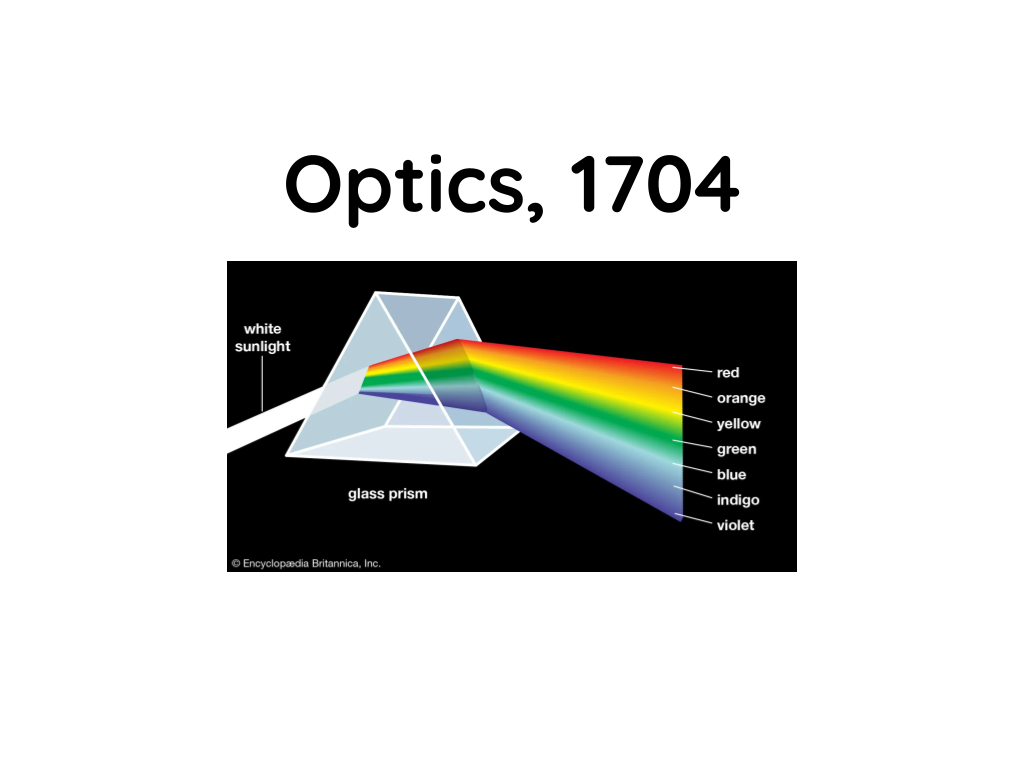
What is Sir Isaac Newton’s experiment on Optics in 1704?
It was Newton’s experiment that showed that light is a compound of many primary colors which can be separated & mixed together to form additional colors at will. Newton called this the “inflexion” of light
11
New cards
What is diffraction?
diffraction is separating colors
12
New cards
Optics is the science of
light and how it interacts with the world
13
New cards
Optics explain how
  • Rainbows exist

  • Light reflects off mirrors

  • Light reflects through a glass of water

  • What splits light shining through a prism
14
New cards
What’s the theory of Optics?
The theory of optics describes how when white light is sane through a triangular prism and the colors are reflected out the other side (Red, Orange, Yellow, Green, Blue, Indigo which is a blue mix of purple, and Violet which is a mix of purple and pink). When the light shone back through the prism, the colors recombined to form a beam of white light.
15
New cards
What’s Chiaroscuro?
It’s Italian for bright-dark. The effect was pioneered by Da Vinci. The effect focused on dramatic contrasts of light and shade. It’s Used to put people in the spotlight.
16
New cards
What’s Tenebroso
It’s Italian for dark-dark. It’s used to add suspense & create a sense of stillness. i.e. vintage movies.
17
New cards
What’s Color Discord
Color Discord is clashing colors such as orange, & pink. It’s used in advertisements to draw attention.
18
New cards
What’s Spectral Colors
Spectral Colors are the colors of the rainbow.
19
New cards
What’s Optical Color Mixing?
Optical Color Mixing is where dots are painted onto a canvas and when someone views it from far, those dots will blend in the mind and it’ll seem like the artist already mixed the colors when in reality there are just dots.
20
New cards
What are some warm colors?
Red, Orange, Yellow, Brown, Gold
21
New cards
What are some cool colors?
Blue, Green, Purple
22
New cards
What was Pablo Picasso’s first word?
It was Lapiz in spanish, in english it means pencil
23
New cards
What did Picasso say about children’s art?
Picasso said, “Every child is an artist. The problem is how to remain an artist once we grow up.”
24
New cards
What are the 2 Periods (categories) of Art that Picasso explored in his early stages of painting?
Blue Period, and the Rose Period
25
New cards
What’s the Blue Period?
In this period, Picasso explored using shades of blue to emphasize pain and anguish. The period occurred due to his bestfriend committing suicide leading to Picasso trying to outgrow the tragic event.
26
New cards
What’s the Pink Period?
In this period, Picasso explored using shades of pink and orange. The period occurred due to Picasso gaining a new inspiration, causing him to start the rose period.
27
New cards
What’s the mood conveyed in Picasso’s “Old Guitarist”?
The mood conveyed in the painting is anguish and pain. This is possible as the painting had only one color which was blue. The shades of blue make us feel cold, sad, and pain.
28
New cards
What ailment did Van Gogh suffer from?
Van Gogh suffered from the Manic Depression.
29
New cards
What painting technique did Van Gogh use?
Van Gogh used the Impasto Technique to paint.
30
New cards
What colors dominate Van Gogh’s “The Bedroom,” 1889?
The colors that are dominating are blue and green.
31
New cards
What mood is conveyed by the colours in Van Gogh’s “The Bedroom,” 1889?
The mood being conveyed by the painting is sadness and distress.
32
New cards
How does the mood conveyed by Van Gogh’s “The Bedroom,” 1889 reflect Van Gogh’s life?
This mood reflects van Gogh’s life as he was rejected many times and had a hard life, and he had Manic Depression which made it hard to get along with people.
33
New cards
Who’s Henry O’Tanner?
Henry O’Tanner is one of the most accomplished African-American artists of all time.
34
New cards
What two themes were important subjects for O’Tanner?
The two themes that are important subjects for O’Tanner are race, and religion.
35
New cards
What color techniques does O’Tanner use in “The Banjo Lesson”?
Henry O’Tanner uses blue to represent spirituality and joy. O’Tanner also yellow-orange in his paintings. He used blue and yellow-orange as the first layer to the painting.
36
New cards
What’s Tint?
When you add white to a color
37
New cards
What’s Shade?
When you add black to a color
38
New cards
What are the Neutrals?
Black, Grey, White
39
New cards
What’s Opaque?
Solid color you can’t see through
40
New cards
What’s Transparent?
See through color
41
New cards
What’s Translucent?
Color that can shine through for example: stained glass
42
New cards
What’s a primary color?
The three most pure colors such as: Red, Blue, Yellow
43
New cards
What’s a secondary color?
When we mix two primary colors such as: Orange, Purple, Green
44
New cards
What’s a tertiary color?
When we mix a Primary and a Secondary color such as: Red-Orange, Yellow-Orange, Red-Purple, Blue-Purple, Blue-Green, Yellow-Green. When naming Tertiary colors, you say the most pure color first for example in Red-Purple, Red is the most purest
45
New cards
What are the 8 acrylic painting techniques?
(1) Transparent wash with lifting
(2) Transparent wash, Semi-Transparent wash, Salt, Sand
(3) Blocking/Taping, Salting, Opaque
(4) Drybrush
(5) Sponging
(6) Scumbling
(7) Sgraffito
(8) Pointillism
46
New cards
What’s Transparent wash with lifting?
You wet the surface by adding paint to the brush and dipping the brush in water to create a wet surface. Then you use a wet tissue from a kleenex box and wet it. Dab the wet tissue on the wet surface to lift the wet paint
47
New cards
What’s Transparent wash, Semi-Transparent wash, Salt, Sand?
You paint the sunset background with a transparent wash. Then, dip the paint brush in paint then, soak the brush. Then, Paint the ocean with a semi-transparent wash. Then, add salt to the water. Finally, add sand to the beach
48
New cards
What’s Blocking/Taping, Salting, Opaque?
Add tape in the shape of a tree. Then, paint the sky and the grass for background. Then, Add salt. Then, Wait for the paint to dry then take the tape off
49
New cards
What’s Drybrush?
Peacock
50
New cards
What’s Sponging?
This is similar to the transparent wash with lifting except, you use a sponge to lift the paint. OR. You can add yellow paint to a sponge to an already made background of hills and make it seem like there is dandelions by dabbing it
51
New cards
What’s Scumbling?
scrubbing an undiluted, opaque, and generally pale pigment across others for special textural effects or to raise the key of a dark-coloured area.
52
New cards
What’s Sgraffito?
You paint a background, let it dry. Then, paint an object you want to texturize. While the paint is wet, use the back of the brush scratch off some of the paint
53
New cards
What’s Pointillism?
Adding little dots to make it seem like they’re all mixed together from a far
54
New cards

Contrast

Opposites the emphasize (bring the best out of both worlds) of each other

55
New cards

What’s Hue

The purity of the color

56
New cards

What’s Analogous

Colors that are adjacent to each other on the color wheel and share similar characteristics.

57
New cards

What’s Impasto

A painting technique where paint is applied thickly to create texture and depth.

58
New cards

What’s Pigment

Colored material used to give paint its hue.

59
New cards

What’s Triadic

A color scheme involving three colors equidistant from each other on the color wheel.

60
New cards

What’s Complementary

Colors opposite each other on the color wheel, which, when combined, produce neutral colors (e.g., red and green, blue and orange).

61
New cards

What’s Fresco

A painting technique where pigments are applied to wet plaster, becoming part of the wall or surface as it dries.

62
New cards

What’s Monochromatic

A color scheme using variations in lightness and saturation of a single color.



