US physics quiz 2
 Call Kai
 Learn
Learn Practice Test
 Spaced Repetition
 Match
Match Flashcards
 Knowt Play
1/45

There's no tags or description
Looks like no tags are added yet.
Name | Mastery | Learn | Test | Matching | Spaced | Call with Kai |
|---|
No analytics yet
Send a link to your students to track their progress
46 Terms
Axial Resolution
controlled by spatial pulse length (SPL)
Lateral Resolution
controlled by beam width
Elevational Resolution
controlled by slice thickness
Temporal Resolution
controlled by frame rate
Spatial Resolution
• Ability to accurately display structural detail
Includes:
• Axial Resolution
• Lateral Resolution
• Elevational Resolution
Temporal Resolution
• Ability to accurately display motion over time
Determined primarily by:
• Frame Rate
• Imaging Depth
• Number of Scan Lines
• Number of Focal Zones
better axial resolution
shorter SPL (spatial pulse length)
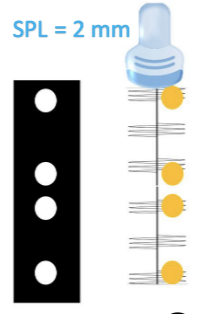
resolved or unresolved
resolved
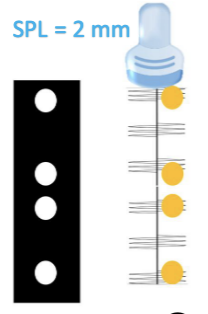
resolved or unresolved
unresolved
which scenario has better axial resolution?
A) SPL= 4mm
B) SPL= 2mm
SPL = 2mm
Shorter SPL Occurs With:
• Fewer cycles per pulse
• Higher frequency → Shorter wavelength
• Increased damping (backing material)
Which change would MOST improve axial resolution?
a) Increase imaging depth
b) Increase transducer frequency
c) Increase beam width
d) Increase dynamic range
b) Increase transducer frequency
better lateral resolution
narrow beam width
Good Lateral Resolution
• Narrow beam width
• Side by side reflectors displayed separately
• Improved detail across the image
Poor Lateral Resolution
• Wide beam width
• Side by side reflectors blur together
• Reflectors may appear as one structure
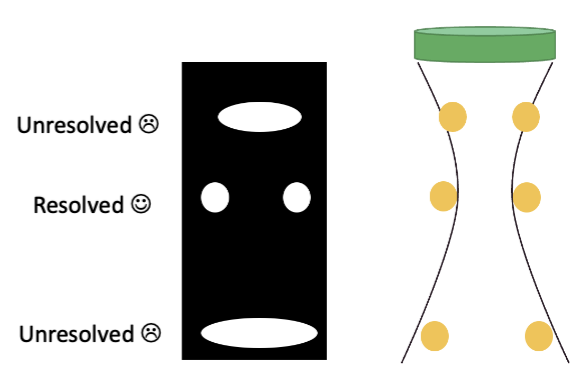
Best Lateral Resolution Occurs:
• At the focal zone
• Where the beam is narrowest
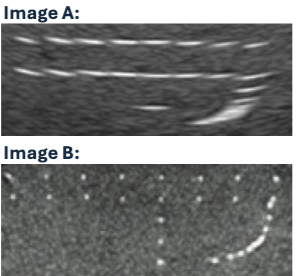
Which image demonstrates BETTER lateral resolution and
WHY?
Image B
• Better side by side reflector separation
• Improved lateral resolution
• Narrower beam width
Which adjustment would MOST improve lateral resolution?
a) Increase imaging depth
b) Increase beam width
c) Place the focal zone at the area of interest
d) Increase dynamic range
c) Place the focal zone at the area of interest
better elevational resolution
narrow slice thickness
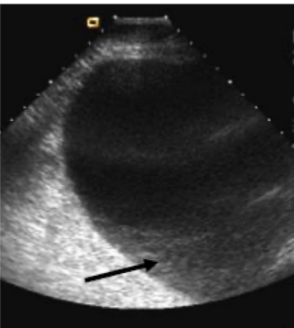
Which artifact is demonstrated in this image and why?
a) Reverberation
b) Slice thickness artifact
c) Mirror image artifact
d) Shadowing
b) Slice thickness artifact
Good Elevational Resolution
• Thin slice thickness
• Structures within the imaging plane displayed accurately
• Reduced partial volume artifact
Poor Elevational Resolution
• Thick slice thickness
• Echoes from outside the imaging plane included in the image
• May create false internal echoes
A sonographer notices low level echoes appearing within a simple cyst that should be anechoic.
Which type of resolution is MOST likely contributing to this artifact?
a) Axial resolution
b) Temporal resolution
c) Elevational resolution
d) Contrast resolution
c) Elevational resolution
better temporal resolution
higher frame rate
Frame Rate Increases With:
• ↓ Depth
• ↓ Scan Lines
• Narrower Sector Width
• Fewer Focal Zones
Frame Rate Decreases With:
• ↑ Depth
• ↑ Scan Lines
• Wider Sector Width
• Multiple Focal Zones
relationship between frame rate and temporal resolution
↓ Frame Rate → ↓ Temporal Resolution
A sonographer increases imaging depth during an abdominal scan.
What happens to:
• Frame rate
• Temporal resolution
Frame rate and temporal resolution decreases
Output Power affects
the transmitted beam
Overall Gain affects
the displayed image brightness
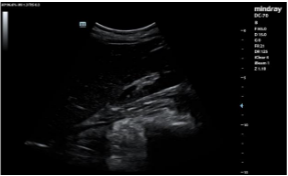
If the entire ultrasound image appears too dark, what adjustment should be made FIRST?
a) Increase output power
b) Increase overall gain
c) Increase imaging depth
d) Increase dynamic range
b) Increase overall gain
TGC adjusts brightness by
depth, not the entire image uniformly
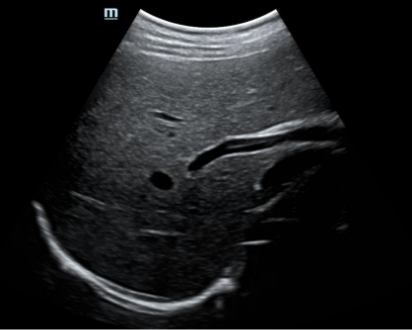
What adjustment is MOST appropriate?
a) Increase overall gain
b) Increase far field TGC
c) Increase output power
d) Increase dynamic range
b) Increase far field TGC
A sonographer notices that the far field of the image appears too dark, while the near field brightness appears appropriate.
Which adjustment is MOST appropriate?
a) Increase overall gain
b) Increase output power
c) Adjust far field TGC
d) Increase frame rate
c) Adjust far field TGC
Wide Dynamic Range
More Gray Shades
Narrow Dynamic Range
Higher Contrast
Which adjustment would produce a higher contrast image with fewer shades of gray?
a) Increase dynamic range
b) Decrease dynamic range
c) Increase frame rate
d) Increase beam width
b) Decrease dynamic range
Image appears globally too dark
Best Adjustment:
increase overall gain
Only the far field appears too dark
Best Adjustment:
adjust far field TGC
Motion appears blurred during cardiac imaging
Best Adjustment:
Increase frame rate:
decrease depth
decrease sector width
reducing focal zones
Side by side structures appear poorly separated
Best Adjustment:
improve lateral resolution:
focal zone placement
A sonographer is performing cardiac imaging and notices:
• Motion appears blurred
• Frame rate is low
• Multiple focal zones are activated
• Imaging depth is excessive
Which combination of adjustments would MOST improve
temporal resolution?
a) Increase imaging depth and increase dynamic range
b) Reduce imaging depth and reduce focal zones
c) Increase beam width and increase gain
d) Increase TGC and increase sector width
b) Reduce imaging depth and reduce focal zones
As transducer frequency increases, spatial pulse length will:
a) Increase
b) Decrease
c) Remain unchanged
d) Double
b) Decrease
If the time required to produce a single image frame increases, temporal resolution will:
a) Improve
b) Remain unchanged
c) Decrease
d) Double
c) Decrease
A sonographer adds multiple focal zones during imaging.
What is the MOST likely effect?
a) Improved temporal resolution
b) Increased frame rate
c) Improved lateral resolution with decreased frame rate
d) Improved axial resolution
c) Improved lateral resolution with decreased frame rate
A sonographer changes from a 3 MHz transducer to a 10 MHz transducer.
What is the MOST likely result?
a) Improved penetration and decreased resolution
b) Decreased attenuation and decreased resolution
c) Improved axial resolution and decreased penetration
d) Increased beam width and decreased frame rate
c) Improved axial resolution and decreased penetration