College Prep Biology: Genetics and Evolution
 Call Kai
 Learn
Learn Practice Test
 Spaced Repetition
 Match
Match Flashcards
 Knowt Play
1/100

There's no tags or description
Looks like no tags are added yet.
Name | Mastery | Learn | Test | Matching | Spaced | Call with Kai |
|---|
No analytics yet
Send a link to your students to track their progress
101 Terms
All Vius have What
RNA, which they put into our cells, to make their own DNA to make more of themselves.
RNA comes from where?
Ribosomes.
Covalent Bonds
A covalent bond is a strong chemical link formed when two atoms, typically non-metals, share one or more pairs of valence electrons to achieve stability, such as a full outer electron shell
Hydrogen Bonds
Very weak bonds; occur when a hydrogen atom in one molecule is attracted to the electrostatic atom in another molecule
Ionic Bonds
Formed when one or more electrons are transferred from one atom to another.
The atoms attract after an electron is transferred because the process converts neutral atoms into oppositely charged ions, which attract each other through strong electrostatic forces.
The donor atom becomes a positive ion (cation), and the receiver becomes a negative ion (anion), resulting in an ionic bond.
Van Der Waals Forces
A slight attraction that develops between the oppositely charged regions of nearby molecules.
Organisation of DNA (Eukaryotic)
Helix --> DNA is wrapped around histone --> The wrapped DNA is called a nucleosome, and they are coiled into a chromatin fibre --> this chromatin fibre is further condensed --> this is then present in the chromosome. --> Found inside the nucleus.
Some DNA is also present in the mitochondria. In plants and algae, some is within the chloroplasts.
Organisation of DNA (Prokaryotic)
Double Helix --> Unlike the linear strands in eukaryotes, prokaryotic DNA forms a continuous loop --> The circular DNA is folded into many loops, which are held in place by Nucleoid-Associated Proteins (NAPs) (the prokaryotic equivalent of histones) --> These loops are supercoiled themselves to take up even less space --> The final, highly condensed mass of DNA sits freely in the cytoplasm in a region called the nucleoid. It is not enclosed by a membrane.
Three Models of DNA Structure?
Conservative
Semi-Conservative
Dispersive
Conservative Model & Who Made It
This was proven wrong by experiments in 1958. It was there to avoid the physical difficulties of unwinding the DNA molecule.
The initial protein helix replicates with one strand being the original double helix protein that was present at the start and one strand being an identical, but new DNA molecule.
Semi-Conservative Model & Who Made It
It was proven in 1958 with Meselson and Stahl's experiment. It was initially theorised by Watson and Crick by their DNa double helix structure consisted of complementary base pairs, suggesting that each strand could easily serve as a template for another.
In both of the DNA molecules produced, there is one strand of the double helix.
Dispersive Model & Who Made It
This was also disproven by Meselson and Stahl in 1958, and people though it was right because it offered a plausible middle ground to explain inheritance, as scientists had no idea how DNA could unwind without getting hopelessly tangled.
In this one, the parental double helix is broken into fragments, copied, and then reassembled into a "mosaic" of new and old strands.
Meselson and Stahl's Experiment (5 Fundamental Questions)
This experiment was undertaken in 1958.
It identified which of the three proposed models was correct.
At the start, Meselson and Stahl bred e. coli in a heavy nitrogen environment. Normally, nitrogen has a mass number of 14, but this was an isotope with one extra neutron.
This environment meant that all the resources that the e. coli got to build its protein were heavy nitrogen. So, when put in an ultra centrifuge, the heavy nitrogen DNA would stay at the bottom compared to the light nitrogen DNA.
So, when they had all heavy nitrogen DNA, they continued the breeding in a normal nitrogen environment, so all future DNA replication would involve that normal nitrogen.
When spun in the centrifuge, you could identify what model it was:
Replication 1:
Conservative: The original heavy DNA would stay together and the lighter DNA would stay together: you would see one band at the top and one at the bottom.
Semi-Conservative & Dispersive: The light and heavy DNA would be mixed together, so there would be a single intermediate band in the middle.
Replication 2:
Semi-Conservative: The hybrid strands from gen 1 would unzip and the heavy strands would combine with new light strands and the light strands would combine with more light stands. So you would have a middle band and a high band.
Dispersive: The DNA would continue its chopping and mixing, every DNA molecule would now be 75% light and 25% heavy, one single band would be observed, that is slightly higher than the previous middle band, but lower than the light band.
The observed bands were all in accordance with the semi-conservative model.
A-Type DNA
This type of DNA is wider and shorter than B. It is present in the bodies of organisms in which the conditions are very extreme, low water, really.
B-Type DNA
This is the standard type of DNA. It is present in high-humidity environments.
Z-Type DNA
This is very rare, is an abnormality in the genes. It is left-handed and has a bit of a zig-zag pattern.
How many of each enzyme are required for the replication of a single strand of DNA (ASK DAS)
For one replication fork, one helicase is required. However, DNA replicates bidirectionally from the origin of replication. For that reason, you need two helicases, one for each fork.
We need hundreds to thousands of SSBs to prevent the DNA from snapping back together or being damaged.
We need six DNA Polymerase III/delta/epsilon, one handles the leading and the other two, the lagging strand. Since there are two forks, this is doubled. Two are needed in the lagging strand so the cell can start the new okazaki fragment before the first is even finished.
Primase, the leading strands each require one each. The lagging strands each require one as well. It just moves with the Okazaki fragment.
Topoisomerase: There are four, one for each strand.
DNA polymerase I and Ligase (Dozens to Hundreds): Depends on the number of Okazaki Fragments.
Eukaryote vs Prokaryote
Eukaryotic cells are larger and more complex, and they contain a nucleus, while Prokaryotic cells are smaller and simpler cells that do not contain a nucleus.
Eukaryotes have membrane-bound organelles and store DNA in the nucleus.
Atom
The smallest unit of matter that can define an element.
Element
A pure substance composed of only one type of atom.
Molecule
A particle formed by two or more atoms bonded together, which can be the same or different.
Compound
A pure substance made of atoms of different kinds, all bonded together in a fixed ratio.
Compounds only have a certain type of particle, like H2O and Salt, making them pure.
Carbohydrate
If a molecule follows the general formula C_n(H_2O)_n, then it is a carbohydrate. These molecules contain high-energy carbon-hydrogen bonds, which are the primary source of immediate energy for cellular respiration.
Monosaccharides
Single sugar molecules
Disaccharides
Carbohydrates that are made up of two monosaccharides (two sugar units)
Polysaccharides
Carbohydrates that are made up of more than two monosaccharides (sugar units)
Lipids
These are molecules with an even distribution of electrons and charge throughout: nonpolar. They are also hydrophobic and are generally less dense than carbohydrates. This makes them more energy-dense than carbohydrates.
Additionally, they contain fewer oxygen atoms and far more C-H bonds.
Triglycerides
An energy-rich compound made up of a single molecule of glycerol and three molecules of fatty acid.
Phosopholipids
Primary structural component of the cellular/plasma membrane. They are also lipids containing a phosphate group in their molecule.
Steroids
Lipids characterised by a carbon skeleton consisting of four fused rings. They are also insoluble in water.
Proteins
If a molecule is a polymer made of amino acid monomers linked by peptide bonds, then it is a protein. Because the specific sequence of these amino acids determines how the chain folds, the final 3D shape is what dictates the protein's function.
Fibrous
If it forms long strands, it is fibrous, providing the physical strength found in connective tissues.
Globular
If the protein folds into a tight, spherical shape, it is a globular protein. Most enzymes fall into this category because they require a specific "active site" shape to bind to substrates and speed up chemical reactions.
Nucleic Acid
If a molecule is composed of a sugar, a phosphate group, and a nitrogenous base, then it is a nucleotide. If these nucleotides link into long chains, they form nucleic acids.
Monomer
A simple compound whose molecules can join together to form polymers
Polymer
Large molecules (macromolecules) are composed of long chains of repeating smaller units, called monomers, that are covalently bound together.
Bases
These are used to hold each strand in the double helix together. The arrangement and ordering of these bases determine protein expression.
The bases are:
A: Adenine
T: Thymine
C: Cytosine
G: Guanine
Nucleotides
Contains a single base, a phosphate group, and a sugar. The sugar is ribose in RNA and deoxyribose in DNA. These are the fundamental units of DNA.
A single nucleotide is a monomer, but in DNA and RNA, they are polymers.
DNA strands are what to each other?
Anti-parallel: 3' - 5' combines with 5' - 3'.
Complementary Base Pairing
A combines with T and G combines with C.
What type of bond holds the nucleotides together
Hydrogen bonds: A to T have two hydrogen bonds. G & C have a triple hydrogen bond.
Origin Of Replication
Identified by the origin recognition complex before the replication even occurs. It is identified by six units beforehand. In this case, the origin of replication is always in places where the A - T density is really high. This is because they are easier to open than G-C.
The origin is slightly opened, then Helicase is brought in.
Direction of DNA Replication
3' to 5' replication is the only direction that DNA replicates (Helicase moves). However, the formation of RNA occurs anti-parallel to that, so 5' to 3'.
So, technically, it is ALWAYS 5' to 3'.
Phosphate vs Phosphorous vs Phosphate Group
Phosphorus (\(P\)) is the essential chemical element, while phosphate (\(PO_{4}^{3-}\)) is a compound formed when phosphorus binds with oxygen.
A phosphate group is a functional group consisting of a central phosphorus atom covalently bonded to four oxygen atoms
Enzyme
A type of protein that speeds up a chemical reaction in a living thing.
Helicase
An enzyme that untwists the double helix of DNA at the replication forks. It breaks the hydrogen bonds that hold the bases together.
Topoisomerase
An enzyme type that functions in DNA replication, helping to relieve strain in the double helix ahead of the replication fork.
Types of Topoisomerase (MAIN - Only those appropriate for Year 11)
DNA Gyrase: It cuts both of the strands, and then puts one of the strands behind another strand, to create a negative supercoil.
Topoisomerase I: Cuts one strand and then puts it behind the other, to only relieve tension.
Topoisomerase II: This one cuts both, just in the same way that DNA Gyrase does, but this one is used for eukaryotic cells, whereas DNA Gyrase is not.
Primase (RNA)
This basically lays down 12 to 15 new nucleotides of RNA (using the Chargaff Rule) into the cell. It puts one primer for the leading strand, and a new one for each Okazaki Fragment.
After this is done, and so is most of the rest of the replication, the RNA is ripped out by DNA Polymerase I. The same enzyme then adds the correct DNA nucleotides. Ligase fills in the gaps.
It can't be all RNA the whole time because RNA is floppy and might mutate, and if we tried doing that whole process separately, it would be very expensive and time-consuming.
Ligase
An enzyme that connects two fragments of DNA to make a single fragment. It is necessary because even though the lagging strand does have its Okazaki Fragments relatively close to each other, since they were made separately, the kinks need to be fixed.
However, it is also used during the initialisation step when we have to remove the RNA from the new strand.
DNA Polymerase I
Removes RNA nucleotides of primer from the 5' end and replaces them with DNA nucleotides. It also repairs DNA. It has exonuclease activity (the ability to remove nucleotides one at a time).
DNA Polymerase ...
Adding bases to the new DNA chain, proofreading the chain for mistakes
III for bacteria
\(\delta \) and \(\epsilon \) for humans.
SSB Proteins
Open DNA to make sure the two strands don't reanneal
Phosphodiester Bond
A phosphodiester bond is a strong covalent linkage between the \(3'\) carbon atom of one sugar molecule and the \(5'\) carbon of another in DNA and RNA. It forms the sugar-phosphate backbone of nucleic acids, connecting nucleotides through a phosphate group and two ester bonds.
Positive Supercoiling vs Negative Supercoiling (Bacteria and Eukaryote Example)
Positive, the DNA is overwound as a result of the helicase and SSBs forcing the strands apart and overwinding the original structure. When it is overwound, the helix kind of loops over itself and prevents further breakage.
Negative, the DNA is underwound when it is turned in the left direction (the DNA strand goes in the right direction). This must be done during DNA replication to prevent the replication from stopping, and in this case, as well, loops form.
DNA gyrase breaks the curled part of the supercoil. It then uses ATP hydrolysis to move the broken segment to the other side of the strand and then connects them. This makes a negative supercoil.
For humans and all eukaryotes, Topoisomerase 1 makes a cut in only one of the two DNA strands, puts the strand behind the larger structure of DNA, and then puts them back together.
Okazaki Fragments
Small fragments of DNA are produced on the lagging strand during DNA replication and are joined later by DNA ligase to form a complete strand.
Nucleotide
Monomer of nucleic acids made up of a 5-carbon sugar, a phosphate group, and a nitrogenous base.
The base is A, T, G, C or A, U, G, C, depending on whether it is RNA or DNA.
Bases & Pairs
A, T, G, C: DNA
A, U, G, C: RNA
A - T & G - C
A - U
Charguff's Rule.
A:
Adenine
T:
Thymine
U:
Uracil
G:
Guanine
C:
Cytosine
Purine & Pyrimidine Bases
Purine has two loops, and pyrimidine has one loop.
The chunkier bases are A & G. The rest are pyrimidine.
DNA vs RNA
Deoxyribose sugar vs. Ribose sugar, Thymine vs. Uracil , Double strand vs. Single strand
Why is it U in RNA
Uracil is energy-cheaper to make than Thymine. It doesn't have the expensive CH_3 molecule.
Thymine is very permanent; the permanency is not required for Uracil.
Cytosine also immediately deanimates in water and with certain chemicals, turning into uracil. If DNa naturally used Urcail, the cell's repair enzymes would have no way of knowing if a 'U' in the code was a damaged C or not meant to be there.
Ribose into Deoxyribose: How? INCOMPLETE & ASK DAS
When a cell is preparing for DNA replication, it first produces ribonucleoside diphosphates (NDPs). These are the building blocks of RNA.
When they encounter Ribonucleotide Reductase (RNR), a chemical reaction is initiated.
DNA Orientation
Right-Handed.
DNA Replication is what tinuous?
Semi-Discontinuous because the leading strand is consistent, and the lagging strand is not.
DNA Replication Master Series. INCOMPLETE
Initiation:
Elongation:
Termination:
What makes what makes what that then makes something else?
RNA makes DNA which makes Protein which makes DNA again.
Where does the Oxygen point?
Towards the phosphate group (5')
Enzymes end in what
-ase
When does DNA replication occur in a cell cycle
interphase.
Okazaki Fragments: WHY FORM
The new DNA can only form in the 3' to 5' direction. So, the polymerase must start with 3' and then go forward. So, on one side, it is in line with the direction of the helicase; on the other side, it is not, so it has to make a segment until enough space is clear to go back.
Where do the nucleotides come from?
They're floating around
Does the primase bring its own RNA?
It makes its own, yes.
DNA Helix Nucleotides and Diameter
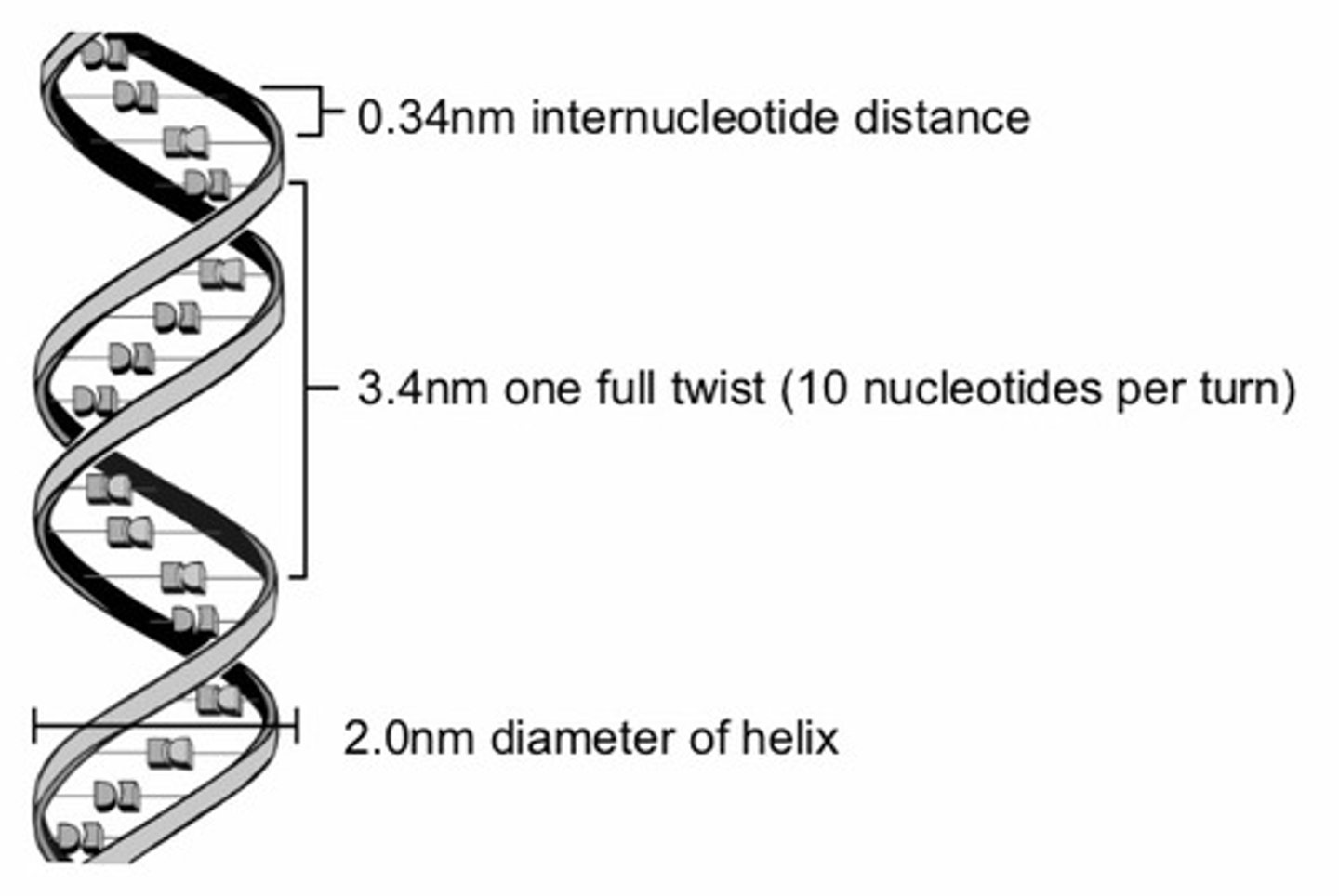
Therefore, ten base pairs are present per turn of the helix. The diameter of the DNA double helix is 2 nm, and it is uniform throughout. Only the pairing between a purine and pyrimidine can explain the uniform diameter.
Structural vs Functional Proteins
Why do we need a doughnut-shaped clamp for DNA (PCNA)
Protein Synthesis
The process of using the DNA to create proteins which express the traits that the DNA holds for you.
Noncoding vs Coding DNA and their functions and structure.
All Different Ways Protein Can Be Altered
Codon vs Gene
Codon: three nucleotides
Gene: contains multiple codons that are used to code for an entire protein.
One codon codes for one amino acid. The gene has many codons in it, which all code for amino acids, and thus, code for an entire protein. The combination of proteins working together results in a trait.
Depending on how a protein is altered after its creation, it can have different functions
What is Alternative Splicing
Transcription comes before or after Translation
C before L .
Transcription
The process whereby the DNA sequence in a gene is copied into mRNA. In the process, only A SINGLE GENE is copied, because of course, the entire DNA strand does not need to be expressed in one go. Because only a gene is copied, it is small enough to leave the nucleus pore complex (NPCs), but the DNA is not.
Transcription : Where
Nucleus
Transcription:
How does the RNA polymerase know when to strt and when to end.
How big is the detached bubble in transcription ?
Is keeps closing just behind the RNA polymerase, and opens just ahead of it.
If the detached bubble is only pretty small, how does the mRNA not interfere with the existing DNA that closes into it.
Template Strand
Experiment to Determine Percentage of each Base Present
Get a solution of chromosomal extract: douse the cell with high salt, detergent, or milk alkali treatment. This will have DNA and proteins.
Remove the protein, using a protease treatment.
Hydrolyse (break the bonds using water) the DNA to release the bases from the DNA strands. A strong acid is used for protonation, and then the nucleophilic attack occurs, which leads to the water's components binding across the bond.
Using chromatography, separate the bases.
Extract bands from paper into solutions and determine the amounts of each base using spectroscopy. Each base will absorb a specific wavelength of light. Examination of the absorption profile of the base sample will allow you to calculate the amount of the base.
Compare the base content in the DNA from different organisms.
Translation
Process by which mRNA is decoded and a protein is produced
What handed, what is the pitch, what is the angle, bp separation amount.
The strands are coiled right handed (clockwise), the pitch of the helix is 3.4 nm, and there are roughly 10 base pairs in each turn. Therefore, the distance between a base pair in DNA is approx. 0.34nm. Twist angle per base pair: 36 degrees.
A-DNA: Right-handed, pitch = 2.6nm, 11 bp per turn, Twist angle per base pair: 32.7 degrees. Distance between a base pair is approx. 0.23nm.
Z-DNA: Pitch of 4.4nm and 12 base pairs per turn. The distance between a base pair is approx. 3.67. It is left-handed. Twist angle per base pair: -10 degrees, because it is left-handed.
Why and how do DNA grooves form?
10 differences between the prokaryotic chromosome and eukaryotic chromosome
1. Prokaryote: typical chromosome formation is absent in prokaryotes. Eukaryote: The genetic material is organised as distinct structural entities called the Chromosomes.
2. Prokaryote: A single chromosome per cell. Eukaryote: Two or more chromosomes per cell.
3. Prokaryotic chromosome is much smaller than Eukaryotic
4. Prokaryotic: Chromosome is covalently closed. Eukaryotic: Contains a linear chromosome with two ends.
5. Prokaryotic chromosome codes for a few proteins. Eukaryotic chromosome codes for a massive amount.
6. Prokaryotic chromosome occupies freely in the centre of the cell and is not covered by the nucleus. Chromosomes are always enclosed in the nucleus of Eukaryotes.
7. Due to the absence of nucleus, the prokaryotic chromosomes stay in direct contact with the cytoplasm (nucleoid). Eukaryotic chromosomes are separated from the cytoplasm by the nuclear membrane.
8. Prokaryotic chromosomes are sometimes associated with the mesosome (they are attached to it. The mesosome may or may not serve actual purpose).
Hemizygous
Heredity
How traits are passed down from parent to offspring.