Personality (Psych 001) - Andrew Ward
 Call Kai
 Learn
Learn Practice Test
 Spaced Repetition
 Match
Match Flashcards
 Knowt Play
1/52

There's no tags or description
Looks like no tags are added yet.
Name | Mastery | Learn | Test | Matching | Spaced | Call with Kai |
|---|
No analytics yet
Send a link to your students to track their progress
53 Terms
personality
an individual's characteristic pattern of thinking, feeling, and acting
psychodynamic theories
theories that view personality with a focus on the unconscious and the importance of childhood experiences
Psychoanalysis
Freud's theory of personality that attributes thoughts and actions to unconscious motives and conflicts; the techniques used in treating psychological disorders by seeking to expose and interpret unconscious tensions
unconscious
according to Freud, a reservoir of mostly unacceptable thoughts, wishes, feelings, and memories. According to contemporary psychologists, information processing of which we are unaware.
free association
in psychoanalysis, a method of exploring the unconscious in which the person relaxes and says whatever comes to mind, no matter how trivial or embarrassing
id (pleasure principle)
a reservoir of unconscious psychic energy that strives to satisfy basic sexual and aggressive drives. The id operates on the pleasure principle, demanding immediate gratification.
eg. infant crying for satisfaction, doesn't care ab anything else
ego (reality principle)
the partly conscious, "executive" part of personality that mediates among the demands of the id, superego, and reality. The ego operates on the reality principle, satisfying the id's desires in ways that will realistically bring pleasure rather than pain.
going for realistic things to make us happy, factoring in repercussions
- gets anxiety from id, superego, real world
superego
the partly conscious part of personality that represents internalized ideals and provides standards for judgment (the conscience) and for future aspirations
how we think we should behave (eg. christian guilt)
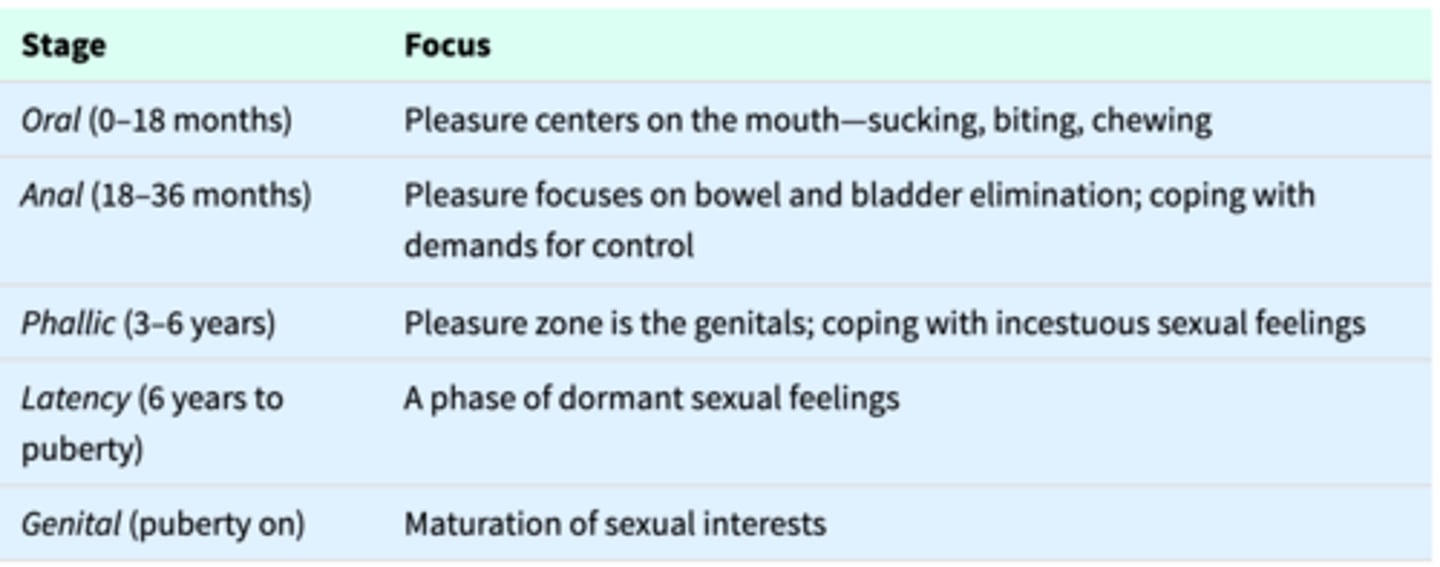
psychosexual stages
the childhood stages of development (oral, anal, phallic, latency, genital) during which, according to Freud, the id's pleasure-seeking energies focus on distinct erogenous zones
Freud's Psychosexual Stages
1. Oral Stage (0-18mo): pleasure centers on the mouth - sucking, biting, chewing
2. Anal Stage (18-36mo): pleasure focuses on bowel and bladder elimination; coping with demands for control
3. Phallic Stage (3-6yrs): pleasure zone is the genitals; coping with incestuous sexual feelings
4. Latency Stage (6-puberty): phase of dormant sexual feelings
5. Genital Stage (puberty-): maturation of sexual interests
Oedipus complex
a boy's sexual desires toward his mother and feelings of jealousy and hatred for the rival father
identification
the process by which children incorporate their parents' values into their developing superegos
fixation
psychoanalytic theory, a lingering focus of pleasure-seeking energies at an earlier psychosexual stage, in which conflicts were unresolved
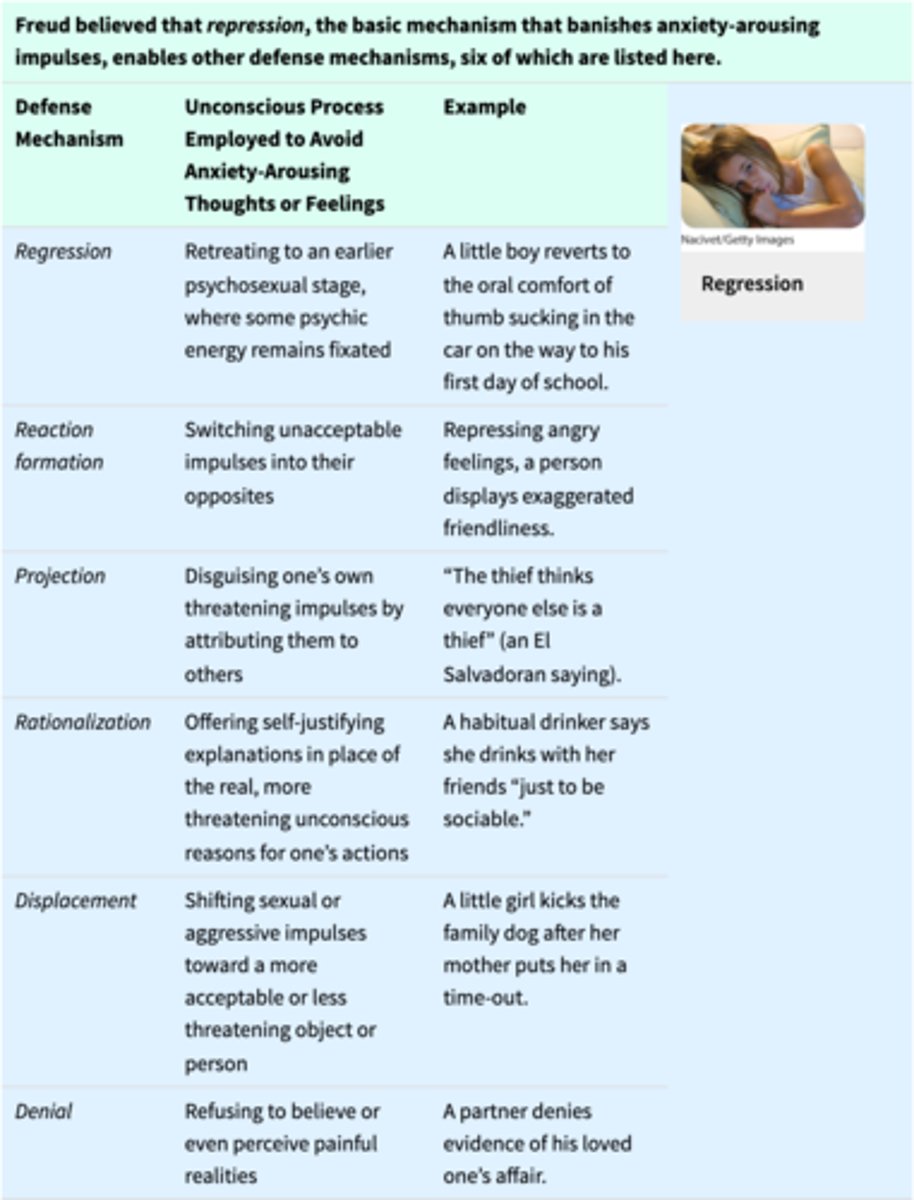
defense mechanisms
in psychoanalytic theory, the ego's protective methods of reducing anxiety by unconsciously distorting reality
Repression
in psychoanalytic theory, the basic defence mechanism that banishes from consciousness anxiety-arousing thoughts, feelings, and memories
-living in civil society --> repression
Six Defense Mechanisms
1. regression: retreating to earlier psychosexual stage where some psychic energy remains fixated
2. reaction formation: switching unacceptable impulses into their opposites
3. projection: disguising one's own threatening impulses by attributing them to others
4. rationalization: offering self-justifying explanations in place of the real, more threatening unconscious reasons for one's actions
5. displacement: shifting sexual or aggressive impulses toward a more acceptable or less threatening object or person
6. denial: refusing to believe or even perceive painful realities
Freudian slip
a verbal mistake that is thought to reveal an unconscious belief, thought, or emotion
collective unconscious
Carl Jung's concept of a shared, inherited reservoir of memory traces from our species' history
terror management theory
a theory of death-related anxiety; explores people's emotional and behavioral responses to reminders of their impending death
Thematic Apperception Test (TAT)
a projective test in which people express their inner feelings and interests through the stories they make up about ambiguous scenes
projective test
a personality test, such as the Rorschach or TAT, that provides ambiguous stimuli designed to trigger projection of one's inner dynamics
Rorschach inkblot test
a projective test designed by Hermann Rorschach; seeks to identify people's inner feelings by analyzing how they interpret 10 inkblots
- controversial; many say doesn't have reliability and validity
Humanistic theories
theories that view personality with a focus on the potential for healthy personal growth
heirarchy of needs
Maslow's pyramid of human needs, beginning at the base with physiological needs that must first be satisfied before higher level safety needs and then psychological needs become active. (Physiological, Safety, Belongingness/Love, Esteem, Self-actualization)
self-actualization
according to Maslow, one of the ultimate psychological needs that arises after basic physical and psychological needs are met and self-esteem is achieved; the motivation to fulfill one's potential
self-transcendence
according to Maslow, the striving for identity, meaning, and purpose beyond the self
Rogers' Person-Centered Perspective
Rogers agreed that people have natural tendencies to grow, become healthy, move toward self-actualization
acceptance, genuineness, empathy
Acceptance
offer unconditional positive regard - a caring, accepting, nonjudgemental attitude Rogers believed would help people develop self-awareness and self-acceptance
Genuineness
people are open with their own feelings, drop their facades, and are transparent and self-disclosing.
empathy
ppl share and mirror other's feeling and reflect their meanings
self-concept
all our thoughts and feelings about ourselves, in answer to the question, "Who am I?"
Trait
a characteristic pattern of behavior or a disposition to feel and act, as assessed by self-report inventories and peer reports
Eysenck Personality Questionnaire
a questionnaire to assess the personality traits of a person; believed that extraversion-introversion and emotional stability-instability are genetically influenced
personality inventory
a questionnaire (often with true-false or agree-disagree items) on which people respond to items designed to gauge a wide range of feelings and behaviors; used to assess selected personality traits.
Minnesota Multiphasic Personality Inventory (MMPI)
the most widely researched and clinically used of all personality tests. Originally developed to identify emotional disorders (still considered its most appropriate use), this test is now used for many other screening purposes.
empirically derived test
a test (such as the MMPI) developed by testing a pool of items and then selecting those that discriminate between groups
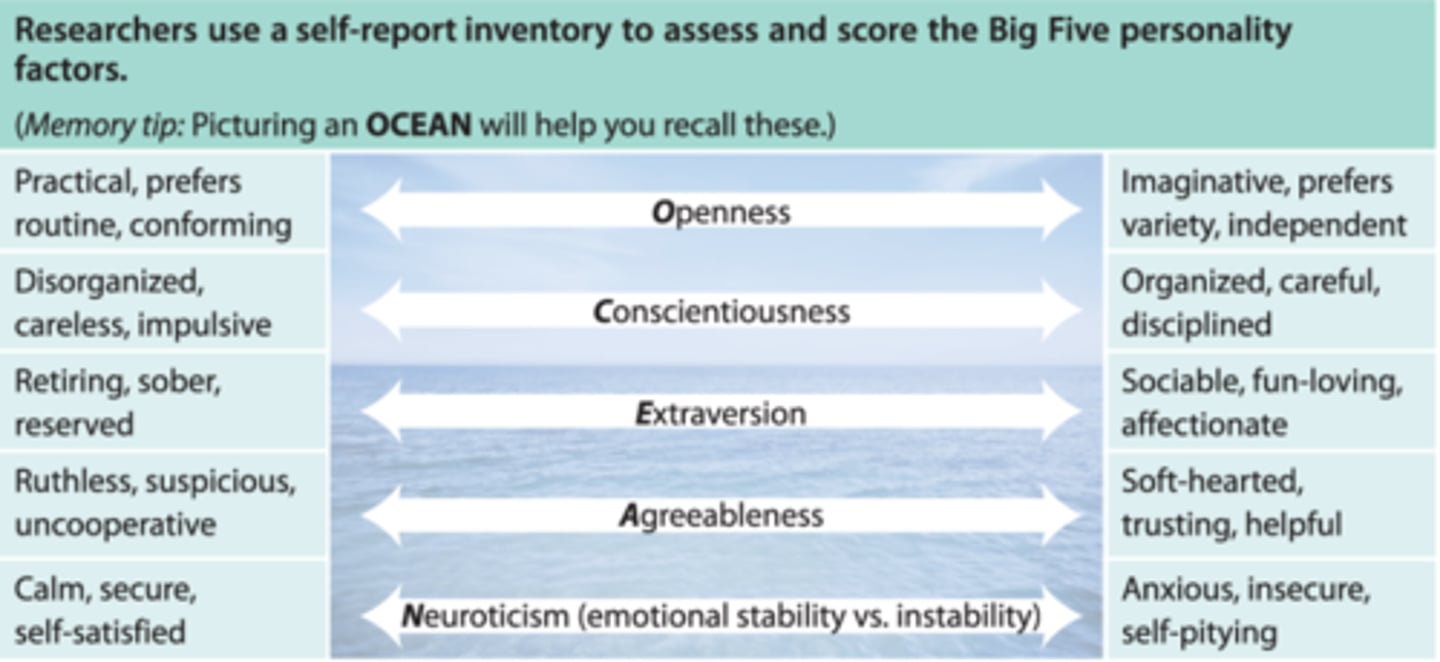
Big Five factors
five factors that describe the personality: openness, conscientiousness, extraversion, agreeableness, neuroticism
social-cognitive perspective
views behavior as influenced by the interaction between people's traits (including their thinking) and their social context.
albert bandura
reciprocal determinism
the interacting influences of behaviour, internal cognition, and environment
self
in contemporary psychology, assumed to be the center of personality, the organizer of our thoughts, feelings, and actions
spotlight effect
overestimating others' noticing and evaluating our appearance, performance, and blunders (as if we presume a spotlight shines on us)
self-esteem
one's feelings of high or low self-worth
self-efficacy
one's sense of competence and effectiveness
Freud criticisms
Lack of supporting evidence
Nonfalsifiable - you can't prove the unconscious mind exists
Lack of generalizability- Freud tried applying adult findings to kids
Too much emphasis on sex drive
Limited data set (upper class victorian ppl)
Personal biases
Neo-Freudians
followers of Freud who developed their own competing psychodynamic theories
childhood matters but more emphasis on personal relationships instead of instincts
hot-cold empathy gap
A bias in which people underestimate the influence of their current internal state on their attitudes, preferences, and behaviors
id vs ego
convergent validity
the measure should correlate more strongly with other measures of the same constructs
correlates w other tests
construct validity
the extent to which variables measure what they are supposed to measure
Barnum effect
People have the tendency to see themselves in vague, stock descriptions of personality
Trait Theory
A theory of personality that focuses on identifying, describing, and measuring individual differences in behavioral predispositions
Mischel's Person by Situation Interaction
People express particular traits in particular situations
Most likely to see consistency within these similar situations
Some traits are more situationally determined (shyness, cheating...)
Schwartz, Ward, et al.: Maximizing vs. Satisficing
Maximizers look for best choice; recipe for dissatisfaction (not the same as perfectionism)
Satisficers look for first option that's good enough
Markus and Kitayama (1991)
-Argued cultural differences in conformity reflect different conceptions of the self in individualist and collectivist cultures
-Individualist - the self is motivation for non-conformity
-Collectivist - self is interdependent and people are motivated to fit in