Ambulatory Office Pediatrics
 Call Kai
 Learn
Learn Practice Test
 Spaced Repetition
 Match
Match Flashcards
 Knowt Play
1/160

There's no tags or description
Looks like no tags are added yet.
Name | Mastery | Learn | Test | Matching | Spaced | Call with Kai |
|---|
No analytics yet
Send a link to your students to track their progress
161 Terms
What are some things we do at a WCC?
- review interval history (acute problems with pertinent ROS)
- chronic problems (w/ pertinent ROS)
- perform physical exam & developmental assessmnet
- order age-approrpiate screening tests
- administer immunizations if due
- provide anticipatory guidance
What is observed with gentials/anus on PE?
- Tanner staging
- rarely pelvic exam, but possible
What's an important MSK aspect of the PE to look out for?
scoliosis checks
What is the expected growth from birth to 6 months?
- should be back to birth weight by 2 weeks (normal for newborns to lose up to 10% of birth weight the first few days after birth)
- grow 1/2-1 in per month
- gain 5-7 oz per week
- should double birth weight by 4-6 months
What is the recommended feeding for the first 6 months of life?
breastfeeding (or at least milk) should be the only food the first 6 months
When are solids added?
solids are added after 6 months, but breastfeeding should continue until 12 months
Why is breastfeeding so important?
contains antibodies that provide protection against GI and URIs
What happens in newborns can't handle CMPA?
can't tolerate cow's milk, so if a breastfeeding mom is having any type of cow's product in diet, we'll see poor wieght gain and blood in the stool for the baby
What are pros of bottle feeding?
more maternal freedom, no worries about moms' diet, intake or medications
What are the cons of bottle feeding?
antibodies cannot be replicated, costly
True or false: a baby drinking only cows milk (before a year) can cause renal issues
true
How do we diagnose a baby who isn’t tolerating CMPA?
test stool and if it comes back for occult blood, stop mom from having diary or only give hypoallergenic formula
What is baby-led weaning?
- a feeding approach that emphasizes self-feeding and infant control of how much they consume
- offer a variety of foods that the family is already eating
- might lead to potentially less picky eating during early childhood
What to avoid in infant feeding and anticipatory guidance?
- choking hazards (nuts, grapes, popcorn, raw carrots)
- honey - associate with infant botulism
- fruit juice and cow's milk (when under 12 months)
What is failure to thrive?
failure to gain weight appropriately, especially in children younger than 3
What happens in failure to thrive?
- weight <2nd % and decreased velocity of weight gain
- "falling off the curve"
- bascially poor weight gain happens first, eventually fall off in length too
Possible etiologies of failure to thrive?
psychosocial factors, organic causes, improper formula preperation, breast feeding problems
What is the diagnostic workup when failure to thrive is suspected?
initial lab tests: CBC, BMP, UA and culture, tTG-IgA (for celiacs)
Additional testing is based on symptoms (amylase/lipase, stool studies, CXR/echo, thyroid testing)
How is failure to thrive managed?
- hospitalization
- nutrition education, high calorie formula
- frequent follow up appointments
When does BP evaluation begin?
at 3 y/o unless risk factors exist
What can a too small cuff and too large cuff cause?
too small: falsely high BP
too large: falsely low BP
What is the best way to assess BP in peds?
Auscultation, automated BP monitors are an okay alternative, but aren't always great for peds because can cause falsely high results
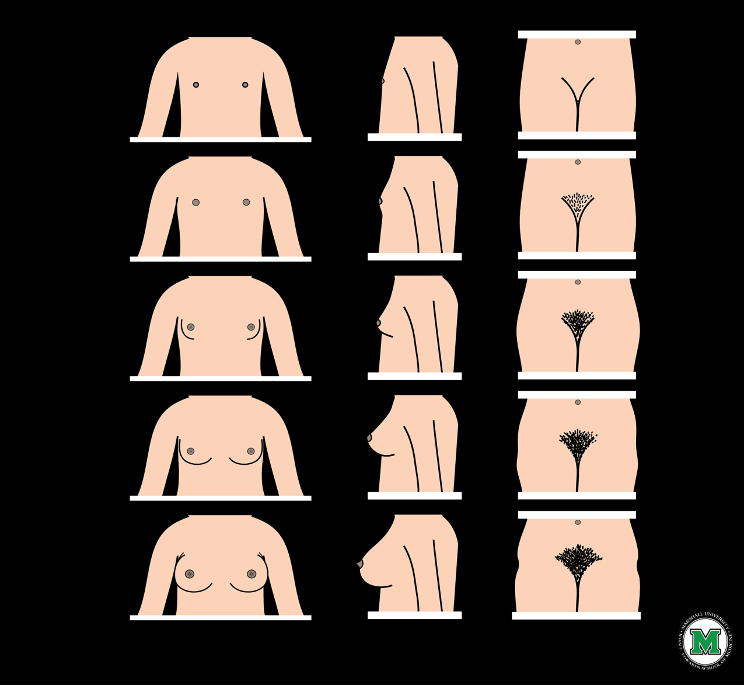
What are the 5 stages of Tanner staging (female breast)?
1. prepubertal
2. breast buds
3. growth of breast and areola
4. seperation of nipple and areola from mound of breast aka "secondary mound"
5. areola rejoins breast (complete development)
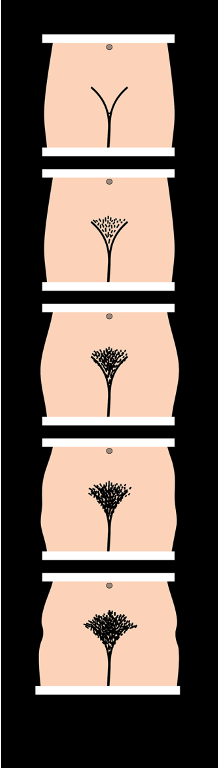
What are the 5 stages of Tanner staging (female genitalia)?
1. prepubertal
2. straight/fine pubic hair initially on mons pubis; sparse
3. hair increases in amount and is darker, curlier, more coarse and spreads to labia
4. adult type hair but limited in amount, no hair on the thighs
5. complete development (adult genitalia)
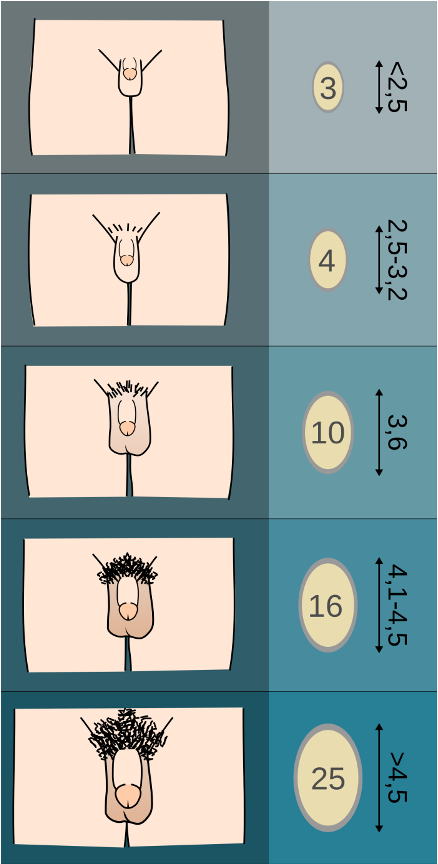
What are the 5 stages of Tanner staging (male genitalia)?
1. prepubertal
2. sparse growth of straight long, slightly pigmented hair at the base of the penis; testes increase in size, scrotal skin reddens
3. hair becomes curly, coarse and dark; penis grows in length
4. hair is full, limited in area; penis grows in width, scrotal skin darkens
5. completel development (adult genitalia)
When do most active developmental changes occur?
0-3 y/o
True or false: delays are uncommon
false; they can be common and occur in about 18% of kids
What should we be screening for as far as developmental assessment at each WCC?
- parental concerns
- developmental history
- observe the child
- identify RFs for possible delays
- accurately track findings and progress
True or False: no screening tool is universally deemed appropriate for all populations and all ages
true
What are some means of developmental assessment?
- grades and standardized testing
- performance in athletics/extracurriculars - art/music
- learning to drive a motor vehicle
When is ages and stages questionnaire 3rd edition (ASQ-3) used?
birth to age 5
What 5 domains are assessed in the ASQ-3?
1. communication
2. gross motor
3. fine motor
4. problem solving
5. personal-social
When can Denver II be administered?
0-6 y/o
What does the Denver II consist of?
consists of 125 taks-items across 4 domains
What are the 4 domains in the Denver II?
1. personal-social
2. fine motor-adaptive
3. language
4. gross motor skill
What are the scoring categories in the Denver II?
- pass
- fail
- no opportunity (NO)
- refrusal
What does pass mean in Denver II scoring?
child successfully performs item (observed/reported)
What does fail mean in Denver II scoring?
child does NOT successfully perofm item (observed/reported)
What does no opportunity mean in Denver II scoring?
used on reported items only, child has not had had the chance to perform the item due to restrictions from the caregiver or for other reasons
What does refusal mean in Denver II scoring?
child refuses to attempt the item
What are milestones for 1-2 months
- holds head erect and lifts head
- regards faces and follows objects through visual field drops
- becomes alert in response to voice
- smiles spontaneously
What are milestones for 3-5 months?
- sits with support
- turns from back to side (pushes up to elbows or forearms when on tummy)
What are the milestones for 6-8 months?
- sits alone for a short period
- imitates bye-bye
- passes object from hand to hand in midline
- rolls from back to stomach
What are the milestones for 9-11 months?
- stands alone
- uses thumb and index finger to pick things up
- walks by supporting self on furniture
What are the milestones for 1 year?
- walks independently
- says "mama" and "dada" with meaning
- can use a neat pincer grasp to pick things up
- tries to build a tower of 2 cubes
- says 1 or 2 other words
What are the milestones for 18 months?
- builds a tower of 3-4 cubes
- walks up and down stairs with help
- says 4-20 words
- feeds self
What are the milestones for 24 months?
- builds a tower of 6-7 cubes
- jump off floor with both feet
- stands on either foot alone
What are the milestones for 30 months?
- walks backward
- begins to hop on 1 foot
- copies a crude circle
- holds crayon in fist
- caries on a conversation
encopresis
severe stool blockage, but there's diarrhea leaking out because of it, so it gives the impression that the child is going
What are the milestones for 3 years?
- holds crayon with fingers
- builds tower of 9-10 cubes
- copies circle
- gives first and last name
- rides tricycle using pedals
What are the milestones for 3-4 years?
- climbs stairs with alternating feet
- begins to button and unbutton
- gives full name
- feeds self at mealtime
- takes off shoes and jacket
What are the milestones for 4-5 years?
- runs and turns without losing balance
- may stand on 1 leg for at least 10 seconds
- buttons clothes and laces shoes (does not tie)
- self-care at toliet (may need help with wiping)
- dresses self except for tying
What do abnormal developmental results require?
comprehensive, developmental, and medical evaluation, which assesses for hearing loss, metabolic d/o, lead poisoning, autism screen, and genetic disorders
What referrals should be made when there are abnormal developmental results?
- early intervention (EI) services
- PT, OT, SLP
- neurodevelopmental pediatrician/geneticist
- pediatric psychiatrist/behavioral specialist
What is the most common nutritional deficiency in children?
iron defiicency anemia
What are RFs for iron deficiency anemia?
- prematurity, breastfeeding
- early introduction of cow's milk (earlier than 12 months) and/or excess intake of cows milk (more than >24 oz/day)
Why can excessive cow's milk intake cause iron defciency anemia?
it decreases iron absorption
When do we do lead poisoning screening?
12 months and 24 months, but if high risk start at 6 months
What are RFs for lead poisoning?
home built before 1978, chipped/peeling paint, home in industrial setting, high levels in other kids in area
What are the screening options for lead poisoning?
- Risks can be assessed via a questionnaire
- capillary heel-stick (if increased, confirm with venous specimen)
- venous sample
When do we start assessing visual acuity?
perform at 3-6, 8, 10, 12, & 15 years
How is visual acuity assessed?
picture identification, tumbling E
What is considered full credit for the VA assessment?
>50% of line correct
What is the rule of 8s for VA asssessment?
patients age + the 10s digit of the denominator should be < 8? (ex. 3 y/o 20/50 = 3+5 = 8)
Who gets referral after a VA assessment?
- abnormal VA for age
- 2-line discrepnacny between the eyes
- high risk - down syndrome, preterm
What is visual screening?
instrument based screening (photoscreening and autorefraction)
What is the purpose of visual screeninga and when can it start?
does not directly assess VA, but can identify ocular RFs like strabismus, cataracts, and ptosis; can begin at 6 months
What is the most common chronic disease in childhood?
dental caries
When do we start assessing cavity risk?
6 monhts & 9 months
When should a kid start seeing the dentist?
at 12 months (or within 6 months of first tooth)
What dental supplement is needed if water source is deficient?
fluoride supplementation from 6 months - 16 y/o
What families need fluoride supplementation?
if they have well-water, they'll need supplements, even some people with city water (if levels are low) will need it
What is fluoride varnish application?
application q 3-6 months age 6 months-5 y/o, done by dentist or PCP/pediatrician; good for kids with lots of cavities
When does anxiety screening begin, and what can be used to screen
starts by 8; can use SCARED, CATS
When does depression screening begin, and what can be used to screen?
starting at 12 y/o; PHQ-2, PHQ-9
When do you screen for lipids?
9-11 y/o and then 17-21 y/o, but start earlier/repeat periodically if obesity or other CV RFs
At what age do we begin screening for PAP/HPV testing?
21
At what age do we begin screening for CG & CT?
anually if sexually active <25 y/o
At what age do we begin screening for HIV?
once between 15-21 years, anually if high risk
What amount of new HIV cases occur in pts 13-24, and what amount occur in males?
1 in 4 (26%) occuring in pts 13-24; 4 in 5 occur in males
At what age do we begin screening for hepatitis C?
> 18 y/o
At what age do we begin screening for TB?
only if high risk
What is considered infancy?
< 12 months
What is considered early childhood?
1-4 years
What is considered middle childhood?
5-10 y/o
What is considered adolescence?
anually
What are the most important aspects of medical history in comprehensive pediatric history?
- birth history
- developmental history
According to WHO, what are the percentile ranges for 0-24 months?
2nd to 98th percentile
According to the CDC, what are the percentile ranges for 0-36 months and 2-21 years?
3rd to 97th percentile OR 5th to 95th percentile
What is the expected growth in infancy at 6-12 months?
- grow 3/8 in (1 cm) per month
- gain 3-5 oz per week (0.5 oz/day)
- should triple birth weight by 1 yr (12 months)
How much milk is the baby fed at birth (0-24 hrs), and what is the expected number of feedings per day?
up to 1/2 ounce; 8 to 12 feedings
How much milk is the baby fed at birth (24-48 hrs), and what is the expected number of feedings per day?
1/2 to 1 ounce; 8 to 12 feedings
How much milk is the baby fed at birth (48-72 hrs), and what is the expected number of feedings per day?
up tp 1 ounce; 8 to 12 feedings
How much milk is the baby fed at 1 week, and what is the expected number of feedings per day?
1 to 2 ounces; 8 to 12 feedings
How much milk is the baby fed at 2 to 3 weeks, and what is the expected number of feedings per day?
2 to 3 ounces; 8 to 12 feedings
How much milk is the baby fed at 1 month, and what is the expected number of feedings per day?
3 to 4 ounces; 8 to 10 feedings
How much milk is the baby fed at 2 months, and what is the expected number of feedings per day?
4 to 5 ounces; 6 to 8 feedings
How much milk is the baby fed at 4 months, and what is the expected number of feedings per day?
4 to 6 ounces; 6 to 8 feedings
How much milk is the baby fed at 6-12 months, and what is the expected number of feedings per day?
7 to 8 ounces; 4 to 6 feedings
When is it recommended to start solids?
6 months, but continue with breast milk or formula until at least a year