Carboxylic Acids: Acidity
 Call Kai
 Learn
Learn Practice Test
 Spaced Repetition
 Match
Match Flashcards
 Knowt Play
1/10

There's no tags or description
Looks like no tags are added yet.
Name | Mastery | Learn | Test | Matching | Spaced | Call with Kai |
|---|
No analytics yet
Send a link to your students to track their progress
11 Terms
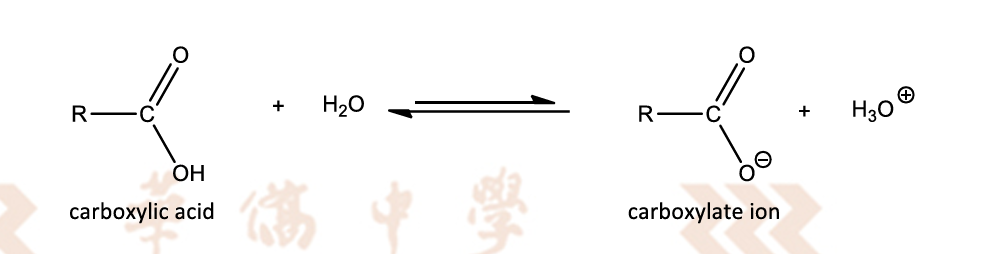
Explain acidity of carboxylic acids
O-H bond breaks to give a H+ proton and -RCO2- carboxylate ion
hence, carboxylic acids are weak(partially dissociates) Bronsted acids(proton donour)
Order the following in increasing acidity/increasing Ka/decreasing pKa
aliphatic alcohols
phenol
water
ethanoic acid
aliphatic alcohols<water<phenol<ethanoic acid
Why are carboxylic acids more acidic thatn phenols and aliphatic alcohols?
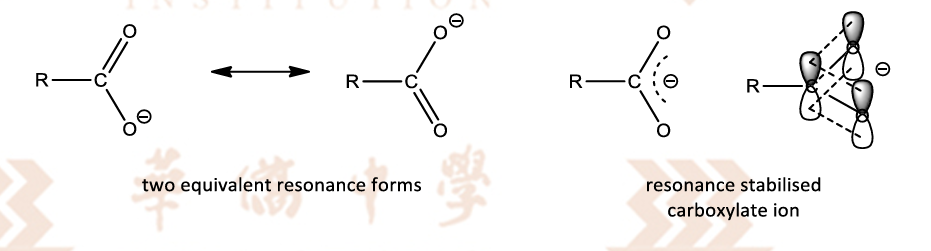
negative charge is delocalised equally over two highly electronegative oygen atoms
negative charge is more dispersed
making carboxylate ion more stabilised
carboxylic acid is more likely to get deprotonated
higher Ka, lower pKa, more acidic
wheras negative charge on phenoxide ion is less delocalised because
carbon atoms do not bear negative charge as well as two electronegative oxygen atoms in carboxylate ion
reactivity of aliphatic alcohols with
Na
NaOH(aq) [strong base]
Na2CO3(aq) OR NaHCO3(aq) [weak base]
Na: ✅
NaOH(aq) [strong base]: ❌
Na2CO3(aq) OR NaHCO3(aq) [weak base]: ❌
reactivity of phenols with
Na
NaOH(aq) [strong base]
Na2CO3(aq) OR NaHCO3(aq) [weak base]
Na: ✅
NaOH(aq) [strong base]: ✅
Na2CO3(aq) OR NaHCO3(aq) [weak base]: ❌
reactivity of phenols with
Na
NaOH(aq) [strong base]
Na2CO3(aq) OR NaHCO3(aq) [weak base]
Na: ✅
NaOH(aq) [strong base]: ✅
Na2CO3(aq) OR NaHCO3(aq) [weak base]: ✅ (most acidic compared to the other two)
Why are carboxylic acids able to react with sodium carbonate or sodium hydrogencarbonate?
Based on acid-base equilibrium, equilibrium will always lie to the right side— the side of the weaker acid and weaker base
Stronger acids are able to protonate the conjugate base of a weaker acid
carboxylic acids are stronger acids than carbonic acid
carboxylic acid is able to protonate carbonate ion(-CO32-) or hydrogencarbonate ion(-HCO2- )

Explain effect of electron-donating substitutuents on acidity of carboxylic acids
e- donating groups intensify the negative charge on the carboxylate ion
destabilising the ion
carboxylic acid less likely to deprotonate
decreasing acidity, decreasing Ka, increasing pKa
Explain effect of electron-withdrawing substitutuents on acidity of carboxylic acids. How does electronegativity of halogen in the group affect the acidity?
e- withdrawing groups disperse the negative charge on the carboxylate ion
stabilising the ion
carboxylic acid more likely to deprotonate
decreasing acidity, decreasing Ka, increasing pKa
more electronegative the halogen atom in the electron-withdrawing group
exert stronger inductive effect and disperse the negative charge more
As number of electron-withdrawing group increases, the acidity of carboxylic acid decreases/increases
as number increases
negative charge of carboxylate ion is more dispersed
carboxylate ion is more stable and more likely to deprotonate
increasing acidity, higher Ka, lower pKa
As the fruther the electron-withdrawing group is to the carborxylate group, the higher/lower the acidity of carboxylic acid
less indcuctive effect is exerted
negative charge of carboxylate ion is less dispersed
carboxylate ion is less stable and less likely to deprotonate
lower acidity, lower Ka, higher pKa