Optical Spec in Condensed Phase
 Call Kai
 Learn
Learn Practice Test
 Spaced Repetition
 Match
Match Flashcards
 Knowt Play
1/42

There's no tags or description
Looks like no tags are added yet.
Name | Mastery | Learn | Test | Matching | Spaced | Call with Kai |
|---|
No analytics yet
Send a link to your students to track their progress
43 Terms
Give the bra-ket notation for the integral of two wavefunctions of two different states
<Ψ2(x)|Ψ1(x)>
Define the Fermi golden rule
If Ψ1 = ground state wavefunction and Ψ2 = excited state wavefunction, the rate of transition,
k12 = 2π/ℏ|<Ψ2|H12|Ψ1>|2ρ(E)
When transitions are allowed, integral is non-zero.
Define photoluminescence quantum yield (PLQY)
PLQY = measure of the efficiency of the use of radiation for a particular process.
What is the difference between an excimer and exciplex?
Excimer: complex formed between two identical molecules, one of which is excited. A + A + hv → AA*
Exciplex: complex formed between two different molecules, one of which is excited. A + B + hv → AB*
Define chromophore
Chromophore: part of a molecular structure involved in the absorption and emission of optical radiation.
Give the equation linking energy gap ΔE to wavelength λ
ΔE = hc/λabs
Define the transition dipole moment, Δμ
Δμ12 = <Ψ2|μ^1|Ψ1> . Measures how strongly light couples two states, determining allowedness of transition and intensity of absorption band.
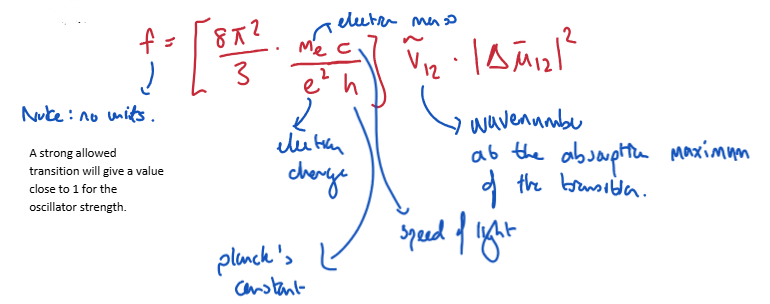
Give the equation for oscillator strength - what do values show?
measures the probability of an electronic transition. Higher f (closer to 1) = stronger absorption band
What is the effect of conjugation on transition intensity?
Where pi electrons are delocalised over the molecular length.
Conjugation increases the oscillator strength and therefore the transition intensity and absorption.
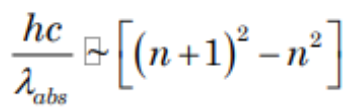
With increased conjugation, the HOMO-LUMO (band) gap decreases.
Equation can link absorption wavelength to number of pi electrons (n = no of pi electron/2)
Draw a Jablonski diagram showing non-radiative emission (internal conversion), fluorescence, phosphorescence, and intersystem crossing.
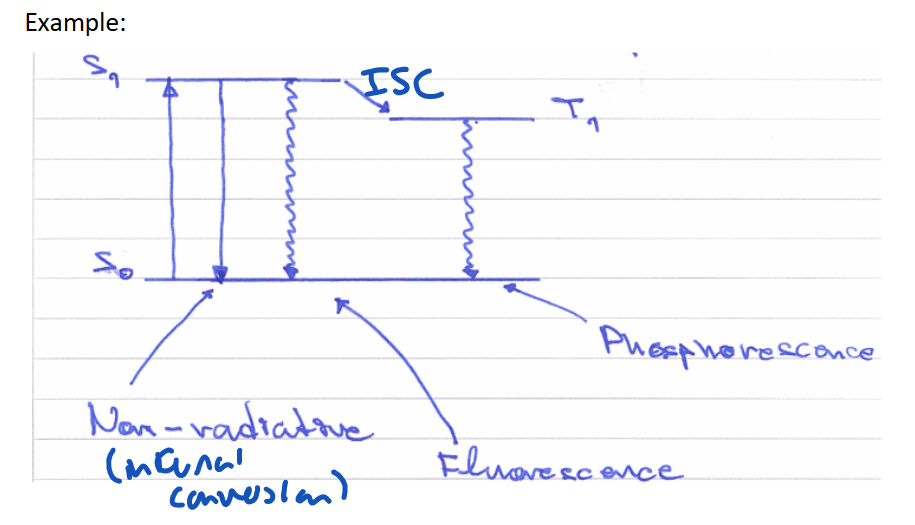
Why is there no T0 state?
Would be putting two electrons of the same spin in one orbital (forbidden).
Why does lowering the temperature promote fluorescence in stilbene?
Non-radiative S0 ← S1 relaxation can occur via torsion around the central C=C bond (conformational change). This process is competing with radiative decay, hence we see weak fluorescence, but can be stimulated by lowering the temperature so that the energy barrier for rotation is no longer reached.
What effect can viscosity have on competing non-radiative (conformational change) and radiative processes?
Conformational change is dependent on the viscosity of the solvent which causes shear friction and restricts rotation. Hence at low viscosity → low barrier → non-radiative processes. High viscosity → barrier to rotation → fluorescencce.
What is the difference between fluorescence and phosphorescence?
Fluorescence = radiative pathway between two levels of the same multiplicity. Ms = 0. S0 ← S1.
Spin allowed
Fast process (short lived).
Phosphorescence = radiative pathway between two levels of different multiplicity. MS = 1. S0 ← T1.
Spin forbidden by intersystem crossing.
Much weaker transition dipole moment and very slow so longer lifetimes.
What states are involved in intersystem crossing + why is it more prominent in heavy atoms?
T1 ← S1.
In heavy atoms (Z > 40), SOC can dominate due to large electron clouds. Larger nucleus → electrons moving at higher velocities → relativistic effects. This mixes singlet and triplet states and the triplet state gains some singlet character, so ISC becomes partially allowed. Hence more likely to see phosphorescence for heavier atoms.
How does vibronic coupling → broad spectra (emission and absorption).
Can separate the Jablonski plot electronic states into vibronic sublevels.
Fluorescence always occurs from the lowest vibrational excited state (via non-radiative processes) and can radiatively relax into many vibronic sublevels in S0 → broad spectra.
S0 absorption always occurs from the v”=0 sublevel and can absorb into many vibronic sublevels of S1. Note that the absoprtion and emission peaks are just mirror images.
Why is absorption shifted to shorter wavelengths/higher energies compared to emission? Explain what larger shifts mean.
After a molecule absorbs light, it loses some energy non-radiatively to get to the lowest vibronic sublevel of the excited states before it emits. This energy loss = Stoke’s shift = vabs - vfluores .
In the morse potential, S1 has a longer equilibrium bond length. Absorption is most intense to a higher vibrational level of the S1 due to better overlap of vibrational wavefunctions. Hence a larger stokes shift = more geometry change in the molecule’s excited state.
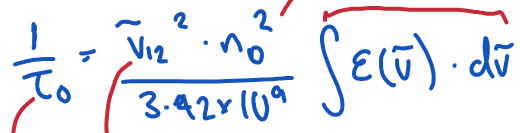
Define each term in this equation:
τ0 = natural lifetime = total lifetime in the excited state.
v12 = wavenumber in the absorption maximum.
nD = refractive index of medium.
Integral = integrated absorption band = area under peak in spectrum.
How does the concentration of molecules in the excited state change over time? What is kR in this context?
C*(t) = C*0e-kRT . kR = radiative rate = τ0-1
The rate of change of the excited state follows first order kinetics i.e. the concentration of molecules in the excited state decays exponentially.
Outline pump and probe as a technique for measuring kinetics of ground state return.
Two laser beams are used, one to excite the sample (pump) and the other to probe the absorption in the same volume.
Pump promotes transition: S1 <- S0.
Probe pulse probes the absorption of the 'bleached' sample. Probe beam goes through the sample with high intensity.
We can use a time delay on the probe beam to monitor changes in absorption as the system relaxes.
Measured in the photodetector.
Can alter the time delay depending on how far we move the mirror back.
As the sample returns to ground state the probe beam is absorbed and the intensity decreases.
What two factors impact resolution in transient absorption experiments?
The response time of the electronic detection system.
The temporal width (duration of the pulse) of the excitation pulse.
Short pulses have good time resolution but worse spectral resolution (longer bandwidth).
Give the equation for fluorescence lifetime (i.e. the factors that make up fluorescence lifetime)
τf = 1/(kR + ΣkNR)
Outline how time correlated single photon counting (TCSPC) can be used to measure the decay rate of fluorescence.
Start signal generated by pulse.
TAC starts charging up (time to amplitude converter).
When the stop signal arrives TAC stops charging. The stop signal is generated when a single photon Is detected.
Repeat to build a decay curve (histogram) of photon distribution (counts) over time (ns).
The decay curve can be fitted to an exponential function to get the fluorescene lifetime.
Give the equation for photoluminescence quantum yield - what do values closer to 100% show?
ϕPLQY = number of emitted photons/number of absorbed photons.
Larger values = chromophore is better at photoluminescene.
Give the equations for fluorescence quantum yield using (1) rates and (2) lifetimes.
ϕf = kR/(kR + ΣkNR)
ϕf = τf/τ0
Give 3 different ways the fluorescence can be quenched (i.e. reducing the fluorescence quantum yield)
Collision quenching
Electronic energy transfer
Electron transfer.
Note: the amount of quenching depends on the concentration of quenchers.
What does the Stern-Volmer constant, KSV represent?
Measures the strength of quenching interactions between chromophore and quencher. Larger KSV = more efficient quenching.
Outline the comparative method and absolute method for measuring PLQY
Comparative: sample with unknown PLQY is measured under the same experimental conditions as a known reference.
Absolute: Integrating sphere collects the luminescence of the sample in all directions. 3 different measurements required:
Measurement over the excitation line without sample. (Ppump)
Measurement over the excitation line with sample. (Pdepl)
Luminescence, F
Give the advantages and disadvantages for the absolute method and comparative method for PLQY measurements.
Comparative:
advantages: many standards available, easy.
disadvantages: tedious (x2 measurements), more error sources.
Absolute:
advantages: no standards needed, more accurate
disadvantages: difficult set up , requires expensive integrating sphere.
What is polarised light - how do we get polarised light?
Where the electric field of the electromagnetic wave oscillates in a defined direction (only 1 vector).
Arises from polarisers. Polarised light sources include laser systems.
How does 1. the electric field, 2. the angle between the electric field vector and 3. the transition dipole all impact the probability of absorption of polarised light by a chromophore?
Larger electric field (E) = stronger interactions of light and molecule = higher absorption probability.
When the angle = 0, we get maximum absorption of light. When the angle = 90 → no absorption.
Larger the transition dipole the larger the molar extinction coefficient (better interaction) therefore stronger absorption.
Outline how linear dichroism works
Orient/align the sample using liquid crystals or stretched films.
Absorption measured in orientations perpendicular and parallel to stretch
LD measures the difference in absorbance for light polarised parallel and perpendicular to a molecular alignment axes. (A∥−A⊥)
Negative signal = transition dipole moment of the chromophore oriented perpendicular to the alignment axes.
Positive signal = transition dipole moment lying along the axis.
What is the absorption order parameter - what do values show?
-0.5 </= S(λ) </= 1.0 . Describes the orientation/alignment of the absorbing transition dipole moment.
If S = 1 → perfect alignment parallel. (angle = 0)
If S = -0.5 → perfect alignment perpendicular. (angle = 90)
If S = 0 → random orientation (isotropic sample) (at the magic angle 54.7)
Outline photoselection.
Photoselection: polarised excitation light selectively excites only molecules whose absorption transition dipole moments align with the polarisation direction of the excitation beam.
Hence in the example, we will see a lower intensity for the bulk sample excited using polarised light.
What do different values of fluorescence anisotropy (r(λ)) suggest about the system?
Highly ordered system, r is around 1.0 (since there is little to no F(perpendicular))
For a non-ordered but fixed system i.e. molecules are effectively immobile during fluorescence lifetime (angle between 0-90), the max anisotropy, r0 = 0.4, which occurs when emission and absorption dipoles are colinear.
If the non-ordered but fixed system is not colinear (i.e. angle (beta) between the two dipoles) → lowered fluorescence anisotropy (-0.2 < r < 0.4). -0.2 when beta = 90.
Explain the effects of rotational motion in causing the loss of fluorescence anisotropy- how can this affect be quantified?
A chromophore in a low viscosity solvent is not fixed and can rotate fast during the fluorescence lifetime, leading to depolarisation (r → 0).
Rotational correlation motion depends on the viscosity and temperature of the solution and size of the molecule
Quantified as the rotational correlation time, Φrot = nV/kBT where n = viscosity , V = volume.
Outline how donor-donor electronic energy transfer can lead to loss of fluorescence anisotropy
Electronic energy transfer between chemically identical chromophores. The initially excited chromophore transfers its excitation energy to a neighbouring system which then in turn can transfer it further. This energy transfer effectively reassigns excitation to a molecule with a random orientation → rapid depolarisation.
What are the two ways in which electronic energy transfer occurs between a donor and an acceptor?
radiative. Donor emits light which is reabsorbed by acceptor (v. inefficient)
non-radiative (Forster mechanism or Dexter mechanism).
Outline the Forster mechanism for electronic energy transfer - when is it allowed?
A dipole-dipole interaction can occur between a donor and acceptor, facilitated for a pair of chromophores close in space.
For molecules with permanent dipole-dipole interaction.
Only allowed if there is no change in the spin of either donor or acceptor, and the dipoles are not in perpendicular mutual orientation
What factors affect the efficiency of electronic energy transfer via the Forster mechanism
Dipole-dipole coupling energy (VDA) - increase leads to more efficient transfer.
Distance: VDA falls off as 1/RDA3 (Note that the rate of electronic energy transfer falls off as 1/RDA6)
Overlap integral, J. Greater overlap between donor fluorescence and acceptor absorption → more efficient.
Forster radius (Distance between a donor and acceptor at which the efficiency of the electronic energy transfer is 50%.). If R'(DA) > R(of) = < 50% EET efficiency. If R'(DA) < R(of) = > 50% EET efficiency.

Outline each term in this equation
R = Forster radius = distance between a donor and acceptor at which the efficiency of the electronic energy transfer is 50%.
nD = refractive index
K = orientation factor. Quantifies alignments of the donor and acceptor transition dipoles. Larger K = more efficient energy transfer (greater Forster radius)
Integral = J (overlap integral)
Explain how electronic energy transfer can impact the fluorescence lifetime.
EET is in principle a fluorescence quenching process for the donor.
= Another route out of the S1 state for the donor that isn't fluorescence.
EET will limit the rate of fluorescence decays of the donor (shorter fluorescence lifetime of donor).
τf = 1/(kR + ΣkNR + kDA)
Outline the Dexter mechanism for electronic energy transfer and the factors that effect its efficiency.
Short-range process. Van der Waals contact. Simultaneous exchange of electrons by donor and acceptor, conserving spin (i.e. D and A must both singlet or both triplet) Factors:
Distance: rate of EET decays exponentially with distance between donor and acceptor.
Overlap integral: good overlap of donor and acceptor electronic wavefunctions → greater efficiency.