Part 2 of Unit 2 Test Review (Judiciary and Bureaucracy)
 Call Kai
 Learn
Learn Practice Test
 Spaced Repetition
 Match
Match Flashcards
 Knowt Play
1/35

There's no tags or description
Looks like no tags are added yet.
Name | Mastery | Learn | Test | Matching | Spaced | Call with Kai |
|---|
No analytics yet
Send a link to your students to track their progress
36 Terms
Appellate
Refers to the power of a higher court to review and revise the decisions of a lower court.
This process is the foundation of the appeals system,where a party who loses a case in a trial court can ask a higher court to review the proceedings for legal errors
Original Jurisdiction
The authority to hear a case for the first time
In cases affecting ambassadors and public ministers and those in which a state is a party
Rare Situation : The Supreme Court exercise original jurisdiction and thus serve as a trial court, typically when one state sues another over a border dispute or to settle some type of interstate compact
Attorney General
Is the chief legal officer for a nation or state who represents the government in legal matters
They advise the executive branch, supervise government attorneys, and handle high-level cases
Federal level: Heads the Department of Justice and is a member of the President’s cabinet
They are appointed by the President and confirmed by the Senate
Judicial Review
To examine acts of legislatures to see if they comport with the proposed Constitution.
→Shapes the law and how it is carried out
Binding Precedent
When a U.S district court receives a case that parallels an already decided case from the circuit level, the district court is obliged to rule the same way
Even an independent-minded judge who disagrees with the higher court’s precedent knows an appeal of a uniquely different decision, based in similar circumstances, will likely be overruled by the court above.
*All courts in the land are bound by U.S. Supreme Court decisions
Persuasive Precedent
Judges can consider past decisions made in other district courts or far away circuit courts as a guiding basis for a decision
Things to consider Precedents
Precedents can of course be overturned
No two cases are absolutely identical, which is precisely why judges make decisions on a case-by-case basis
Attitudes and interpretations differ and evolve over time in different courts
Concurring Opinion
Justices who differ from the majority can draft and issue differing opinions.Some may agree with the majority and join the vote but have reservations about the majority’s legal reasoning
Dissenting Opinion
Justices who vote against the majority
An opinion has no force of law and no immediate legal bearing but allows a justice to explain his or her disagreements to send a message to the legal community or to influence later cases
Majority Opinion
Reflecting the Court’s ruling
Justices who write this type of opinion have expertise on the topic or are obviously passionate about the issue
The majority opinion sums up the case, the Court’s decision, and its rationale
Federalist 78
Hamilton affirmed that the independent judicial branch has the power of judicial review to examine acts of legislatures to see if they comport with the proposed Constitution
He emphasized that as long as judges are acting properly, they shall remain on the bench.This “permanency” shall protect them from the other branches of government when they make unpopular but constitutional decisions
He believed an independent judiciary posed no threat
*The establishment of judicial review was not settled by Hamiltom’s writing, instead the landmark in Marbury v.Madison established that principle of judicial
Rule of Four (Supreme Court)
Once four of the nine justices agree to accept the case, the appeal is granted. This rule of four, a standard less than a majority, reflects court’s commitment to claims by minorities
Justices consider the wider national and societal impact if they take and rule on the case
Activism
When judges strike down laws or reverse public policy,
*To remember this concept, think judges acting to create the law
Can be liberal or conservative, depending on the nature of the law or executive action that is struck down
Restraint
When judges hesitate to inject their own preferences into legal rulings unless a law is clearly unconstitutional
A law should only be struck down if it violates the actual written word of the Constitution
Standing (in court)
Is the capacity of a party to bring a lawsuit in court.
To have standing, a party must demonstrate a sufficient connection to and harm from the law or action being challenged
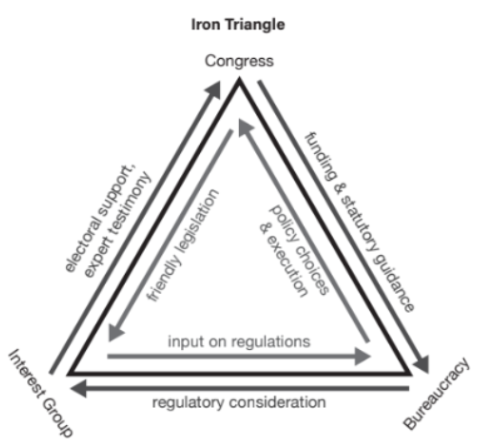
Iron Triangle
The relationship among these three entities–an agency, a congressional committee, and an interest group – is called an iron triangle because the three-way interdependent relationships are so strong
The three points of the triangle join forces to create policy
Iron triangle establishes tight relationships that are often collectively beneficial.
Ex.
→Bureaucrats have an incentive to cooperate with congressional members who fund and oversee their agencies
→Committee members have an incentive to pay attention to interest groups that can provide policy information and reward them PAC donations
→Interest groups and agencies generally are out to advance similar goals from the start
*At times iron triangles are criticized for those goals when they are exclusively for the benefit of special interest and not for the common
Issue Network: ( People )
Includes committee staffers (often the experts and real authors of legislation), academics, advocates, leaders of think tanks, interest groups, and/or the media,
These experts and stakeholders–sometimes at odds with another on matters unrelated to the issue they are addressing– collaborate to create specific policy on one issue
The policy making web has grown because of so many overlapping issues, the proliferation of interest groups, and the influence of industry Big Idea: Multiple actors and institutions interact to produce and implement possible policies
Civil service Commission
To oversee the process and prevent officials from requiring federal employees to contribute to political campaigns
A bipartisan
Part of the Pendleton Civil Service Act of 1883
Civil service reform act (1883)
Congress passed this act to prevent the constant reward to loyal party members
Merit System
Includes competitive, written exams for many job applicants
Part of the Pendleton Civil Service Act of 1883
Office of Personnel Management (OPM )
Runs the merit system and coordinates the federal application process for jobs and hiring.
Goals: Promoting the ideals of public service, finding the best people for federal jobs, and preserving merit system principles
Patronage
The bureaucracy became a place to reward loyal party leaders with federal jobs
As presidents of different parties came and went, this “rotation system” continued regardless of merit or performance of appointees
Historical Context: Jefferson filled every vacancy with members of his party
Spoils System
Presidents appointed regional and local postmasters in the many branch offices across the nation expecting loyalty in return
Type of patronage
Delegated Discretionary Authority
The power to interpret legislation and create rules– to executive departments and agencies
Congress has granted departments, agencies, bureaus, and commissions–staffed with experts in their field – varying degrees of discretion in developing their own rules and regulations required to implement sometimes vague legislation
Sometimes the laws are so vague that it not even clear that authority has been delegated to an agency
Federal Election Commission
Administering and enforcing federal campaign finance laws
Independent Regulatory Agencies
Have unique charges from Congress to enforce or regulate industry-specific law. These entities can create industry-specific regulations and issue fines and other punishments.Some are structured with a director and assistants, and some are headed by a board or commission led by a chairperson.
The president can remove upper-level executive branch officials at will, except those that head independent regulatory agencies
Can create policies with the enforcement of law for unique industries or jurisdictions
Have more specialized responsibilities in their administrative mission compared to the other agencies [ Have greater leeway and power to shape and enforce national policies than the other
Ex.FedeeralCommunications Commission (FCC), Federal Electrons Commission (FEC), Food & Drug Administration (FDA), Environmental Protection Agency (EPA), Securities & Exchanges Commission (SEC)
Appropriations
Funds set aside for a certain purpose – are typically made annually as part of the federal budget
Is a law passed by Congress that grants a specific amount of money to be spent for a particular purpose, agency, or program.
This power is a check that Congress has on the executive branch,as it controls the “power of the purse”
Appropriations Committees, are found in both houses where they influence or control the “purse strings”
Congressional Oversight
Is essentially a check and balance on the agencies themselves and competes with the president for influence with them.
With some regularity, House and Senate committees hold oversight hearings to address agency action, inaction, or their relationship with the agency.
Compliance Monitoring
Making sure the firms and companies that are subject to industry regulations are following those standards and provisions
Ex. The Environmental Protection Agency monitors for compliance in several ways. It assesses and documents compliance, requiring permits for certain activities. It collects measurable scientific evidence by taking water or air samples near a factory to measure the amount of pollutants or emissions coming from the factory
Legislative Veto
Is a requirement that certain agency decisions must wait a defined period of either 30 or 90 days.
Congress established the legislative veto in the 1930s to control executive agencies
Historical Example: During the conflict in Vietnam, congress used the legislative veto to put some limits on the deployment of military activity.
*But the public interest groups that had fought to create regulatory agencies in the 1960s watched agencies’ lawful decisions being stopped by one or the other house of Congress.
Declared unconstitutional in the 1980s
Precedent
A ruling that firmly established a legal principle
What was the constitutional argument for lifetime appointments for the courts ? : Hamilton Arguments
→As long as judges are acting properly, they shall remain on the bench.
→This “permanency” shall protect them from the other branches when they make unpopular decisions but constitutional decisions
→Believed an independent judiciary posed no threat
Mandamus
We command
Is a court order from a superior court that compels a lower court, government officer, government agency to perform a mandatory or ministerial duty they are legally required to do
Stare Decisis
Let the decision stand
Amicus Curiae
Friend of the court brief
Is an individual or organization not a party to a lawsuit who provides information, expertise, or arguments to the court to assist in making decisions, often by submitting a written amicus brief
May represent collective interest or offer specialized knowledge not covered by the involved parties
Aren’t bound by the court’s decision and may even support or oppose a party’s stance
Are often court opinions and can influence judicial decisions by highlighting broader implications or offering unique insights An amicus brief argues for a particular ruling in the case
Ex.Academic Institutions may provide expert opinions on legal matters
Writs of Certiorari
To make more certain
A court order for an official to do what they’re legally required to do