bio 2 - evolution ch 27 (post midterm)
 Call Kai
 Learn
Learn Practice Test
 Spaced Repetition
 Match
Match Flashcards
 Knowt Play
1/77

There's no tags or description
Looks like no tags are added yet.
Name | Mastery | Learn | Test | Matching | Spaced | Call with Kai |
|---|
No analytics yet
Send a link to your students to track their progress
78 Terms
do diploid organisms carry one or two copies of each chromosome(s)?
two copies of each chromosome, with one copy of each gene on each chromosome
Darwins ToE
he first thought: specific hadn’t changed since the beginning of time - naturalistic
then: proposed that species arise, change, and become extinct due to natural, not supernatural forces - evolve to survive natural selection
animals will die off if they do not change and only the best of an animal will survive
thinks over generations change occurs
Darwins natural selection
individual organisms within a species exhibit variation that can be passed from one generation to the next - heritable variation
members of a population have different functional, physical, and behavioral traits
organisms compete for available resources
individual organisms within a population differ in terms of their reproductive success
ability to have more offspring = differential reproductive success
organisms become adapted to conditions as the environment changes - says NS through differential reproductive success shapes traits, inherited from predecessors, in response to the environment - descent with modification leads to adaptation
Lamarck’s hypothesis about ToE
inheritance of acquired characteristics - environment can bring about an inherited change
thought that originally giraffes had short necks but stretched them to eat food high up and with continual stretching most giraffes now have long necks and over time passed their gradually longer necks to their offspring
epigenetic inheritance
chemical modifications to the DNA that occur in one generation may be passed on to later generations
Darwin’s natural selection
organisms become adapted to conditions as the environment changes
differential reproductive success shapes traits leading to descent with modification aka adaptation → evolved trait that helps an organism to be more suited to its environment
fossils
remains and traces of past life or any other direct evidence of past life
shells, bones, and teeth are most often preserved
most are embedded in sedimentary rock
they are deposited in layers called strata
they are older than the one above it and younger than the one below it
fossils as transitional links
shows intermediate between things such as dinosaurs and birds
whales adapted to increasing aquating lifestyle as seen as they have remnants of a hindlimb with fewer bones in smaller sizes and have changed nasal opening locations compared to their predicesors
the two methods for geological timescale
relative dating method - determines relative order of fossils and strata but not actual date
absolute method - radioactive dating technique to assign date based on half life of radioactive isotopes
evolution
all the changes that have occurred in living organisms due to differential reproductive success in living organisms over geological time
why do some individuals reproduce more than others?
because they are better suited to their environment
What are the fundamental characteristics all living organisms share?
made of cells
take chemicals and energy from environment
respond to stimuli
reproduce
biogeographical evidence of evolution
changes in cells occuring in water → we are composed of 70-90% water
continental drift - distribution of fossils and current species provide evidence of former positions of continents
mass extinctions
the main five have occurred at the end of:
Ordovician
Continental drift of Gondwana to South Pole contributed
Devonian
End of 70% of marine invertebrates
Permian
Triassic
Cretaceous periods
due to meteorite striking Earth - dinosaurs went extinct
a sixth is likely happening now
anatomical evidence of evolution
Common descent offers an explanation for anatomical similarities among organisms
homologous structures
vestigial structures
embryological dev
homologous structures - anatomical evidence of evolution
Anatomically similar because they are inherited from a common ancestor
vestigial structures - anatomical evidence of evolution
Anatomical structures fully functional in one group and reduced or nonfunctional in another
Example: snakes have no use for hindlimbs, and yet some have remnants of hindlimbs in pelvic girdle and leg
occurs due to evolution and inheritance of anatomy from ancestors
embryological development - anatomical evidence of evolution
At some time in development, all vertebrates have a tail and paired pharyngeal pouches → Reflects common ancestry
exception is analogous structures ie Serve the same function but not constructed similarly and do not share a common ancestry - wings of bird or wings of insect
biochemical evidence of evolution
Almost all organisms use the same basic biochemical molecules, including DNA, ATP, and many enzymes
all have the same DNA triplet code for same 20 amino acids in their proteins
diversity is only due to slight differences in genes
artificial selection - humans as agents of evolution
human-controlled breeding to increase the frequency of desired traits
•Works like natural selection
•Original population exhibits various characteristics, allowing humans to select preferred traits
microevolution
is the change in allele frequencies in a population over time
includes population genetics
population genetics in microevolution
is the field of biology that studies the diversity of populations at the level of the gene - interested in how genetic diversity in populations changes over generations
gene pool
the sum total of all alleles of all genes in individuals in a population
if there were 50 alleles in the peppered moth ___ (2 alleles x 25 moths) 10 were D and 40 were d then the frequency of D and d alleles would be 10/50 and 40/50
allele frequency
the proportion of each allele in a population’s gene pool
D and d adds up to 1
This relationship is true of the sum of allele frequencies in a population for any gene of any diploid organism
P + Q = 1
Hardy Weinberg equilibrium
describes a population in which allele frequencies do not change over time. uses equation p² + 2pq + q² to describe the genotype and allele frequencies in a population
principle says: Allele frequencies in a gene pool will remain at equilibrium/constant, in each generation of a large, sexually reproducing population as long as the following five conditions are met
all five conditions are never met in real world yet populations are constantly evolving
the principle is an important tool because the violation of one or more of the conditions causes allele and genotype frequencies to change in predictable ways
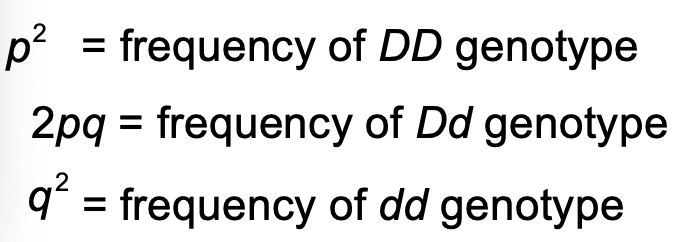
what are the five conditions that must be met for the Hardy-Weinberg equilibrium
No mutations
No genetic drift
No gene flow
Random mating
No selection
yet all five conditions are never met in real world yet populations are constantly evolving
are changes in traits that occur over an individuals lifetime evidence they have evolved?
no! these traits are not heritable
in order for traits to evolve they must be passed on to subsequent generations
evolution is about change in a heritable trait within a population, not within an individual, over many generations
significant extinction events occurred between:
holocene approx 11k years ago and now which is anthropocene
the mass extinction of 50% of all species, dinosaurs, and most reptiles occured:
between the mesozoic and current cenozoic era between 66 million years ago to 55.8 million years ago
the mass extinction of 48% of all species, including corals and ferns occurred:
between periods of mesozoic - triassic and jurassic - 201 to 145 million years ago
the mass extinction of 83% of species on land and sea occurred:
between paleozoic and mesozoic periods permian and traissic 252 to 201 million years ago
the mass extinction of over 50% of coastal marine species and corals occurred:
during the paleozoic periods of devonian 360 to carboniferous 299 million years ago
the mass extinction of over 57% of marine species occurred:
during the paleozoic periods of ordovician 443 to silurian 416 million years ago
when did Earth form?
4570 million years ago
When did the first prokaryotic cells evolve?
3500 million years ago
When did the first eukaryotic cells evolve?
2100 million years ago
When did the first protists diversify?
1000 years ago
absolute dating method
way of assigning actual date of a fossil by using the half life - length of time it takes for half of the radioactive isotope to change into another stable element
when did the five major mass extinctions occur?
during the end of ordovician (continental drift), devonian, permian, triassic, and cretaceous (asteriod) periods
what do population geneticists study?
microevolution by measuring the diversity of a population in terms of allele and genotype frequencies over generations
genetic drift - condition that must be met based on Hardy Weinberg equilibrium
random changes in allele frequencies by chance. If a population is very large, changes in allele frequencies due to chance alone are insignificant
deviation will lead to loss of allele diversity and some may disappear - change in allele frequency means evolution
no gene flow - condition that must be met based on Hardy Weinberg equilibrium
gene flow is the sharing of alleles between two populations through interbreeding. if there is no gene flow then migration of individuals and therefore their genes into or out of the populations does not occur
deviation will lead to individuals carrying alleles into or out of the population - change in allele frequency means evolution
random mating - condition that must be met based on Hardy Weinberg equilibrium
random mating occurs when individuals pair by chance and not according to their genotypes or phenotypes
deviation will change genotype frequencies but will not lead to evolution
no selection - condition that must be met based on Hardy Weinberg equilibrium
often the environment selects certain phenotypes to reproduce and have more offspring than other phenotypes. if selection does not occur no phenotype is favored over another to reproduce
deviation will have certain alleles selected for or against and change the alelle frequencies leading to evolution
bottleneck effect of genetic drift
results in severe reduction in the gene pool that affect allele frequencies after a disaster
founder effect of genetic drift
when a few individuals form a new colony and only a fraction of the total genetic diversity of the original gene pool is represented in these individuals
particular alleles carried by the founders are dictated by chance alone
results in severe reduction in the gene pool that affect allele frequencies
evolution by natural selection requirements:
individual variation - members of a population differ from one another
inheritance - many of the differences are heritable genetic differences
overproduction - too much breading for what the environment can support
differential reproductive success - some people are better at producing and producing fertile offspring
what is fitness in biology
measured by the number of fertile offspring produced htroughout its lifetime
what are the main three types of natural selection?
stabilizing selection, directional selection, and disruptive selection
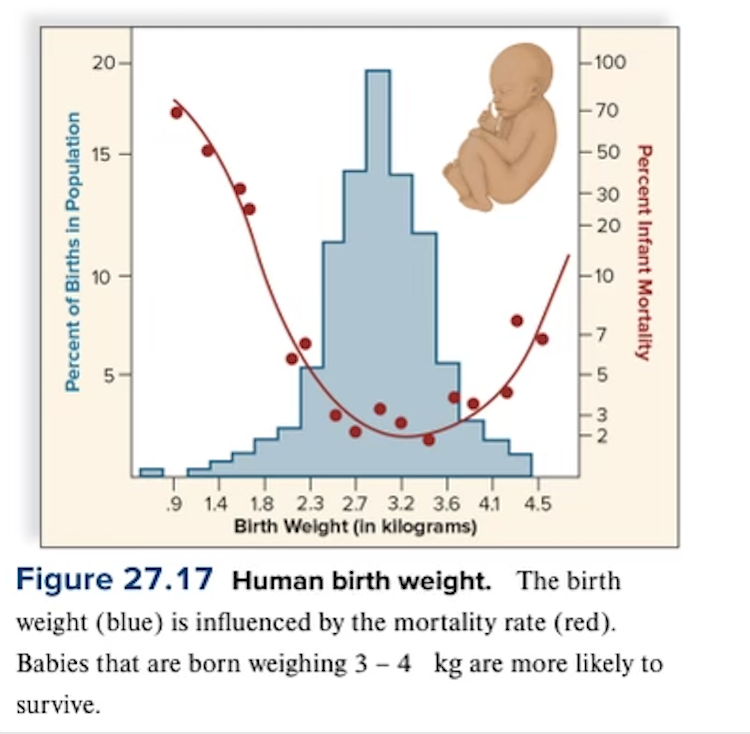
stabilizing selection
extreme phenotypes are selected against and individuals near the average are favored
can improve adaptation of the population to those aspects of the environment that remain constant
birth weight → babies have a better chance of survival when intermediate weight over too ig or too small
directional selection
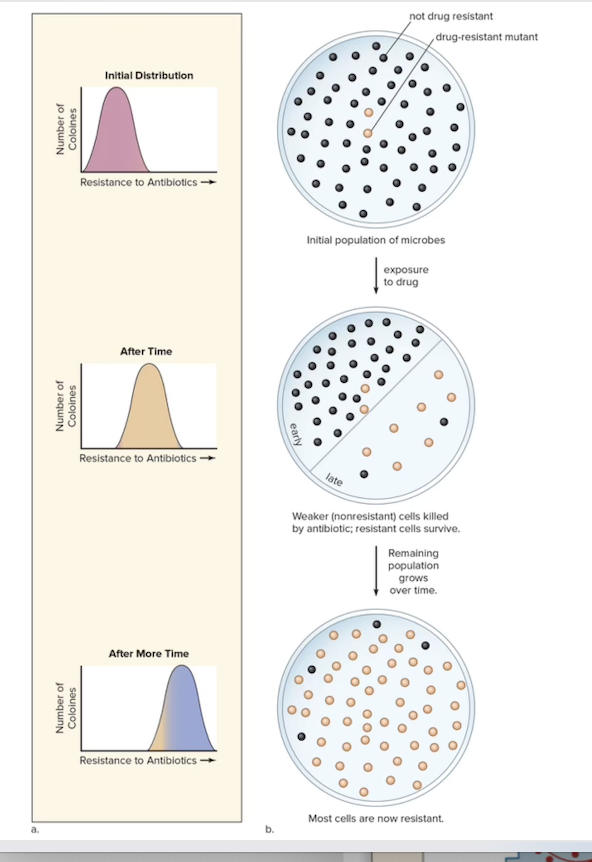
occurs when an extreme phenotype is favored and the distribution curve shifts in that direction
changes average phenotype in a population - can occur when adapting to a changing environment
ie bacteria that becomes resistant to antibiotics to survive
disruptive selection
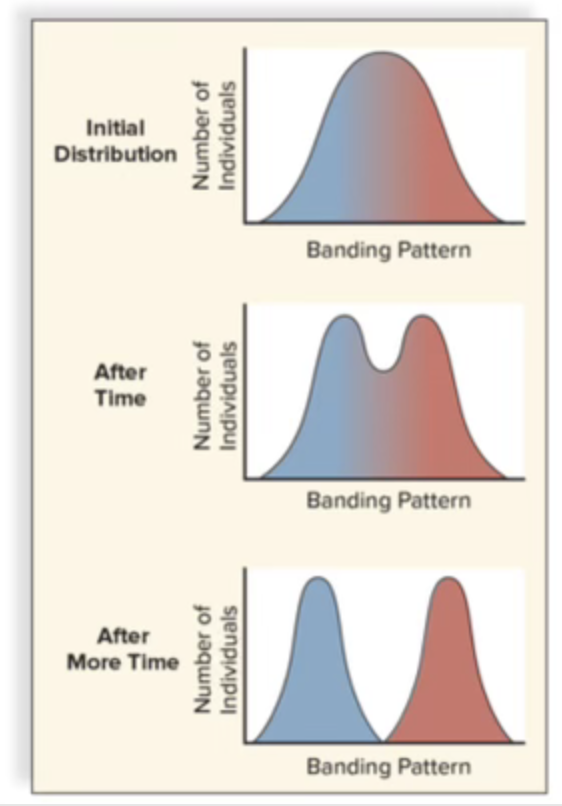
two or more extreme phenotypes are favored over any intermediate phenotype
in certain areas thrushes feed on snails with dark shells and in other areas on snails with light banded shells so they have changed to survive in their respective habitats
how an variation be maintained despite forces trying to reduce it?
mutations still generate new alleles
recombination and independent assortment shuffle alleles during gametogenesis
fertilization creates new combinations of alleles to those in the gene pool
gene flow might still occur
natural selection favors certain phenotypes but the other types may still remain in reduced frequency
the heterozygote advantage
only alleles that are expressed are subject to natural selection and this can help protect recessive alleles that otherwise could be weeded out of the gene pool by natural selection
balanced polymorphism : when NS favors a ratio of two or more phenotypes in generation after generation → sickle cell disease
recesisve phenotype may have greater fitness in a changing environment
what are the species concepts?
morphological, evolutionary, phylogenetic, and biological
morphological species concept
species are distinguished from each other by one or more diagnostic traits or distinct physical characteristics
disadvantages: in some animals it is hard to see measurable traits (bacteria), some organisms seem to be identical, some have subtle and sometimes misleading differences, fossils do not tell you about the color behavior or anatomy of soft tissue
evolutionary species concept
relies on identification of certain morphological traits to distinguish one species from another
requires that the members of a species share an evolutionary pathway
small changes that seem to be transitions in the same evolutionary would mean changes in a trait would now allow for a new species to be conceived but abrupt changes indicate the evolution of a new species in the fossil record
phylogenetic species concept
an evolutionary family tree is used to identify species based on a common ancestor, a single ancestor for two or more different groups
a species is the smallest set of interbreeding organisms, usually a population, that shares a common ancestor
a phylogeny, a branch that has all descendents of a common ancestor is said to be monophyletic - main criterion for defining species
advantage is not relying on morphological traits to define a species
biological species concept
relies on reproductive isolation, or the physiological, behavioral, and genetic processes that inhibit interbreeding
if organisms cannot pate and produce offspring in nature or if their offspring are sterile they are defined as different species
reproductive isolation mechanism
accomplished by isolating mechanisms
prezygotic isolating mechanisms are in place before fertilization and thus reproduction is never attempted
postzygotic isolating mechanisms are in place after fertilization so reproduction may take place but does not produce fertile offspring
speciation
occurrs when one species gives rise to two which continue on their own evolutionary pathway
whenever reproductive isolation develops between two formerly interbreeding groups or populations
ie allopatric speciation or sympatric speciation
allopatric speciation
occurs when populations become separated by a geographic barrier and gene flow is no longer possible
sympatric speciation
when a single population divides into two reproductively isolated groups without being geographically isolated
found with plants where multiplication of the chromosome number in one plant prevents it from successfully reproducing with others of its kinds - can self reproduce to maintain this new plant species
adaptive radiation
the proliferation of a species by adaptation to different ways of life
Tree finches are similar to woodpeckers but lack the long tongue so they use a cactus spine or twig to ferret out insects
pace of speciation
two hypotheses about the pace of speciation and therefore evolution
phyletic gradualism model
punctuated equilibrium model
phyletic gradualism model - pace of speciation
supported by Darwin - states change is slow but steady within a lineage before and after a divergence (splitting of the line of descent)
Not surprising there are few transitional links because new species come after reproductive isolation which cannot be detected in fossil records
only when a new species evolves and displaces the existing species is the new species likely to show up in the fossil record
punctuated equilibrium model - pace of speciation
says that long period s of stasis (no visible change) are followed by rapid periods of speciation
uses fossils to show that speciation occurs relatively rapidly and can explain why there are few transitional links
mass extinctions are usually followed by rapid periods of speciation
systematic biology
the study of evolutionary history of biodiversity
uses characteristics of living and fossil organisms to infer the evolutionary relationships among organisms and to then organize biodiversity based upon these relationships
taxonomists
scientists that study taxonomy, use several categories of classification created by Carl Linnaeus to show varying levels of similarity
the higher the category the more inclusive it is
taxonomy
the branch of systematic biology concerned with identifying, naming, and classifying organisms
taxon
a general name for organisms that exhibit a set of shared traits
bionomial system of nomenclature is used to assign a two part name (genus and species)
second part of the name tells you something about the organism ie sapien refers to a large brain
classification
process of naming and assigning organisms or groups of organisms to a taxon
phylogeny
a hypothesis of evolutionary relatedness among taxa represented by a family tree - the estimation and visual representation of history
cladistics
a method phylogeneticists use to construct a phylogeny called a cladogram
branches on the cladogram = clades and each has the most recent common ancestor and all its descendents
only traits that are shared among all individuals are used to define a clad - shared derived traits
not found in the “outgroup”
cladistics are based on parsimony - which considers the simplies explanation (least changes) is best to hypothesize evolutionary history
convergent evolution
independent evolution of analogous traits in distantly related lines of descent
analogous structures have the same function in different groups but organisms with these structures do not share a recent common ancestor → instead it is due to adaptation to similar environments
Linnaean classification system
carries historical taxa but sometimes homologous not analogous traits were used to classify organisms which then has trouble
three domain system
method of classification with two prokaryote groups (bacteria and archaea) and the eukaryote domain (eukarya)
supergroup
The classification of protists is complex; involves an additional level of classification so it now has this above kingdom but below domain