Data Flow Architecture
 Call Kai
 Learn
Learn Practice Test
 Spaced Repetition
 Match
Match Flashcards
 Knowt Play
1/26

There's no tags or description
Looks like no tags are added yet.
Name | Mastery | Learn | Test | Matching | Spaced | Call with Kai |
|---|
No analytics yet
Send a link to your students to track their progress
27 Terms
What is a data flow software arch? What are the components?
presents a system as a series of transformations on successive sets of data
system is decomposed into functional process modules (sub systesm), where data directs and control the order of the data computation processing
each module component in the arch. transform its input to its output data
What are some of the connection between modules components
Input-output streams
input-output files
buffers
piped streams
or other type connections
Properties of Data Flow Architecture, Focus, interactions, property
the focus in the data flow is the data availability
data can flow in a graph topology witch cycles (linear, cyclic, tree)
there is not interaction between modules except the data connection between them
the modifiability and reusability are the property attributes of the data flow architecture
arch. elements are independent of each other
each element does not need to know the identity of any other
Pipes
stateless and serve as conduits for moving stream of data between multiple filters
pipes are special cases of filters; the modification function is the identity
binairy or character stream
Filters
are stream modifiers, which process incoming data in some specialized way and send that modified data stream out over a pipe to another filter
independent data stream transformer
reads data from its input data stream
transform and processes it
writes over a pipe to next filter
does not need to wait for batched data
Batch Sequential
each transformation element cannot start its process until its previous element completes computation
data flow carries a batch of data as a whole to move from one element to another
connection links between elements are conducted through temporary files
Applicable Design Domain of Batch Sequential
data is batched
each sub-system reads related input files and writes output files
Benefits of Batch Sequential
simple division between sub-systems
each subsystem can be a stand-alone program working on input data and producing output data
Limitations of Batch Sequential
external control to (scheduler, control program)
low throughput (waiting for batch, reduces efficiency)
no interactive interface
Pipe and Filter Arch. Overview
flow is directed by data
composed of
data source
filters
pipes
data sink
connection between components are data stream
data stream is a FIFO buffer type data structure
Serialization
process of saving an object onto a storage medium or to transmit it across a network connection link in binary form
Deflating or Marshaling
the process of serializing an object
Deserialization or unmarshaling
extracting a data structure from a series of bytes
Push Only
write only
a data source may push data in a downstream
a filter may push data in a downstream
Pull only
read only
a data sink may pull data from upstream
filter may pull data
Push/Pull
read/write
filter may pull data from upstream and push transformed data in a downstream
Active Filter
pulls in data and push out the transformed data (push/pull)
it works with a passive pipe which provides read/write mechanisms for pulling and pushing
Passive Filter
lets connected pipe push data, and pull data out
it works with active pipes that pull data out from a filter and push data into next filter
UML for Pipe and Filter
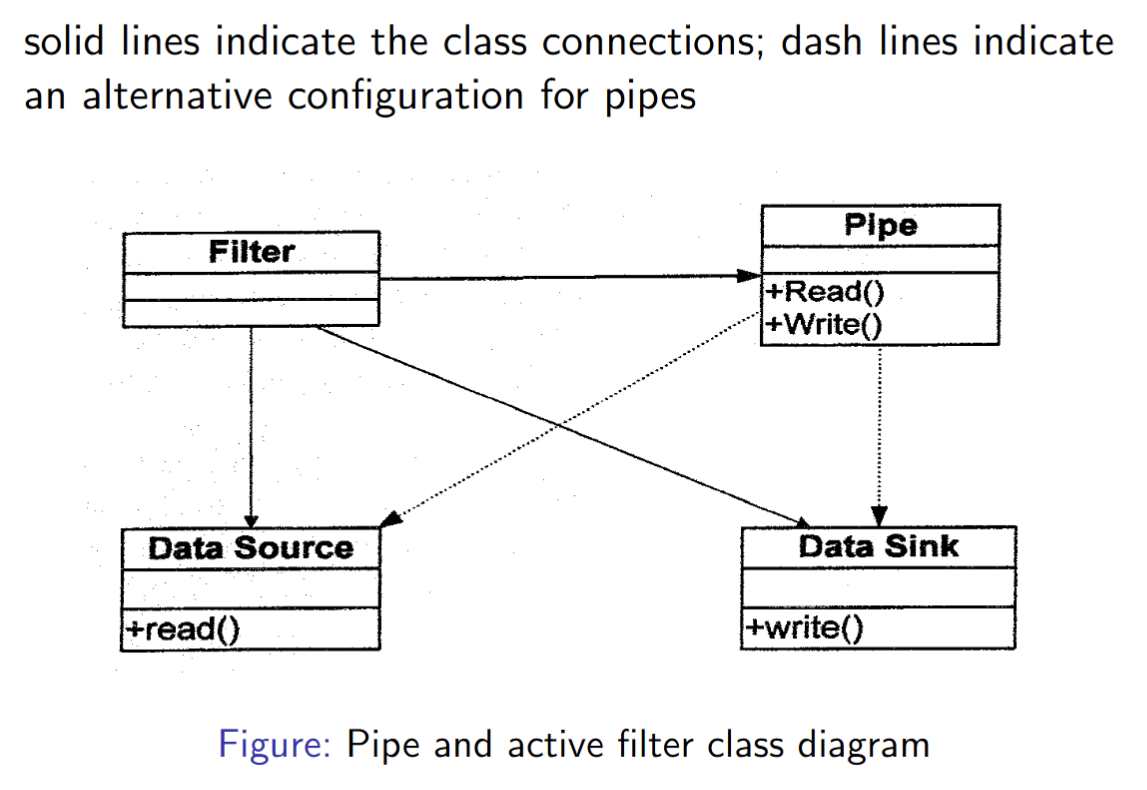
Active pipe
must have active filters
Applicable design domain of pipe and filter arch.
wherever the system can be broken into a series of processing steps over data stream
data format on the data stream is simple and stable, and easy to be adapted if it is necessary
there are significant work which can be pipelined to gain performance
suitable for producer/consumer model (one part of system creates data and the other uses ti)
Benefits of Pipe and Filter
Concurrency
reusability: Encapsulation of filters makes it easy to plug and play and to substitute
Modifiability: Low coupling between filters
Simplicity: Clear division between piped filters
Flexibility: it support sequential + parallel execution
Limitation of Pipe and Filter
not suitable for dynamic interactions, data flows, no decision logic, its fixed
Low Common Denominator is required for data transmission in the ASCII formats
the bits/s is dictated by the slowest transformer
overhead of data transformation among filters such as parsing overhead into two consecutive filters
filters must deserialize, them serialize to send out
error handling issue, don’t know what system is responsible for error, integration is hard, but unit is easy
Process-Control Architecture
suitable for embedded system software design
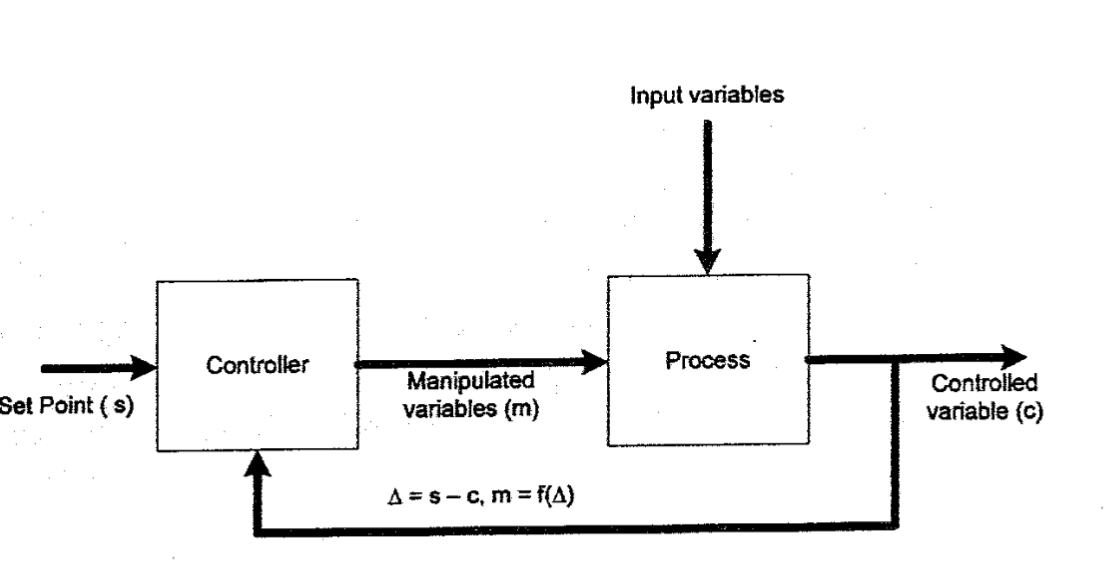
process control architecture decomposes the whole system into two type sub-systems
executor processor unit for changing process control variables
controller unit for calculating the amounts of changes
Must have the following
controlled variable: should be measured by sensors
has a set point which is the goal to reach
input variable
Manipulated variable
adjusted by the controller
Process Control Architecture UML
Applicable Domain Process Control Architecture
embedded software system involving continuous signal
system that needs to maintain an output data at a stable level
system has a target point
Benefits + limitaitons of Process Control Architecture
Better solution to the control system where no precise formula can be used to decide the manipulate variable
software can be completely embedded in the devices
Limits: can be unstable and requires thorough mathematical analysis