Non-Medical Sciences
 Call Kai
 Learn
Learn Practice Test
 Spaced Repetition
 Match
Match Flashcards
 Knowt Play
1/248

There's no tags or description
Looks like no tags are added yet.
Name | Mastery | Learn | Test | Matching | Spaced | Call with Kai |
|---|
No analytics yet
Send a link to your students to track their progress
249 Terms
Stages of an Audit
- Preparation
- Select a criteria for standards
- Measure level of performance
- Make improvements
- Sustain improvemenys
- (Reaudit)
Values of the NHS
- Collaboration
- Compassion
- Commitment to care
- Respect and dignity
- Improving lives
- Everyone counts
NHS Constiutions
Department of Health (2011)
- what dr + pt can expect from NHS
- protected from sudden political change
Health and Social Act (2012)
- Clinically led commissioning
- Increased pt involvement in NHS
- Renewed focus on public health (Public Health England)
- Concerned bodies to set standards for care + data collection
- Allow healthcare market competition in best interest of pt
Clinical Commissioning Groups (CCGs)
- Run by GPs, nurses + consultants
- Healthcare for local area
- In charge of 60% of NHS budget
NHS Foundation Trusts
- Care provided by CCG's commission
Eg. ambulance, primary care services
Types of Private Healthcare
Type 1 + Type 2
Type 1 Private Healthcare
Pt pays for healthcare directly / private health insurance
Type 2 Private Healthcare
Healthcare remains public but services are outsourced to private firms
Stigma
Negative stereotyping associated with a particular characteristic leading to discrimination
Types of Stigma
- Discreditable stigma
- Discrediting stigma
- Enacted stigma
- Felt stigma
- Projected stigma
Discreditable Stigma
Can be hidden from others
Discrediting Stigma
Can not be hidden from others
Enacted Stigma
Discrimination due to being different
Mechanic and Volkart's Triggers to Consultation
- Frequency of illness in population
- Familiarity of symptoms
- Predictability of outcome of illness
- Amount of threat + loss resulting from illness
Health Belief Model
(3PsBCS) (SSBBCS)
- Perceived susceptibility
- Perceived severity
- Perceived benefit
- Barriers
- Cue to action
- Self efficacy
4 Quadrants Approach (for decision making)
- Medical indications
- Patient preferences
- Quality of life
- Contextual features
Tanahill's Model of Health Promotion
(PPE)
- Prevention
- Protection
- Education
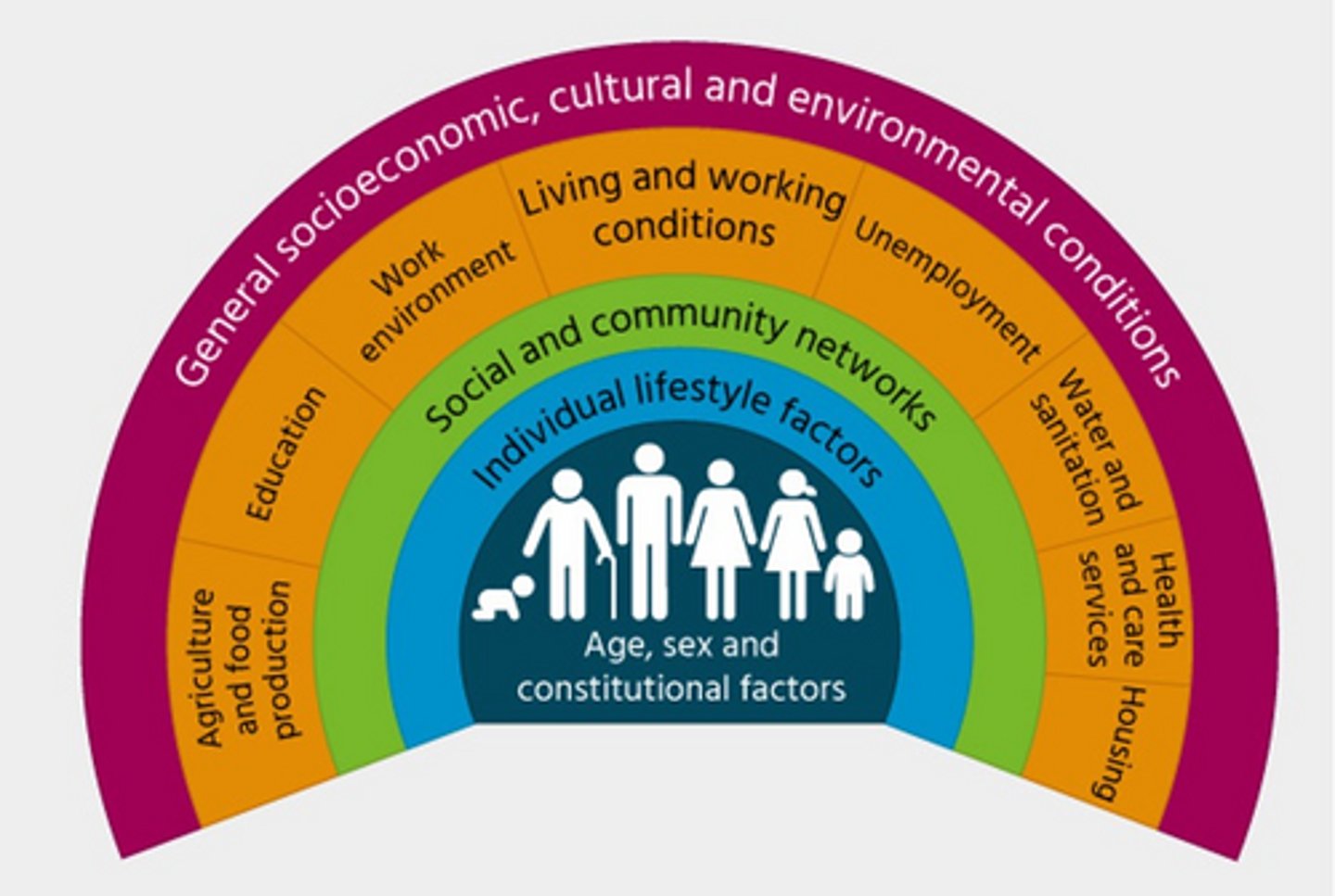
Dalgren + Whitehead's Rainbow Model (1991)
[innermost to outermost]
- Age, sex and constitutional factors
- Individual lifestyle factors
- Social + community networks
- Living + network conditions
OCEAN Personality Structure
- Openness
- Conscientiousness
- Extroverted
- Agreeability
- Neuroticism
Screening for Women: Breast Screening
- 50-70 yrs
- 70+ can self refer
Screening for Elderly: Bowel Cancer Screening
- 60-74 yrs
- home test kit every 2 yrs
Screening for Elderly: Abdominal Aortic Aneurisms (AAA) Testing
- 65+ yrs
- detects dangerous swelling in aorta
Prenatal Testing
- Amniocentesis
- Chronic villus sampling (CVS)
Prenatal Testing: Carrier Testing
Identification of genetic mutations inherited in an autosomal recessive fashion
Dignity Conservation
(ABCD)
- Attitude
- Behaviour
- Compassion
- Dialogue
Preservation of Dignity
- Control + autonomy
- Privacy
- Emotional processing
- Confidentiality + discretion
- Communication
Theory of Epidemiological Change
- Complex change in patterns of health + disease
- Includes interactions between these patterns + their demographic, economic + sociological determinants + consequences
- Made up of 5 propositions
Theory of Epidemiological Change: Proposition 2
- Long-term shifts in mortality + disease patterns
- Pandemics of infection replaced by degenerative / man-made disease as the main cause of death
3 Stages:
- Age of pestilence + famine
- Age of receding pandemics
- Age of degenerative + man-made diseases
Theory of Epidemiological Change: Proposition 3
Most profound changes in health + disease pattern are amongst children + young women
Theory of Epidemiological Change: Proposition 4
Shift in health + disease patterns closely associated to transitions in demographic + socioeconomic transitions
Theory of Epidemiological Change: Proposition 5
- Peculiar variation in pattern, pace, determinants + consequences of population change
3 Basic Models:
- Classical
- Accelerated
- Contemporary
Theory of Epidemiological Change: Proposition 5 (Classical)
Progressive transition from high mortality + fertility to low mortality + fertility
Theory of Epidemiological Change: Proposition 5 (Accelerated)
- Accelerated mortality transition
- Fluctuates from age of pestilence + famine and early phase of age of receding pandemics followed by classical model
Theory of Epidemiological Change: Proposition 5 (Contemporary)
Recent decrease in mortality whilst fertility is high
Avoiding Attachment
Mother - distant, disengaged
Child - not very explorative, emotionally distant
Reasonable Patient Test
What would a reasonable pt want to know
Specific Patient Test
What would a specific pt want to know
Mental Capacity Act (2005)
- Applies to 18+ with mental illness
1. Assume they are competent
2. Make an effort to help them make an informed decision
3. They have the right to make the 'wrong' choice
If non-capacitous
- Make a decision in their best interest
5. Make it as least restrictive as possible
Gillick Competence
- Children <16 yrs may consent if they show sufficient understanding
- Both pt + dr must be understand the dynamic of medical issue, dynamic of family and moral issues
Fraser Guidelines on Contraception
Girls <16 yrs must be given contraception if they ask for it
Legally Breaching Confidentiality
- By statue in litigation + fitness to practice cases
- Prevention + prosecution of serious crime
- Notifiable diseases - this does not include HIV/AIDS
- Audits + public health surveillance
- Coroner's inquest
- Reporting gunshot + knife wounds
Social drift and Social Causation
Social Drift - illness leads to low socioeconomic status
Social Causation - low socioeconomic status leads to illness
Disadvantages of Medical Dominance
Exclusion - takes away legitimacy of other professionals
Limitations - restricts other health territories
Subordination - makes sure that other health professionals work under and answer to doctors
Felt Stigma
Feelings of shame + guilt due to experiencing stigma
Projected Stigma
Tactics to avoid enacted stigma
Transtheoretical Model of Change
PCPAM
- Precontemplation
- Contemplation
- Preparation
- Action
- Maintenance
Note: Can enter / exit / re-enter at any stage of the cycle
Prima Fascie
- Principle is binding unless it conflicts with another moral principle
- If it does you must choose between them
- Principle is correct unless proven otherwise
- Use of discretion + judgement to decide which principle outweighs the other
Ross' Prima Facie Duties
- Fidelity
- Reparations
- Gratitude
- Justice
- Beneficence
- Self-improvement
- Non-maleficence
Human Rights Act (1998)
Respect pt rights even if their personal preferences do not align with your own
Salutogenesis
Medical approach focusing on factors that support health + well-being rather than factors that cause disease
Public Health England
- Protects + improves nation's health
- Decreases health inequalities
- Sponsored by Department of Health and Social Care
- Conducts research to improve public health challenges
Food Standards Agency (FSA) (2000)
- Protects public health + consumer's wider interests in relation to food
- Created after several high profile food-bourne illnesses
Factors FSA Monitor
- Food supply
- Food price
- Food availability
- Animal welfare
Marmot's Health Inequality Factors
(HIDES)
- Housing
- Income
- Disability
- Education
- Social isolation
6 Policy Objectives
- Give children the best start in life
- Enable all children to maximise capabilities
- Create fair employment
- Ensure healthy standard of living
- Strengthen role + impact of ill-health prevention
Parsons (1951)
- Implements social order (paternalism)
- Pt who fails to comply viewed as deviant
Stimson (1974)
Patients should have a say in their regimen
Compliance
Extent to which a a pt behaviour matches presciber's recommendations
Concordance
- Open negotiation + agreement
- Both dr + pt have equally valid health beliefs
Internal Locus
Individuals believe they are in control of what happens to them
External Locus
Individuals believe that external factors are in control of what happens to them
What makes up Public Law?
Statue law + Common law
Civil Law / Private Law
- Person vs Person
Tort's Law
- Branch of civil law
- Deals with acts leading to harm of an individual's rights, property or reputation
- Fair compensation
Contract Law
Ensures parties abide by mutual obligations
Important Human Rights Articles
(2,3,5,8)
- Right to Life (article 2)
- Prohibition of Torture (article 3)
- Right to Liberty (article 5)
- Right to respect for private life (article 8)
Priority Setting
(AIM DEN)
- Age
- Type of illness
- Merit
- Demand
- Effectiveness
- Need
Replacement Rate
- Number of children a couple would have to have to replace themselves
- Less developed countries require more children per couple due to death (additional 0.1-0.3)
Replacement Rate + Fertility Rate
- More developed countries have a tendency towards replacement
- Higher fertility rate than replacement rate leads to population growth
- Lower fertility rate than replacement rate leads to population decline but it takes a few decades
Why more developed countries have a tendency towards replacement
- Decreased child mortality rates
- Better access to food + medicine
- Less civil war
Population Screening
- Identifying healthy people who may have increased chance of a given disease
- Forms secondary prevention
- A programme of inter-related activities - not just a test
Benefits of Population Screening
- Improves long term health outcomes
- Sorts who may require additional testing
Difficulties of Population Screening
- False positives may lead to over-detection / over-treatment
Screening during Pregnancy
- Infectious diseases
- Down's, patau's and edward's syndrome
- Sickle cell disease and tharassaemia
- Physical abnormalities (mid-pregnancy scan)
Screening for Newborns
- Physical exam of eyes, heart, hips + testes
- Hearing test
- Blood spot test to check for rare conditions
Screening for diabetics
- Annual diabetic eye checks for 12+ yrs
- Detects early signs of diabetic retinopathy
Screening for Women
- Cervical screening
- Breast screening
Screening for Women: Cervical Screening
- 25-64 yrs
- Every 3 years for 26-49 yrs
- Every 5 yrs for 50-64 yrs
Screening for Elderly
- Bowel cancer screening
- Abdominal aortic aneurisms (AAA) testing
Focus Group
- Assembly of people discussing a particular viewpoint
- Researcher must be actively encouraging of + attentive to the group interaction
Advantages of Focus Groups
- Participation's thoughts
- Good at looking at what they think as they do exploratory research
- Quick results
- Saves time + money
- More data
- Minority group data
Disadvantages of Focus Groups
- Unsuitable for reflective practice
- Can cause conflict
- Use of vulnerable people
- Impact of bringing individuals from different levels of an ganisation
- Observer interference
- Sensitive topics are opted out
- Less control - discussion may go off topic
Genetic Testing during Pregnancy
- Carrier testing
- Pre-natal testing
Prenatal Testing: Amniocentesis
- Removal + testing of cells from amniotic fluid
- Check's baby's genetic / chromosomal condition
Prenatal Testing: Chronic Villus Sampling (CVS)
- Small sample of cells from placenta removed for testing
- Can be carried out earlier than amniocentesis
Prenatal Testing: Psychological Impacts
- Concerns on tests
- Stress-provoking
Beeston + Globus (1979)
- Anxiety levels highest prior to amniocentesis
- Peaks again prior to test results notification
Psychological Impacts of Testing during Pregnancy
- Anxiety
- Embarrassment
- Inferior social status (mostly in women)
- Helplessness regarding offspring's health
Predictive Testing
One's own risk for developing a disease later on in life
Predictive Testing: Psychological Impacts
Distress after learning test results
Advantages of Genetic Testing
- Future decision making in a partner (carrier testing)
- Peace of mind
- Early treatment
Disadvantages of Genetic Testing
- Change in social status (may lead to stigma)
- Psychological distress
- Long process (esp in <18 yrs)
- Negative result may lead to survivors guilt
Risks in Genetic Testing
- Miscarriage
- Stigmatising children
- Breaking confidentiality to prevent harm to other family members
- Risk of selection / slow elimination og variety on population
- Is it beneficial for the child or the parent?
Dignity
Inherent worth of every human being
Effects of Breaching Dignity
- Embarrassment
- Withdrawal
- Anger
- Apologetic
Virtue Ethics
- Focuses on character of moral agent rather than righteousness of an action
- Fuller ethical analysis than just principilism / consequentialism
Principilism
Based on core moral principles than abstract philosophical theories
Consequentialism
Moral righteousness of an action is based solely on the outcomes
Utilitarianism
Bring about the greatest happiness for the greatest number of people
Stigma with the MMR Vaccine
- Less people getting MMR vaccine due to unsubstantiated claims released in the Lancet by Andrew Wakefield
- Loss in herd immunity