Mod. 2 Time Value of Money & Valuing Cash Flow Streams
 Call Kai
 Learn
Learn Practice Test
 Spaced Repetition
 Match
Match Flashcards
 Knowt Play
1/14

There's no tags or description
Looks like no tags are added yet.
Name | Mastery | Learn | Test | Matching | Spaced | Call with Kai |
|---|
No analytics yet
Send a link to your students to track their progress
15 Terms
prefer 5,000 today instead of 5,100 in 2 years
you win a cash prize of $5,000
option A: 5,000 today
option B: 5,100 in 2 years
Choose option A because
consumption: want the money now to spend
inflation: cash doesn’t move with inflation so a dollar today is worth more than a dollar tomorrow
investment opportunity: if i have the cash today, i can invest it
money has time a value
“A dollar today is worth more than a dollar tomorrow.”
compare the $5,000 today to $5,100 in 2 years by finding
present value of 5,100
future value of 5,000
interest rate
an exchange rate across time
the rate at which we can exchange money today for money in the future
interest rate factor
1 + r =
discount factor
1 / (1 +r) =
present value
when we express the value in terms of dollars today
future value
if we express dollars in the future
timeline
a linear representation of the timing of potential cash flows
steps
1) identify periods
2) identify cash flow amounts
3) determine if its a cash inflow + or cash outflow -
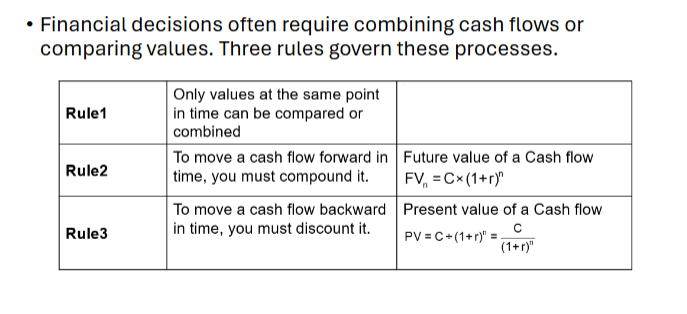
3 rules of time value
can only compare money at the same point in time
to use cash flows forward in time, it must compound (have an interest factor- future value)
to use cash flows backward in time, it must be discounted (present value)
net present value (NPV)
PV benefits - PV costs
the difference between the present value of the project or investments benefits and the present value of its costs
compares the present value of cash inflows (benefits) to the present value of cash outflows (costs)
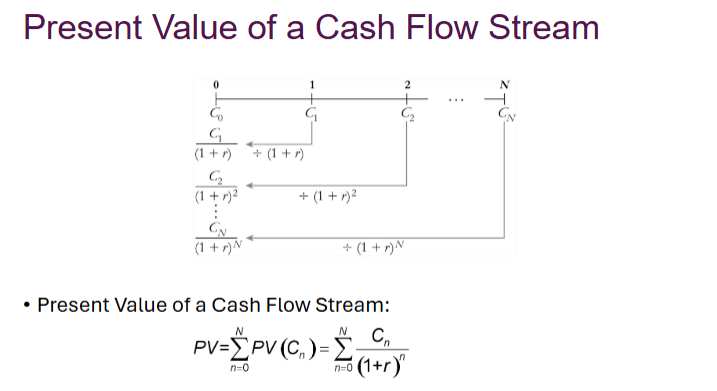
approach 1 of valuing a stream of cash flows
finding the PV (rule 3)
move the stream of cash flows backward to the same point in time
find a pv for each cash flow
add them up
approach 2 of valuing a stream of cash flows
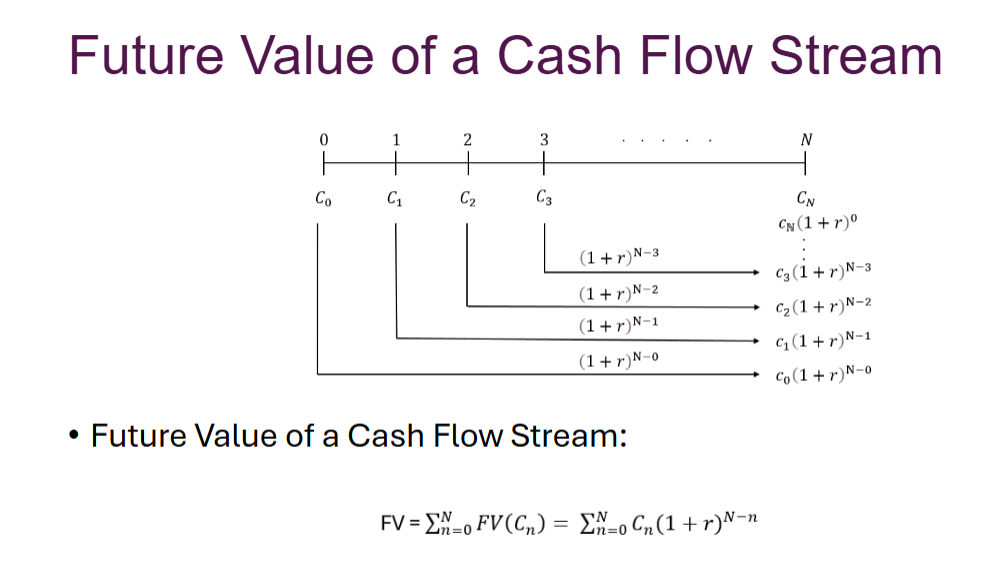
finding the FV (rule 2)
move the stream of cash flows forward to the same time point
finding an FV for each cash flow
add them up
Perpetuity
a constant cash flow that occurs at regular intervals forever
C / r = constant
C / (r-g) = growing
C = cash flows
r = rate of return or the interest rate
can have a constant or growing
Annuity
when a constant cash flow occurs at regular intervals for a finite number of periods (N)
can use a formula or calculator
N = number of payments
depends on if its at the beginning of the year = n-1
end of year = amount of yrs given
growing annuity
a cash flow stream occurring at regular intervals for a finite number of periods (N)
The initial cash flow is C, it grows at a rate of g