Mod. 8 Capital Structure
 Call Kai
 Learn
Learn Practice Test
 Spaced Repetition
 Match
Match Flashcards
 Knowt Play
1/15

There's no tags or description
Looks like no tags are added yet.
Name | Mastery | Learn | Test | Matching | Spaced | Call with Kai |
|---|
No analytics yet
Send a link to your students to track their progress
16 Terms
Main Question
Does the choice of capital structure affect firm value???
capital structure
The relative proportions of debt, equity, and other securities that a firm has outstanding
the mix of debt and equity
unlevered equity
Equity in a firm with no debt
levered equity
Equity in a firm that also has debt outstanding
Perfect Capital Market (conditions)
•There are no taxes
•There are no transaction costs and no brokerage costs.
•The capital markets are competitive.
Conclusion
Modigliani-Miller I condition
question: does debt affect a firms value in a perfect capital market?
Answer: No, firm value is independent of capital structure in the perfect capital markets.
Modigliani- Miller I
leverage and firm value in a perfect capital market
MMI proposition
•In a perfect capital market, the total value of a firm is equal to the market value of the total cash flows generated by its assets and is not affected by its choice of capital structure.
•In the absence of taxes or other transaction costs, the total cash flow paid out to all of a firm’s security holders is equal to the total cash flow generated by the firm’s assets.
•Therefore, by the Law of One Price, the firm’s securities and its assets must have the same total market value.
Two identical firms except one has debt (with taxes)
Modigliani-Miller II conditions
based on firm having debt and additionally taxes
conclusion
question: does having taxes have a negative or positive impact on company value?
Answer: positive, due to tax shield, lowers taxable income, allowing more to go to investors (in form of dividends)
•MM show that the total CF to Firm L’s investors is equal to the total CF to Firm U’s investor plus an additional amount due to interest deductibility:
•CFL = CFU + rdDT.
•What is value of these cash flows?
•Value of CFU = VU
•MM show that the value of rdDT = TD
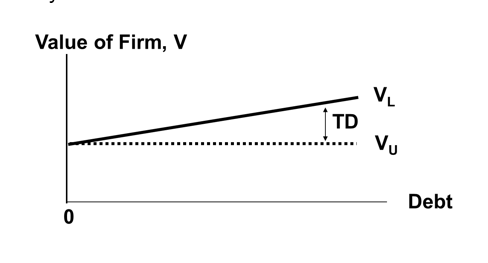
•Therefore, VL = VU + TD.
•If T = 40%, then every dollar of debt adds 40 cents of extra value to firm.
Modigliani-Miller II
leverage and firm value with corporate taxes
•Corporate tax laws allow interest to be deducted, which reduces taxes paid by levered firms.
•Therefore, more CF goes to investors and less to taxes when leverage is used.
•In other words, the debt “shields” some of the firm’s CF from taxes.
•CFU = $1,800 , CFL = $2,280,
•Tax shield on interest payment = 0.4*$1,200
•CFL ("$2,280")= CFU ($1,800 ) + rdDT (0.4*$1,200)
firm value and debt when corporate taxes are considered
under MM with corporate taxes, firm value increases continuously as more and more debt is used
tax shield
a reduction in taxable income achieved through allowable deductions, exemptions, or credits. By lowering your taxable income, it effectively "shields" a portion of your earnings from taxation, resulting in lower overall tax liabilities for individuals and businesses
debt lowers the total taxable income amount, meaning the firm pays less in taxes, increasing its cash flows
more cash flows goes to investors and less to tax
= tax rate * interest payment * debt
based on the tax and debt amount
with debt = lowers net income, but also lowers taxes
interest payments are not taxable
levered firms have larger firm value under this condition
exam Q for MMI
when does debt not/ cannot affect the firm value?
answer: in perfect capital markets
means no taxes, no friction, is competitive
generates similar cash flows even with different levels of debt use
idea that IN a IMPERFECT capital market, debt DOES affect firm value
next Q is if this is a good thing or bad thing MMII
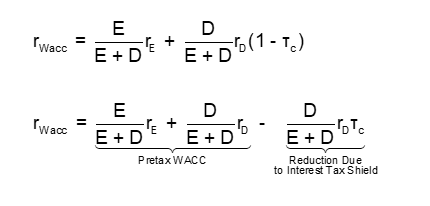
WACC with taxes
•With tax-deductible interest, the effective after-tax borrowing rate is and the weighted average cost of capital becomes
Exam Q for MMII
in environment with taxes and the company has some debt, given the tax rate, debt amount and interest rate, estimate the tax* shield
Answer: Tax debt interest rate (which is T * D *rd)
VL = Vu + TS (TS = TD in symbols, is the additional value)
the additional value created by debt according to MMII shows how the use of debt in taxed markets IS positive
next Q. what is the optimal level of debt (trade-off theory)
trade off theory
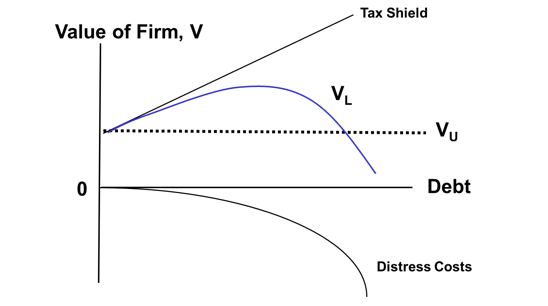
•MM theory ignores bankruptcy (financial distress) costs, which increase as more leverage is used.
•At low leverage levels, tax benefits outweigh bankruptcy costs.
•At high levels, bankruptcy costs outweigh tax benefits.
•An optimal capital structure exists that balances these costs and benefits.
can we maximize firm value with debt?
MMII is based on unrealistic expectations that the firm will be able to generate enough earnings to pay off the debt aka never go bankrupt (this is not realistic)
tax shiel v cost of financial distress
graphically shows how debt is beneficial up to a point
tied to trade off theory
VL = firm value
VU = optimal amount of debt
Hamada’s formula
used for finding the optimal capital structure/ amount of debt a company should use
•MM theory implies that beta changes with leverage.
•bU is the beta of a firm when it has no debt (the unlevered beta)
•bL = bU [1 + (1 - T)(wd/ws)]
beta: affects cost of equity, WACC, total and average risk of company
WACC used in firm valuation of DCF
maximizing firm value = minimizing WACC
this equation connects capital structure to cost of equity through the beta and WACC estimation