quiz 4: chapter 12 - adolescent development
 Call Kai
 Learn
Learn Practice Test
 Spaced Repetition
 Match
Match Flashcards
 Knowt Play
1/25

There's no tags or description
Looks like no tags are added yet.
Name | Mastery | Learn | Test | Matching | Spaced | Call with Kai |
|---|
No analytics yet
Send a link to your students to track their progress
26 Terms
Cultivation Theory and Social Learning
__: proposes that media gradually shape or “cultivate” a person’s worldview, so that over time it comes to resemble the worldview most frequently presented by media.
Adolescents who are heavy users of television, video games, and YouTube have been found to endorse views of __ that involve emotional detachment, dominance, and toughness, compared to lighter users of these media.
One aspect of cultivation theory is known as __ (Gerbner et al., 1994): the more people watch TV and other similar media, the more they are likely to believe that the world is a dangerous place, that crime rates are high and rising, and that they themselves are at risk for being a victim of a crime.
↪ According to cultivation theory, they believe this because media often depict crime and violence, which leads viewers to cultivate a view of the __ as mean, violent, and dangerous.
Cultivation theory.
masculinity.
mean world syndrome.
world.
Cultivation Theory and Social Learning
__ theory focuses on the effects of media on children and adolescents (Bandura, 1994).
Social learning theory addresses people’s ? rather than their worldview.
According to this theory, people will be more likely to __ they see frequently performed by models who are rewarded or at least not punished.
In a famous experiment known as the “Bobo doll” study, children watched an adult kicking and punching a clownlike doll (“Bobo”). Later, the children __ the adult’s behavior almost exactly.
Studies have found that heavier exposure to sexual content on TV is related to earlier/later initiation of sexual intercourse, and this has been interpreted as indicating that the adolescents modeled their sexual behavior after the TV characters.
Many of the studies using social learning theory have concerned the relationship between television and ?.
Social learning.
behavior.
imitate behaviors.
imitated.
earlier.
aggression.
Uses and Gratifications Approach
In contrast to cultivation theory and social learning theory, the __ approach emphasizes that people actively make choices about how they use media on the basis of their developmental motivations and needs.
This theory views people as active/passive rather than active/passive media consumers.
This theory emphasizes that how media content influences a person depends on the ? and motives that the person has for seeking out certain media content in the first place.
The uses and gratifications approach is based on two/three key principles.
uses and gratifications.
active. passive.
needs.
two.
Uses and Gratifications Approach
The first principle is that people differ in numerous ways that lead them to make __ to consume.
↪ For example, not all adolescents like violent shows; the __ approach assumes that adolescents who like such shows differ from adolescents who do not, prior to any effect that watching violent shows may have.
The second principle is that people consuming the same media product will respond to it in a variety of ways, depending on their __.
↪ For example, some adolescent girls may respond to other girls’ social media photos by feeling more insecure about the way they look, whereas other girls may be relatively unaffected.
different choices about which media.
uses and gratifications.
individual characteristics.
Uses and Gratifications Approach
Rather than viewing young people as the passive, easily manipulated targets of media influences, the __ approach asks, “What sort of uses or purposes motivate young people to go to a movie, or listen to a song, or use Google, or post on TikTok? And what sort of gratifications or satisfactions do they receive from the media they choose?”
uses and gratifications.
Media Practice Model
__ model: proposes that adolescents’ media use is active in a number of ways.
Adolescents do not all have the same media preferences. Rather, each adolescent’s __ motivates the selection of media products.
Paying attention to certain media products leads to interaction with those products, meaning that the products are ? and interpreted.
Then adolescents engage in __ of the media content they have chosen.
They may incorporate this content into their __—for example, girls who respond to thin models by seeking to be thin themselves.
Or they may __ the content—for example, girls who respond to thin models by rejecting them as a false ideal. Their developing identity then motivates new media selections, and so on.
Media practice model asks how adolescents select, interact with, and apply media products in the course of developing an __.
Media practice.
identity.
evaluated.
application.
identities.
resist.
identity.
Rates of Media Use
In the early 21st century, for adolescents in many developed/developing countries, media are a nearly constant presence in their daily lives. Increasingly, the dominant method of media use is the __.
In the US, about 95% of adolescents ages 13 to 17 have access to a __.
Nearly __ American households also own a TV.
In contrast, access to computers and tablets depends on family income.
↪ About 92% of adolescents from middle- to high-income/low-income families have access to a home computer, compared to 67% of adolescents from middle- to high-income/low-income families.
↪ In about 78% of middle- to high-income/low-income households, adolescents have access to a tablet, compared to only 60% of adolescents from middle- to high-income/low-income families.
developed. smartphone.
smartphone.
all.
middle- to high-income. low-income.
middle- to high-income. low-income.
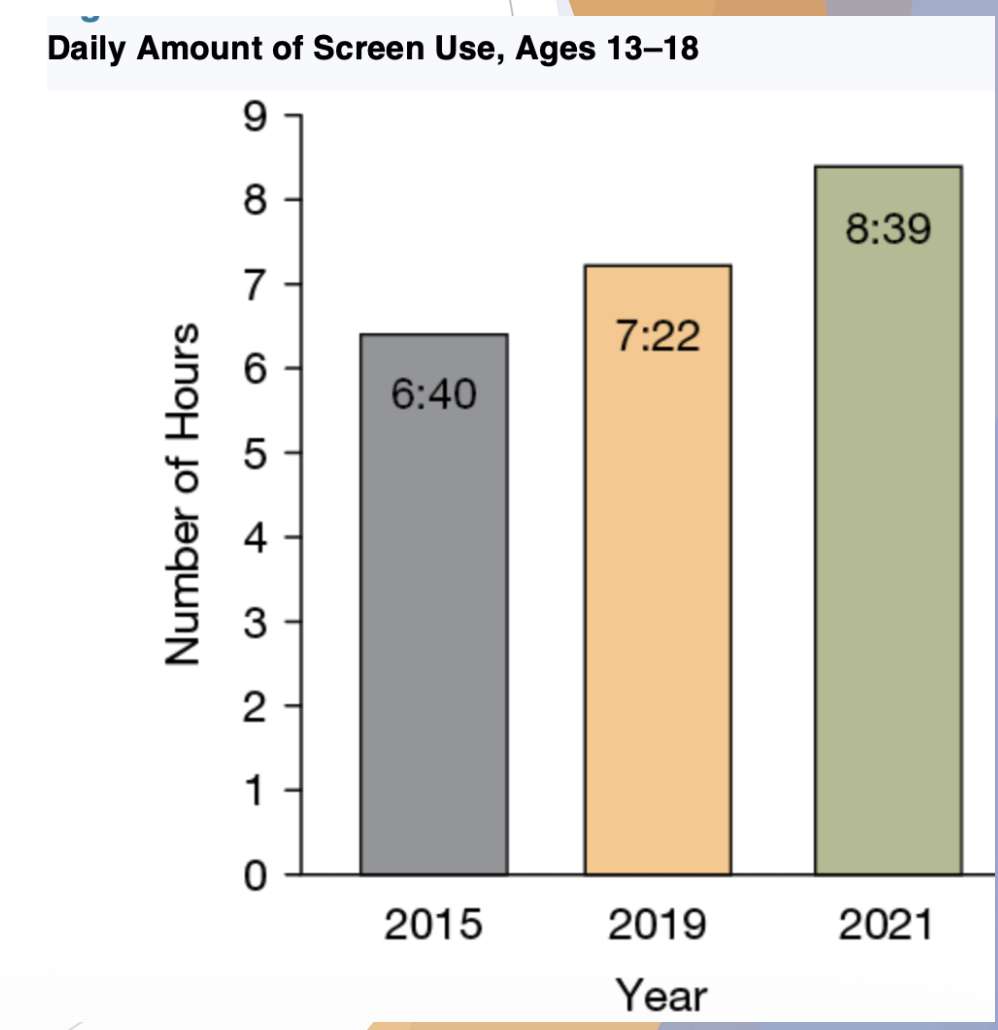
Rates of Media Use
The hours per day that adolescents spend on screen use have been steadily climbing/decreasing in recent decades and ticked upward/downward again during the COVID-19 pandemic.
Surveys that measure “screen use” include time spent watching television and online videos, playing video games, using social media, browsing websites, creating content, e-reading, and other digital activities.
More than __ hours of screen use in a typical day is a lot of hours!
climbing. upward.
8.
Rates of Media Use
Part of the explanation for the frequent daily use of media is __, in which a media activity is combined with other activities.
For example, the TV might be on while eating dinner, or an adolescent might be texting while simultaneously using a computer.
Smartphones and other mobile devices (such as tablets) allow adolescents to be __ essentially everywhere at all times.
One survey found that 44% of 13- to 17-year-olds were online several times a day and another 45% reported being online “almost __.”
multitasking.
online.
constantly.
Rates of Media Use
The three most common daily screen use activities among adolescents are ? (77%), ? (62%), and ? (49%).
The three activities they enjoy the most are ? (62%), ? (39%), and ? (34%).
Even though low-income households have less access to tablets and computers, adolescents from these households actually spend less/more time on screens—just over __ hours a day, compared to just over 7 hours a day for adolescents from high-income families—because they watch more TV.
watching online videos. using social media. watching TV.
watching online videos. playing video games. using social media.
more time. 9.
Rates of Media Use
While only a majority/minority of adolescents say they enjoy using social media, it is a widely used type of media that has grown phenomenally, especially among adolescents.
As recently as 2015, __ was the most popular social media platform, used by more than 70% of adolescents, but now only 40% report having ever used Facebook.
YouTube, Instagram, TikTok, and Snapchat have become less/more popular.
minority.
Facebook.
more.
Types of Media Use
Adolescents, like people of other ages, often make use of media simply for __, as an enjoyable part of their leisure lives.
__ often accompanies young people’s leisure, from driving around in a car to hanging out with friends to secluding themselves in the privacy of their bedrooms for contemplation.
The most common motivation stated by adolescents for listening to music is “to have __.”
Television is used by many adolescents as a way of diverting themselves from personal concerns with entertainment that is active/passive, distracting, and undemanding.
Entertainment is clearly one of the uses young people seek when watching __ videos as well.
Young people generally use media for the __ purposes of fun, amusement, and recreation.
entertainment.
Music.
fun.
passive.
online.
entertainment.
Types of Media Use
Often media are used to find information for __.
T/F: Adolescents also seek out information online that would be difficult or impossible to obtain within their immediate environment.
For example, a survey of American Indian and Alaska Native teenagers from rural communities found that three-quarters had access to the internet, and that one of the most common uses included “to get news about” ? topics (76%), ? and entertainment (68%), and current events or ? (49%).
The researchers pointed out that for these youth, who live in low-income and rural communities, __ are important sources of information.
schoolwork.
TRUE.
health. sports. politics.
media.
Types of Media Use
Media scholars have also proposed that media function as a __ for adolescents, meaning that adolescents often look to media for information (especially concerning sexuality) that their parents may be unwilling to provide, in the same way they might look to a.
T/F: These scholars point out that adolescents indeed gain information from media, but also warn that media may be misleading (for example, leading to overestimates of the number of teens who are sexually active).
super peer.
TRUE.
Types of Media Use
Another notable use of media among adolescents is __, a personality characteristic defined by the extent to which a person enjoys novelty and intensity of sensation.
T/F: Adolescents and emerging adults tend to be higher in sensation seeking than adults, and certain media provide the intense and novel sensations that appeal to many young people.
Overall, sensation seeking is related to higher/lower media consumption in adolescence, especially video watching (online or on TV), music, and video games.
Adolescent girls/boys dominate the audiences for the high-sensation music genres of rap, heavy metal, and hard rock, as well as “action” films with scenes involving explosions, car chases and crashes, gunfire.
sensation seeking.
TRUE.
higher.
boys.
Types of Media Use
Young people also use media to relieve and dispel __ emotions.
Studies indicate that listening to ? and watching ? and videos are coping strategies adolescents commonly use when they are angry, anxious, or unhappy.
T/F: Music may be particularly important in this respect.
↪ In early adolescence, when the number of problems at home, at school, and with friends increases, time spent listening to music also decreases/increases.
↪ Certain types of music, such as hip-hop or heavy metal, may appeal especially to young people who use music for __.
Adolescents often turn to videos and television as a way of turning off the ? emotions that have accumulated during the day.
↪ Watching videos can be fun and funny, but at the same it also helps adolescents __ and dispel negative emotions.
negative.
music and TV.
TRUE.
increases.
coping.
stressful.
relax.
Identity Formation
__: the development of a conception of one’s values, abilities, and hopes for the future.
Identity is partly what makes a person unique, but an identity is also __, as adolescents and emerging adults figure out their gender identity, cultural identity, political identity, and so on.
Media can provide materials that young people use toward the construction of an __.
Part of identity formation is thinking about the kind of ? you would like to become, and in media, adolescents find ? selves to emulate and ? selves to avoid.
The use of media for this purpose is reflected in the pictures and posters adolescents put up in their __, which are often of media stars from entertainment and sports.
Identity formation.
social.
identity.
person. ideal. feared.
rooms.
Identity Formation
Media can also provide adolescents with information that would otherwise be unavailable to them, and some of this information may be used to help construct an __.
↪ For example, research has shown that sexual and gender minority adolescents use the internet to find information about sexual and gender identity labels, and to learn about critical processes such as coming out or gender transition.
Adolescents also use media to learn sexual and romantic scripts.
↪ For example, how to approach a potential romantic partner for the first time, how to resolve problems in a relationship, and even how to kiss.
Gender, sexuality, and romantic relationships are central to the kind of identity exploration and identity formation for which adolescents use __.
identity.
media.
Youth Culture
Media consumption can give adolescents a sense of being connected to a __ or subculture that is united by certain youth-specific values and interests.
In cultures where people change residence frequently (such as the US), media provide rare/common ground for all adolescents.
No matter where they move within the US, adolescents will find ? in their new area who have watched the same movies, listened to the same music, and played the same video games.
youth culture.
common.
peers.
Socializing with Peer and Friends
Adolescents and emerging adults use media for __ with peers and friends.
Sometimes this means ? with each other.
↪ One survey found that 45% of 12- to 14-year-olds play __ because they “like to compete with others and win.”
In focus groups, adolescent girls/boys also say that video games are a frequent conversation topic among their peers.
Smartphones and social media are other ways that media are used for __ with peers.
↪ In a national survey of adolescents, they described __ as the most important benefit of social media.
socializing.
competing.
video games.
boys.
socializing.
keeping in contact with friends.
Do Media Undermine Adolescents’ Socialization?
An important difference exists between media and other __ contexts in the adolescent’s environment, such as family members, teachers, community members, law enforcement agents, and religious authorities.
Typically, these other socializers have an interest in encouraging the adolescent to accept the attitudes, beliefs, and values of adults to preserve __ order and pass the ? on from one generation to the next.
In contrast, media are typically presented by people whose primary concern is the __ success of the media enterprise.
As a result, the content of media consumed by adolescents is driven not by a desire to promote successful socialization but by the uses adolescents themselves can __.
T/F: Because the media are largely market-driven, media providers are likely to provide adolescents with whatever it is they believe adolescents want—within the limits imposed on media providers by other adult socializers such as parents and legal authorities.
socialization.
social. culture.
economic.
make of media.
TRUE.
Do Media Undermine Adolescents’ Socialization?
This means that adolescents have greater/less control over their socialization from media than they do over socialization from family or school.
This has two important consequences.
First, it results in a great deal of __ in the media available to adolescents, from classical music to K-pop, from public television to pornography, from LinkedIn to Instagram, as media providers try to cover every potential ? of the market for media products.
T/F: Adolescents can choose from among this diversity whatever media materials best suit their personalities and preferences, and on any given occasion adolescents can choose the media materials that best suit the circumstances and their emotional state.
greater.
diversity. niche.
TRUE.
Do Media Undermine Adolescents’ Socialization?
Second, to some extent this socialization goes over the heads of the other socializing adults in the adolescent’s environment.
Parents may try to impose restrictions on the music, movies, video games, and internet sites their adolescents access.
↪ In one national study, 61% of parents reported checking the websites their adolescents visited, and 60% said they checked their adolescents’ social media profile.
↪ A minority/majority of parents used controls for blocking or filtering their adolescents’ online activities (39%) and restricting their smartphone use (16%).
But if an adolescent is determined to access certain media, it is probably impossible for parents to prevent it, because adolescents have so much __ when their parents are not monitoring them.
minority.
daily time.
Media Violence and Aggressiveness
Although hundreds of studies have been conducted on watching violent media content and aggression, the evidence that such content is a motivator of aggressive behavior in adolescents is mixed/leaned toward one side.
Correlational studies show a relationship between watching violent media and ?, the evidence that such content is a motivator of aggressive behavior in adolescents is mixed/leaned toward one side.
Correlational studies show a relationship between watching violent media and children’s __, but this does not account for self-selection of media content, and in any case the relationship is not as strong for adolescents as it is for children.
mixed.
children. mixed.
aggression.
Video Games and Aggressiveness
Most adolescents do/do not become aggressive as consequence of playing violent video games.
However, a subgroup of adolescents (about 10%, more boys than girls) are attracted to the violence in video games in ?-adolescence, and by the time they reach early emerging adulthood their level of aggression has continued to increase/decrease.
Additionally, they show increasing symptoms of depression, anxiety, and ?.
In the rare studies that ask adolescents how they are affected by the games, they say they enjoy the fantasy role-play and the social aspect, and that the games have a cathartic effect on their __.
do not.
mid. increase.
shyness.
anger.
Controversial Advertising
__ advertising has a long history of exploiting adolescents’ needs for independence and for acceptance by peers.
Studies find that cigarette advertisements from past decades for Camel, Kool, Marlboro, and Newport were highly attractive/unattractive to adolescents, especially adolescent smokers, and that these brands were also the ones adolescents were most likely to smoke.
Internal tobacco company documents provide evidence that __ companies explicitly sought to appeal to adolescents.
In recent years tobacco advertising in developed/developing countries has been restricted, and the focus of the advertising has switched to online ads for ? products and to developing countries.
Cigarette.
attractive.
tobacco.
developed. vaping.