L8b Memory: encoding processes
 Call Kai
 Learn
Learn Practice Test
 Spaced Repetition
 Match
Match Flashcards
 Knowt Play
1/49

There's no tags or description
Looks like no tags are added yet.
Name | Mastery | Learn | Test | Matching | Spaced | Call with Kai |
|---|
No analytics yet
Send a link to your students to track their progress
50 Terms
What are the 3 stages of memory
encoding, consolidation + storage, retrieval
What is the theory vs reality of these 3 stages of memory
they occur in sequential stages vs there is dynamic movement forwards and backwards in the stages
What is the Zeigarnik effect
the tendency to remember uncompleted or interrupted tasks better than completed ones
4 methods of creating long-lasting memories
practice and repetition, spacing and the testing effect, motivation, organisation and schemas
What is the Total Time hypothesis, proposed by Ebbinghaus, about learning and study time
learning is linearly related to the amount of study time
What can we assume then drives brain plasticity
practice
What brain area was large in taxi drivers and what did the brain area’s size correlate with
posterior hippocampus, correlated with time spent as a taxi driver
Experiment – medical students were scanned at three intervals (before, during, and after intensive exams) – what increased in which two brains areas and how long did these effects last
gray matter volume in the parietal cortex and posterior hippocampus, 3 months
What is the repetition effect
that generally, repetition improves learning
When does simple repetition fail to lead to learning
no attempt to organise the material, especially if info is complex and not perceived as useful
What indicates that memory and attention is very selective
extensive practice is not registered if not deemed important
What is spaced repetition
distributing learning trials sparsely across a period of time
What are the 2 outcomes of spaced repetition
faster improvement rates of learning and less forgetting
Why does spaced repetition work – what does it allow for and what this means for memory
allows for consolidation between trials which enables memory to become more firmly established
What are the caveats of spaced repetition (2)
takes longer so not always practical or convenient and individuals may feel less efficient
What two conditions did Kornell and Bjork test when getting students to learn the styles of 12 artists, and which was more effective
interleaved (spaced) vs massed, interleaved was more effective
Baddeley and Longman tested 4 training schedules for learning typing skills, which training led to the fastest learning (hour/day and for how long)
1hr day over 11 weeks compared to those training 4hrs a day in 4 weeks
What is the testing effect
testing yourself produces between learning than simply reviewing/re-studying material
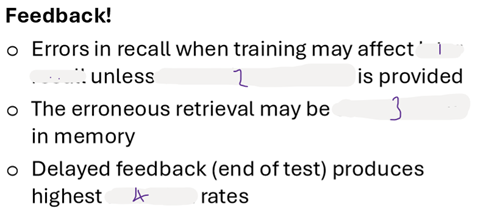
Fill in the gaps about feedback in the testing effect (2 is two words)
later recall, corrective feedback, strengthened, retention
What study strategy promoted the deepest learning (inference effects)
group that studied then tested themselves
Motivation to learn can make learning more efficient, what are the two ways motivation can affect learning
automatically or strategically
How does motivation affect learning automatically
external or internal motives prior to exposure to stimuli improves memory
How does motivation affect learning strategically
people use deeper and more elaborate memorisation strategies for high value items
What did Gruber et al find about curiosity and memory
high curiosity during learning improved memory but not only for the item of interested but also for unrelated incidental material presented close in time
Does a familiar or novel environment facilitate enhanced memory encoding
novel
How does novelty facilitate memory encoding – what does it trigger the release of, in what area of the brain (VTA), and what brain area does this engage
dopaminergic release in the ventral tegmental area -> engaged hippocampal encoding of the novel information
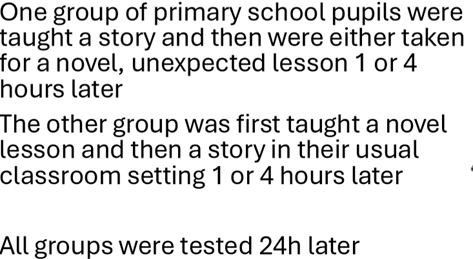
Ballarini et al tested novelty and memory in children, these were the two conditions as well as a control condition which involved no novelty – what was the effect of these unrelated novel experiences on children’s memory
improved in the one-hour condition, no effect in 4-hour gap
What brain regions and brain area is associated with motivation-enhanced memory encoding
network of brain regions involving the hippocampus
What are subsequent memory effects
brain areas more active during encoding for items later remembered compared to items later forgotten
Which brain area showed subsequent memory effects in Kim et al’s meta analysis
hippocampus
What is subjective organisation, according to Tulving
chunking together separate words for recall, even if those words weren’t encoded together
3 ways to chunk together items
linked to a common associate, coming from the same semantic category, or forming a logical hierarchical structure
How did Frederic Bartlett’s approach to memory differ, what type of information did he examine (3)
recall of complex materials, recall errors and meaningful information
What did Bartlett argue was the best way to organise thought and eventually memory
by giving meaning to studied materials
2 ways in which ascribing meaning to stimuli can influence learning/memory
modulate encoding of information and how it is stored in memory
What is Paivio’s Dual-coding hypothesis (related to meaning)
more imageable words are more memorable
Why are imageable words more memorable
can be encoded via multiple routes which improves the chance of successful recall
Words with high imageability e.g. church, arm, apple, can be encoded via what two routes
visual appearance and verbal meaning
Words with low imageability e.g. virtue, history, silence, can be encoded via what one routes
verbal meaning
What is the hypothesis that attempts to explain why meaning facilitates long-term memory
levels of processing (LOP) framework
Explain the LOP framework by Craik and Lockhart, what is memory a by-product of
memory is a by-product of the depth at which information is processed
What are the 3 levels of processing
visual processing is shallow, phonological is intermediate and semantic processing is the deepest and most memorable
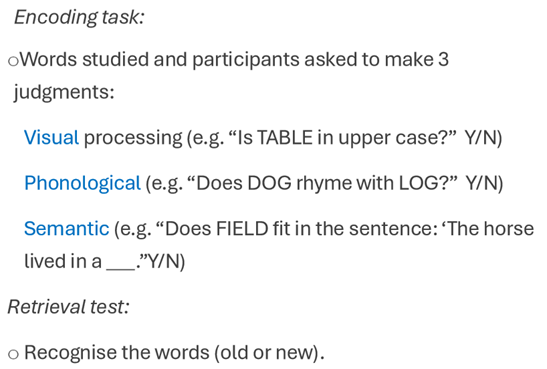
Craik and Tulving’s levels of processing experiment – which condition elicited greater recall
semantic
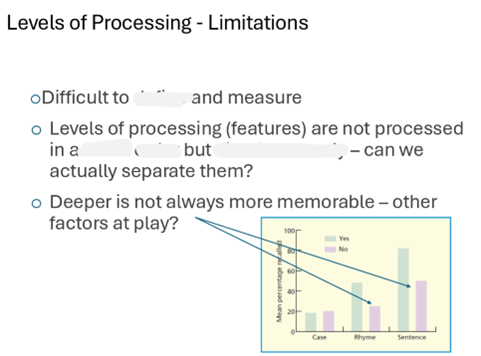
Complete the limitations of LOP framework
define, serial order, simultaneously
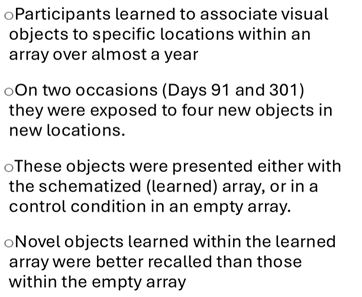
What does this experimental evidence by Sommer et al demonstrate about schemas and memory
existing schemas support new encoding
In a study by Liu et al., participants had to encode associations between faces and houses, they remembered double the amount of pairs when the faces were famous – what does this suggest
prior knowledge supports encoding
What two Brian regions support the integration of new information with prior knowledge
ventromedial prefrontal cortex (vmPFC) and hippocampus
What is the overall conclusion about organisations and schemas in memory
when given the opportunity to organise information (e.g. schema, semantic knowledge), memory performance is guided by meaning
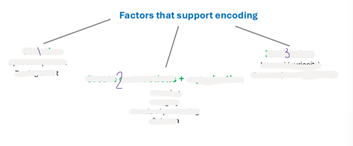
What are the 3 factors that support encoding
practice, create connections + organisation, and motivation
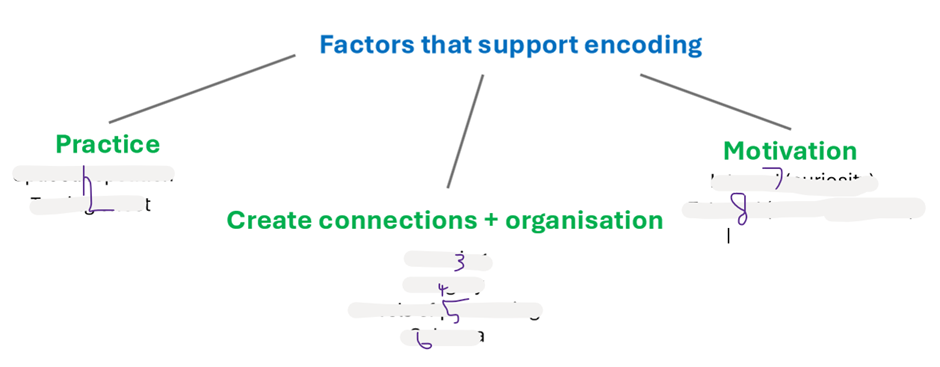
What are the tools used within each factor
spaced repetition and testing effect; meaning, imagery, levels of processing and schema; internal and external