chem unit 4 summer
 Call Kai
 Learn
Learn Practice Test
 Spaced Repetition
 Match
Match Flashcards
 Knowt Play
1/100

There's no tags or description
Looks like no tags are added yet.
Name | Mastery | Learn | Test | Matching | Spaced | Call with Kai |
|---|
No analytics yet
Send a link to your students to track their progress
101 Terms
bio catalysts
large proteins, lowers activation energy, unchanged by reaction
properties of enzymes
not permanently altered or consumed in rxn, effective in small amounts, accelerates the rate the rxn eq rate without altering eq point
enzyme rxn
E + S with ES= E+P
isoform
diff forms of the same protein
isoenzyme
enzyme isoforms that catalyze the same rxn but differ in structure and tissue distribution
zymogen= proenzyme
secreted in inactive form to prevent action until needed
enzyme composition
apoenzyme= protein, inactive without cofactor
cofactor= allows enzyme to function, loose bind to tight (covalent/prosthetic group)
holoenzyme (catalytically active unit)= apoenzyme + cofactor
inorganic activator (ZN alkakine phosphatase) organic coenzyme (NAD+)
allosteric vs active site
all- where regulatory molecules bind (back)
act- where substraye binds
oxidoreductases
oxidation-reduction reaction between 2 substrates
transferases
the transfer of a group other than hydrogen between 2 substrates
hydrolases
hydrolytic cleavage of substrates
lyase
removal of groups from substrates without hydrolysis, products contain db
isomerse
interconversion of geometric, optical, or positional isomers
ligase
the joining of 2 substates molecules, coupled with breaking of the pyro-phosphate bond in adenosine triphosphate ATP or a similar compound
inhibitors
decrease rate of reaction, reversible or permanent
competitive inhibitor
similar to substrate, competes for active site
noncomp inhibitor
binds to allosteric site (back), changes structure of enzyme so it can’t bind substrate
uncomp inhibitor
binds enzyme-substrate and prevents release of product
purpose of testing enzymes
enzymes are concentrated in specific tissues and organs, “normal” enzyme concentration in plasma = normal cell turnover, increase= increases cell injury or synthesis, decreased= decreased synthesis or inherited deficiency
enzyme activity affected by temp and pH
=proteins, optimal within physiological range (37C, low slow, high denaturation 40-50), extreme pH= denaturation, controlled by incubation water baths/ buffers
enzyme activity affected by cofactors and inhibitors
= gas and brakes pedals, necessary cofactors must be in reagent, comp inhibitor can be out competed by increasing sub concentration
enzyme activity affected by substrate concentration
= direct relationship until saturation, low concentration(slow), high (faster), reagents include 10-100x excess substrate to ensure we reach saturation
enzyme activity affected by enzyme concentration
=target analyte, with all other variables controlled, enzyme activity is directly proportional to enzyme concentration
enzyme activity affected by temp, pH, cofactor, inhibitor, substrate concentration
= controlled by analzyer/reagent
michaelis-menten curve
relationship between substrate concentration and rxn velocity
maximum velocity- occurs at enzyme saturation, excessive substrate
Km= constant, [S] at ½ Vmax, unique to E with specific S, E-S affinity (lower affin higher Km)
V= Vmax [S] / Km + [S]
first order kinetics
velocity directly proportional to the substrate concentration
zero order kinetics
velocity plateau, velocity is independent of substrate concentration , linear, enzymes cannot work any faster, producing constant amount of product
enzyme measured by
change in absorbance (product formation, substrate depletion, coenzyme depletion, altered coenzyme formation)
enzyme measurement methods
fixed-time / discontinuous / end-point assay (rxn stopped at a specific time with addition of weak acid)
continuous monitoring / kinetic assay (more common)
enzyme activity unit
amount of enzyme that produces 1 umol of product per minute under standardized conditions, IU/L or U/L
direct enzyme measurement
electrophoresis or immunoassay for isoenzymes and isoforms
oxidoreductases
catalyze oxidation-reduction reactions between 2 substrates (lactate dehydrogenase)
transferases
catalyze the transfer of a group other than hydrogen between 2 substrates (creatine kinase)
hydrolases
catalyze hydrolytic cleavage of substrate (lipase and amylase)
tissue specificity
high- found predominately in one tissue, moderate- widely distributed in the body, low- found in most body tissue
lactate dehydrogenase LD LDH manifestations
myocardial infarction, hepatic disorder, hemolysis, carcinoma
lactate dehydrogenase LD LDH
oxidoreductase involved in anaerobic glycolysis, found in most cells of the body, highest amount in liver, heart, skel muscle, rbc
lactate dehydrogenase LD LDH significance
total increase or relative increase of one isoenzyme, cardio elevated in MI, myocarditis, shock, CHF, highest in pericious anemia, megaloblastic anemia
lactate dehydrogenase LD LDH measurement
forward, lactate to pyruvate yielding NADH, absorbance at 340nm
lactate + NAD with lactase dehydrogenase to Pyruvate + NADH + H
ref range 100-224 U/L
creatine kinase manifestation
myocardial infraction, skeletal muscle disorder
creatine kinase
transferase involved in ATP regeneration in muscle cells, stores phosphate as creatine phosphate for energy, highest amount found in skel muscle brain heart
creatine kinase significance
isoenzymes used in diagnosis of specific conditions, dimer with 2 subunits (m= muscle, b= brain), 3 combinations (CK-MM skel and card muscle, CK-BB brain and CNS, CK-MB cardiac muscle)
creatine kinase measurement
reverse reaction, hexokiinase- G6PD-NADPH system, increased 340 nm absorbance as NADPH is formed
creatine phosphate + ADP with CK to creatine + ATP then ATP + glucose with KH to ADP + G6PD then G6PD + NADP with G6PD to 6-phosphoglucanate + NADPH
CK ref range
male 46-171, female 34-145
CK-MB: less that 5% total CK
aspartate aminotransferase ALT or SGOT manifestation
myocardial infection, hepatic disorder, skeletal muscle disorder
aspartate aminotransferase ALT or SGOT
transferase (transfer of an amino group between aspartate and alpha keto acids), synthesis and degradation of amino acids, highest amount in liver (highest in acute hepatocellular disorders), heart, skel musc, kidney
aspartate aminotransferase ALT or SGOT measurement
decrease in absorbance at 340 nm
L-Aspartate + a-ketoglutarate <asorartate aminotransferase (P5P)> oxaloacetate + L-Glutamate
Oxaloacetate + NADH + H with malate dehydrogenase to malate + NAD
aspartate aminotransferase ALT or SGOT ref range
5-35 U/L
alanine aminotransferase ALT (AGPT) manifestation
hepatic disorder
alanine aminotransferase ALT (AGPT)
catalyzes transfer of amino group from alanine to a-ketoglutarate, highest amount in liver (more specific than ast, highest in acute viral or toxic hep, moderately increased in obstructive liver disease, hepatic cancer and cirrhosis)
alanine aminotransferase ALT (AGPT) measurement
decrease in absorbance at 340 nm
alanine + a-ketoglutarate with alanine aminotransferase (P5P) to pyruvate + L-Glutamate
Pyruvate + NADH with lactase dehydrogenase to L-Lactate + NAD+
alanine aminotransferase ALT (AGPT) ref range
7-45
alkaline phosphatase ALP manifestation
hepatic disorder, bone disorder
alkaline phosphatase ALP
frees inorganic phosphate from organic phosphate yielding alc, found in most tissue, highest amount in bone (osteoblast involvment= higher ALP) and LIVER
alkaline phosphatase ALP measurement
increase in absorbance 405 nm
alkaline phosphatase ALP ref range
4-15y= 54-369
males 20-50y= 53-128
males over 60y= 56-119
females 20-50y= 42-98
females over 60y= 53-141
gamma-glutamyltransferase GGT manifestation
hepatic disorder
gamma-glutamyltransferase GGT
transferase involved in pro synthesis, regulation of tissue glutathione, and transport of amino acids across membranes
found in liver, brain, prostate, pancreas, kidney
elevated in alcoholism, hepatobiliary disorders, pancreatitis, diabetes
gamma-glutamyltransferase GGT measurement
increased absorbance at 405 nm
Y-Glutamyl-P-nitroanilide + Glycylglycine to P-nitroaniline (yellow) + Glutamylglycylglycine
gamma-glutamyltransferase GGT ref range
male 6-55
female 5-38
amylase AMY manifestation
acute pancreatitis
amylase AMY
hydrolase involved in the digestion of starch, secreted by salivary glands and pancreas, diagnose pancreatitis, elevated in gastric and duodenal uulcers, renal disease, narcotic use, mumps
amylase AMY measurement
synthetic carb hydrolyzed by amylase producing color change measured spectrophotometrically
amylase AMY ref range
30-220
lipase LPS manifestation
acute pancreatitis
lipase LPS
catalyzes the hydrolysis of triglycerides, primarily sourced from pancreas, elevated in acute pancreatitis, pancreatic carcinoma, kidney disease, duodenal ulcers, intestinal obstruction
lipase LPS measurement
synthetic lipid substrate measuring the rate of color formation spectrophotometrically
lipase LPS ref range
under 38
electrolytes
ions capable of carrying an electrical charge, needed for fluid balance, nerve conduction, muscle contraction, acid base balance, enzyme function
water
60% of body weight, intracellular fluid ICF = 2/3, extracellular fluid ECF= 1/3 (intravascular- plasma, interstitial- surrounding cells, transcellular- body fluids like csf synovial pleural peritoneal)
electrolyte distribution is maintained by
diffusion and active transport
Na/K ATPase pump: ATP pumps 3Na out f the cell and 2 K in
intracellular and extracellular lytes
i- K, Mg, phosphate
e- Na, Cl, HCO3
osmolality
concentration of solute(milliosmoles) in a solution
increase affect on hypothalamus- increase in thirst, arginine vasopressin hormone AVP/ antidiuretic hormone ADH secretion by the posterior pituitary then reabsorb by the water
decrease causes opposite
osmolality measured by
freezing point depression (more dissolved particles= lower freezing point), vapor pressure decrease
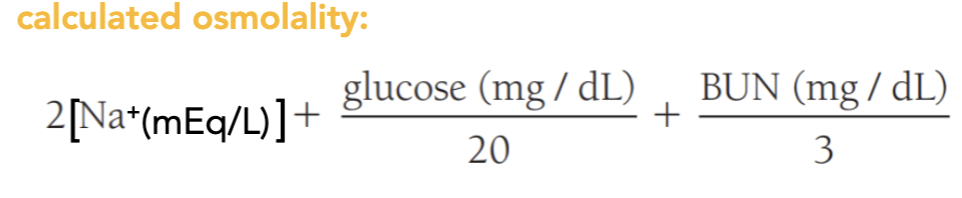
Na and accompanying anions 90% and glucose urea and other 10%
osmolality ref range
serum 275-295 mOm/kg
urine 1-3
random urine 50-1200
osmolal gap
increased with ethanol, methanol, and ethene glycol
=measured- calculated osmolality
ref range 5-10
calculated osmolality
RAAS (renin angiotensin aldosterone system)
adequate blood volume= good bp= good perfusion, vasoconstriction, control Na and H2O
RAAS process
low blood volume and pressure detected in kidney, renin secreted by juxtaglomerular cells, converting liver angiotensinogen to angiotensin I, lung angiotensin converting enzyme ACE becomes angiotensin I and II, angiotensin II simulates vasoconstriction and secretion of aldosterone from adrenal gland, increasing reabsorption of Na (water follows) and secretion of excess K
atrial natriuretic peptide ANP and B-type (brain) natriuretic peptide BNP
released from heart atria due to volume expansion or stretching, opposes RAAS (promotes Na and H2O excretion), hypervolemia (congestive heart failure CHF)
sodium Na
major extracellular cation, water balance, and blood volume and pressure regulation, hypoNAtremia (diuretics, prolonged vomit/diarrhea), hyperNAtremia (dehydration), ISE
Na ref
serum plasma 136-145
urine 120-240
csf 136-150
Potassium K
major intracellular cation, nerve conduction, muscle contraction, cardiac rhythm, hypoKalemia (diuretics, prolonged vomit/dia, insuline administration), hyperKalemia (renal failure, psuedohyperkalemia- hemolysis), ISE
K ref
3.5-5.1
chloride Cl
major extracellular anion, water balance, electroneutrality (follows Na), acid base balance, hypoCHLORemia (prolonged v/d, metabolic alkalosis), hyperCHLORemia (dehydration, metabolic acidosis), ISE
Cl ref
98-107
bicarbonate HCO3
major extracel anion, acid base balance (HCO3 and Co2 work together, HCO3 is base accepting H), decrease= metabolic acidosis, increase= alkalosis
bicarbonate HCO3 measurment
reported as total CO2 (plasma CO2 mainly exists as HCO3)
coupled enzymatic rxn (decrease in NADH absor)
CO2 + H2Oto H2CO3 to H+HCO3
HCO3 ref
22-33
calcium Ca2
extra cat, 99% in bone 1% in blood and fluid, muscle contraction, nerve transmission, coagulation, hypoCALCemia (hypoparathyroidism low PTH, vit D deficiency), hyperCALCemia (hyperparathyroidism high PTH)
Ca2 regulated by
parathyroid hormone PTH, vit D, calcitonin
Ca2 measurment
total calcium- colormetric assay, ionized 50%, protein(alb) bound 40%, small ion(phosphate, bicarb) bound 10%, may be decreased by low alb
ionized calcium- ISE, physiologically active form, unaffected by alb
Ca2 ref
total calcium serum plasma- kid 2.13-2.63, adult 2.24-2.53
ionized Ca serum- 1.15-1.33 whole blood- 1.15-1.27
Magnesium Mg2
intra cat, enzyme cofactor, ATP metabolism, neuromuscular func, hypoMAGNESemia (low K and Ca2, alcoholism, malnutrition), hyperMAGNESemia (renal failure)
Mg2 measurement and ref
colormetric, xylidyl blue
serum 0.66-1.07
phosphate
major intra anion, component of ATP, bone mineralization, acid base buffering, hypoPHOSPHATemia (malnutrition, hyperparathyroidism), hyperPHOSPHATemia (renal failure, hypoparathyroidism)
phosphate measurement and ref
colorimetric ammonium molybdate
serum adult 0.81-1.45
lactate
byproduct of anaerobic metabolism, component of ATP, bone mineralization, acid base buffering, increased lactate (tissue hypoxia, poor perfusion, shock)
lactate measurement
couples enzymatic lactate oxidase peroxidase
no tourniquet/fist pumping, heparin or sodium fluoride, deliver to lab on wet ie separate ASAP
lactate ref
plasma venous- 0.3-2