Unit 4: Solids & Liquids
 Call Kai
 Learn
Learn Practice Test
 Spaced Repetition
 Match
Match Flashcards
 Knowt Play
1/43

There's no tags or description
Looks like no tags are added yet.
Name | Mastery | Learn | Test | Matching | Spaced | Call with Kai |
|---|
No analytics yet
Send a link to your students to track their progress
44 Terms
Types of Motion and how much energy do they require:
Translational (Require the most)
Rotational
Vibration (Require the least)
Polar bond:
One between atoms with different electronegativities
Electronegativity:
The attraction an atom has for electrons in a chemical bond.
One atom acquires a partial positive charge and the other a partial negative charge.
Dipole:
A separation of charge.
Dipole moment:
The magnitude of a dipole
Ionic bond:
Between two atoms with a large difference in electronegativity.
If the difference in electronegativity between two atoms is 1.7 Paulings or greater, the bond is ionic.
Polar covalent bond:
unequal sharing of electrons by atoms that creates a small dipole. (between 0.4
and 1.7 Paulings)
Non-polar covalent bond:
an equal sharing of electrons.
no dipole created since the electrons are shared equally
differences that are 0.4 Paulings or less
This bond forms between atoms with similar (or the
same) electronegativities
The average distance between particles of molecules in Solids & Liquids:
Very close
Less than one molecular diameter
The average distance between particles of molecules in Gas:
Very far apart
The average distance between particles is about 10 molecular diameters
Intermolecular Forces:
Forces of attraction between molecules or atoms
When a molecular substance changes, states the atoms within the molecule are ___:
unchanged
Why does the strength of the intermolecular forces determines the physical properties of the substance:
The temperature at which a liquid boils reflects the kinetic energy needed to overcome the attractive intermolecular forces
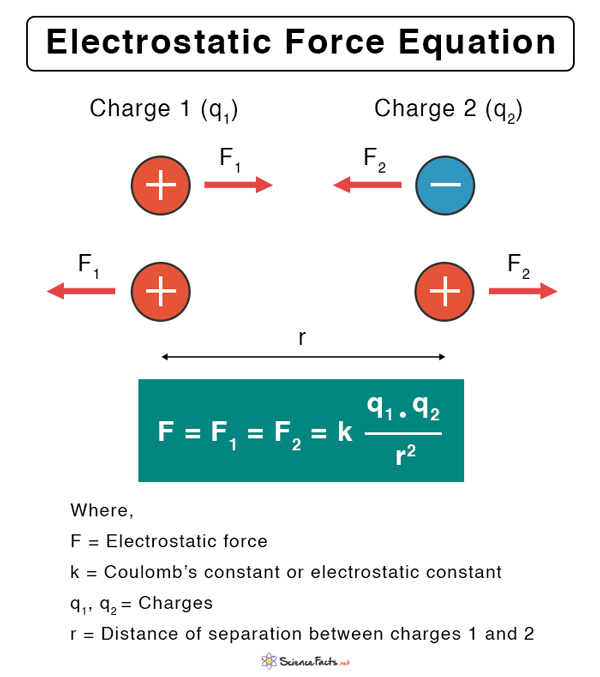
Electrostatic Force/Coulomb’s Law:
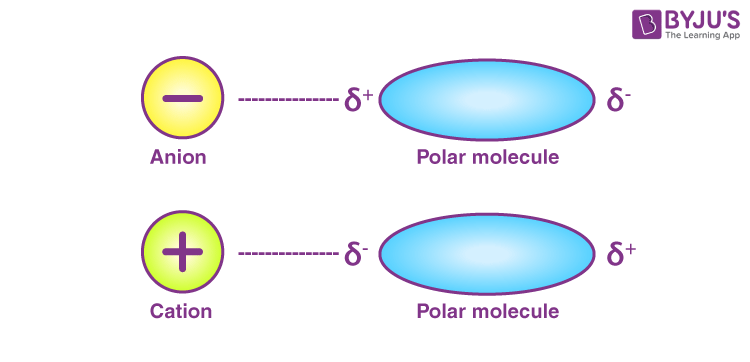
Ion-Dipole Interactions:
Types of Intermolecular Forces
Between an ion and a polar molecule
Three factors that effect the Ion-Dipole Interactions:
The magnitude of the ion’s charge
The magnitude of the dipole
The distance between the ion and the dipole
Hydration of an ion in water:
Each ion becomes “hydrated” - surrounded by polar water molecules.
As the ions are surrounded, energy is released. (Exothermic process)
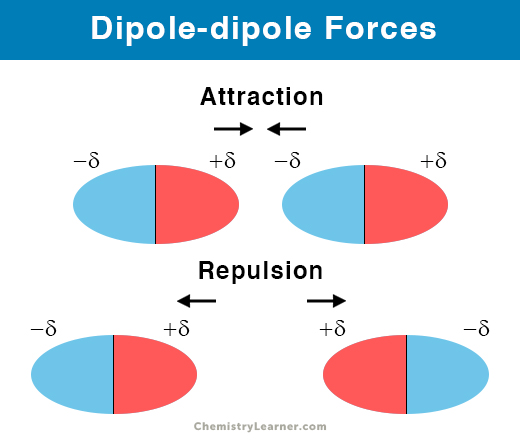
Dipole-Dipole Interactions:
Between polar molecules
Require close proximity of molecules
More polar molecules = stronger dipole-dipole interactions
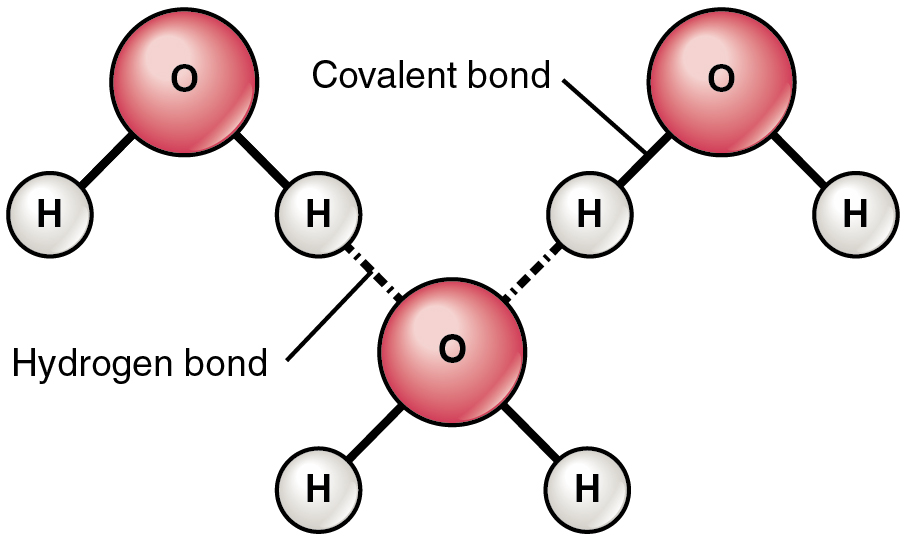
Hydrogen Bonding:
Dipole-dipole type interactions
Occur between molecules with extremely polar bonds, where a partially positive hydrogen atom is strongly attracted to the lone pair of a nearby electronegative atom (N, O, or F)
Hydrogen Bonding in Water:
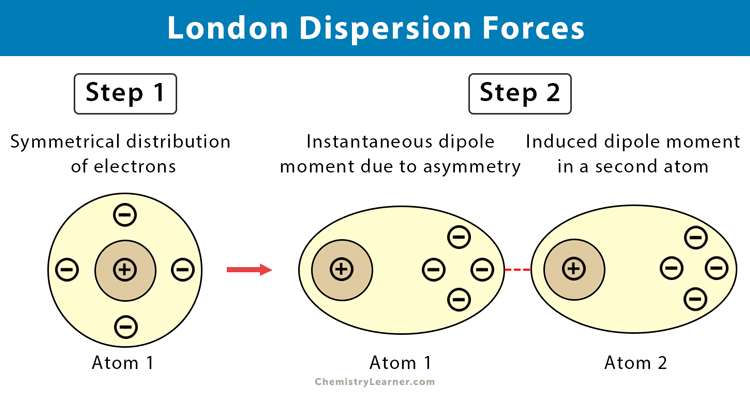
London Dispersion Forces/Van der Waals forces:
Temporary intermolecular forces present in all molecules (polar and nonpolar), caused by uneven electron distribution that creates temporary dipoles
Why are noble gases (e.g., Helium, Neon) able to form liquids:
Because of London Dispersion Forces, which become strong enough to hold atoms together at very low temperatures
Properties of Liquids:
Very low compressibility
Fixed volume, assumes shape of container
High density (comp. to gases)
Particles close together, touching
Translational, rotational, & vibrational
Properties of Gas:
Assumes shape & volume of container
Particles very far apart
High-speed translational, rotational, & vibrational
Low density
Properties of Solid:
Fixed volume & shape
Particles tightly packed in fixed positions
Vibrational only
Cohesive forces:
The forces between molecules within the liquid
Strong cohesive forces = Strong intermolecular forces = High surface tension = High viscosity (độ nhớt)
Viscosity decreases with increased temperature in liquids because:
Higher temperatures increase molecular kinetic energy → molecules overcome intermolecular attractive forces and move more freely
Adhesive forces:
The forces between liquid molecules and their container
These forces are strong if the liquid is polar and the surface is polar (or if the liquid is non-polar and the
surface is non-polar)
A liquid will WET a surface if there are strong adhesive forces
Capillary action:
Explained by strong adhesive forces between the liquid and the tube’s surface and the strong cohesive forces between liquid molecules
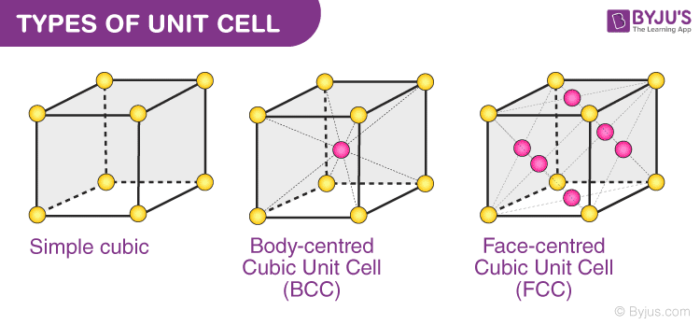
Crystal Lattice:
A 3D, regular, periodic arrangement of particles (atoms, ions, or molecules).
Unit Cell:
The smallest, repeating unit of a crystal lattice
Three common cubic unit cells:
Simple Cubic (sc)
Body-Centered Cubic (bcc)
Face-Centered Cubic (fcc)
BXH bond:
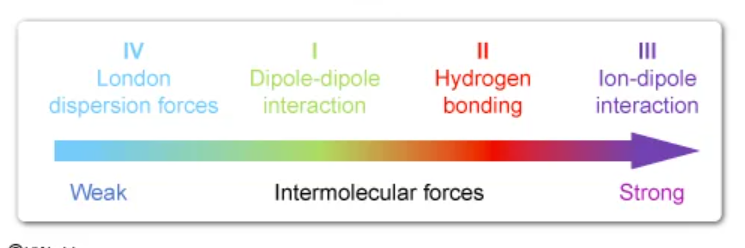
Stronger IMFs mean:
Higher boiling point / melting point
Higher viscosity
Higher surface tension
Lower vapor pressure
Define Crystalline vs. Amorphous solids
Crystalline: Regular, repeating 3D geometric arrangement
Amorphous: Considerable disorder and no repeating pattern
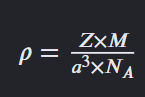
Density of a unit cell:
Z = number of atoms inside 1 unit cell
M = molar mass
Na = Avogadro Number
a3 = Volume
Why do Ionic Solids conduct electricity when melted/aqueous, but not when solid?
As a solid, ions are locked in a rigid lattice. When melted or dissolved, the ions are free to move and carry an electrical current.
Difference between a Substitutional and an Interstitial alloy?
Substitutional: Atoms are replaced by other metal atoms of similar size
Interstitial: Small gaps in the lattice are filled by much smaller atoms
What are the 4 main classifications of solids:
1. Ionic solids
2. Molecular solids
3. Atomic solids (Metallic, Network, Group 18)
4. Amorphous solids
Ionic Solid:
Cations + anions
Strong electrostatic ionic bonds
Examples: NaCl
High melting point
Molecular Solid:
Nonmetal atoms covalently bonded to each other inside the molecule
Weak Intermolecular Forces (LDF, Dipole-Dipole, or H-bonding)
Low melting point
3 sub-categories of Atomic Solids:
1. Metallic solids
2. Network Covalent solids
3. Group 18 (Noble Gas) solids
Network Covalent Atomic Solid:
A continuous network of strong, directional covalent bonds
High melting point
Eg: Diamond