7.9 Phylogeny
 Call Kai
 Learn
Learn Practice Test
 Spaced Repetition
 Match
Match Flashcards
 Knowt Play
1/13

There's no tags or description
Looks like no tags are added yet.
Name | Mastery | Learn | Test | Matching | Spaced | Call with Kai |
|---|
No analytics yet
Send a link to your students to track their progress
14 Terms
Systematics
classification of organisms and determining their evolutionary relationships
Taxonomy
naming and classifying species
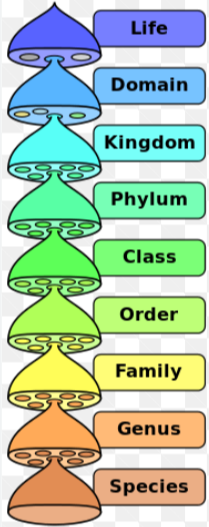
Phylogenetics
hypothesis of evolutionary history
use phylogenetic trees to show evolution
Determining Evolutionary Relationships
to determine evolutionary relationships, scientists use:
fossil records
DNA
proteins
homologous structures
Phylogenetic Trees
diagrams that represent the evolutionary history of a group organisms
similar to cladograms, except trees show the amount of change over time measured by fossils
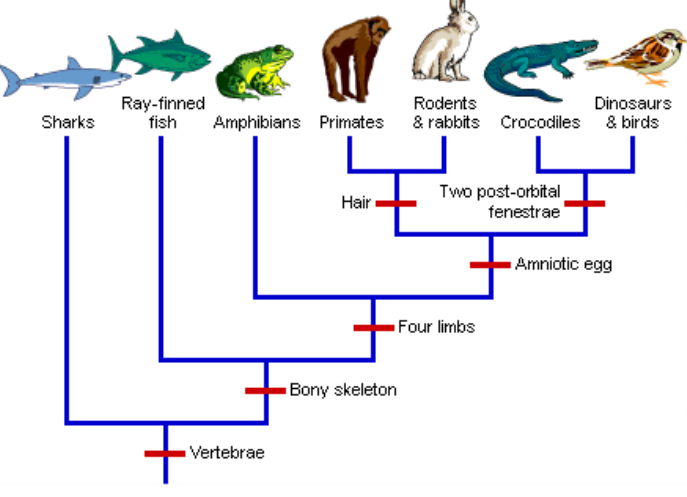
Cladograms
each line represents a lineage
each branching point is a node
nodes represent common ancestors
nodes and all branches from it are called clades
species in a clade have shared derived features
the root is the common ancestor of all species
2 clades that emerge from the same node are sister taxa
a lineage that evolved from the root and remains unbranched is the basal taxon
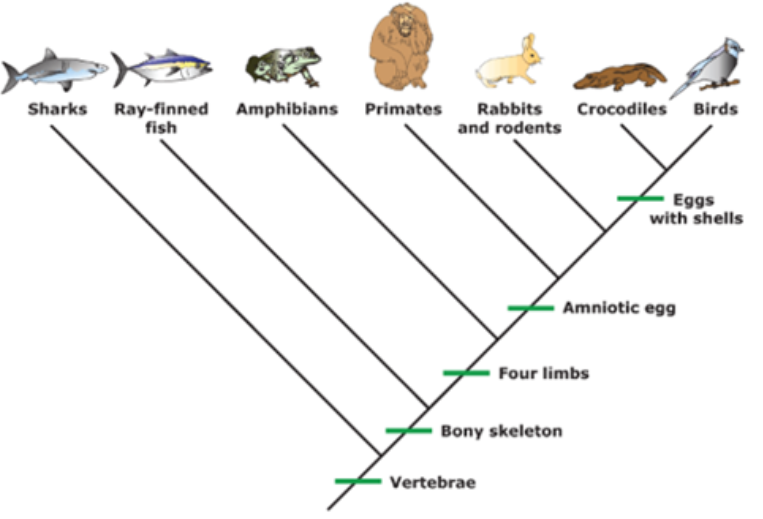
Synapomorphy
a derived character shared by clade members
Derived Characteristics
similarity inheried from the most recent common ancestor of an entire group
Ancestral Characteristic
similarity that arose prior to the common ancestor
Outgroup
a lineage that is the least closely related to the rest of the organisms
many cladograms and trees include an outgroup
Monophyletic Group
includes the most recent common ancestor of the group and all of its descendants (clade)
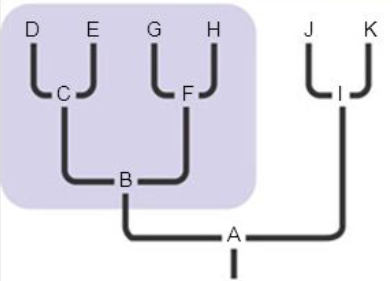
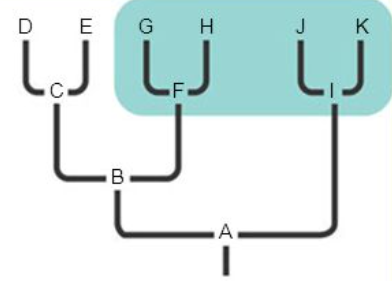
Paraphyletic Group
includes the most recent common ancestor of the group, but not all its descendants
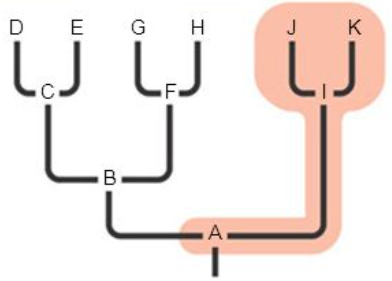
Polyphyletic Group
Does not include the most recent common ancestor of all members of the group
Parsimony
if there are conflicts among characters, use the principle of parsimony
use the hypothesis that requires the fewest assumptions (DNA changes)