APES Textbook Ch 19
 Call Kai
 Learn
Learn Practice Test
 Spaced Repetition
 Match
Match Flashcards
 Knowt Play
1/8

There's no tags or description
Looks like no tags are added yet.
Name | Mastery | Learn | Test | Matching | Spaced | Call with Kai |
|---|
No analytics yet
Send a link to your students to track their progress
9 Terms
atmosphere
a thin envelope of gases surrounding the earth
atmospheric pressure
the force, or mass, per unit area of a column of air. This force is caused by the bombardment of a surface such as your skin by air molecules
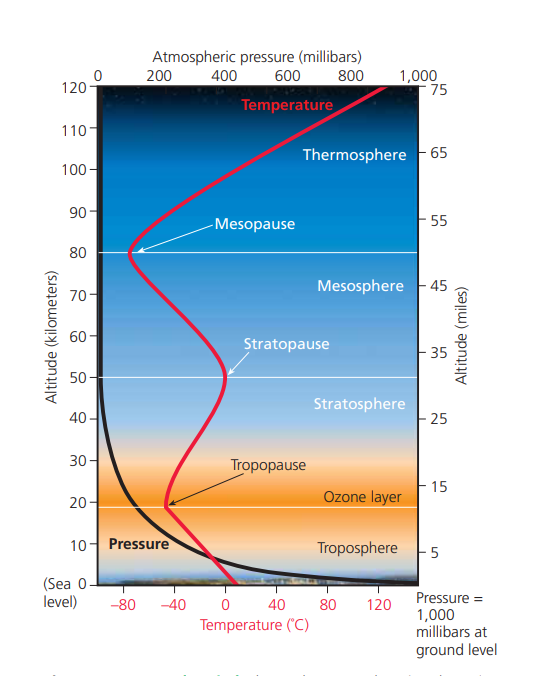
Atmospheric pressure decreases with altitude because there are fewer gas molecules at higher altitudes.
troposphere
the atmospheric layer closest to the earth’s surface.
This layer extends only about 17 kilometers (11 miles) above sea level at the equator and 8 kilometers (5 miles) over the poles. If the earth were the size of an apple, this lower layer containing the air we breathe would be no thicker than the apple’s skin
a dynamic system involved in the chemical cycling of the earth’s vital nutrients
Its rising and falling air currents and winds are largely responsible for the planet’s short-term weather and long-term climate
stratosphere
extends from about 17 to about 48 kilometers (from 11 to 30 miles) above the earth’s surface (Figure 18-3).
Although the stratosphere contains less matter than the troposphere, its composition is similar, with two notable exceptions: its volume of water vapor is about 1/1,000 that of the troposphere, and its concentration of ozone (O3) is much higher.
ozone layer
Much of the atmosphere’s small amount of ozone (O3) is concentrated here.
Found roughly 17–30 kilometers (11–19 miles) above sea level
Air pollution
the presence of chemicals in the atmosphere in concentrations high enough to harm organisms, ecosystems, or human-made materials. The effects of air pollution range from annoying to lethal.
Primary pollutants
harmful chemicals emitted directly into the air from natural processes and human activities
secondary pollutants
when some primary pollutants react with one another and with the basic components of air to form new harmful chemicals