theory of mind (dev psych)
 Call Kai
 Learn
Learn Practice Test
 Spaced Repetition
 Match
Match Flashcards
 Knowt Play
1/41

There's no tags or description
Looks like no tags are added yet.
Name | Mastery | Learn | Test | Matching | Spaced | Call with Kai |
|---|
No analytics yet
Send a link to your students to track their progress
42 Terms
dev psych
Developmental psychology is the study of how people's perceptions and interactions (tfb) with the world change and stay the same (continuity) over time (from birth to death, not of just one period of life).
This change and continuity is what's unique to dev psych, the perceptions and interactions is all of psychology.
There's biological, cognitive, social and emotional development (e.g. moral development; psychosocial- changes in personality, feelings, emotions). They're not independent of each other.
The four foundations.
Developmental diversity: what factors create differences in individuals' development across their lifespan?
Continuity within change
Discontinuous development is development occurring in distinct stages or steps. Each step results in behaviour that is qualitatively (change in kind / type) different from the behaviour at earlier steps. A series of reorganisations, in response to the environment appearing at different times. Taking place in stages, each with qualitative changes that are characteristic of a specific period of development.
Continuous development is development occurring gradually, with achievements in one level building quantitatively (change in number / degree of some pre-existing characteristic). Happening incrementally over time, measurable.
It is the lifespan perspective- comparisons among widely differing periods of life- that makes change seem more frequent and obvious. Such changes would be less obvious if studied over shorter periods of time.
Challenge of finding factors that underlie developmental changes that happen over the lifespan. Looking for the continuities hidden within long-term changes. Is there an underlying continuity between the person's behaviour at 2 and 35? Maybe it was strong attachment and what changed was the way it was expressed.
Key question: how do we account for underlying continuity in qualities, behaviours and skills in spite of apparent change?
lifelong growth
Varied potential for growth across different life domains and at all ages.
Key question: what is potential for growth- emotional, cognitive and physical?
William Damon explored the development of moral goals from infancy to middle age. Moral goals as the sense of right and wrong, and the disposition to act on this. That it’s never formed completely but deepens steadily, with a person's previous experiences at each new age.
In infancy and early preschool years, moral goals rely on them empathising (had actually felt what someone feels) and sympathising (aware of another's feelings despite not experiencing them directly).
In primary school years, they use these capacities to develop moral concepts- ideas about equity and fairness. But won't necessarily act on it. Why this inconsistency between moral belief and action? Particularly for children, because they have not yet linked their moral goals with other realms of living, thinking, their self-concepts/identities. So, they can think one thing about morality but do another. So, it looks different than previously: a morality that does include words, but they usually don't align with their actions. But this is still psychological growth- it's an extension of those same empathetic/sympathetic abilities. Verbal concepts put themselves in the place of another person and imagines how they feel.
In adulthood, moral goals slowly combine into self-identity- but only a minority does this completely. Who 'I' am is increasingly defined by what I believe is right/wrong; aligning my 'self' with moral ideas leads to stronger commitments to actions that embody these ideals. You'll likely say something if you believe something, but still with increased sophisticated thinking, you can balance self-assertion against other moral commitments, like not unnecessarily offending others. This causes less 'verbal hypocrisy', and also less predictability and more diversity of both beliefs and actions. Shows further moral growth, because the moral complexities are still based on those original abilities.
It's growing continuously, while also changing character: from an exclusive basis in intuitions (empathy, sympathy), to distinct verbal beliefs, to beliefs and actions partially reconciled.
Changing meanings and vantage points
Dev psych deals with key events and themes of life from different lenses. Work, humour, sex… they all mean different things to different people, and different things as a person ages, depending on their current roles and responsibilities.
Key question: how do people's developmental experiences shape their perspectives?
Such as, the perspectives of parenthood. Or, on every day household chores- which family member should do which? The ideal for a family is rarely achieved fully. The 'official' division may be accepted by the parent(s) only. Competing views are common, which are likely to change over time, too. Because, children grow and acquire new housekeeping skills, engage in activities that make new housekeeping demands, or leave the home altogether. Also, parents grow, and change their own activities and obligations. Conflict is common, and will soon disappear, replaced by another conflict about housework. It is still the same housework, but people's views about 'who does what' change.
Developmental diversity
Dev psych looks for general trends and patterns that account for important changes. But, it also looks at differences in patterns of development and explore the reasons as to why they occur. Consider development as plastic / flexible.
Developmental plasticity refers to openness of human development to change in response to influential experiences. Still, development is probable- the options available to a person at only one point in time are limited.
The plastic and flexible yet probable developmental pathways are created by a unique combination of genetic, personal, environmental, social, cultural circumstances. These are grouped as person-context interactions, and interactions between Nature and Nurture.
Person-context interactions are diverse outcomes that arise from any given event, from the interaction between each person (their unique understanding of the world around them, life history, expertise, motivations, strengths, limitations) and the context (obstacles, challenges, resources). Each person develops within their own combination of contexts, and each person interprets those contexts in ways that align with (or challenge) their current worldview.
Nature and Nurture is the close and continual interplay between genetic information about a person (physical appearance, capacities, vulnerabilities for illnesses) and the environment in which the person lives (social, physical). Genetic info is inherited. It is predetermined that how this is expressed can be affected by the environment around the genes (including other genes and cell nutrition). Environmental influences begin during pre-natal development (maternal stress levels and nutrition). Many nuances in development occur in response to the impact genes have on the person's interaction in the environment, and the environment on the way the genetic info is expressed. So, while genetic inheritance orients us towards certain behaviours, they won't occur unless in the appropriate environment. Similar genetic backgrounds can behave in different ways; dissimilar genetic backgrounds can behave in similar ways.
Diversity is not only within cultures/societies but between cultural groups within a society. Cultural differences influence the support and expectations of a child in big ways.
Parent-teacher conferences between Anglo American teachers and Hispanic mothers. Differences in personal and family values, general cultural values, expressed. Individual achievements of the child vs how the child fitted into the group. Independence vs interdependence. Resulted in frustration, less effective support when trying to succeed socially and academically. But even among the parents and teachers, there were differences. Some adjusted to each other's conversational priorities, which is good- chronic miscommunication among caregivers, and less effective resulting support, can impair a child's social and cognitive development in the long-term.
Developmental theories vary their emphasis of nature and nurture. Such as, with acquiring language or individual differences.
Developmental cognitive neuroscience (developmental diversity)
(psychology, biology, neuroscience, medicine). Looks at the changes in the brain, the cognitive processing of the individual and their behaviour patterns. Asks: what transformations take place in the adolescent brain that lead to increased risk-taking? How do genetic make-up and experience influence the growth and organisation of the brain?
Relationship of changes in the brain, and social and emotional development, are studied under developmental social neuroscience. Asks: how does social status shape a person's perceptions and evaluation? How do social relationships influence resilience and vulnerability?
Resilience approach (developmental diversity)
Resilience approach focuses on individual and community strengths. Considering that the outcome (e.g. of a natural disaster) is the same for all people, these developmental themes help us to recognise the diversity in experiences for all people affected, the reasons for that diversity, and potential outcomes. All that depends on each person's circumstances.
METHODS OF STUDYING DEV PSYCH
Systematic research, study and investigation of continuity and change in humans.
Using the scientific method- objectivity, careful control, the systematic and orderly observation and collection of data.
Scientific Methods
Involves the following procedures.
Formulating research questions.
Stating questions as hypotheses (prediction, derived from a theory, precisely expressing a research question, permitting it to be tested).
Testing the hypothesis (depends on convenience, ethics, scientific appropriateness).
Interpreting and publicising the results (enough detail that allows other psychologists to replicate the study, testing conclusions in different setting and contexts).
Each way to carry out these steps has its own strengths and limitations. Broadly, they vary in time frame, extent of intervention and control, and the sampling strategies used.
variation in time frame- cross sectional study
Cross-sectional study compares persons of different ages or age groups (cohorts) in relation to psychological variables.
Differences in gender roles, in ages 11 to 14. Coded participants' attributes as agentic (stereotypical male role), communal (stereotypical female role), neutral. Both showed more communal attributes, females described more communal attributes than males, and older adolescents showed more communal attributes. Sheds light on gender stereotypes and similarities in gender roles.
Cross-sectional studies are useful in describing age-related trends in a relatively short time frame, which is convenient and ensures that findings are not obsolete / outdated by the time the study is done.
But, it does not provide information about individual differences, as comparisons are limited to age-group averages. We cannot state whether individual differences exist in how adolescents use communal or agentic attributes. Cohort effects, experiences of a particular age cohort, may affect individuals in that group differently. Might not represent age-related changes, as these groups were born and reared in different environments at different times.
variation in time frame- longitudinal study
Longitudinal study observes the same participants periodically over multiple time-points. Look at sequences of change and individual consistency and inconsistency over time. From months to even a decade.
Often this is the only way to get accurate information on the events and circumstances in the life of participants- avoiding recall bias.
Expensive and time-consuming, taking many years to provide an answer to a research question.
Plus, some participants may drop out or die.
Dunedin Study of 1037 children, born from April 1972 to March 1973. First followed up at age 3, then every two years up until 15, then at 18, 21, 26, 32, 38, 45. Represents all socioeconomic levels of NZ society, can draw several crucial conclusions in relation to growing up in NZ. High follow-up rate, recorded info on a wide range of issues.
But, not all human differences are related to age. There are historical changes.
comparing cross sectional and longitudinal
While cross-sectional studies can be completed quicker, they don't guarantee showing actual change within individuals. Like, the study above, it did not ensure each individual adolescent became more communal, but the average trend. Maybe for some, the communal attributes will only increase slightly as they age, or decrease.
Also, you can't distinguish among cohorts (groups of people born at the same time, therefore undergoing similar developmental experiences). It may leave the impression that differences in the cohorts reflect true developmental change, instead of the effects of being born earlier in the century. Cross-sectional studies always has this ambiguity, especially when they compare groups that differ widely in age.
Longitudinal studies don't eliminate this either. But, they do show how they actually change over time (showing more truly 'developmental' change). They can examine relationships between events and behaviours.
Apted's 7 UP series, which from 1962 documented 14 English kids, all aged 7 from a variety of educational and social backgrounds. Depicting the range of socioeconomic backgrounds. Whether each child's social class would predetermine their future. Interviewed every seven years.
variations in time frame- sequential studies
Sequential studies partially solve the time frame issue, by combining these two. There are at least two cohorts that are observed longitudinally and comparisons are made both within each cohort across time and between the cohorts at certain time points. Tells us about the actual developmental changes within individuals and the historical differences.
Schaie and changes in cognitive abilities of adults. Testing several successive cohorts of young adults and then at a later age. He established that many cognitive skills don't decline with age, especially if used daily; earlier cohorts generally achieve lower scores; some individuals show more decline with age. None of these could be found solely by cross-sectional / longitudinal studies.
Baer and linear aspects of family cohesion. Adolescents from Year 6-10 followed as three cohorts, on whether family cohesion changed from early to middle adolescence. Questionnaire, responded in longitudinal follow-ups in the next two years. Clearly involved sequences, conducted at varying times.
We can make both cross-sectional and longitudinal comparisons, and if results are similar, we can be more confident about our results. Design of this is efficient, because we can investigate change in family cohesion throughout early to middle adolescence over time.
variations in time frame- microgenetic studies
Microgenetic designs are an adaptation of longitudinal designs. Looks at changes in specific behaviours while they are occurring. Capturing the process of change and observe how change occurs within this microcosm.
Especially useful with cognitive development. Siegler, strategies children use to acquire and develop new knowledge in reading, science, math.
Records the process of development, but you need to spend a lot of time analysing each participant's behaviour many times to ascertain changes in their behaviour. That's time and requires matching of demands of the task to the capability of the participant. But, they do inform us about developmental processes as they occur.
variations in time frame- ethnographic studies
Ethnographic studies, in cross-cultural research, compare cultures and developmental contexts. Ethnography is a detailed description of a single culture / context based on extensive observation. Often researcher lives in the culture, can even compare two cultures. Cross-cultural research identifies universal changes, predictable events / processes experienced by individuals in all cultures. Improves people's lives, but the findings can't be generalised beyond the people and setting in which the research was conducted.
variations in control- naturalistic studies
Developmental studies also vary in how much they try control the circumstances in which individuals are observed.
Naturalistic studies observes behaviour in natural settings. Such as, exploring the daily emotional lives of parents in their forties and fifties and their adolescent children (Larson and Richards). They carries electronic pagers that beeped at random intervals, so they would report on their current moods and activities by telephoning a prearranged number. Home relieved the stress for fathers, but created it for mothers, teenagers felt hassled by the small daily chores.
variations in control- experimental studies
Experimental studies arrange circumstances so only one/two factors vary at a time. Like how children understand the human mind, by explaining the meanings of metaphorical statements about the mind (their success at this was the DV). Everything was constant, but age (2.5 to 10, the IV), to understand when they began believing in a personified view of the mind (not taking it literally, but metaphorically). By 8.
This is a causal relationship, because they are directly manipulating the changes in the IV.
Experimental method also requires making decisions about the population.
When every member has an equal chance of selection, it's a random sample. Otherwise, it's biased. You can never be sure you have avoided systematic bias, but we can improve objectivity by defining the population. So, interpretations only apply to this population.
They have precautions to ensure validity (accurately measure / observe characteristics that they intended to measure). Such as, by having two sample groups (experimental, control). Comparing the results helps to explicitly establish the effects of the experimental treatment.
Has helped with problems involving interventions to improve the welfare of people at risk for difficulties. Like, the impact of a program to develop literacy skills in preschoolers from families of low SES. Randomly assigned classrooms to a group, at the end of one year they were tested. The experimental group improves more (control did, too, just by growing older).
Experimental method often gives clearer results. But, because people sometimes don't behave naturally in experimental situations, results can be artificial. Naturalistic studies don't face this, but they do risk generating ambiguous results.
correlation
Correlation is a systematic relationship / association between two behaviours, responses, human characteristics. Positive, negative correlation. Expressed numerically with correlation coefficient ® from +1.00 to -1.00. Near 0.00 is no systematic relationship, or a random one. It is not whether one causes another, but an association. May reflect a third factor that has impact on both behaviours.
variations in sample size- surveys, interviews, case studies
Smaller samples allow a researcher to learn more about the sample's circumstances or their reasons for particular behaviour / thinking. Larger samples lose this, but we can cover a greater range of participants.
Surveys are specific, focused interviews of large numbers of people. Like for the patterns of school achievement among Asian youth (stereotype, model students) (Kao). Compared family incomes, educational levels, ethnic backgrounds, with academic achievement. Academic success varied among particular Asian ethnic groups, and depended more on how much time and money parents spent on education than on the other three factors. Asian and Caucasian didn't differ.
Large sample is good, but these questions tend to be 'cut and dry'. They don’t explore subtleties of thinking or why people have for taking certain actions / holding certain beliefs.
Interviews are face-to-face directed conversations. Large amount of info in short time. But because they take time, they use very small number of participants. Like, how teenage girls cope with stresses of dealing with gender role expectations as they grow up under different conditions. Private school, 'well-off' families vs public school, racially mixed, lower income. Could explore their perspectives in depth, finding out when and how differences in their circumstances influenced their development as young women. Economic and family supports mattered. Constant challenge was finding and remaining true to their own perspective / voice, sometimes especially for the 'well-off'.
Case studies use on or a few individuals. Gets a wide variety of info (interviews, test scores, questionnaires, observations). Emphasising relationships among specific behaviours, thoughts and attitudes in the individual. Like language sills and knowledge about reading of 3 11yos (Jiminez)- proficiently bilingual Hispanic (1), proficiently monolingual Caucasian (2), modestly bilingual Hispanic (3). Interviewed about their perceptions of their own skills with each language. Found subtleties like 1 saw each language as an aid to understanding the other, while 3 simply believe Spanish assisted their English.
A case study can explore an aspect of human development, making connections among behaviours, needs, social relationships (and confirming one found in experimental studies, if they actually occur in the everyday, reminiscing naturalistic studies).
ethical constraints on studying development
Ethics is using our own values and understanding of what's right to decide how we should behave.
Using codes of ethics, Australian National Health and Medical Research Council (NHMRC). Principles of ethical conduct in all health and medical research in the publication: The National Statement. Four ethical considerations: respect, beneficence, research merit and integrity, justice. Protects the rights of participants.
Respect. Participant has a valuable and important role in research. Researcher often has a high status in society. Researchers should avoid pressuring individuals to participate and let them know that they are respected within the research relationship. Design the study in a way that protects their privacy and confidentiality and their cultural sensitivities. And, that they have the freedom to make decisions. When participants are vulnerable research, the researcher's job is to protect them.
Beneficence and non-maleficence. Beneficence is doing good for others and providing benefit to others. Non-maleficence is doing no harm. It's not enough to do no harm. While there may be some risk of harm / discomfort, you need to identify all possible risks and establish plans for protecting and supporting the participants if those risks happen. And in terms of beneficence, they make sure that the benefits outweigh the risks. Participant understands and they make an informed decision.
Research merit and integrity. Trusting the research that is carried out. Research merit is the appropriateness of the research team, design, conduct, question. Uses methods appropriated for the question. Integrity is truthfulness of the research team, design and analysis. Accurately acknowledges previous research that informs the study, and if it makes reasonable assertations about its own impact without being hyperbolic.
Justice. Equality and fairness. Workload, benefits, risks are distributed equally among participants. Cannot be tricked. Should take into account needs and behaviours of participants.
There are also First Nations communities, for which there is more guidelines in the NHMRC. Respect and empowerment. AU, then NZ.
When working with children, we remember their vulnerability and cognitive abilities. Guidelines found from each state Education Department. Needs approval. In NSW, they adhere to the Child Protection Act 1908, and the Commission for Children and Young People Act 1998, and a declaration that they aren't a 'prohibited person'.
strengths and limitations of dev knowledge
Dev psych shows us change and staying the same in people, over time.
Especially useful when considering times of transition in a person's life.
Time itself poses problems- 'take too long' to develop relative to the time frame available for researcher to study in. In longitudinal studies, researchers must consider impacts of cohort differences and age differences within their samples.
People experiencing developmental changes are quite vulnerable and uncertain about the changes taking place. Work with the ethical principles.
lab report assessment
Aim: To explore how lifespan developmental psychology can help scholars understand people's perspectives of global issues, for PSYC20008 students and their closest friends and family.
Will make more specific.
Closest friends and family, because these are people invested in the students' learning (so they'll answer truthfully), and will feel comfortable saying anything, etc.
Analysis: Chi-square test of independence, analysis in JASP
UN SDGs
Another paper that measured friends and family, but it’s done in Canada / covid (giving meaning to why we’re doing it now).
Will respondent be concerned about the SDGs, overall? Feel supported in their sense of autonomy, competence and belonging? Will respondents who said the first, also say the second? What will that tell us?
UN Sustainable Development Goals
"The goals and targets will stimulate action over the next 15 years in areas of critical importance for humanity and the planet." - UN, 2015
Wanting to develop, but do so sustainably.
They want to make progress not achieve them, by 2030.
The first paper sees how far we have come.
We exclude the seventeenth goal, because we are just undergrads.
Not part of th lab report, but Australia is a strong collaborator with other countries, while China, USA, and Spain, produce the most research.
Top five goals studied by researchers in all fields. What is in the lab report is how much psychology is holding people accountable.
Goal 3 (Health): ensuring healthy lives and promote wellbeing for people at all ages (249,970 studies)
Goal 4 (Education): ensuring inclusive and equitable quality education and promoting lifelong learning opportunities for all (82,337 studies)
Goal 5 (Gender): achieving gender equality and empowering people of all genders (38, 368 studies)
Goal 10 (Inequality): reducing inequality within and among countries (26, 695 studies)
Goal 16 (Justice): promoting peaceful and inclusive societies, providing access to justice for all, building effective, accountable and inclusive institutions (12, 753 studies)
why dev psych matter
Psychology matters here because it
Explains why people engage in / avoid sustainable behaviours
Identifies the psychosocial determinants that affect people's environmental perceptions, attitudes and behaviours
Informs strategies for encouraging people to take environmentally friendly actions
Guides policies that promote sustainability
(Bulut, Caglar, Contribution of psychology to SDGs: a bibliometric analysis)
There are few fewer papers that have a psychology lens on SDGs.
"Developmental psychology [has] the theoretical, methodological and empirical knowledge to prepare adults to cope with global societal challenges."
(Strohmeier, Global societal challenges: a plea for strong voices from developmental psychology)
Change and stability and how we achieve these goals all relates to developmental psychology. So, how can we link this to the goals?
Relational developmental theoretical perspectives, and evidence-based scholarly research.
Relational = considers the relationship between 'things', rather than each 'thing' in isolation.
This avoids reductionist thinking, and takes context into account, and recognises that development is not 'linear'.
The relationship between the water can and plant, the plant and sun, the water can and sun. Any of these things could affect whether the plants grow. So, it's not just that 'the plant's soil is dry'.
We can change the context or the sample and see what happens compared to other studies. Person <--> environment (e.g. resilience <--> study sample).
Chi-square is very specific. It's an example of: Observed count <--> expected count.
All research is developed in the context of prior knowledge. No single study is all encompassing. Large-scale, top-down interventions are ideal but not realistic if they don't account for context. Understanding which models work best in which contexts is as important as preventative intervention.
![<ul><li><p><span style="font-family: "Arial Nova Light";">Psychology matters here because it</span></p><ul><li><p><span style="font-family: "Arial Nova Light";">Explains why people engage in / avoid sustainable behaviours</span></p></li><li><p><span style="font-family: "Arial Nova Light";">Identifies the psychosocial determinants that affect people's environmental perceptions, attitudes and behaviours</span></p></li><li><p><span style="font-family: "Arial Nova Light";">Informs strategies for encouraging people to take environmentally friendly actions</span></p></li><li><p><span style="font-family: "Arial Nova Light";">Guides policies that promote sustainability</span></p></li><li><p><span style="font-family: "Arial Nova Light";"><em>(Bulut, Caglar, Contribution of psychology to SDGs: a bibliometric analysis)</em></span></p></li></ul></li><li><p><span style="font-family: "Arial Nova Light";">There are few fewer papers that have a psychology lens on SDGs.</span></p></li></ul><p></p><ul><li><p><span style="font-family: "Arial Nova Light";">"Developmental psychology [has] the theoretical, methodological and empirical knowledge to prepare adults to cope with global societal challenges."</span></p><ul><li><p><span style="font-family: "Arial Nova Light";">(<em>Strohmeier, Global societal challenges: a plea for strong voices from developmental psychology)</em></span></p></li><li><p><span style="font-family: "Arial Nova Light";">Change and stability and how we achieve these goals all relates to developmental psychology. So, how can we link this to the goals?</span></p></li><li><p><span style="font-family: "Arial Nova Light";">Relational developmental theoretical perspectives, and evidence-based scholarly research.</span></p></li><li><p><span style="font-family: "Arial Nova Light";">Relational = considers the relationship between 'things', rather than each 'thing' in isolation.</span></p></li><li><p><span style="font-family: "Arial Nova Light";">This avoids reductionist thinking, and takes context into account, and recognises that development is not 'linear'.</span></p></li></ul></li></ul><p></p><ul><li><p><span style="font-family: "Arial Nova Light";">The relationship between the water can and plant, the plant and sun, the water can and sun. Any of these things could affect whether the plants grow. So, it's not just that 'the plant's soil is dry'.</span></p></li><li><p><span style="font-family: "Arial Nova Light";">We can change the context or the sample and see what happens compared to other studies. Person <--> environment (e.g. resilience <--> study sample).</span></p></li><li><p><span style="font-family: "Arial Nova Light";">Chi-square is very specific. It's an example of: Observed count <--> expected count.</span></p></li><li><p><span style="font-family: "Arial Nova Light";">All research is developed in the context of prior knowledge. No single study is all encompassing. Large-scale, top-down interventions are ideal but not realistic if they don't account for context. Understanding which models work best in which contexts is as important as preventative intervention.</span></p></li></ul><p></p>](https://assets.knowt.com/user-attachments/ba0ba61e-2b1f-454d-9067-b8001d6b8eb7.png)
SDT
A meta-theory of development.
The tendency for mastery and growth are innate but not automatic (put simply, we enjoy mastery and growth, but we have to work for it, meaning it's not automatic). Social environments support and constrain capacity for growth / wellbeing.
Basic psychological needs: growth / wellbeing means a person's sense of autonomy, relatedness, competence are all supported / satisfied.
SDT and SDGs
How are the BPNs related to concern about the UN goals?
Research question: How does concern for UN goals correlate with competence, autonomy and relatedness?
206 adults, living in Italy. Aged 18-68 (M = 33), 68.9% female, 62.6% at university, recruited by university students.
SDGs: rate which of these goals should be a top priority (1-9)? This approach measures relative concern for goals.
BPNs: 9-items, rating scale 1-9, divided into autonomy / competence / relatedness questions. This is the shorter and earlier version of the scale in our study.
Because, people who have all three met, are thought to more readily engage with these goals.
They grouped the goals into three factors (1-3, Health; 6,7,9,12-15,17, Environment; 4,5,8,10,11,16, Equity).
Participants' perceived competence, autonomy and relatedness were significantly and positively correlated with environmental UN goals (statistical significance). But yeah, the more those needs were satisfied, the more likely there was concern for goals.
(Mosca, Milani, Fomara, BPNs, Good Societal Development and Satisfaction with Life)
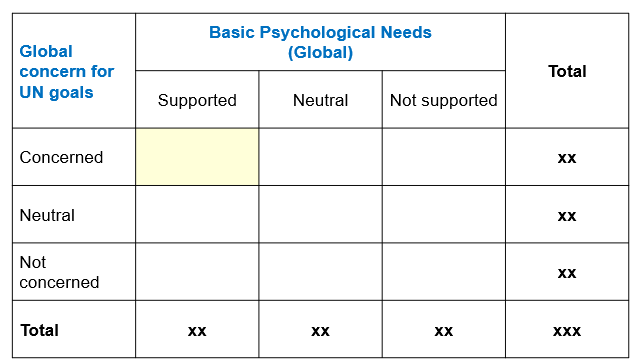
hyp 1
Among participants who are University of Melbourne students, there will be a statistically significant association between Basic Psychological Needs and
global concern for the UN sustainable development goals. More participants who report that their Basic Psychological Needs are supported will show concern for the UN sustainability goals than expected by chance.Should rephrase for our own lab report.
Should use this same structure for writing up our second hypothesis.
Note: the sample used in the analysis, the analysis, the variables, the categories within the variables.
Global = overall, categorical.
4) Maybe that we need to meet SDGs by 2030. That psychology (especially developmental psychology) is underused in this issue.
Yellow box is what we are predicting, answered through the chi-square test.
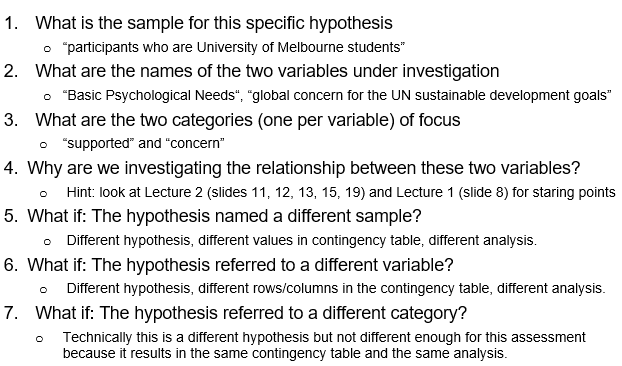
lab results
As hypothesised, University of Melbourne students who reported supported BPNs also showed concern for SDGs.
Additionally, participants with supported relatedness showed concern for SDGs.
This indicates that supported BPNs, and particularly relatedness, is associated with interest in SDGs in this sample.
ToM
The attribution of mental states (ideas, thoughts, knowledge, emotions, desires, beliefs) to oneself and to other people. Understanding how people's mental states influence behaviour.
"I have mental states." "Other people have mental states." "Other people can have different mental states from me."
Throughout our social interactions, we keep track consciously and unconsciously of what others feel, want, believe. This is referred to as using our theory of mind- a fundamental skills that helps us to understand and get along with other people.
To build relationships, to survive.
ToM experiences include: joint attention, gesture, communication, cooperative play, empathy, role taking, pretend play, deception, moral reasoning, sarcasm.
Egocentrism as tendency to confuse own POV with that of another. Piaget demonstrated the three mountain model task. He thought that before 8, they couldn't distinguish between and physical and mental realities. Yet during infancy, they have shown recognition of other's desires. They learn perspective-taking in early childhood and then it develops further.
how ToM develops
ToM develops alongside… biological development (maturation of brain systems), cognitive development (integration of various cognitive skills), social development (shaped by cultural and social experiences).
how bio (and cog) develop
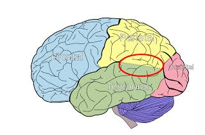
Needs brains structures in the first place. Particularly the tempero-parietal cortex- for distinguishing between external and internal experiences, the self and other, we need it to work for us to do it.
The more we interact, the more ToM develops.
In the first two years, changes over time are as such… (indicating that ToM is slowly developing with age)
Early infancy (interest in others- prefers mother, understand behaviour because turning body shows internal state of interest).
3 months (joint attention, rudimentary / not consistent).
8 months (intention, desire to act a certain way).
9 months (gesture, communication and pointing).
12 months (understanding others' desires).
18 months (joint attention, now refined/ consistent; imitation, sensitivity to others' intentions, pretend play).
24 months (what they don't understand is that what helps them feeling that way, won't help another).
Around 4 years, they understand false beliefs (and that someone else has a false belief). When they can understand false belief, that's the beginning of ToM.
At 5 years, preliminary interpretative ToM. Now, ToM just keeps getting more complex.
At 6 years, second order ToM. Not just that something is a false belief, but if overhearing someone saying a false belief, you know that person being told knows it's a false belief.
At 9 years, advanced interpretative ToM. Preliminary understanding of sarcasm, irony.
Continues beyond that. May not always have full ToM. Or, for example, when we're stressed, it varies.
Age-related improvements in ToM relate to improvements in their executive functioning.
Mind-mindedness- caregiver's tendency to treat young children as with mind of their own.
social dev of tom
First hypothesis of Devine & Hughes (2016) measured this…
Most 3YO show no evidence of false belief understanding.
Most 5YO show evidence of false belief understanding.
So, what happens in these 2 years? What factors are associated with ToM development? Biological development (age)? Or, social development?
Second hypothesis tested this and found….
Social development of ToM- increasingly complex interactions with others, and understanding of others, increases complexity of ToM.
There are cultural influences (evidence: unwritten guide book of appropriate mental states)- contexts provide scope for predicting likely mental states.
There are family relationships (evidence: different roles)- diversity of relationships provide models for diversity of mental states.
There are sibling constellations (evidence: age matched, within five years, and their constant interactions)- opportunities to witness separate mental states (role models, conflict, play).
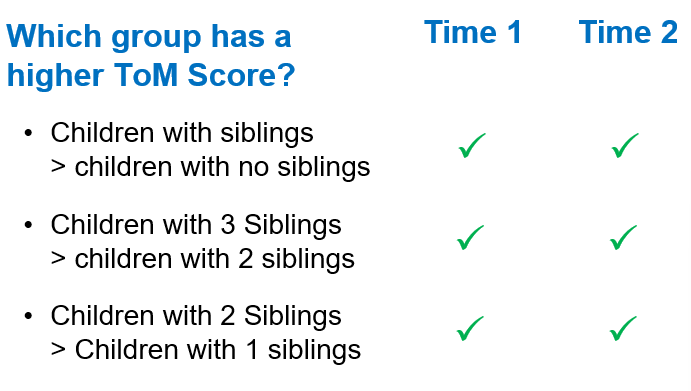
How do sibling constellations affect ToM? The study tested 157 kids (52% female, aged 3 to 5 yo, with 0-3 siblings) and a year later. To see if there was difference. Varied ToM tests, creates overall ToM 'score'.
Showed that not age (biological) but number of siblings matter for better ToM.
measuring tom
One measure is false belief tasks- tasks that test a child's understanding that other people will act according to their own beliefs, even when the child knows those beliefs are incorrect.
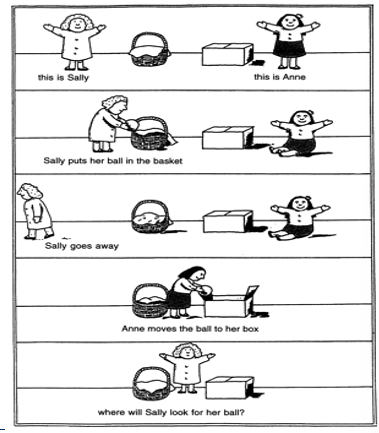
Like, Sally and Anne Task. This diagram shows how a researcher plays with two dolls in front of the child, where Anne deceives Sally, and then child must answer "where will Sally look for her ball?". They pass when they know Sally will look in the basket, because she doesn't know Anne put it in the box (not that because child knows it's now in the box, now Sally knows as well).
Smarties task / M&M task. (Makes sure they understand what's going on, so they can do it). They're shown a bag of M&Ms thinking there's that stuff inside, but when shown there's something unexpected inside (NOT M&Ms). Then, researcher asks that if their friend came in right now, would they think that M&MSs or the pencils (e.g.) were inside. If they say M&MS, it shows they have FBU.
Is age associated with FB understanding?
Yes- robust finding that among studies that 3YO typically fail FB tests and 5YO typically pass FB tests.
Not that simple- some evidence that children younger than 3 can demonstrate FB understanding, evidence that ToM continues to develop beyond age 5.
So, maybe the measures are the issue? Maybe they don't want to embarrass dad (in M&M task, e.g.). Or, they don’t understand the game.
Are siblings associated with FB understanding?
Yes- number of siblings correlates positively with % pass rate of FB tasks.
Not that simple- correlation between number of siblings and number of children passing FB tasks can be weak (r = .16; significant, not predictive power); social relationships might be more important for how children interpret ToM than how they develop ToM.
Better does not mean developing earlier.
data
Data is information that can be transformed and organised into a manner that can be manipulated, analysed and used to infer relationships.
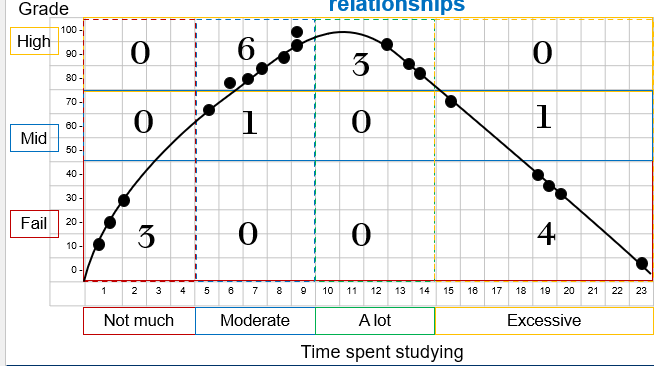
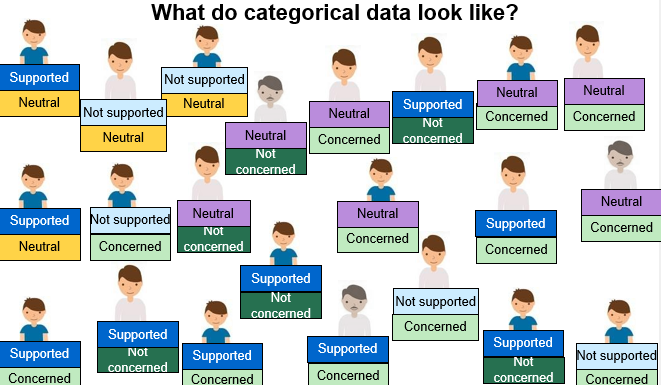
Both continuous data (interval, ratio (ratio has a real zero, 0kg is NOTHING)) and categorical data (binary, nominal, ordinal) are levels of measurement, continuous just has 'more'.
Continuous relationships and categorical relationships. Continuous data can turn into categorical- see that it is not a correlation anymore, but frequencies.
analysing categorical data- frequency counts
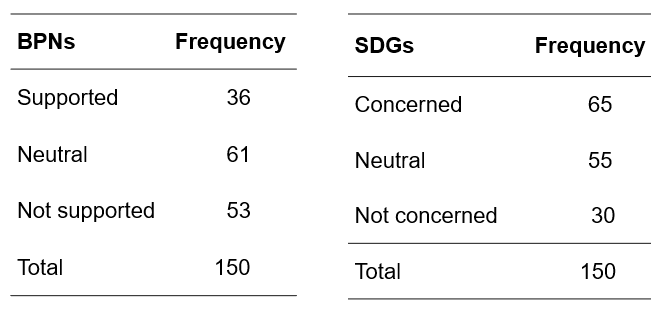
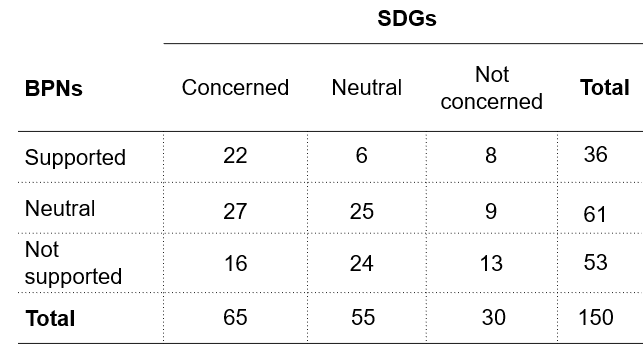
Frequency counts: the basis of our descriptive data (do not put frequency tables like these in results section, but use contingency tables to cross-tabulate your variables). This a distribution of variables, will need to use this descriptive data in results.
then calculating chi-square, cross tabulate variables to see observed frequencies
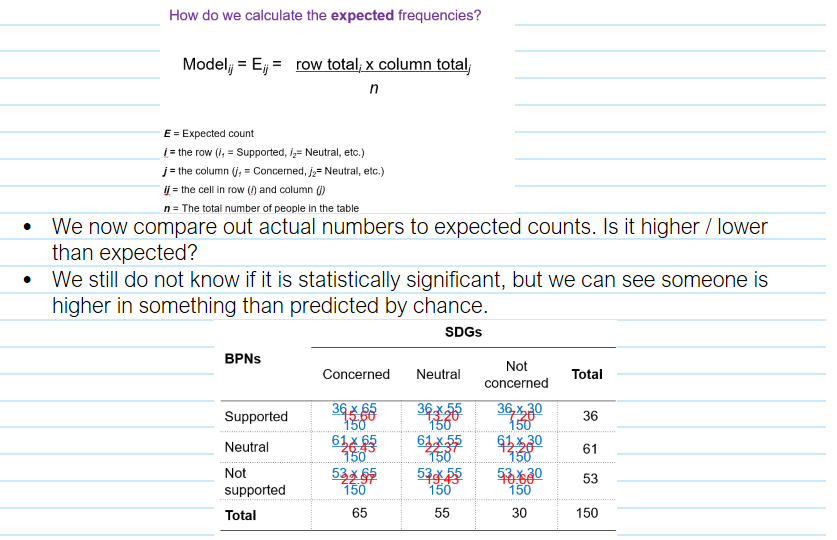
then calculate expected frequencies for each cell
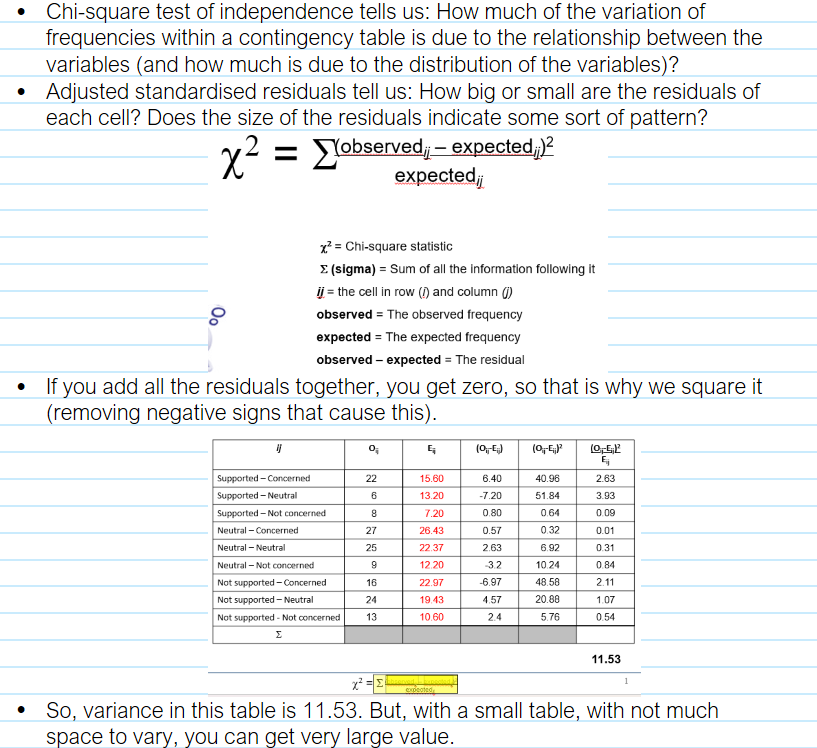
then calculating chi square statistic
calculate df and p value
Degrees of freedom: the number of values in an equation that are free to vary (assuming you know the total).
df = n - 1
That two of our numbers are free to vary (if n = 3), but only one is locked in. Any two numbers you can choose, but last one is locked in to get it.
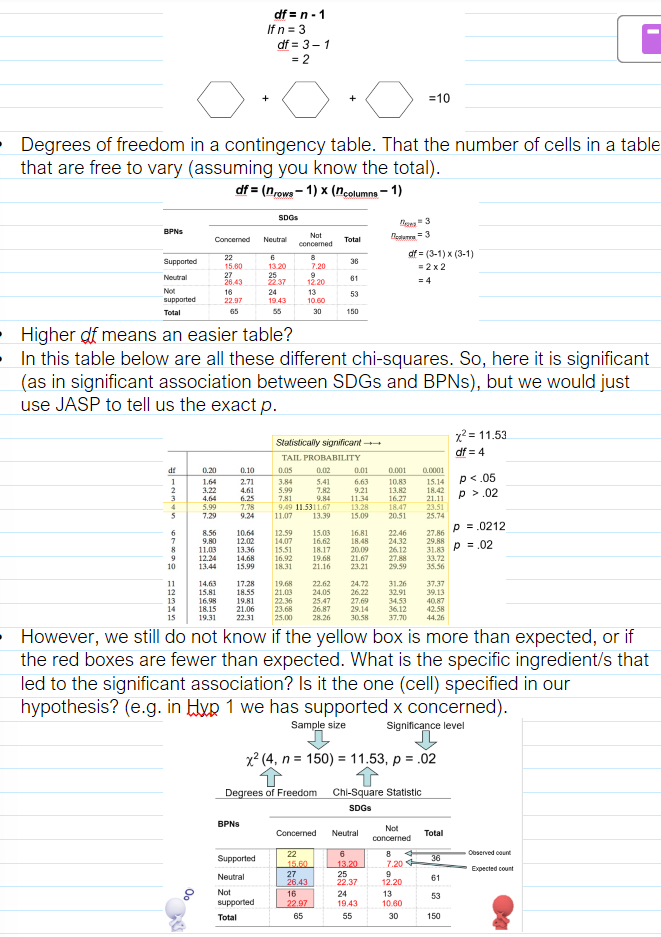
calculate standardised results
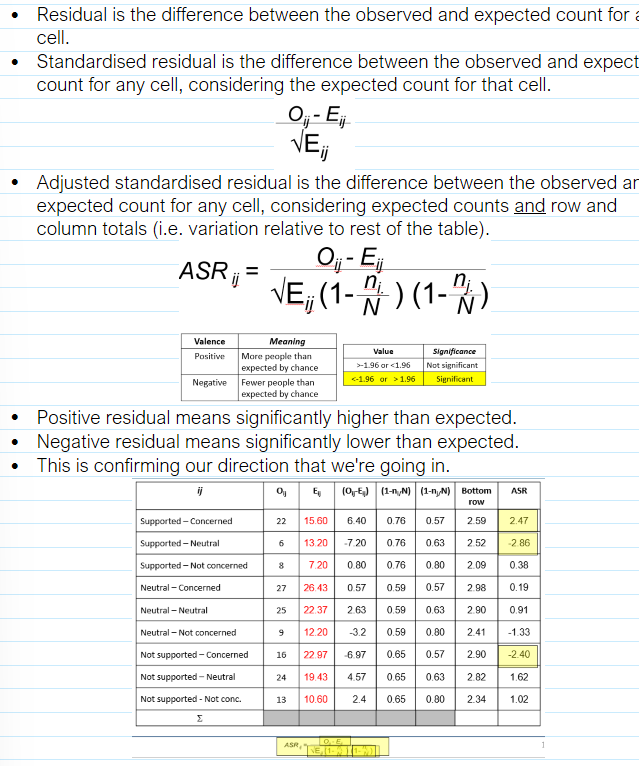
do i include results if…
The Cell that reflects my specific hypothesis has a significant / non-significant standardised residual? YES.
Cells that are not reflected in my hypothesis have significant standardised residuals? THINK ABOUT IT.
Cells that are not reflected in my hypothesis have non-significant standardised residuals? NO.