AQA A level Bio 3.3 Digestion and Absorption
 Call Kai
 Learn
Learn Practice Test
 Spaced Repetition
 Match
Match Flashcards
 Knowt Play
1/11

Earn XP
Description and Tags
Name | Mastery | Learn | Test | Matching | Spaced | Call with Kai |
|---|
No analytics yet
Send a link to your students to track their progress
12 Terms
All mammals produce a lipase called CEL.
CEL digests triglycerides.
CEL is activated by bile salts binding to the enzyme.
Describe two other functions of bile salts (2)
Form micelles (1)
Emulsify lipids/fats (1)
Some hospital patients suffer from diarrhoea caused by infection with the bacterium Clostridium difficile. The C. difficile bacteria release toxins. These toxins cause the diarrhoea.
The toxins damage the cells lining the ileum, causing them to lose their microvilli. The damage to the cells reduces the absorption of the products of digestion and reduces the absorption of water, resulting in diarrhoea. Explain why the damage to the cells lining the ileum reduces absorption of the products of digestion and why this reduces absorption of water. (3)
Reduced surface area (1)
Decreases water potential in ileum/lumen (1)
(So) water moves out of cells/into ileum by osmosis (1)
To be used as passive immunity treatment, the anti-toxin antibody would be injected. If it was given by mouth, it would be digested. Describe how the anti-toxin antibody would be digested. (3)
Endopeptidase(s) break internal (peptide) bonds (1)
Exopeptidase(s) break terminal (peptide) bonds (1)
(Membrane-bound) dipeptidase(s) break dipeptides to amino acids (1)
Describe the processes involved in the absorption and transport of digested lipid molecules from the ileum into lymph vessels. (5)
Micelles contain bile salts and fatty acids/monoglycerides (1)
Make fatty acids/monoglycerides (more) soluble (in water) (1)
Fatty acids/monoglycerides absorbed by diffusion (1)
Triglycerides (re)formed (in cells) (1)
Vesicles move to cell membrane (1)
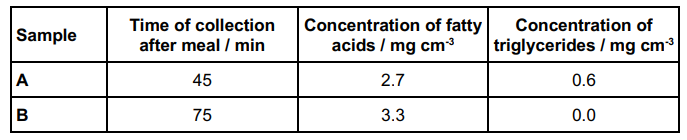
To study lipid digestion, a scientist placed a tube into the gut of a healthy 20-year-old man. The end of the tube passed through the stomach but did not reach as far as the ileum.
The scientist fed the man a meal containing triglycerides through the tube. The scientist also used the tube to remove samples from the man’s gut at intervals after the meal. The scientist measured the type of lipid found in the samples. Some of her results are shown in the table below
Use your knowledge of lipid digestion to explain the differences in the results for samples A and B shown in the table above. You should assume that no absorption had occurred. (3)
Triglycerides decrease because of the action of lipase (1)
Triglycerides decrease because of hydrolysis (of triglycerides) (1)
Triglycerides decrease because of digestion of ester bonds (between fatty acid and glycerol) (1)
Describe the role of enzymes in the digestion of proteins in a mammal.(4)
(Reference to) hydrolysis of peptide bonds (1)
Endopeptidase act in the middle of protein/polypeptide (1)
Exopeptidases act at end of protein/polypeptide (1)
Dipeptidase acts on dipeptide (1)
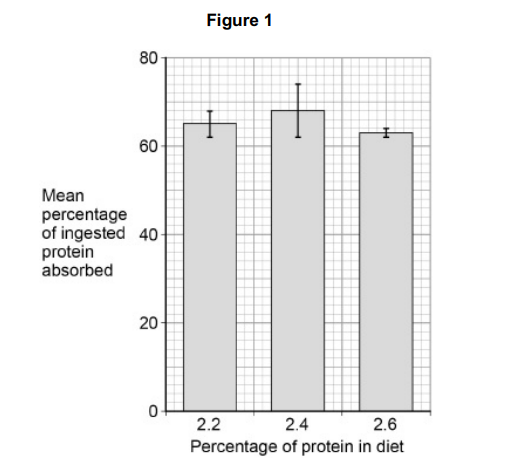
Scientists investigated how the diet of rabbits affected their digestion and absorption of protein. The scientists fed rabbits an identical mass of food but varied the percentage of protein in the food.
The scientists measured the mean mass of protein fed to the rabbits that was absorbed, which they then expressed as a percentage value.
The scientists’ results are shown in Figure 1.
The error bars show ± 2 standard deviations.
± 2 standard deviations cover 95% of the data
What can you conclude about the absorption of the products of protein digestion as the percentage of protein increased in the rabbits’ food? (3)
No significant difference (in protein absorption) (1)
(because ± 2) SDs overlap (1)
(So mean) percentage absorbed not affected by percentage in diet (1)
Amount of protein (in diet) is not a limiting factor (1)
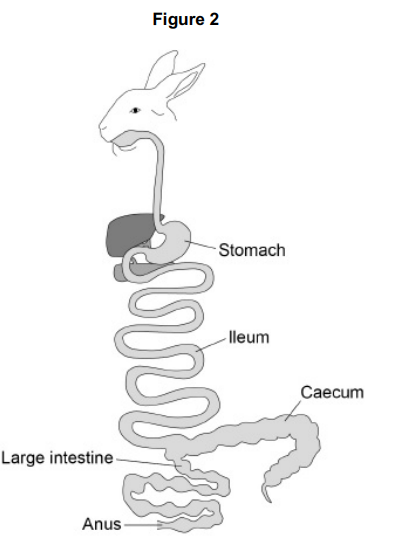
Scientists investigated how the diet of rabbits affected their digestion and absorption of protein.
The digestive system of a rabbit is shown in Figure 2.
The food eaten by a rabbit is digested mainly by microorganisms in its caecum. The caecum is a section of intestine attached between the ileum and the large intestine. The resulting semi-digested material leaves the anus of a rabbit as soft, caecal droppings. The rabbit then eats these caecal droppings.
Use this information and Figure 2 to suggest how eating its own caecal droppings helps a rabbit’s digestion and absorption of dietary protein. (3)
More/remaining/undigested (protein) broken down (1)
(So more) amino acids absorbed (1)
(Because) protein/food passes again through stomach/ileum (1)
Explain the advantages of lipid droplet and micelle formation. (3)
Droplets increase surface areas (for lipase / enzyme action) (1)
(So) faster hydrolysis / digestion (of triglycerides / lipids) (1)
Micelles carry fatty acids and glycerol / monoglycerides to / through membrane / to (intestinal epithelial) cell (1)
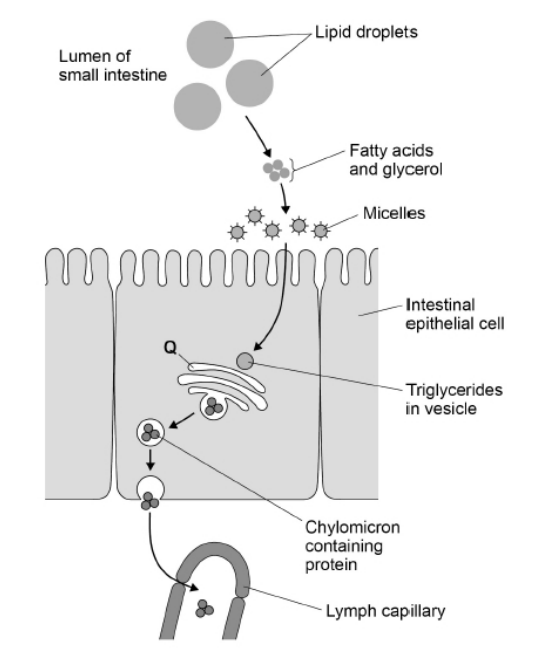
Name structure Q in the diagram above and suggest how it is involved in the absorption of lipids. (4)
Golgi Apparatus (1)
Modifies/processes triglyceride (1)
Combines triglycerides with proteins (1)
Packaged for release/exocytosis (1)
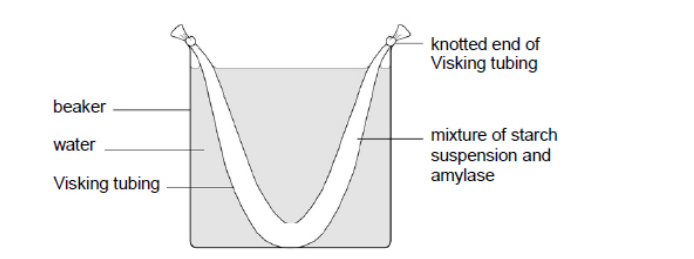
A student set up the experiment shown in the diagram below.
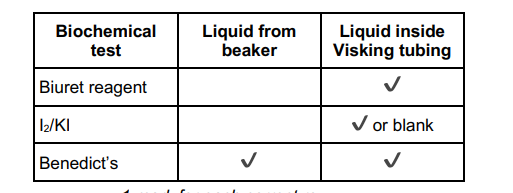
The material from which Visking tubing is made is partially permeable. After 15 minutes, the student removed samples from the liquid in the beaker and from the liquid inside the Visking tubing. She carried out biochemical tests on these samples. She drew the table below to record her results.
Complete the table by placing a tick (✔) in each box that you expect to have shown a positive result. (3)
Biochemical test | Liquid from beaker | Liquid inside Visking tubing |
|---|---|---|
Biuret reagent | ||
I₂/KI | ||
Benedict’s |
1 mark for each correct row
A student set up the experiment shown in the diagram below.
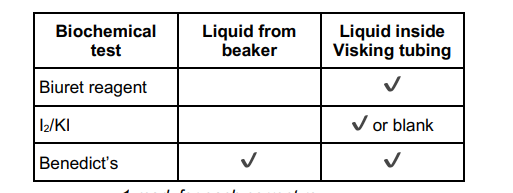
The material from which Visking tubing is made is partially permeable. After 15 minutes, the student removed samples from the liquid in the beaker and from the liquid inside the Visking tubing. She carried out biochemical tests on these samples. She drew the table below to record her results.
Explain these results (3)
Biuret: protein molecules too large to pass through tubing (1)
Iodine in potassium iodide solution: starch molecules too large to pass through tubing (1)
Benedict’s: starch hydrolysed to maltose, which is able to pass through tubing. (1)