A2.1 Origins of cells
 Call Kai
 Learn
Learn Practice Test
 Spaced Repetition
 Match
Match Flashcards
 Knowt Play
1/17

There's no tags or description
Looks like no tags are added yet.
Name | Mastery | Learn | Test | Matching | Spaced | Call with Kai |
|---|
No analytics yet
Send a link to your students to track their progress
18 Terms
Conditions on early earth
Lack of atmosphere (4.5 billion years ago) which became a thick water vapour atmosphere (4 billion years ago). Thus, there was frequent lightning
Lack of oxygen results in no ozone layer and nothing to block UV light penetration, causing higher temperatures
The presence of gaseous compounds e.g. CO2, CH4, H2S that allowed penetration of UV light. CO2 and CH4 also retains heat. These factors contributed to high surface temperatures.
Why are viruses non-living?
Viruses do not carry out functions of life on their own. They take over machinery of infected living cells to carry out activities necessary for their reproduction
What are the functions of life?
Metabolism → convert energy from one form to another
Growth → may be limited but always present
Reproduction → passing on heriditary molecules to offspring
Response → adapt to the environment
Homeostasis → maintenance of a constant internal environment
Nutrition → breaking chemical bonds in compounds to provide energy for the organism
Excretion → release of unusable, toxic, or harmful chemical compounds from the organism
What is cell theory
All organisms are composed of one or more cells
Proven by microscopes
Cells are the smallest unit of life
No one has found a living entity that is not at least one cell large
All cells come from pre-existing cells
Proven by experiments e.g. Pasteur experiment
What is the pasteur experiment
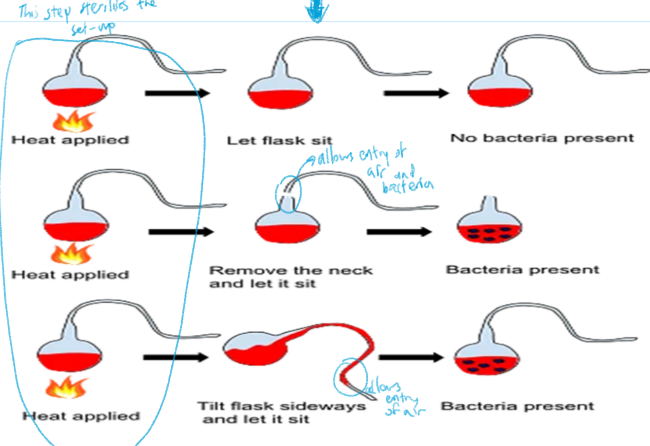
What are the requirements for the evolution of cells
Cells can currently only be producd by the division of pre-existing cells
Catalysis
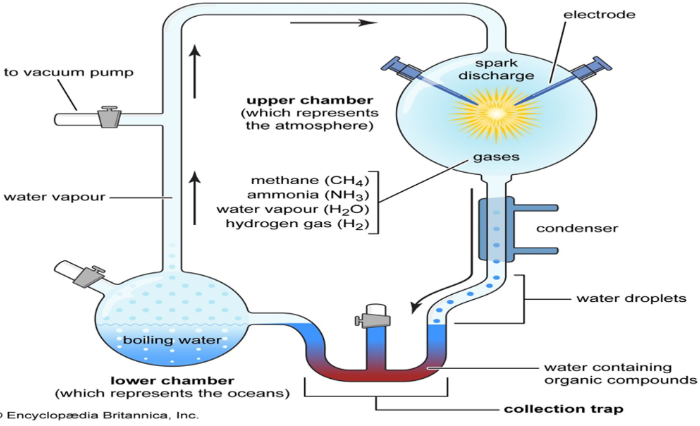
Synthesis of small carbon compounds from abiotic molecules (Miller-Urey experiment)
Self-assembly
Small organic molecules joining to form polymers, which is accelerated with the presence of enzymes
Hot sand/rock/clay can also produce polymers as water from compounds is vapourised to form molecule chains.
Emergence of compartmentalisation
Polymers contained by membranes to form protective homeostatic environment around polymers, separate from surroundings
Compartmentalisation of the cell
Self-replication of molecules
Development of self-replicating molecules so that inheritance and control can occur.
What is the function of the parts of the miller urey experiment
Apparatus charged with simple compounds like CH4, NH3, H2 to represent early earh atmosphere
Heat to produce water vapour which goes to chamber containing inorganic compounds
Electrodes to simulate lightning
Cold water as condenser to collect gaseous compounds
Collecting device to collect sample
Evaluate the Miller-Urey experiment
Strengths
presence of simple organic molecules in collecting device included hydrocarbons and amino acids
Reproducible by others
Results suggest life originated in primordial soup, a water-based sea of simple organic molecules
Weaknesses
No one has definite knowledge about conditions on early earth
Gases used may not be present → current gases in the experiment create a reducing environment favourable for the development of organic compounds. If gases were from volcanic mantle, the atmosphere would be non-reducing as the gases would be water vapour, CO2, SO2, small amounts of CO and H2S, which do not provide adequate hydrogen
Proteins break down in water to produce individual amino acids, and amino acids have not been observed to form more complex structures in water.
Conclusion
The model does not provide reliable evidence of the first steps in the evolution of life due to its unprovable assumptions.
What are the alternative hypotheses to the miller urey experiment
Introduction of carbon by comets and meteroites that struck earth
Formation of atmosphere by volcanic fumes
Hydrothermal vents
What is the function of membranes
Barrier between inside of the cell and the surrounding environment
Regulation and maintenance of activities within the cell
Describe the formation of membranes
Possible due to the presence of fatty acids on early earth
Fatty acids display a polarity with hydrophilic and hydrophobic properties
When large numbers of fatty acids are placed in water, they tend to organise themselves into vesicles
Vesicles produced in the lab can grow, engulf other organic molecules, and replicate themselves
What are the properties of RNA that make it the presumed first genetic material
RNA can assemble spontaneously from nucleotides, which are simpler organic molecules. This enables the appearance of RNA in early cell formation. (RNA is simpler than DNA)
RNA can form copies of itself and act as a type of genetic material
Varying types of nucleotides are capable of combining to form a larger molecule, which can carry code allowing inheritance of specific characteristics
RNA demonstrates the ability to control chemical reactions and act in an enzymatic role. Ribozymes in the ribosome are still used to catalyse peptide bond formation in protein synthesis.
What is the evidence for a last universal common ancestor
Universal genetic code carried by DNA and shared by all cells
Over 300 genes/sections of DNA common to all cells
Same building blocks of DNA/RNA in cells
Common molecular processes within all cells, including the replication of DNA molecules and transport of proteins
Similar transport mechanisms for cellular material within cells and in and out of cells
Is the last universal comon ancestor the first life on earth
no
What are fossils
Shells, bones, teeth
Remains of trails, footprints
Impressions of soft body parts
What are some dating techniques
Absolute dating
Radiometric dating, based on half-life of fossils
Fossils accumulate radioactive isotopes of certain elements at constant rates when they were alive
Comparing amount of isotope in a fossil with the amount when it was alive shows age of fossil
Relative dating
Uses sediment layers of earth and index fossils
Sediments form layers in sequence, with the oldest at the bottom
Index fossils are fossils of the same age at strata in different parts of the world
It is assumed that all fossils in that strata should be the same age
Geological processes may disturb the original sequence of layers which may provide inaccurate fossil ages.
Formation of communities around hydrothermal vents
Cracks in sealed crust causes water to rise, picking up minerals
Organisms form communities around the vents
red-and-white tube worms that absorb the minerals and transfer them to symbiotic bacteria, which make food from the minerals that nourish the tube worm
This shows that lack of sunlight at bottom of the ocean does not result in no life being present, giving credibility to the formation of early life around hydrothermal vents
Evidence of LUCA at hydrothermal vents
Oldest fossilised traces/precipitates are there
Commonality of genetic sequences near the vents indicate a likely single ancestor
Presence of mineral-rich environment with both acidic and basic fluids required for chemical reactions
Presence of both H2 and CO2 to form the reducing environment essential for carbon compound formation