Required practical 4 - Determination of the young modulus by a simple method
 Call Kai
 Learn
Learn Practice Test
 Spaced Repetition
 Match
Match Flashcards
 Knowt Play
1/10

There's no tags or description
Looks like no tags are added yet.
Name | Mastery | Learn | Test | Matching | Spaced | Call with Kai |
|---|
No analytics yet
Send a link to your students to track their progress
11 Terms
Apparatus and Equipment
Equipment:
2 1.5m long steel wires
Main scale and vernier scale
1kg masses and 2 1kg holders
Micrometer
Metre ruler
Step 1 of the experiment
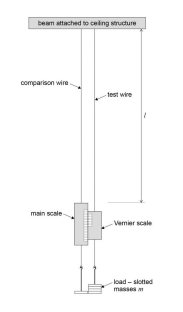
Set up the apparatus as shown in the diagram
Step 2 of the experiment
Measure the initial length l of the test wire with the metre ruler
Step 3 of the experiment
Add a 1kg mass holder to both wires so they are taut and record the initial scale reading
Step 4 of the experiment
Add an additional 1kg mass to the test wire and record the new scale reading. Find its extension e by subtracting the initial scale reading from this and record it
Step 5 of the experiment
Add another 1kg mass and repeat this, adding 1kg each time up to around 8kg
Step 6 of the experiment
Repeat the experiment twice more and find and record the mean e for each m, where m is the mass of the 1kg masses on the test wire’s holder
Step 7 of the experiment
Measure the diameter d of the test wire at various points along it using the micrometer and find and record the mean diameter
Graphs and calculations
Calculate the cross-sectional area of the wire (A) → A = πd²/4
Find the force F on the test wire for each m by calculating mg and tabulate this.
Plot a graph of F against e and draw a line of best fit. The young modulus E will be l multiplied by the gradient divided by A.
E = stress/strain => Fl/Ae => IG/A where G is the gradient
Safety
The wire will be stretched very tightly and could break and injure eyes, so safety goggles must be worn.
If the wire breaks, the masses could fall and cause injuries, so a sand tray should be placed beneath them to catch them.
Improvements and notes
The comparison wire compensates for sagging of the beam and thermal expansion effects and provides a reference point against which to measure the extension.
The original length l of the test wire should be as long as possible to reduce uncertainty in its measurement.