T2 Ultimate Biology Flashcards
 Call Kai
 Learn
Learn Practice Test
 Spaced Repetition
 Match
Match Flashcards
 Knowt Play
1/29

There's no tags or description
Looks like no tags are added yet.
Name | Mastery | Learn | Test | Matching | Spaced | Call with Kai |
|---|
No analytics yet
Send a link to your students to track their progress
30 Terms
I can identify the differences between infectious and non-infectious diseases. |
The difference between infectious and non-infectious diseases is that infectious diseases can be transferred from one organism to another while non-infectious diseases cannot be passed between organisms.
I can explain the difference between microbes and pathogens (viruses, bacteria and fungi) |
The difference between microbes and pathogens is that while all pathogens are microbes, only a tiny portion of microbes are pathogens. A microorganism is only considered a pathogen if it causes disease.
Differences between viruses, bacteria and fungi
Virus Characteristics
- Do not require nutrients, produce wastes or exchange gases with the environment
- Non-living structures
- No cells
- Protein coat called capsid
Bacteria
- Microscopic unicellular organisms
- While some are beneficial, some cause disease – pathogenic bacteria
Fungi
- Eukaryotic cells that are unicellular or have filaments
- Reproduce by means of spores – made of a single cell with a tough coating.
- When the spores find warm, moist environment, they grow. Sweat prone areas of the human body favour growth of fungi
- Fungal infections are contagious and can be passed from person to person through skin-to-skin contact
- Very few of the diseases they cause are life threatening but they can be difficult to treat
I can describe the two main modes of disease transmission (direct contact and indirect contact) |
Diseases can be transmitted through direct or indirect contact.
Direct contact - is when disease is transmitted through physical person to person contact.
- Person to person contact
- Droplet spread
Indirect contact - disease is transmitted through contaminated objects
- Food and drinking water
- Animal to person contact
- Animal reservoirs
- Insect bites
- Environmental sources
I can identify the three lines of defence and their function.
First line of defence - prevent pathogens from entering body
- Includes 2 barriers – physical & chemical
- Barriers always ready and prepared to defend body from infection
- If defence is broken, second line of defence within body is activated
Second line of defence - general, non-specific response to pathogens that have bypassed first line through phagocytes, inflammation and fever.
- If pathogens surpass first line and infection develops, second line of defence becomes active
- First, non-specific response, followed by inflammatory response
- Phagocytosis
- Fever – make it hard for pathogen to survive
- Through immune response, immune system attacks pathogens
Third line of defence - provides highly specific and targeted response to pathogens utilizes lymphocytes (B and T cells) to recognize, destroy, and remember specific antigens, providing long-lasting immunity.
- If pathogen does get through, third line of defence is activated
- Very specific – cells recognise pathogen invading specifically compared to second line which is activated by any pathogen
- Specialised white blood cells (B) trave. The bloodstream and each produce antibodies
- Antibodies bind to markers on pathogens to identify them
- Once antibody binds to pathogen, B cell releases millions of matching antibodies into blood to fight pathogen
- T cells destroy antigens that B cells find and infections within cells
- After infection has been defeated, some of B cells remain as memory cells along with leftover antibodies
- Builds immunity
I can describe how fever is a negative feedback mechanism response of the body to microorganisms. |
A fever is a negative feedback response of the body to microorganisms because the body detects an infection and raises its temperature to help fight it. This higher temperature helps slow down or destroy pathogens. Once the infection is controlled, a negative feedback loop ensures the body returns to its normal temperature by triggering cooling responses like sweating. This return to normal shows negative feedback, as the body reverses the change once the problem is solved.
I can describe methods to prevent the spread of infection
- Personal hygiene
- Proper disposal of sewage and garbage
- Chemical treatment of clothes and other surfaces – disinfectants and antiseptics
- Heating
- Chemically treating water with chlorine
- Pasteurisation of milk
- Chemical control of vectors -insecticides
- Quarantine laws
- Use of drugs in treating infections – antibiotics
I can describe how vaccinations protect against infections.
Vaccines protect your body against infections which sometimes produce a stronger, long-lasting protective response compared to immunity from a natural infection. Vaccinse expose your body to a weakened or inactive part of the pathogen. This prompts an immune response which trains the immune system to identify the antigen and fight it by producing antibodies and memory cells. This helps your body build immunity to the disease and when the immune system encounters the actual pathogen, they can destroy them faster and more efficiently as they are familiar and immune to them.
I can recognise that the nervous system consists of the central nervous system (CNS) and peripheral nervous system (PNS). |
The nervous system is the body system that senses the environment and controls actions. It consists of the central nervous system and the peripheral nervous system.
CNS
- Brain & spinal cord
- Makes sense of messages it receives from sense organs
- Coordinates responses by muscles and glands
- Controls all voluntary movement and involuntary movement
- Core of thoughts, perceptions and emotions
PNS
- Bundles of nerves that relay messages between sense organs, CNS and muscles and glands
- Spread out through entire body
I can identify and define axon, myelin sheath, dendrite, cell body and neurotransmitters. |
Nerve Cells
neurons that carry electrical impulses in one direction at very high speed
Cell body
contains nucleus and is control centre of cell
Dendrites
connect to other cells and receive nerve impulses
Axon
transmit nerve impulse. Covered in myelin.
Myelin sheath
- insulates and increases speed of impulse
Axon terminals
– transmit message to next neuron
Neurotransmitters –
body’s chemical messengers. Molecules used by nervous system to transmit messages between neurons or form neurons to muscles
I can develop and use models to explain how the nervous system transmits information via the stimulus-response pathway |
1. Stimulus detected by receptor
2. Impulses transmitted via neurons to CNS where decision making occurs
3. When response is selected, signal is transmitted via neurons to effectors
4. Effectors produce response
The nervous system transmits information through the stimulus response pathway. First, a stimulus is detected by a receptor. Impulses are then transmitted via neurons to the central nervous system where decision making occurs. When a response is selected, a signal is transmitted through neurons to effectors which finally produce a response.
I can distinguish between different types of receptors; chemoreceptors, mechanoreceptors, pain receptors, photoreceptors and thermoreceptors. |
Receptors transform environmental stimuli into electrical nerve impulses
Chemoreceptors – sensitive to chemicals, located in nose and tongue
Mechanoreceptors – sensitive to touch, pressure, sound and motion, located in skin, inner ear and muscles
Pain receptors – sensitive to chemical changes in damaged cells, located throughout body most in skin
Thermoreceptors – sensitive to temperature changes, located in skin
Photoreceptors – sensitive to light – located in eyes
I can describe a reflex response.
Reflex – rapid and involuntary response to stimulus, resulting from simple pathway called reflex arc
- Reflex actions do not involve the brain and instead sensory information is directly relayed to motor neurons within the spine
- Results in a faster response but one that does not involve conscious thought or deliberation
- Particularly beneficial in survival situations when quick reactions are necessary to avoid permanent damage.
I can describe what hormones are and the role they play in our bodies |
Hormones are chemical substances that act as messengers in the body. They are produced in endocrine glands scattered through the body. All these glands form the endocrine system, connected by blood vessels.
I can explain how the body uses negative feedback loops to control blood glucose levels |
High levels of glucose in the blood can damage cells and therefore glucose levels must be regulated.
Two hormones are responsible for regulating blood glucose concentrations – insulin and glucagon
Insulin
1. After meal, blood glucose levels high
2. Insulin released from pancreas
3. Insulin causes liver to take glucose from blood and convert to glycogen
4. Results in decrease in blood glucose concentration
Glucagon
1. After exercise, blood glucose levels low
2. Glucagon released from pancreas
3. Causes liver to convert glycogen back to glucose
4. Increase in blood glucose concentration
Negative feedback loops ensures body systems maintain homeostasis. The insulin cycle is an example of a negative feedback loop as a change in a system causes another change that brings the system back to its starting position. For example, when eating food increases the blood glucose level (change in system), insulin is released(change caused by first) which lowers the blood glucose level (2nd change bringing back to start
I can explain how homeostasis regulates the body systems
Homeostasis is the automatic self-regulating process of maintaining a constant internal environment. Homeostasis involves receptors that are sensitive to a particular stimulus and effectors that have an effect on the same stimulus. It works continuously through negative feedback loops and systems instantly respond to changes.
I can make links between the nervous system, endocrine system and homeostasis within our bodies using body temperature and blood glucose examples |
The nervous system and endocrine system work together to maintain homeostasis in the body. For body temperature, the nervous system quickly detects changes through receptors and sends signals to the brain located in the central nervous system, which triggers responses like sweating or shivering which is part of negative feedback. For blood glucose, the endocrine system releases hormones such as insulin and glucagon to keep levels stable. This negative feedback loop acts to reverse change and bring the body back to normal which maintain homeostasis. Together, they ensure the body stays balanced despite changes in the environment.
I can describe the functions of leaves, flowers and fruits in plants |
Leaves
- Absorb carbon dioxide from air
- Combing carbon dioxide with water to make glucose – main site of photosynthesis
- Release oxygen into the air
Flowers
- Reproduction
- Attract pollinators
- Site of fertilization
Fruit
- Protect and disperse (distribute) seeds
- Facilitate germination – process of seeds developing to new plants
I can describe the process of fertilisation in plants
|
Fertilization is the process of when the female and male gamete join together to form a seed which occurs after pollination.
I can explain the importance of pollinators
Pollinators are important because they are crucial for facilitating sexual reproduction in plants. Pollinators carry pollen which contain male genetic information from male parts of a flower (anthers) that brush against the female parts of flowers (stigmas). Without pollen, many plants relying on sexual reproduction won’t be able to form unique offspring and produce essential food.
I can identify the parts of a flower
|
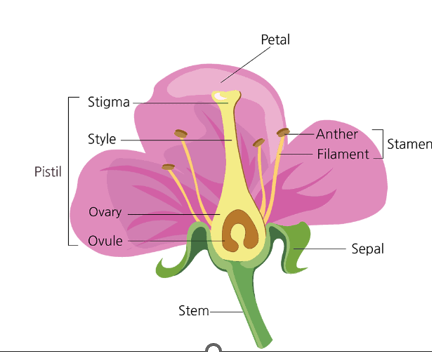
I can compare the male and female structures of a plant
|
The male and female structures of plants have different roles in reproduction. The stamen is a male part made up of a filament and anther. The stamen produces pollen in the anther which contains the male gametes. The pistil is a female part and includes the stigma, style and ovary. The stigma collects pollen and is attached to the style which transports and moves pollen to the ovary which contains female sex cells. When pollen lands on the stigma, pollination occurs and fertilization occurs later in the ovary, leading to seed formation.
I can describe how plants reproduce asexually (including fragmentation, budding and grafting) |
Asexual reproduction in plants creates genetically identical offspring from a single parent without fertilization.
Fragmentation
1. A part of the plant is broken or cut off
2. Offcut grows roots
3. Offcut establishes a new plant
Budding
1. Parent plants grow a bud from its root system
2. Bud stays attached to the parent and uses energy from parent plant to grow
3. Once grown enough, bud survives as individual plant
Grafting
1. Plant has stem cut off
2. Stem is attached to an established plant that has been trimmed close to roots
3. Attached part grows into same type of tree as original stem
Summary
Fragmentation, budding and grafting are common methods for asexual reproduction in plants. Fragmentation involves a part of a plant being cut off where the offcut grows roots and establishes as a new plant. Budding is similar where a parent plant grows a bud from its root system which stays attached and uses energy from the parent plant to grow. Once grown enough, the bud survives as an individual plant. Grafting is when a stem is cut off a plant and is attached to an established plant which has been trimmed close to the roots. The attached part grows into the same type of tree as the original stem.
I can explain how asexual reproduction helps plants survive
Asexual reproduction helps plants survive because they do not rely on pollinators or other organisms to reproduce. This reduces the risk of extinction, as plants can continue to produce offspring even in isolation. In processes such as budding or vegetative reproduction, new plants grow from the parent and are well adapted to stable environments. Asexual reproduction also allows rapid population growth without the need for a mate and is more time- and energy-efficient.