Unit 3 Macro
 Call Kai
 Learn
Learn Practice Test
 Spaced Repetition
 Match
Match Flashcards
 Knowt Play
1/124

There's no tags or description
Looks like no tags are added yet.
Name | Mastery | Learn | Test | Matching | Spaced | Call with Kai |
|---|
No analytics yet
Send a link to your students to track their progress
125 Terms
Say’s Law
Supply creates its own demand.
Is Say’s law a good approximation in the short run? Long run?
Good approx. in long run (years/decades)
Productive power of supply increases → Total demand increases
Poor approx. in short run (weeks/months/years)
Recessions/depressions occur where firms face a lack of demand for their products
Keynes’ Law
Demand creates its own supply.
Is Keynes’ law a good approximation in the short run? Long run?
Good approx. in short run
Firms often face:
Falling demand during recessions
Excess demand during booms (capacity constraints)
Poor approx. in long run
Not fully applicable in all cases
If demand were all that mattered, governments could expand output indefinitely via spending or tax cuts
In reality, economies face real limits on production capacity
Aggregate Supply (AS)
The total quantity of output (i.e. real GDP) firms will produce and sell.
Why does the AS curve slope upwards?
AS slopes up, because as the price level for outputs rises, with the price of inputs remaining fixed, firms have an incentive to produce more to earn higher profits.
Potential GDP
Maximum qty that economy can produce with full employment of workers, physical capital, technology, and institutions.
AS can cross this when employees work overtime, companies hire excess workers, etc.
Full employment
When unemployment is at the natural rate of unemployment.
Aggregate Demand (AD)
The amount of total spending on domestic goods and services in an economy.
Short run aggregate supply (SRAS) curve
Positive short run relationship between the price level for output and real GDP, holding the prices of inputs fixed.
Long run aggregate supply (LRAS) curve
Vertical line at potential GDP showing no relationship between the price level for output and real GDP in the long run.
What is recession?
Period of significant economic decline lasting a few months or more.
Who determines recession classification, and how?
National Bureau of Economic Research (NBER); Measured from previous economic peak (top) to economic trough (bottom)
Depression
A severe recession.
3 factors that can lead to shifts in the AS curve
Productivity growth (long-run) ❀
Will indirectly impact short-run
Changes in input prices (short-run) ❀
Unexpected shocks to input goods/labor
Components of AD
Consumption + Investment + Government + (Exports-Imports)
How does a rightward shift (increase) occur for AD?
Increase in any component → higher total spending at all price levels
How does a leftward shift (decrease) occur for AD?
Decrease in any component → lower total spending at all price levels
How can changes by consumers and firms affect AD?
When consumer confidence is high, spending increases.
When business confidence is high, investment increases.
If confidence falls, both consumption and investment decline.
Describe the AD/AS diagram.
Illustrates the relationship between total spending (AD), total production (AS), and the price level.
Y-Axis: Price Level
X-Axis: Real GDP
Equilibrium: where AD = SRAS & LRAS
How is recession shown in the AD/AS diagram?
Shown by how far equilibrium output is from potential GDP (LRAS).
How is growth in AD/AS is shown?
Gradual shift to in AS the right → long-run economic growth
Resurgent growth: equilibrium GDP close to LRAS (near full employment)
How is cyclical unemployment in AD/AS is shown?
Shown by how close the economy is to the potential or full GDP employment level (x-axis):
Low: when the level of output is close to potential GDP.
High: when the output is substantially to the left of potential GDP.
What are 2 sources of inflationary pressure in AD/AS diagram?
If the AD continues to shift to the right when the economy is already at or near potential GDP/full employment → moves equilibrium price level into a higher section of the AS curve.
Leads to reduction in GDP
A rise in input prices that affects many or most firms across the economy (e.g., oil or labor) and causes the AS curve to shift back to the left.
Leads to rise in GDP
How do inflation rates behave in the short run?
Fluctuates; rises in booms, falls in recessions.
How can we use the AD/AS diagram to illustrate both Say’s law and Keynes’ law?
By dividing the SRAS curve into different zones.
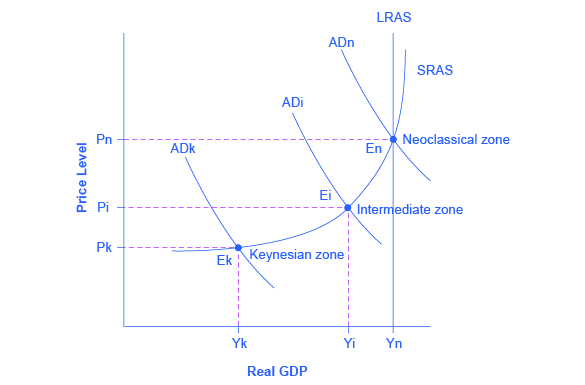
Keynesian Zone
Portion of the SRAS curve where GDP is far below potential and the SRAS curve is flat.
What happens if AD intersects the Keynesian Zone?
If AD intersects this zone, equilibrium real GDP is far below potential GDP. so:
The economy is in recession.
Cyclical unemployment is high.
Inflationary pressure is minimal.
Neoclassical Zone
Portion of the SRAS curve where GDP is at or near potential output and the SRAS curve is steep.
What happens if AD intersects the Neoclassical Zone?
If AD intersects this zone, equilibrium is near potential GDP, so:
Cyclical unemployment is low (though structural unemployment may persist).
Increasing real GDP requires a rightward shift of AS.
Shifts in AD primarily create changes in the price level.
Intermediate Zone
Portion of the SRAS curve where GDP is below potential but not as far below as in the Keynesian zone; the SRAS curve is upward-sloping but not vertical.
What happens if AD intersects the Intermediate Zone?
If AD intersects this zone, unemployment and inflation move in opposing directions.
If AD shifts right, output moves closer to potential GDP.
Unemployment decreases.
Price level rises, creating upward pressure on inflation.
If AD shifts left, output moves further from potential GDP.
Unemployment increases.
Price level falls, creating downward pressure on inflation.
What were the 2 main publications made by John Maynard Keynes?
Economic Consequences of the Peace (1919)
The General Theory of Employment, Interest Money (1936)
Economic Consequences of the Peace
Written in 1919 by John Maynard Keynes
UK Treasury Rep to Versailles Peace Conference post WWI
Against harsh reparations on Germany
Reparations would burden citizens & hinder state’s ability to buy exports → German radicalisations
The General Theory of Employment, Interest Money
Written by John Maynard Keynes in 1936
Identify recessions as demand-side issue ~ situated against the Great Depression
Advocates counter-cyclical government spending to stimulate demand
Gov to fund public works to reduce unemployment
Ideological foundations of Roosevelt’s New Deal
When did Keynesianism become mainstream macro theory?
The 70s
What does the Keynesian model look like?
Firms produce output only if they expect it to sell
AD is unstable → can change unexpectedly
Keynesian AD/AS model uses a SRAS curve:
Horizontal at levels of output below potential (increases likelihood of recession)
Vertical at potential output
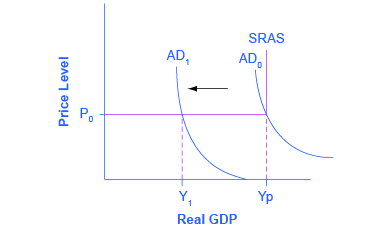
What component (supply or demand) is the Keynesian model focused on?
Aggregate Demand
Which component of demand is the most powerful in shifting AD? Why?
Government budget.
During extreme circumstances like deep recessions, other categories cannot shift AD:
Hard to convince constrained consumers to spend (C)
Hard to convince pessimistic firms to invest (I)
Hard to get firms to increase exports, even if imports reduce (X-M)
What does Keynesian economics focus on explaining?
Why depressions occur and offering a policy prescription for minimizing their effects.
The Keynesian view of recession is based on two key building blocks
Aggregate demand is not always automatically high enough to provide firms with an incentive to hire enough workers to reach full employment.
The macroeconomy may adjust only slowly to shifts in aggregate demand because of sticky wages and prices.
Sticky Wages & Prices
A situation where wages and prices do not fall in response to a decrease in demand, or do not rise in response to an increase in demand.
What does sticky wages/prices make it difficult for the economy to do?
To be restored to full employment/potential GDP
Why do sticky wages/prices occur according to Keynes?
Coordination Argument: downward wage and price flexibility requires perfect info about level of lower compensation acceptable to other laborers and market participants.
Menu Costs
Costs firm face in changing prices
What do sticky wages/prices and a drop in demand bring about?
Unemployment and recession
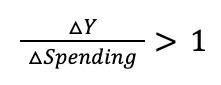
The Expenditure Multiplier
A change in spending causes a more than proportionate change in real GDP.
In the Keynesian model, what can happen when AD shifts left?
Recession
Phillips Curve
A curve that illustrates the tradeoff between unemployment and inflation.
What is Keynes’ solution to recession?
Expansionary fiscal policy.
What is Keynes’ solution to inflation?
Contractionary fiscal policy.
Contractionary Fiscal Policy
Tax increases or cuts in government spending designed to decrease AD and reduce inflationary pressures.
Results in downward pressure on the price level, but minimal reduction in real GDP output
Who conducts Fiscal policy?
The Government
Milton Friedman
Most influential neoclassical economist
Founder of the “Chicago School of Economics” and Monetarisms
Monetary History of the United States (1963) w/ Anna Schwartz
Neoclassical views of laissez faire free markets dominated macro from 70s-21stC
Capitalism and Freedom (1962)
Monetary History of the United States
Written by Milton Friedman and Anna Schwartz in 1963
Disputed prominent view of the Great Depression at the time
Federal Reserve made wrong decisions that worsened the depression
Fiscal policy is not effective in limiting recessions
Causes more harm than help
Proper monetary policy is the way to limit recessions
Capitalism and Freedom
Written by Milton Friedman in 1962
Proposes free, unregulated markets in several domains
Ex: school voucher system, drug deregulation, no medical licenses
What is the neoclassical perspective?
In the long run, the economy will fluctuate around its potential GDP and its natural rate of unemployment.
What component (supply or demand) is the Neoclassical model focused on?
Aggregate Supply
What are the 2 main features of the neoclassical model?
In the long run…
Potential GDP determines the economy’s size (real GDP)
Wages and prices will adjust in a flexible manner so that the economy will adjust back to its potential GDP equilibrium
Zero Cyclical Unemployment
When there is full employment in the labor market (≠ when unemployment rate is 0) + when economy is producing at potential GDP
How do Neoclassical economists think we can stimulate GDP growth?
By increasing productivity
What are the two key productivity factors that drive GDP growth?
Increased investment in physical/human capital per person
Technological advancements
What institution estimates potential GDP?
nonpartisan Congressional Budget Office
Within what percentage range below or above potential GDP do most recessions and upswings occur in a given year?
±1-3%
How is the LRAS curve drawn in the Neoclassical model?
LRAS curve is drawn as vertical line at level of potential GDP (determines level of real output)
What happens over time to the LRAS curve?
As productivity/potential GDP increases, the LRAS curve shifts to the right
According to the neoclassical view, why can an economy produce above potential GDP in the short run but not in the long run?
Hint: discuss sticky/flexible wages
Because wages and prices are sticky in the short run, a surge in aggregate demand can temporarily increase output above potential GDP. However, over time wages and prices adjust, making them flexible, so the increase in demand leads only to higher prices rather than higher output, and the economy returns to its potential GDP.
What are the 2 main theories about the speed of macroeconomic adjustment from the short run to the long run?
Rational expectations: People use all available information to form accurate expectations about the future, so they adjust quickly to price-level changes, minimizing prolonged fluctuations in output and employment.
Adaptive expectations: People base expectations on past experiences and adjust gradually, leading to slower adjustment and prolonged fluctuations in output and employment.
What is expected inflation?
A future rate of inflation that consumers and firms build into current decision making.
According to the neoclassical view, what are the limitations of using AD policies to stabilize the economy?
Adjusting AD can at best speed up the economy’s natural self-correction, and at worse can cause:
Delays in recognising recessions
Slow political process for implementing tax and spending changes
Risk that policies arrive too late (→ pro-cyclical & worsening economic fluctuations)
How does the neoclassical view approach unemployment and inflation?
Focuses on lowering the natural rate of unemployment through public policy that reforms labour markets by reducing NR of unemployment
Skeptical that AD can reduce unemployment in the long run because, with a vertical LRAS, demand changes don’t affect long-run unemployment
AD should grow in line with AS to keep the price level stable and minimize inflation
According to the neoclassical view, what is the policy focus between fighting recessions & promoting long-term growth?
Neoclassicalists believe the economy naturally self-corrects from recessions or expansions due to flexible wages and prices, so the key policy focus is promoting long-term growth by boosting productivity.
Central Bank
The organisation responsible for conducting monetary policy and ensuring that a nation’s financial system is running smoothly.
What is the US Central Bank called?
The Federal Reserve (“The Fed”)
What is the structure of the Federal Reserve?
7 Board of Governors, appointed by President, confirmed by Congress
Each serves for single 14-year term, staggered every two years
Policy decisions don’t require Presidential/Congressional/Judicial approval
President cannot ask board member to resign
1 board member serves as Chair
How many districts is the Federal Reserve broken up into?
12
What do Regional Federal Reserve Banks do?
Provide banking services to commercial banks in their district.
Involved in regulating banks in their district (i.e., not engaging in fraud, adhering to Federal Reserve requirements).
District commercial banks elect a board of directors for each regional Fed Bank, who chooses a regional Fed Bank president.
What 3 functions is the Federal Reserve designed to perform?
To conduct monetary policy.
To promote stability of the financial system.
To provide banking services to commercial banks/depository institutions/federal government.
Bank Regulation
Intended to maintain banks’ solvency by avoiding excessive risk (i.e., avoid purchasing stocks).
Bank Supervision
Several agencies monitor banks’ balance sheets to make sure they have positive net worth and aren’t too risky.
What are the 3 main bank supervisory institutions?
Office of the Comptroller of the Currency (within the U.S. Department of the Treasury) → Conduct on-site reviews of the 1,500 or so of the largest national banks
National Credit Union Administration (NCUA) → Supervises credit unions
The Federal Reserve → Supervises “bank holding companies” (conglomerate firms that own banks and other businesses)
Bank Run
When depositors race to the bank to withdraw their deposits for fear that otherwise they’d be lost.
A frenzy can cause a run on a healthy bank and destroy it.
Can create systemic failure if panic spreads
What 2 strategies has Congress put into place to protect against bank runs?
Deposit insurance: an insurance system that makes sure depositors in a bank do not lose their money, even if the bank goes bankrupt.
Banks pay an insurance premium to the Federal Deposit Insurance Corporation (FDIC).
Lender of last resort: an institution that provides short-term emergency loans in conditions of financial crisis (i.e., The Fed).
Monetary Policy
Involves managing interest rates and credit conditions, which influences the level of economic activity. Organised by the central bank.
Expansionary (loose) monetary policy
Increases the supply of money and the quantity of loans, or reduces interest rates.
Contractionary (tight) monetary policy
Reduces the supply of money and the quantity of loans, or increases interest rates.
Should monetary policy be countercyclical?
Yes
Countercyclical
Moving in the opposite direction of the business cycle of economic downturns and upswings
What are the 3 traditional tools of monetary policy used by a central bank in a limited reserves environment?
Open market operations
Changing reserve requirements
Changing the discount rate
(1) Open Market Operations
The central bank sells or buys Treasury bonds to influence the quantity of money and the level of interest rates —> increase money supply
Most common monetary policy tool in the U.S.
Targets the Federal Funds Rate
This is the only tool usually used for moderate economic movements
Federal Funds Rate
The interest rate banks charge on overnight loans to other banks
What is the Federal Open Market Committee (FOMC)?
A committee that makes the decisions regarding open market operations.
How is the FOMC composed?
It is composed of 7 members of the Federal Reserve’s Board of Governors, 5 voting members from the regional Federal Reserve Banks.
The NY Fed President is a permanent FOMC member and the other 4 spots are rotated between other regional Fed presidents
(2) Changing reserve requirements
The central bank can raise or lower the reserve requirement.
What is the effect of a greater reserve requirement?
Greater reserve requirement = less money available to lend out; Contractionary Monetary Policy
What is the effect of a smaller reserve requirement?
Smaller reserve requirement = greater amount of money available to lend out; Expansionary Monetary Policy
Reserve Requirements
The % of each bank’s deposits that it is legally required to hold either as cash in their vault or on deposit with the central bank.
Does the Federal Reserve frequently use large changes in reserve requirements for monetary policy?
No
What was an exception to the Fed’s usual use of reserve requirements?
During the COVID-19 pandemic, the Fed reduced reserve requirements to 0% in order to support liquidity and stabilize the financial system.
(3) Changing the discount rate
The central bank can raise or lower the discount rate.