BIO 111 Midterm Lab
 Note
Note Call Kai
 Learn
Learn Practice Test
 Spaced Repetition
 Match
Match Flashcards
 Knowt Play
1/15

There's no tags or description
Looks like no tags are added yet.
Name | Mastery | Learn | Test | Matching | Spaced | Call with Kai | Chat |
|---|
No analytics yet
Send a link to your students to track their progress
16 Terms
What are key aspects of general lab safety and procedures?
Wear appropriate PPE (gloves, goggles, lab coat), follow instructions and protocols carefully, know emergency procedures, dispose of waste properly, and report accidents immediately.
Name 5 common lab equipment and their uses.
Beaker – holds liquids;
Graduated cylinder – measures liquid volume;
Pipette – transfers small amounts of liquid;
Microscope – magnifies small objects;
Balance – measures mass.
How do you convert 1,000 millimeters (mm) to meters (m)?
1,000 mm = 1 m (since 1 m = 1,000 mm).
What are the steps of the scientific method?
Make an observation.
Ask a question.
Form a hypothesis.
Conduct an experiment.
Analyze data.
Draw conclusions.
Communicate results.
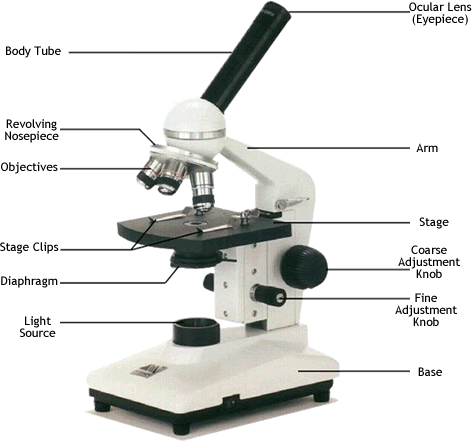
Name the parts of a microscope and their functions.
- Eyepiece: Magnifies the image.
- Objective lenses: Provide different magnification levels.
- Stage: Holds the slide.
- Coarse/fine focus: Adjusts focus.
- Light source: Illuminates the specimen.
- Diaphragm: Controls light.
- Base and arm: Support the microscope.
How do you calculate total magnification on a microscope?
Total magnification = Eyepiece magnification × Objective lens magnification.
Example: 10x (eyepiece) × 40x (objective) = 400x total magnification.
What are the main differences between prokaryotic and eukaryotic cells?
- Prokaryotic: No nucleus, no membrane-bound organelles (e.g., bacteria).
- Eukaryotic: Has a nucleus and membrane-bound organelles (e.g., plant and animal cells).
Name the 4 types of macromolecules and their monomers.
1. Carbohydrates – monosaccharides.
2. Proteins – amino acids.
3. Lipids – fatty acids and glycerol.
4. Nucleic acids – nucleotides.
What are the 4 types of macromolecules, and how are they tested for?
Carbohydrates – tested with Benedict’s solution (reducing sugars) or iodine (starch).
Lipids – tested with Sudan IV or paper translucence test.
Proteins – tested with Biuret reagent.
Nucleic acids – tested with Dische diphenylamine test.
How do you test for the presence of starch?
Use iodine solution; starch turns blue-black in its presence.
What is pH, and how do acids and bases differ in terms of ions?
- pH measures the acidity or alkalinity of a solution.
- Acids donate H⁺ ions.
- Bases donate OH⁻ ions.
What are the characteristics of enzymes?
- Proteins that act as biological catalysts.
- Speed up reactions without being consumed.
- Specific to substrates.
- Affected by temperature and pH.
Label the parts of an enzyme reaction: enzyme, active site, substrate, and product.
- Enzyme: Protein that catalyzes the reaction.
- Active site: Where the substrate binds.
- Substrate: Reactant molecule.
- Product: Result of the reaction.
What is the difference between osmosis and diffusion?
- Diffusion: Movement of molecules from high to low concentration.
- Osmosis: Diffusion of water across a selectively permeable membrane.
What did the dialysis tubing lab demonstrate about osmosis and diffusion?
- Dialysis tubing acts as a selectively permeable membrane.
- Small molecules (e.g., water) pass through, while larger molecules (e.g., starch) do not.
- Demonstrates movement of substances based on concentration gradients.