Lec 10: Vitamin E
 Call Kai
 Learn
Learn Practice Test
 Spaced Repetition
 Match
Match Flashcards
 Knowt Play
1/24

There's no tags or description
Looks like no tags are added yet.
Name | Mastery | Learn | Test | Matching | Spaced | Call with Kai |
|---|
No analytics yet
Send a link to your students to track their progress
25 Terms
Vitamin
organic micronutrient needed for cell function and metabolism, 13 essential vitamins
Fat-soluble vitamins
A, D, E, K
Water-soluble vitamins
folate, thiamine, riboflavin, niacin, pantothenic acid, biotin, vitamin B6, vitamin B12, and vitamin C
Vitamin E discovery
1992, necessary for reproductive ability in rodents
Vitamin E activity and sources
antioxidant, nuts, seeds, green leaf vegetables
Vitamin E structure
Compounds made up of eight fat-soluble compounds, four tocopherols and four tocotrienols, chromane (head, benzene: pyran, furan)and phytyl tail (fatty tail) are key structural components
Tocopherol vs tocotrienol structure
tocopherol: saturated phytyl tail (NO DOUBLE BONDS) and tocotrienol has an unsaturated tail (CONTAINS DOUBLE BONDS).
Tocopherol is less flexible
Tocopherol exists in ... forms
four, alpha, beta, gamma, and delta
Tocopherol forms differ based on
the number and position of the methyl groups on the chromanol head (the heterocyclic compound that acts as the parent nucleus of the tocopherols)
alpha-tocopherol structure
chromanol head is fully methylated and the phytyl tail is saturated
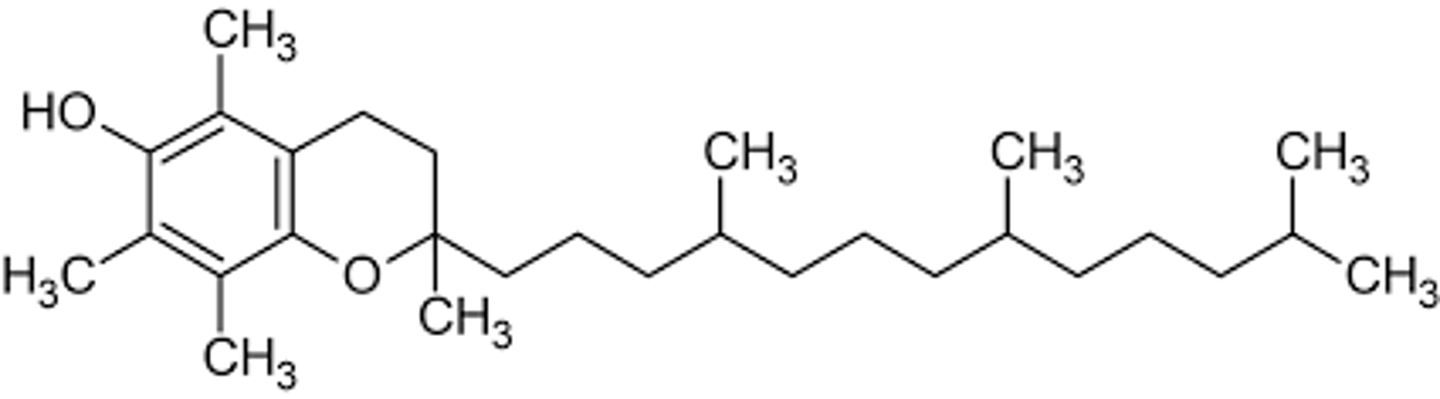
Physiochemical properties of vitamin E
1. tocopherols are viscous oils at room temp
2. Insoluble in water but soluble in ethanol and aprotic solvents (DMF, DMSO, acetone, don't give hydrogens)
3. slightly yellow/amber, odorless, clear, viscous oil
4. Exist as a powder in encapsulated form
partition coefficient
Lipid solubility measure, disbursement in oil/water aka concentration in organic phase/ concentration in aqueous phase, serves as a measure of how compounds partition between oil/water. HIGH PC=LIPID SOLUBLE, LOW PC= WATER SOLUBLE
Sources of vitamin E
seeds, fruits, green leafy vegetables
alpha-tocopherol can be extracted from and is only synthesized in
purified or concentrated vegetables and pant extracts, only synthesized in plants and photosynthetic organisms
Vitamin E extraction pathway
1. Oil extraction: seeds are pressed or solvent extracted
2. Degumming: removes phospholipids and free fatty acids
3. Deodorization: produces deodorizer distillate
4. Saponification: removes fatty acids using alkali
Vitamin E solvent extraction
tocopherols are separated using organic solvents, distillation and chromatographic separation are HIGHER-PURITY methods
Lipid digestion: goal of fat digestion
dismantle triglycerides (monoglycerides, fatty acids, and glycerol), but fats are hydrophobic and digestive enzymes are hydrophilic
Phases of lipid digestion
1. Lingual lipase
2. Gastric lipase
3. Bile
4. Pancreatic lipase
5. Phospholipase A2
6. Hepatic lipase
7. Endothelial lipase
8. Lipoprotein lipase
Lipid digestion in the mouth/stomach
Mouth: lingual lipase
Stomach: muscle contractions and gastric lipase
Lipid digestion in the small intestine
Cholecystokinin (CCK): gallbladder releases bile, bile acts as emulsifier
Pancreatic lipase, hydrolysis: triglycerides and phospholipids, bile routes
Impacts blood cholesterol levels
Emulsification of Fat by Bile
1. Fat and watery GI juice do not mix
2. Gallbladder secrets bile when the fat enters the small intestine
3. Bile breaks down large fat molecules into small droplets that are hydrophilic
4. After bile emulsification, the hydrophilic droplets are digested by hydrophilic lipase
Hydrolysis of a Triglyceride
Triglyceride ---> monoglyceride + two fatty acids
Enterohepatic Circulation of Bile
1. Liver makes bile from cholesterol
2. Gallbladder stores bile
3. In the small intestine bule emulsifies fats
4. Bile is then reabsorbed into the blood and the process starts again OR in the colon, the bile trapped by soluble fibers is excreted
Micelle formation
formed in the lumen of the small intestine, complex of lipid materials (but soluble in water), contains bile salts, phospholipids, and cholesterol. Combines with 2-monoglycerides, free fatty acids, and fat-soluble vitamins to form mixed micelles
Lipid Absorption
1. Directly into the bloodstream (glycerol and short/medium chain fatty acids)
2. Lymphatic system (micelles diffuse into intestinal cells, reassembly of triglycerides, packed with proteins-chylomicrons, bypass liver at first)