Special Education GACE
 Call Kai
 Learn
Learn Practice Test
 Spaced Repetition
 Match
Match Flashcards
 Knowt Play
1/39

There's no tags or description
Looks like no tags are added yet.
Name | Mastery | Learn | Test | Matching | Spaced | Call with Kai |
|---|
No analytics yet
Send a link to your students to track their progress
40 Terms
Which of the following would be an example of independent practice?
A. A group project about a country
B. A multiplication assessment
C. A science lab report
D. Writing their own thesis statement after practicing as a group
Answer D is correct. Independent practice allows students to practice the skills they have just been taught. Answer A is incorrect because it is a group project, not something the student is doing alone. Answers B and C are incorrect because it is an assessment.
Which of the following assessments may prove helpful to determine necessary changes to a student’s programming and/or level of support needed in the classroom?
A. Ecological assessment
B. Progress monitoring
C. Vision Assessment
D. Self Assessment
Correct answer is A, ecological assessment because ecological assessments evaluate the success of a learner given their environment (classroom). Progress monitoring is not an assessment but an analysis of the interventions. Vision assessment would not impact the program but would allow you to see if there are vision concerns Self assessment is not reliable for making programatic changes.
Bell curves can be a helpful visual when explaining which test scores?
A. Raw scores
B. Percentile rank
C. Passing scores
D. Percent correct
Answer B is correct. Bell curves explain both percentile ranks and standard scores.
A teacher wants to gather information about a student’s progress on addition facts at the end of the lesson to help support small-group instruction. Which assessment would be the best choice?
A. Exit tickets
B. End of week quizzes
C. Practice problems
D. Observations
Answer A is correct because exit tickets give you a daily check on where the students are in their learning.
Studies have shown that there is a disproportionate representation of students of color being labeled with emotional behavior disorder. Which of the following has research shown to be a contributing factor?
A. High behavioral expectations
B. Student to teacher ratio
C. Cultural biases
D. Language biases
Answer C is correct because cultural bias often contributes to mislabeling students of color with EBD. Students of color are more likely to be targeted for minor infractions which inflate their data, are labeled because of their race instead of ability, and are more likely to be considered oppositional rather than investigating if there are academic needs not being met.
A teacher's students are taking an end of the year assessment that is required to receive high school credit. What type of assessment are they taking?
A. Summative assessment
B. Diagnostic assessment
C. Formative assessment
D. An intelligence test
A is correct because summative assessments measure what the students have learned over all; B is prior to learning taking place; C is an assessment that allows you to monitor progress and adjust instruction.
A teacher gave students an exit slip following a lesson surrounding adding decimals. Upon reviewing the slips, the teacher noticed that over half the class earned less than a 50%. What is the best next step?
A. Throw the exit slips away and pretend it never happened
B. Evaluate what the students got wrong and what needs to be retaught
C. Move on with the lesson and hope the students catch up
D. Tell the class to study and assess them again for a grade
Answer B is correct. The low scores on an exit slip indicate that the students did not understand the lesson. All other answers are incorrect and could hinder student learning.
Which of the following statements is true as it relates to a task analysis?
A. A task analysis requires breaking a skill into smaller components
B. A task analysis requires a student to complete the skill without supports or scaffolds
C. A task analysis can be used to compile examples of student work
D. A task analysis requires a teacher to break down their daily activities
Answer A is correct; tasks analysis do require skills be broken into smaller and more manageable components for learning. B is incorrect because supports and scaffolds can be used in tasks analysis. C is incorrect as compiled examples of student work refers to portfolio assessments.
A third-grade student with a speech-language impairment struggles with expressive language, making it difficult to participate in classroom discussions. The speech-language pathologist (SLP) provides pull-out services twice a week. How can the special education teacher best collaborate with the SLP to support the student’s communication skills in the classroom?
A. Integrate the communication strategies recommended by the SLP into daily classroom activities and provide structured opportunities for the student to practice expressive language.
B. Refer the student to additional private speech therapy services outside of school to supplement in-school intervention.
C. Rely on the SLP to address the student’s language needs during pull-out sessions, then monitor for progress in the classroom.
D. Limit the student’s participation in verbal classroom discussions to reduce frustration and reliance on speech interventions.
A is correct because collaboration between special education teachers and related service providers should include implementing strategies across settings to ensure skill generalization. Providing structured opportunities in the classroom allows the student to practice communication skills in a meaningful context. B is incorrect because while private services can be beneficial, it is not the responsibility of the teacher to refer students for outside interventions. The focus should be on implementing school-based supports. C is incorrect because relying solely on pull-out services does not maximize opportunities for the student to use communication strategies in authentic classroom settings. D is incorrect because limiting participation does not support language development and may reduce the student’s confidence in communication.
A special education teacher is using an online system to document student progress and share reports with parents. What action best aligns with legal guidelines for protecting student privacy?
A. Ensuring that all student data is stored in a password-protected system approved by the school district
B. Using a personal cloud storage account to keep student records accessible from home
C. Sharing login credentials with paraprofessionals so they can access all student reports for documentation purposes
D. Sending progress reports to parents using the student’s personal email account to increase accessibility
A is correct because FERPA and other privacy laws require that student records be securely stored using approved systems to prevent unauthorized access. B is incorrect because personal cloud storage is not secure and could lead to unauthorized access. C is incorrect because sharing login credentials violates data security policies and FERPA regulations. D is incorrect because sending confidential information via a student’s personal email does not ensure privacy compliance.
A district finds that a disproportionately high number of English Language Learners (ELLs) are identified with learning disabilities. What is the most appropriate action for the district to take?
A. Discontinue special education identification for ELL students
B. Review assessment practices and implement culturally responsive evaluations
C. Place all ELL students in remedial reading programs
D. Increase referrals to special education to ensure all students receive support
B is correct because disproportionality often stems from biased evaluation practices; culturally responsive assessments ensure accurate identification. A is incorrect because students should not be excluded from services solely based on language status. C is incorrect because not all ELL students require remediation. D is incorrect because increasing referrals without addressing bias does not solve the problem.
A service coordinator is leading an Individualized Family Service Plan (IFSP) meeting for an infant with developmental delays. How should the team use the family’s concerns, priorities, and resources when developing the plan?
A. Focus on school-based interventions rather than family priorities, as the IFSP will transition into an IEP once the child turns three.
B. Use family concerns as secondary considerations, prioritizing standardized assessment results when developing service plans.
C. Incorporate family input to guide service decisions and ensure interventions are meaningful and relevant to the child’s natural environment.
D. Recommend that the family adjust their expectations to align with the developmental goals set by professionals.
C is correct because IFSPs emphasize family-centered planning, ensuring that goals and services align with the family's needs and daily routines. A is incorrect because IFSPs focus on early intervention in the child’s natural environment, not just future school services. B is incorrect because family concerns are a key component of IFSPs and must be integrated into planning. D is incorrect because professionals should collaborate with families, not override their priorities.
A fourth-grade student with an intellectual disability receives accommodations and modified curriculum through an IEP. The parents argue that their child should receive a private tutor at the school’s expense for all subjects. Under the principle of Free Appropriate Public Education (FAPE), what is the school’s obligation?
A. Offer the same general education curriculum without modifications, as FAPE does not require specialized instruction
B. Hire a private tutor for the student, as parents have the right to request any additional educational support
C. Provide services that ensure the student receives meaningful educational benefits within the public school setting
D. Require the parents to pay for additional services beyond what is provided in the public school
C is correct because FAPE, as defined under IDEA, guarantees that students receive individualized education that provides meaningful progress but does not require districts to provide all requested services. A is incorrect because FAPE includes specialized instruction and accommodations to meet the student’s unique needs. B is incorrect because schools are not required to provide all requested supports beyond what is necessary for the student’s educational benefit. D is incorrect because public schools must provide appropriate services at no cost to families.
A special education teacher is working with an IEP team to prepare a student with autism for independent living and employment. The student requires structured job training and community-based instruction. Which strategy would best support the student’s transition to adulthood?
A. Referring the student to an adult services agency after high school graduation rather than involving community supports during the transition process
B. Focusing primarily on academic coursework to ensure the student receives a standard diploma before exploring employment options
C. Encouraging the family to research postsecondary options independently and report back to the IEP team at a later date
D. Coordinating with vocational rehabilitation agencies, employers, and community organizations to provide hands-on work experiences
D is correct because transition planning should include community-based instruction and collaboration with agencies that support employment and independent living. Hands-on experiences help students develop real-world skills. A is incorrect because waiting until after graduation to involve community agencies may result in gaps in services and lost opportunities for skill development. B is incorrect because while academic coursework is important, transition planning should also include vocational and life skills preparation. C is incorrect because families play a crucial role, but transition planning should be a collaborative effort with support from school and community partners.
A middle school teacher is implementing Universal Design for Learning (UDL) to support diverse learners, including students with exceptionalities. Which instructional strategy best aligns with the principles of UDL?
A. Providing multiple ways for students to engage with content, such as visual supports, hands-on activities, and digital resources
B. Grouping students based on ability level to ensure that each student receives instruction at an appropriate pace
C. Using a single, standardized instructional method to ensure consistency in content delivery for all students
D. Encouraging students to self-select instructional materials and assessments without teacher guidance
A is correct because UDL emphasizes multiple means of engagement, representation, and action/expression to ensure accessibility for all students, including those with disabilities. B is incorrect because ability grouping can be useful in certain contexts but does not align with UDL’s goal of flexible, inclusive instruction. C is incorrect because a single instructional method does not address diverse learning needs and contradicts the flexibility inherent in UDL. D is incorrect because while student choice is encouraged, teacher guidance is essential to ensuring students access appropriate learning supports.
A special education evaluation team is determining whether a fifth-grade student qualifies for services under the category of specific learning disability (SLD). Which of the following assessment methods provides the most valid data for determining eligibility?
A. A combination of norm-referenced achievement tests, cognitive assessments, classroom observations, and the student’s response to research-based interventions
B. A report from the student’s general education teacher summarizing classroom difficulties and work completion
C. A single reading fluency test administered in one sitting to compare the student’s performance to grade-level peers
D. A review of the student’s report card to determine whether their grades indicate a need for special education
A is correct because the comprehensive evaluation process for SLD eligibility requires multiple data points, including standardized assessments, classroom observations, and documentation of how the student responds to evidence-based interventions. B is incorrect because teacher reports are useful but must be supplemented with formal assessments and other objective data sources. C is incorrect because a single test does not provide enough information to determine a learning disability, as multiple measures are needed. D is incorrect because grades alone do not indicate a disability and can be influenced by factors unrelated to special education needs.
IDEA states that a child with a disability must have a documented disability in one of the 13 disability categories and which of the following?
Correct answer:
A. The student must be in need of specially designed instruction.
B. The student must be in need of tutoring.
C. The student must be in need of English as a Second Language services.
D. The student must be in need of parental support.
A is correct. Students qualify for special education services using a two-pronged approach under IDEA; 1) they must have one of the 13 disability categories and 2) they must be in need of specially designed instruction. B, C, and D are incorrect because IDEA does not provide support for those specific reasons alone.
One of the general education teachers is going back to school for their masters in special education. The general education teacher reaches out to you, a special education teacher, for assistance because they need to do a case study. To complete the case study, the general education teacher will need access to special education student records such as IEPs, evaluations, and observations. What should the teacher's response be?
A. The teacher should verify the general education teacher’s identity and participation in an accredited program, then provide access to the student records
B. The teacher should explain that only a written or oral summary of the student records can be provided. Then set up a time to be interviewed by the guest teacher.
C. The teacher should refer the general education teacher to the principal for permission. If the principal approves, the teacher can provide access to the student records.
D. The teacher should reference FERPA and refuse the general education’s request for records without written consent from the students' parents/guardians.
D is correct because according to the Family Education Rights and Privacy Act (FERPA), only the parents or legal guardians of a student may have access to student records; therefore the request must be refused. Answers A, B, and C are incorrect because each provides non-guardian access to student records, which violates FERPA.
A first-grade student has difficulty regulating emotions, frequently becoming frustrated during challenging academic tasks. The student often shuts down or refuses to attempt new learning activities. Based on the interrelationship between developmental domains, what is the most likely explanation for how the student’s emotional regulation is impacting learning?
A. Social-emotional development and cognitive development function independently, so frustration during tasks is not directly related to learning.
B. The student’s frustration is likely caused by a lack of exposure to academic material rather than an emotional regulation challenge.
C. The student may benefit from more movement-based activities, as physical activity is the primary factor affecting emotional regulation.
D. Difficulties with emotional regulation can interfere with attention, working memory, and cognitive flexibility, making academic learning more challenging.
D is correct because emotional regulation is closely linked to cognitive functioning. Stress and frustration can hinder executive functions like working memory, problem-solving, and cognitive flexibility, which are essential for learning. A is incorrect because social-emotional and cognitive development are interconnected, not separate, and emotions directly influence learning behaviors. B is incorrect because while exposure to academic material is important, difficulty regulating emotions can independently impact learning engagement. C is incorrect because physical activity can support emotional regulation, but it is not the primary factor affecting emotional responses to learning challenges.
A district reviews its special education data and finds that a disproportionately high number of students from a specific cultural group have been identified with emotional and behavioral disabilities (EBD). What is the most appropriate action for the district to take in response to this finding?
A. Examine evaluation procedures and implement culturally responsive assessment practices to reduce bias in identification.
B. Increase special education referrals for all students to ensure equal representation among cultural groups.
C. Remove students from EBD services to balance the demographics in special education programs.
D. Continue using current assessment practices, as eligibility decisions are based on standardized criteria.
A is correct because disproportionality can result from biased evaluation methods and lack of cultural awareness. Schools must ensure that assessments and referral processes are equitable and culturally responsive. B is incorrect because increasing referrals for all students does not address the root causes of disproportionality. C is incorrect because removing students without re-evaluation would be inappropriate and may deny necessary services. D is incorrect because standardized criteria alone do not ensure equitable identification; assessment practices must account for cultural and linguistic diversity.
Which of the following would be an appropriate accommodation on a standard assessment for a student with fine motor delays?
Correct answer:
A. A scribe to fill in the answer sheet
B. A study carrel
C. Large print of the test
D. Alternative Assessment
A is correct because the use of a scribe provides the student access to the general assessment and does not change what is being assessed. B is incorrect because a study carrel would be useful if the student is easily distracted but would not be an appropriate accommodation for a student with motor delays. C is incorrect because a large print test would be helpful for a student with visual impairment. D is incorrect because it is a modification since it is changing what is being assessed.
A high school special education teacher is teaching students with learning disabilities how to conduct online research for a class project. Which strategy best promotes ethical digital citizenship?
A. Requiring students to only use printed materials to prevent potential plagiarism issues
B. Allowing students to use any online information they find, as long as it is relevant to their project topic
C. Instructing students on how to properly cite sources and differentiate between credible and non-credible websites
D. Encouraging students to copy and paste relevant information into their projects to ensure accuracy
C is correct because teaching students to cite sources and evaluate credibility helps them understand ethical research practices and digital literacy. A is incorrect because restricting students to printed materials does not prepare them for responsible digital research. B is incorrect because using any online information without evaluation may lead to misinformation and improper citation. D is incorrect because copying and pasting without citation is plagiarism and does not align with ethical digital practices.
A special education teacher is working with a culturally diverse family who is hesitant to engage in school activities. The teacher wants to build a stronger partnership with the family to support the student’s learning. Which approach would be the most effective?
A. Encouraging the family to attend all school-sponsored events to increase their involvement
B. Reaching out to the family in a welcoming, informal setting and learning about their cultural values and expectations for education
C. Providing a list of school policies and expectations to ensure the family understands their responsibilities
D. Requesting that the family communicate only through written correspondence to maintain formal records
B is correct because understanding the family’s cultural background and expectations for education helps build trust and create a more collaborative partnership. A is incorrect because while school-sponsored events are beneficial, forcing attendance does not respect family dynamics or cultural differences. C is incorrect because providing policies alone does not foster meaningful engagement or address cultural considerations. D is incorrect because limiting communication to written correspondence does not promote an open and supportive relationship.
During an IEP meeting, the special education teacher is updating the student’s Present Levels of Academic Achievement and Functional Performance (PLAAFP). Which of the following best describes the primary purpose of this section in an IEP?
A. To document the student’s disciplinary history and attendance records to inform behavioral interventions
B. To provide a data-driven summary of the student’s current academic and functional abilities to guide goal development and instructional planning
C. To outline the student’s preferred learning styles and general classroom interests for instructional planning
D. To describe the student’s future career aspirations and postsecondary goals, regardless of current performance levels
B is correct because the PLAAFP statement describes the student’s strengths and needs based on assessment data and teacher observations, ensuring IEP goals and services are tailored to their current abilities. A is incorrect because while attendance and discipline may be considered, they are not the primary focus of PLAAFP. C is incorrect because learning preferences may inform instructional strategies, but the PLAAFP is based on measurable performance data. D is incorrect because postsecondary goals are included in the transition plan but are not the primary focus of PLAAFP.
Which of the following would be an important daily-living skill for a high school student with an intellectual disability?
A. Knowing how to read and spell sight words
B. Using a microwave and toaster
C. Identifying elements on the periodic table
D. Solving for the area of a circle
Answer B is correct. Using basic home appliances is a daily functional living skill that would be beneficial for a student with an intellectual disability to be able to use. Answers A, C and D may be useful in some situations, they would not be as functional as home appliance use for students with an intellectual disability.
A special education teacher is getting ready to teach a unit on poetry, many students find poetry especially challenging to read fluently and with comprehension. Which of the following strategies should the special education teacher use to best support comprehension of individual poems prior to reading?
A. Give the students a list of Shakespeare's sonnets.
B. Activate prior knowledge about the context, subject, or format.
C. Hand out a list of types of poetry students will need to know.
D. Encourage the students check out books about poetry from the library.
B is correct because activating their prior knowledge will increase willingness to try and build confidence in their reading skills; C is incorrect because it does not directly support comprehension of a poem or target the vocabulary in a poem that could aide in comprehension. A is incorrect because reviewing a list of Shakespeare's work doesn't promote comprehension. D (checking out poetry books from the library) should definitely be encouraged, but isn't the best option listed for promoting poetry comprehension.
Which of the following ways can you best increase learning engagement and help students make concrete connections to themselves?
A. Using the real world to teach
B. Using music to teach
C. Using videos to teach
D. Using pictures and graphs to teach
Answer A is correct because tying instruction to everyday life skills can increase engagement with instruction and practice. Answers B,C,D are not correct because although those engagement strategies they do not increase connection of the material to the student.
First grade students are reviewing short vowel sounds at the beginning of the school year. They are singing songs about the sounds, reading poems, and writing the letter in sand while saying the short vowel sound. Which concept are students practicing?
A. Phonological awareness
B. Fluency
C. Alphabetic Principle
D. Concepts of print
The correct answer is C. Making print letters to sounds is the alphabetic principle.
A is incorrect because letter names and sounds are not part of phonological awareness.
B is incorrect, as fluency is reading words with automaticity, prosody, speed, and rate.
D is incorrect because concepts of print relate to how books “work”.
In general when a teacher is choosing a curricula to support students with developing social skills and looking for what has been seen as most beneficial for individuals with disabilities, what would be the most appropriate resource?
A. Evidence based practices such as modeling or social narratives
B. Emerging practices such as sensory integration or music therapy
C. Asking parents for suggestions
D. Asking the librarian to pull a selection of books to use
Answer A is correct because, whenever possible, educators are required to utilize evidence based practices as researchers have provided an acceptable level of research that shows the practice produces positive outcomes. The other three options are not evidence based, and therefore should be used with infrequency and discretion if an EBP cannot be found.
What is the primary difference between first and second language acquisition?
A. First language acquisition is unconscious.
B. Second language acquisition has a “silent period”.
C. Second language acquisition involves generalization.
D. First language acquisition relies on context clues to make connections.
A is correct because first language acquisition typically occurs unconsciously and naturally, whereas second language acquisition often involves more conscious effort and awareness.
B is incorrect because while second language learners may experience a silent period, first language acquisition does not have a comparable concept.
C is misleading because generalization can occur in both first and second-language acquisition but is often more prominent in second-language learning.
D is incorrect as first language acquisition relies heavily on immersion and natural interactions, not just on context clues.
Which of the below statements is an example of negative reinforcement?
A. The class actively listens to a story without interrupting and the teacher states, “I’m so proud of you all for using active listening and allowing me to read the entire story before we have a discussion!”
B. A student knows their mom will yell if they leaves muddy shoes at the back door, so they take them outside and wash them off, and then leaves them in the garage to dry.
C. A student spills orange juice all over the counter for the third morning in a row. Their father has them clean up the mess then uses overcorrection to practice pouring the orange juice correctly ten times.
D. A student is using their phone during instructional learning time. The teacher takes the phone and tells the student they can pick it up after school.
Answer B is correct because the student has removed the uncomfortable situation of yelling from their mom and increased the desired behavior of cleaning their shoes before bringing them inside. A is positive reinforcement; C is positive punishment; D is negative punishment.
A 4th grade student receives supplemental instruction in the area of behavior. Their IEP goal is currently targeting appropriately gaining attention in the school setting. Their parents hope that the skills will generalize into the community setting as well. Some of the objectives addressed include: raising their hand, waiting their turn to talk, using a respectful tone of voice, and waiting to be called on. Which SEL competency would best target learning to raising your hand, waiting your turn and using a respectful tone?
A. Self-Awareness
B. Relationship skills
C. Self-management
D. Responsible decision making skills
Answer C is correct. The student needs to build skills in the area of controlling their emotions and behaviors, so self management is the competency they should work on.
When selecting a curriculum to target specific skills, what is the most important element teachers must consider?
A. Select the curriculum from a person they trust
B. Select evidence based and standards aligned curriculum
C. Select the most cost effective curriculum
D. Select the prettiest curriculum
Answer B is the correct answer as all instructional practices and curriculum should be rooted in best practices, have a solid research base and be aligned with standards. Answers A, C, and D could be considerations but should not drive the selection of a curriculum.
According to the Stage of New Language Acquisition, the Silent Period is categorized under which stage?
A. Preproduction
B. Early Production
C. Speech Emergent
D. Intermediate Fluency
C is correct because the Silent Period, where English language learners may not produce any spoken language, is typically categorized under the Preproduction stage of new language acquisition.
A, B, and D are incorrect because they represent higher levels of English language proficiency than the Silent Period, which is characterized by limited understanding and production of English.
A teacher notices that a child in the class is struggling with language and communication skills. What action should the teacher take?
A. Monitor the child's struggles, as they are common at this age
B. Seek permission from the child's parents to provide additional support
C. Refer the child for an evaluation to determine if special education services are needed
D. Implement disciplinary measures to address the child's difficulties
C is correct. The teacher should refer the child for an evaluation to determine if they may benefit from additional support or special education services, as mandated by the Child Find component of the Individuals with Disabilities Education Act (IDEA).
Answer A is not an appropriate strategy because supporting the child as soon as possible is the priority.
B is incorrect because additional support by the classroom teacher does not require parental permission, however, the parents should be notified about the concern.
D is an inappropriate practice given this is not a discipline-related issue.
The general education and resource teachers are co-planning a math unit for the upcoming semester. As they plan, they consider ways to include base ten blocks, 100s charts, place value mats, enlarged print, pencil grips and calculators. In the lesson plans, the teachers list the items under:
A. Objectives
B. Supplies
C. Assistive Technology
D. Standards
Answer C is correct because these are all examples of assistive technology which helps students gain access to the curriculum. Answer A is incorrect because objectives are skills that students are expected to learn in a lesson. Answer B is incorrect because while many of the examples listed are supplies, they are not materials all students will require to complete the math unit. Answer D is incorrect because standards are what will drive planning and instruction.
In a second-grade classroom, the teacher incorporates a "Literacy Journal" activity, where students not only write stories but also reflect on the connection between their writing and reading experiences. What instructional practice is the teacher primarily using in this activity?
A. Demonstrating knowledge of factors affecting writing development and social development as components of literacy in early learners
B. Applying knowledge of strategies and activities for promoting young children's writing competence in early childhood classrooms
C. Applying knowledge of evidence-based strategies for helping young children develop writing skills in early childhood classrooms
D. Applying knowledge of the relationship between written language development and the development of skills in language and reading
The correct answer is D. The "Literacy Journal" activity fosters the relationship between writing and reading experiences, promoting a deeper understanding of the connections between written language and language development.
A is incorrect. This strategy focuses on the broader context of writing development, including social, emotional, and cognitive factors. While these factors can influence a child's writing, they are not the primary focus of the literacy journal activity.
B is incorrect. This strategy is more broadly focused on writing instruction in general. The literacy journal is a specific activity within writing instruction.
C is incorrect. This strategy emphasizes the use of research-based practices to support writing development. While the literacy journal can be an effective strategy, it is not necessarily an evidence-based practice in itself.
A teacher is teaching reading to a group of 2nd and 3rd grade students with specific learning disabilities in reading comprehension. They start each year outlining the importance of being able to read, not just in the classroom, but in everyday life situations. In one example, the class discusses all the ways they will read when shopping in a grocery store: reading labels, finding the right products, locating aisles for specific items, reading name tags for employees when asking questions, checking the ingredient lists, ensuring we understand the cooking instructions, etc. The teacher is discussing which of the following strategies?
A. Differentiation
B. Modification
C. Generalization
D. Maintenance
Answer C is correct because generalization strategies help students perform learned skills across settings and tasks. Answer A is incorrect as differentiation refers to tailoring instruction to meet individual needs. Answer B is incorrect as modifications refer to the changes made to expectations and content. Answer D is incorrect as maintenance refers to the strategy that ensures students retain their skills and knowledge.
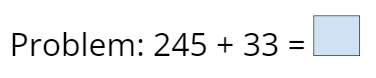
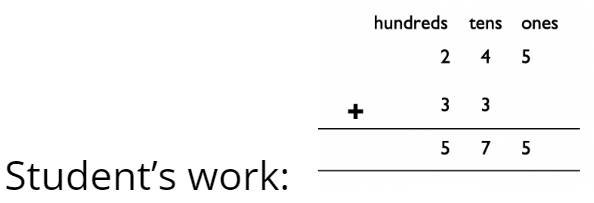
A teacher sees the error below on a student’s independent addition practice. Which concept does the student misunderstand?
A. Number operations
B. Regrouping
C. Place value
D. Independent numbers
Answer C is correct because the student does not understand that 33 is not the same as 330, and lines their numbers up inaccurately in place value when transferring horizontal math problems to vertical.
Which of the following would be the best assistive technology for a 14 year old student with significant visual impairment when given a reading task?
A. Provide a paraprofessional to read to the student
B. Provide a paraprofessional to read to the student
C. Text to speech screen readers
D. Recording devices
Answer C is correct because text-to-speech screen readers can read aloud digital or printed text; this technology also allows the student to be independent. Answer A is incorrect because it limits independence, and is not an assistive technology device. Answer B is incorrect because this device takes verbal information and creates a written document. Answer D is incorrect because a recording device does not read the text for the student, which is the skill targeted.