Comprehensive Natural Gas: Concepts, Supply Chain, Economics, and Geopolitics | Quizlet
 Call Kai
 Learn
Learn Practice Test
 Spaced Repetition
 Match
Match Flashcards
 Knowt Play
1/113

There's no tags or description
Looks like no tags are added yet.
Name | Mastery | Learn | Test | Matching | Spaced | Call with Kai |
|---|
No analytics yet
Send a link to your students to track their progress
114 Terms
What is natural gas?
A fossil fuel found beneath the earth's surface, primarily composed of methane (CH4).
What are the main components of natural gas?
Methane (CH4), natural gas liquids (NGLs), and nonhydrocarbon gases.
What are natural gas liquids (NGLs)?
A group of hydrocarbons including ethane, propane, normal butane, and isobutane.
What are some nonhydrocarbon gases found in natural gas?
Carbon dioxide (CO2), hydrogen sulfide (H2S), nitrogen, water vapor, and rare gases like helium.
What are the key characteristics of natural gas?
Highly combustible, colorless, odorless (odorant added), non-toxic, non-corrosive, high energy content, and can be stored underground or in tanks.
Where is natural gas found?
In underground rock formations called reservoirs, which can be conventional or unconventional.
What distinguishes conventional from unconventional natural gas reservoirs?
Conventional reservoirs have high permeability allowing easy extraction, while unconventional reservoirs have low permeability requiring advanced techniques.
What extraction techniques are commonly used for unconventional natural gas?
Hydraulic fracturing (fracking) and horizontal drilling.
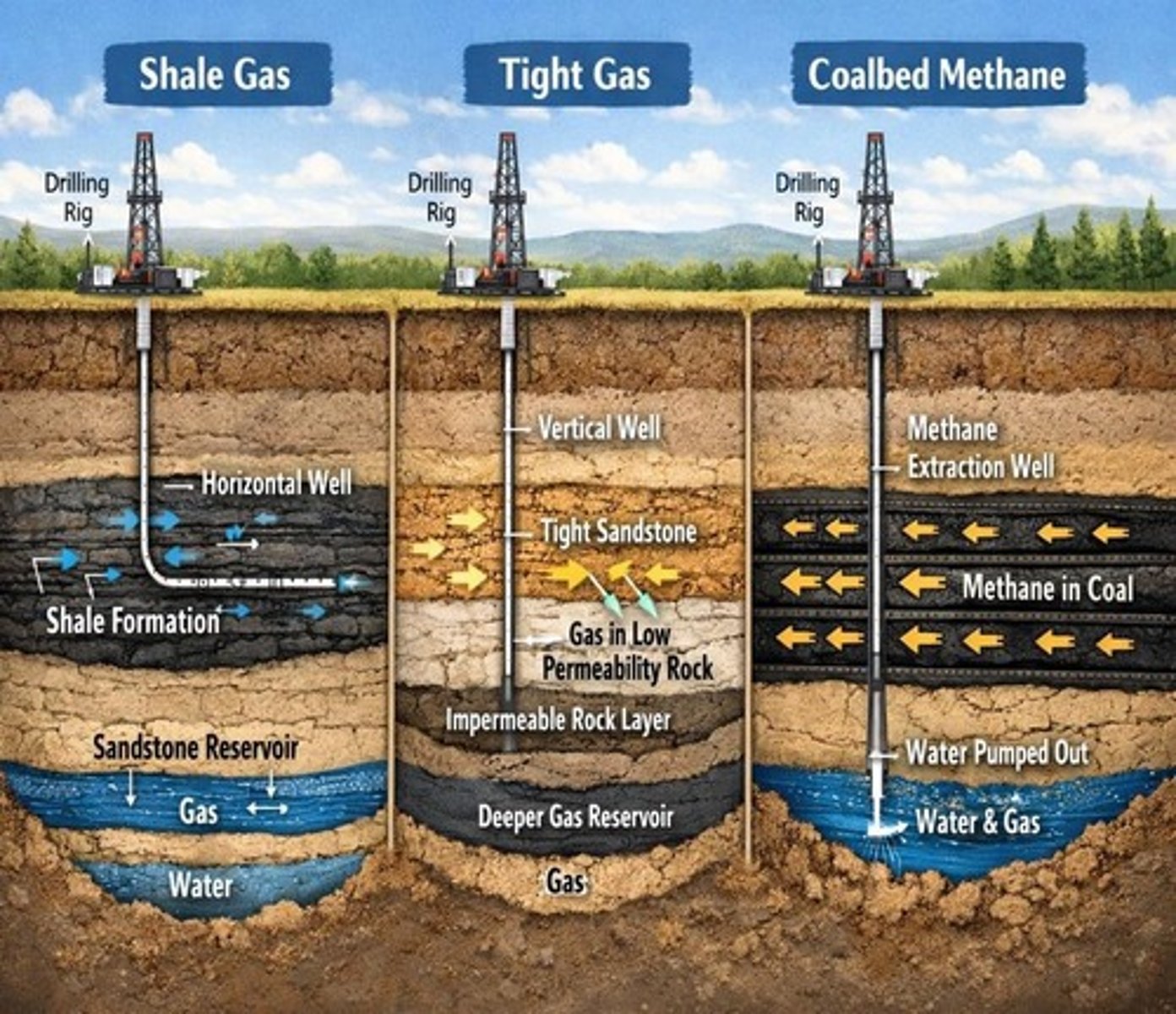
What is shale gas?
Natural gas located in fine-grained sedimentary rocks, often trapped in tiny pores.
What is tight gas?
Natural gas found in dense sandstone formations that requires pressure techniques to extract.
What is coalbed methane (CBM)?
Methane adsorbed onto coal seams, often extracted alongside water to reduce pressure.
How can natural gas be classified based on its composition?
As dry (mostly methane) or wet (contains significant NGLs).
What is the difference between dry and wet natural gas?
Dry gas contains over 90% methane and requires minimal processing, while wet gas contains NGLs and requires processing to separate them.
Why are wet natural gas and NGLs economically attractive?
They offer additional revenue streams from NGL sales and are linked to both gas and oil markets.
What is sweet natural gas?
Natural gas with low hydrogen sulfide (H2S) content, considered safe to process.
What is sour natural gas?
Natural gas containing significant amounts of hydrogen sulfide (typically > 4 ppm).
What are the implications of classifying natural gas as sweet or sour?
Sweet gas is easier and cheaper to process, while sour gas requires additional handling due to toxicity.
What role does natural gas play in the energy transition?
Natural gas serves as a bridge fuel, aiding the transition from coal and oil to renewable energy sources.
What are the geopolitical aspects of natural gas?
Includes trade corridors, strategic competition, and security risks associated with supply and demand.
What are some key takeaways regarding natural gas?
Natural gas is crucial for energy systems, has significant economic implications, and is influenced by geopolitical factors.
What is H₂S and why is it significant in natural gas?
H₂S is highly poisonous and corrosive to pipelines; it is a precursor to sulfur dioxide (SO₂) when burned.
What are the implications of H₂S in pipeline specifications?
Pipeline specification standards usually require H₂S levels to be less than ~4 ppm.
What factors does sulfur content in natural gas affect?
It affects processing requirements, production costs, market value, environmental impact, and infrastructure compatibility.
What is the difference between associated and unassociated natural gas?
Associated NG is found with significant oil production, while unassociated NG exists where gas is the primary resource.
What can be done with associated gas when infrastructure is lacking?
It can be reinjected into the reservoir, flared, or vented.
What are the key characteristics of dedicated gas fields?
Investment decisions depend on gas prices, infrastructure availability, and long-term contracts; production is driven by gas market demand.
What historical developments were pivotal for the global fossil gas industry in the 1960s?
Massive discoveries and infrastructure breakthroughs marked this period.
What was the significance of the Groningen field developed in the Netherlands?
It was discovered in 1959 and production scaled in the 60s, marking a key milestone in natural gas development.
What marked the birth of the commercial Liquefied Natural Gas (LNG) industry?
The first regular exports from the U.S. to Japan began in 1969.
What does the natural gas supply chain describe?
It describes the journey of gas from underground reserves to end-users, divided into upstream, midstream, and downstream stages.
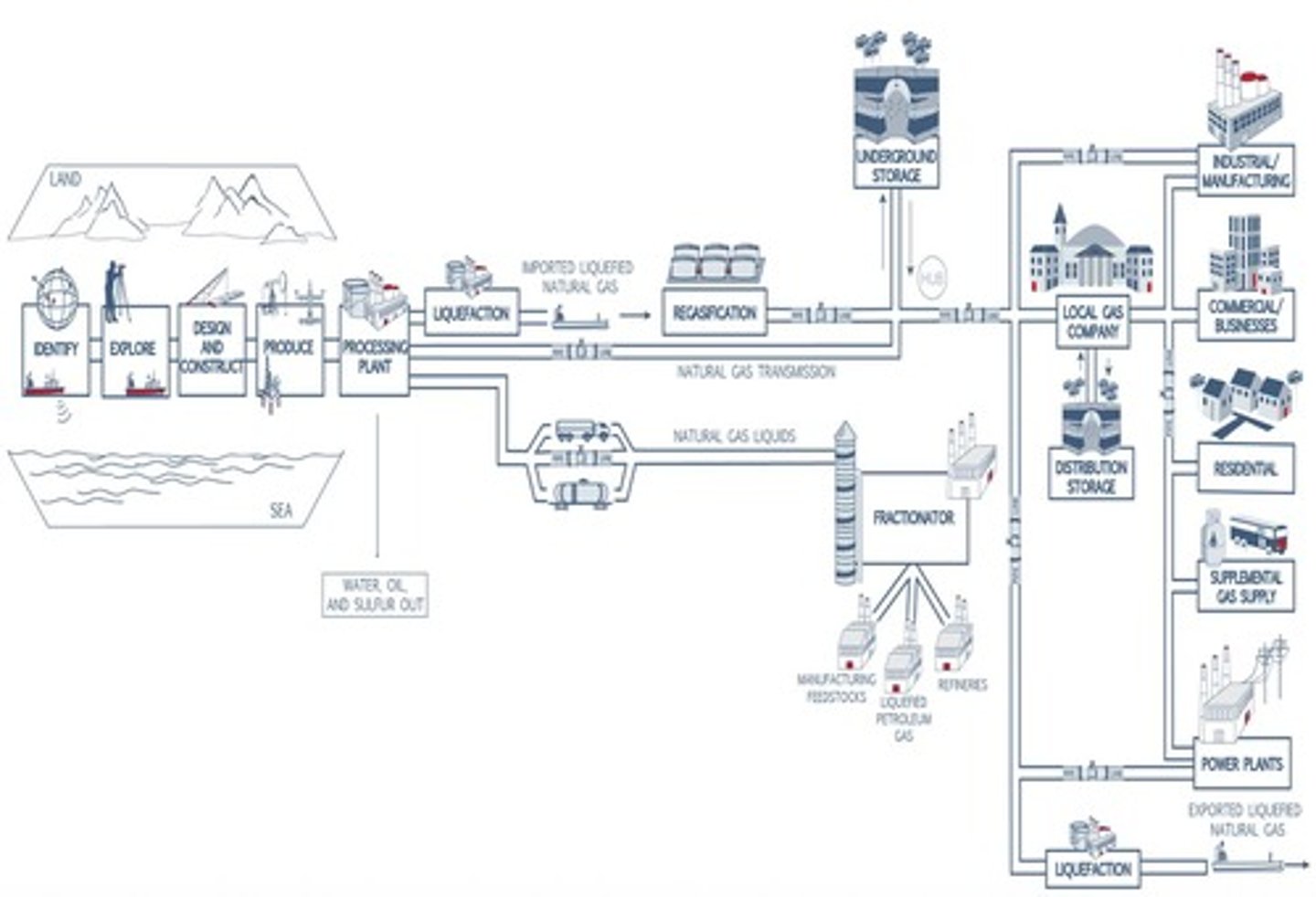
What are the stages of the natural gas supply chain?
Exploration & Production, Processing & Purification, Transportation, and Distribution & End Use.
What is involved in the exploration stage of the natural gas supply chain?
Identifying potential underground gas reservoirs using seismic surveys, geological mapping, and exploratory drilling.
What is the primary difference between onshore and offshore natural gas production?
Onshore production occurs on land and is generally less expensive, while offshore production occurs beneath oceans and requires specialized systems.
What happens to natural gas after it is extracted?
It is sent to a processing plant where impurities are removed to meet quality standards.
How is natural gas distributed after processing?
It is distributed through pipelines or shipping to domestic, regional, or global markets.
What is the role of pipelines in the natural gas supply chain?
Pipelines transport gas over long distances, connecting production sites to demand centers.
What are the challenges of transporting natural gas?
Natural gas is difficult to transport in gaseous form over long distances; shipping as LNG is often necessary.
How does LNG facilitate global trade in natural gas?
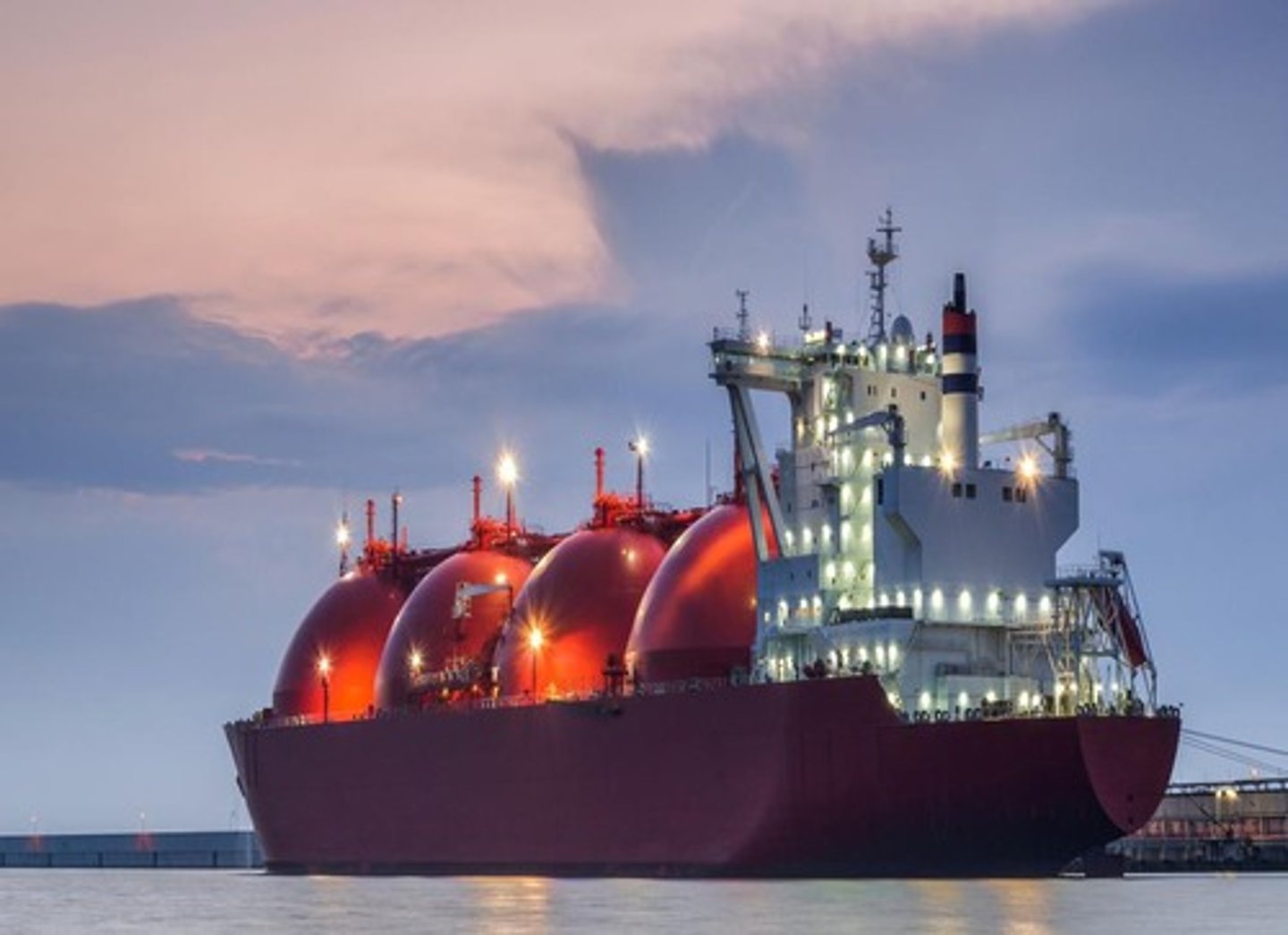
LNG is natural gas cooled to -162°C, reducing its volume by ~600 times, enabling intercontinental trade independent of pipelines.
What are the environmental concerns associated with the natural gas supply chain?
Infrastructure lifespans raise lock-in concerns in climate policy debates due to high capital costs and regulatory oversight.
What is the significance of understanding the natural gas supply chain?
It is critical for energy planning, policy, and sustainability.
What are the processing steps involved in natural gas purification?
Oil and condensate removal, water removal, separation of NGLs, and sulfur and carbon dioxide removal.
What is the primary method of natural gas distribution in domestic markets?
High-pressure, large-diameter pipelines transport gas over long distances.
What are the two pathways natural gas can take after extraction and processing?
Distribution for end use or storage.
What is the significance of the first LNG shipments from the US to Ukraine?
It highlights the importance of LNG shipping for markets separated by oceans or politically sensitive pipeline routes.
What is the role of regulatory oversight in the natural gas supply chain?
It ensures safety and efficiency throughout the various stages of the supply chain.
What specialized infrastructure is required for LNG?
LNG carriers, storage tanks, and regasification terminals.
How have LNG markets changed in recent years?
They have become more flexible, moving from rigid long-term contracts to spot trading.
What has LNG transformed in terms of commodity trading?
It has transformed natural gas from a regional commodity into a globally traded one.
What are the reasons for storing natural gas?
To balance seasonal demand fluctuations, meet short-term high demand, ensure supply security during disruptions, and stabilize prices.
What types of storage sites are used for natural gas?
Natural gas can be stored underground (e.g., salt caverns, depleted reservoirs, aquifers) or above-ground (LNG tanks).
What are the main residential uses of natural gas?
Heating, cooking, and hot water.
In what industrial applications is natural gas used?
As a feedstock for fertilizers, steel, chemicals, cement, and glass manufacturing.
What role does natural gas play in power generation?
It provides flexible and efficient electricity through combined-cycle and gas-fired plants.
What dual role does natural gas play in modern energy systems?
It serves as a primary energy source and a transition fuel.
Why is natural gas valued in electricity systems?
For its flexibility, relatively low carbon intensity compared to coal, and compatibility with renewable energy integration.
What operational advantages do gas-fired power plants have?
They have short start-up and shut-down times compared to coal or nuclear plants.
How does natural gas support grid stability?
By managing peak load and balancing supply-demand fluctuations.
What is the significance of natural gas as a 'bridge fuel'?
It displaces coal and reduces emissions while renewable capacity grows.
How does natural gas compare to coal in terms of emissions?
Natural gas emits less CO₂ per unit of electricity and has lower particulate matter and sulfur emissions.
What environmental concerns are associated with natural gas?
Methane leaks during production, processing, transport, and storage can significantly reduce climate benefits.
What are the local environmental risks of fracking?
Concerns include groundwater contamination, wastewater disposal, and induced seismicity.
What is a major economic characteristic of natural gas?
It is capital-intensive across the supply chain.
What are the cost components in the natural gas supply chain?
Exploration costs, drilling and completion costs, processing costs, transportation costs, and liquefaction costs (if LNG).
How does the total delivered cost of natural gas vary?
Pipeline gas has lower transport costs compared to LNG, which incurs liquefaction, shipping, and regasification costs.
What is a central investment risk associated with natural gas infrastructure?
Long-term reliance on gas may delay full decarbonization, leading to underutilized assets if climate policies tighten.
What do operational costs in natural gas depend heavily on?
Fuel prices
What is the upstream price in natural gas?
Price at the wellhead or production site
What influences natural gas prices?
Extraction costs and fiscal terms
What are the three main pricing points for natural gas?
Upstream price, wholesale price, retail price
What is the wholesale price of natural gas?
Price traded in hubs or via contracts (pipeline or LNG)
What does the retail price of natural gas include?
Taxes, transport tariffs, and distribution margins
What are the demand-side determinants of natural gas?
Seasonality, power sector switching, industrial demand, energy efficiency, and export
What are the supply-side determinants of natural gas?
Production costs, domestic production, resource discoveries, spare capacity, and market design
Why does natural gas pricing matter?
It determines energy affordability, investment decisions, energy security, and competitiveness
How has natural gas pricing evolved historically?
From rigid long-term structures to more market-based systems
What are oil-indexed contracts in natural gas pricing?
Contracts that link gas prices to crude oil prices
What is hub-based pricing?
Pricing based on trading at gas hubs with multiple buyers and sellers
What is the Henry Hub?
A major benchmark for US natural gas pricing
What is the Title Transfer Facility (TTF)?
The most important European gas benchmark
What is LNG spot market pricing?
LNG traded on short-term contracts or flexible destination clauses
What is arbitrage in the context of natural gas?
Redirecting gas to the market offering the highest price
How does LNG trade affect global gas markets?
It leads to stronger price convergence and faster transmission of shocks
What are the implications of expanding LNG trade?
Increased volatility and price spikes due to global market interactions
What is portfolio trading in LNG?
Managing multiple supply contracts and buyers to optimize cargo flows
How does natural gas affect macroeconomics?
It impacts growth, fiscal stability, exchange rates, and trade balance
What are the main benefits for gas exporters?
Foreign exchange and fiscal revenues
What are the main vulnerabilities for gas importers?
Energy insecurity and price volatility
What key geopolitical questions surround natural gas?
Control of reserves and transit routes
How has natural gas evolved in terms of geopolitics?
From a regional fuel to a strategic geopolitical commodity
What role does natural gas play in macroeconomics?
Natural gas affects growth, industrialization, fiscal stability, exchange rates, trade balance, inflation, and energy prices.
How do the macroeconomic effects of natural gas differ for exporters and importers?
Exporters benefit from foreign exchange and fiscal revenues, while importers rely on reliable energy but face energy insecurity and price volatility.
What is the main vulnerability for gas exporters?
Gas exporters face the resource curse and Dutch disease.
What are the key geopolitical questions surrounding natural gas?
Who controls reserves, transit routes, pricing mechanisms, and how does it shape foreign policy alignments?
Why is natural gas considered a geopolitical commodity?
Natural gas has evolved from a regional fuel into a strategic geopolitical commodity due to its impact on energy security and foreign policy.
What are the three structural realities shaping natural gas geopolitics?
Energy security, industrial competitiveness, and geographic concentration of reserves.
How does climate politics relate to natural gas?
Natural gas emits less CO₂ than coal but still contributes to climate change, influencing global energy transitions.
What is the significance of the global distribution of natural gas reserves?
A small number of countries hold the majority of proven reserves, affecting political leverage and dependency relationships.
How do pipelines influence natural gas geopolitics?
Pipelines create geographic interdependence and can reinforce alliances or reshape regional influence.
What are the vulnerabilities associated with natural gas pipelines?
Pipelines are fixed and exposed, making them vulnerable to political disputes, sabotage, and war.
What impact has the LNG revolution had on gas geopolitics?
The LNG revolution has reduced pipeline dependency, increased market flexibility, and enhanced energy security diversification.