Cardiovascular System: Blood Vessels, Circulation, and Blood Pressure
 Call Kai
 Learn
Learn Practice Test
 Spaced Repetition
 Match
Match Flashcards
 Knowt Play
1/49

There's no tags or description
Looks like no tags are added yet.
Name | Mastery | Learn | Test | Matching | Spaced | Call with Kai |
|---|
No analytics yet
Send a link to your students to track their progress
50 Terms
What are the two main types of blood vessels in the circulatory system?
Pulmonary vessels and systemic vessels.
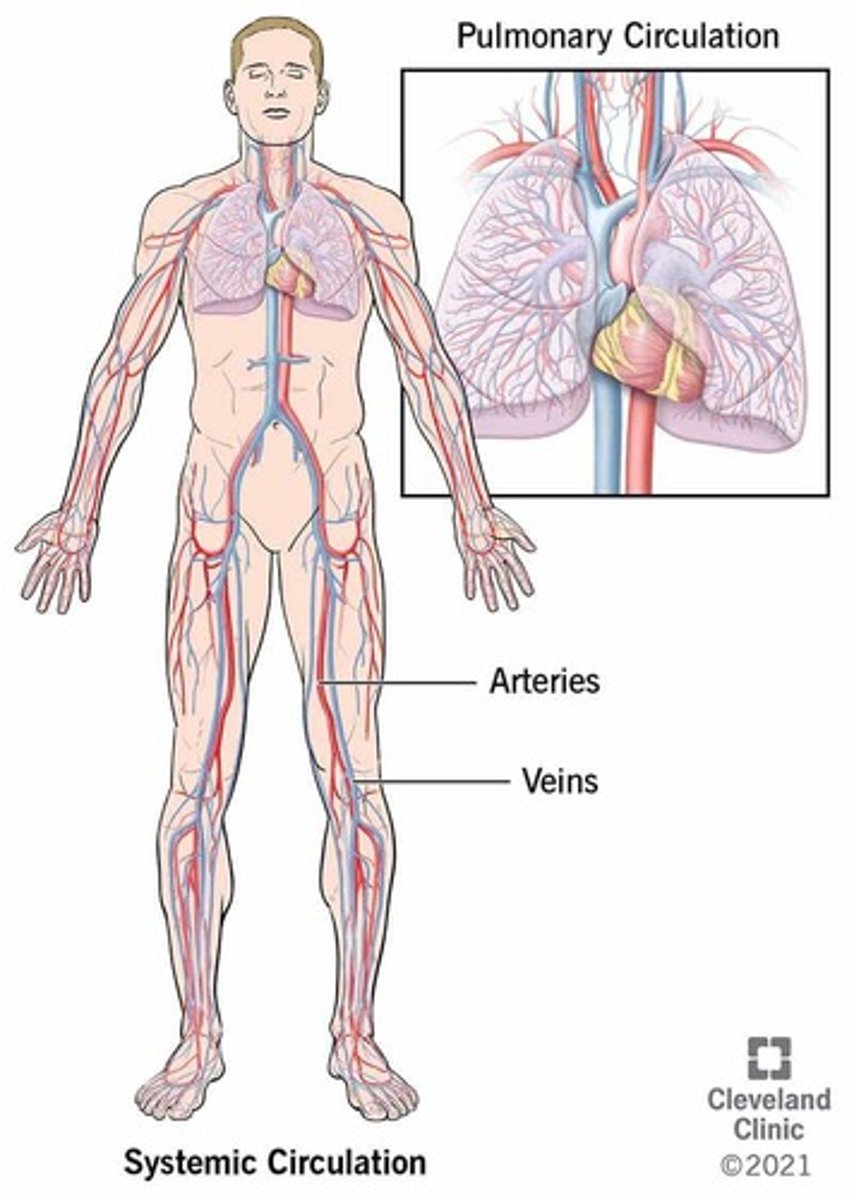
What is the primary function of the circulatory system?
To transport blood to body tissues and back to the heart, facilitating the exchange of substances.
What do arteries do?
Carry blood away from the heart.
What do veins do?
Carry blood toward the heart.
What are capillaries primarily responsible for?
Exchanging nutrients, waste products, and gases between blood and interstitial spaces.
What are the three structural layers of blood vessels?
Tunica interna, tunica media, and tunica externa.
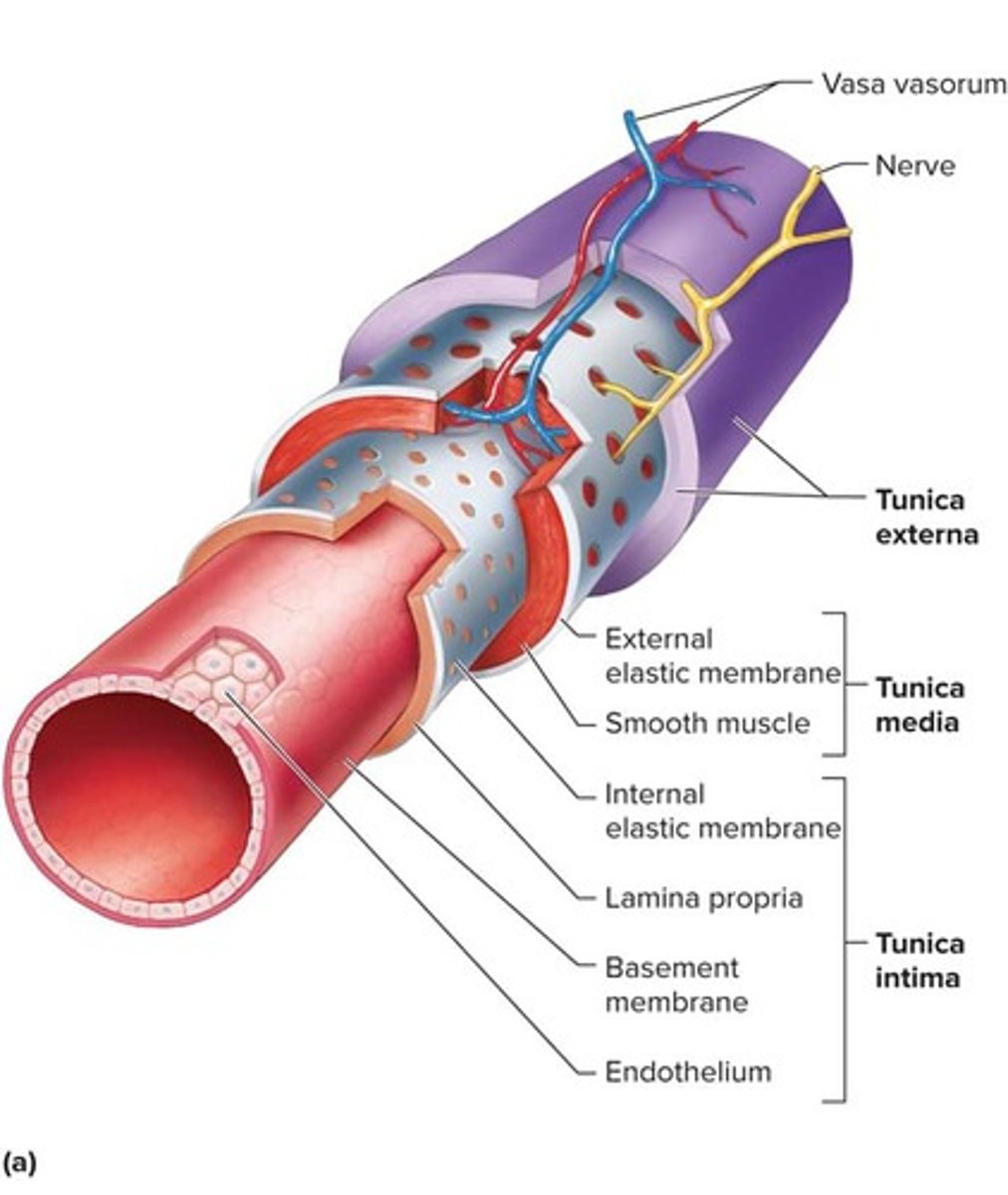
What is the role of smooth muscle in blood vessels?
It regulates blood flow through vasoconstriction and vasodilation.
What are elastic arteries?
The largest arteries with a high amount of elastic tissue, allowing them to withstand high pressure.
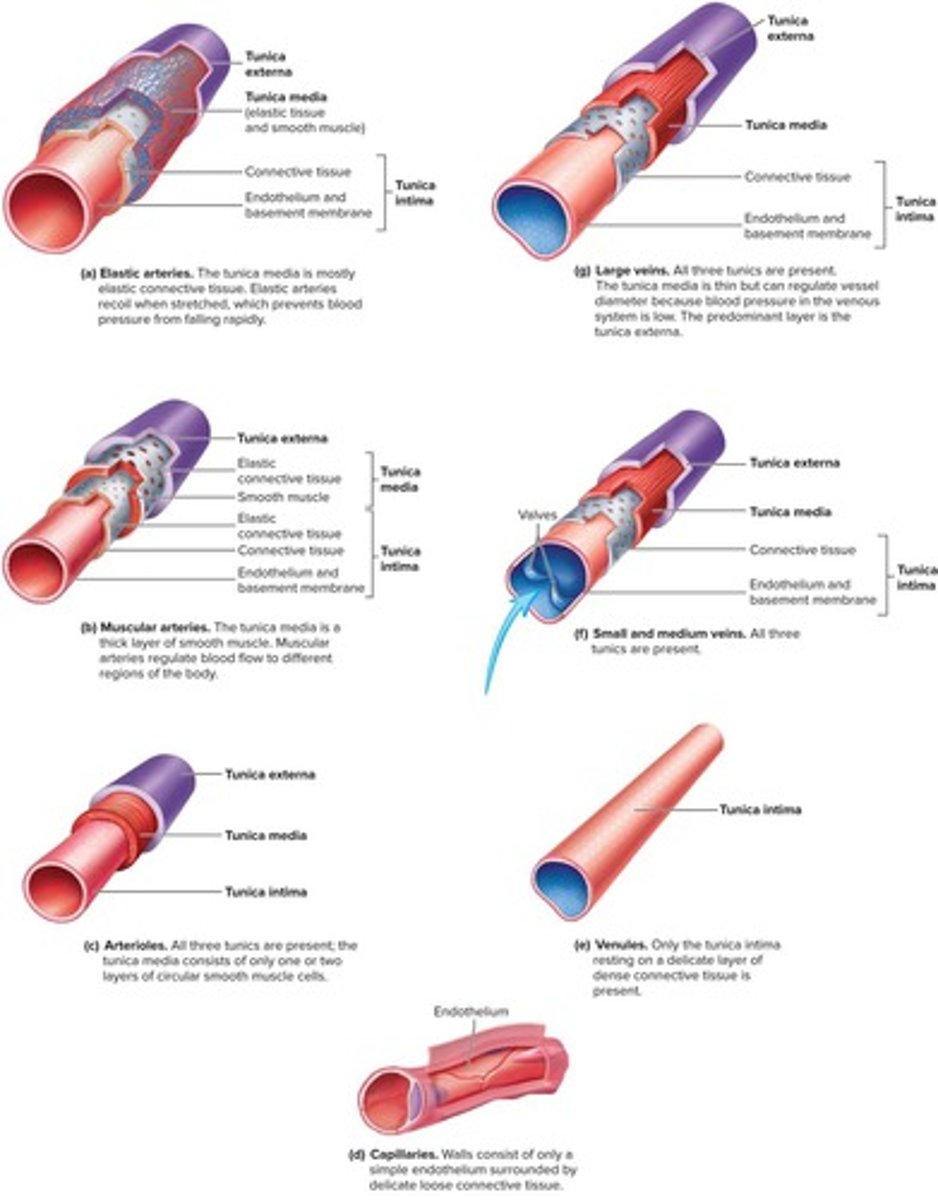
What are muscular arteries?
Arteries that have more smooth muscle and can regulate blood supply by constricting or dilating.
What are arterioles?
Smallest arteries that transport blood from small arteries to capillaries.
What are the three types of capillaries?
Continuous, fenestrated, and sinusoidal capillaries.
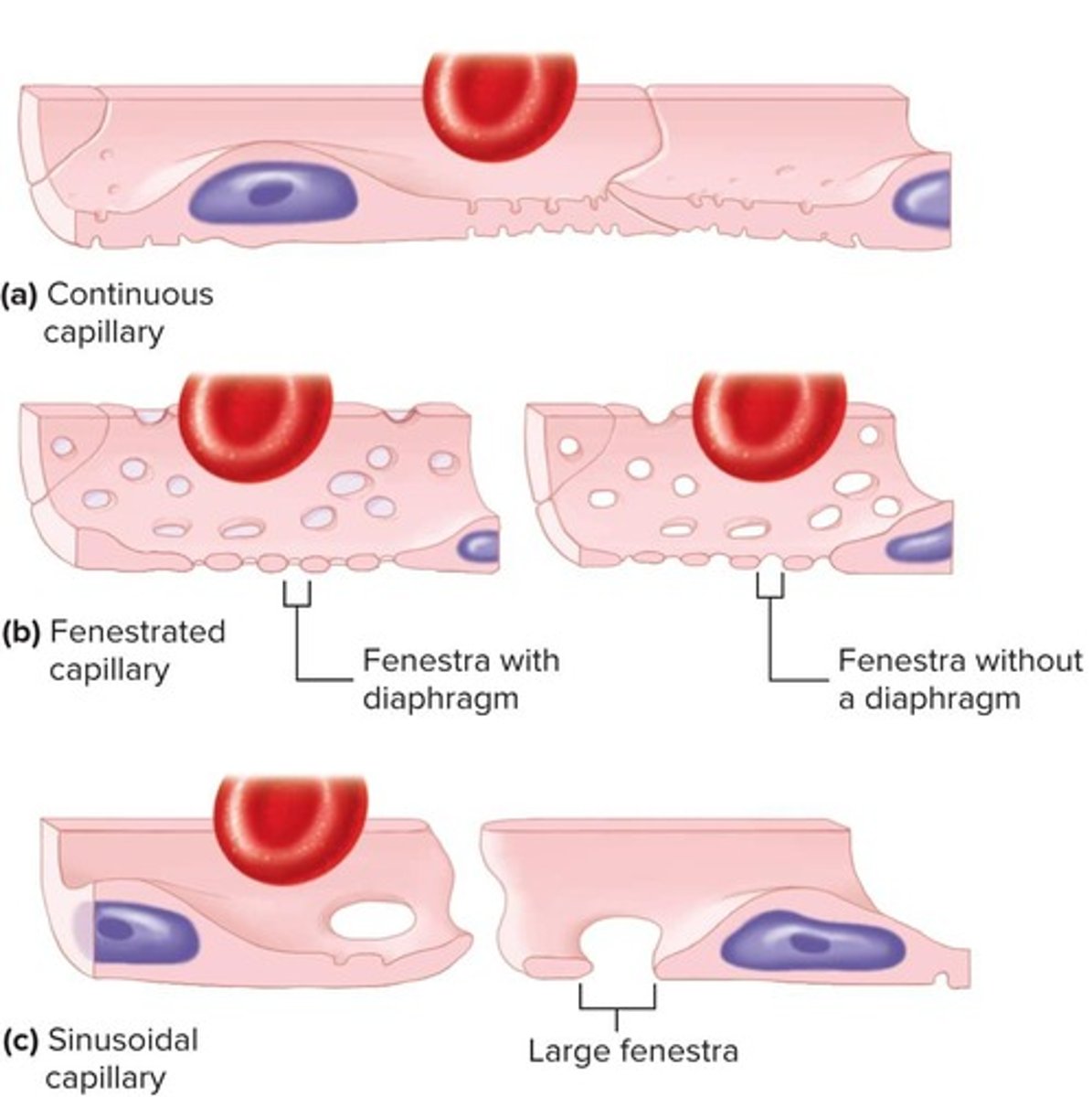
What distinguishes continuous capillaries?
They have no gaps between endothelial cells and are less permeable to large molecules.
What characterizes fenestrated capillaries?
They contain numerous fenestrae, allowing for high permeability.
What are sinusoidal capillaries?
Capillaries with large diameters and large fenestrae, allowing large molecules to cross easily.
What is the capillary network?
A branching network of capillaries where blood flows from arterioles through metarterioles.
What is the primary function of capillary networks in high metabolism tissues?
To facilitate nutrient and waste product exchange.
What are venules?
Small veins that drain capillary networks.
What are the classifications of veins?
Small/medium veins and large veins.
What is the structure of large veins?
They have a thin tunica intima, a tunica media with circularly arranged smooth muscle, and a predominant tunica externa.
What are portal veins?
Veins that begin in a primary capillary network and end in a secondary capillary network without a pumping mechanism.
What is the hepatic portal vein?
A portal vein that carries nutrient-rich blood from GI capillaries to the liver.
What is the hypothalamo-hypophyseal portal system?
A portal system between the hypothalamus and the anterior pituitary gland.
What is Poiseuille's law?
A law that describes the flow of fluid through a cylindrical pipe, relating flow rate to pressure and resistance.
What does Laplace's law relate to in blood vessels?
It relates to the critical closing pressure of blood vessels.
What is blood pressure?
The pressure exerted by circulating blood on the walls of blood vessels.
What is the baroreceptor reflex?
A reflex that can change heart rate in response to changes in blood pressure.
What is the renal nephron portal system?
A system within the urine producing structures of the kidneys.
What is the function of valves in veins?
To prevent backflow of blood; found in all veins greater than 2 mm in diameter.
Where are more valves found in veins?
In the veins of the lower extremities compared to the upper extremities.
What does pulmonary circulation involve?
The flow of deoxygenated blood from the right ventricle into the pulmonary trunk.
What are the two pulmonary veins responsible for?
Carrying oxygenated blood from each lung to the left atrium.
What is the aorta's role in systemic circulation?
It exits the left ventricle and is divided into three parts: ascending aorta, aortic arch, and descending aorta.
What branches from the ascending aorta?
The right and left coronary arteries.
What are the three branches of the aortic arch?
Brachiocephalic artery, left common carotid artery, left subclavian artery.
What is the difference between the thoracic aorta and abdominal aorta?
The thoracic aorta is the portion in the thorax, while the abdominal aorta is inferior to the diaphragm.
What major veins return deoxygenated blood to the right atrium?
Coronary sinus, superior vena cava, and inferior vena cava.
What types of veins exist in the circulatory system?
Superficial veins, deep veins, and sinuses.
What is the true statement when contrasting arteries and veins?
C) Arteries have a thicker tunica media than veins.
How is blood pressure measured using the auscultatory method?
Using a sphygmomanometer and stethoscope to listen for Korotkoff sounds.
What do the first and last Korotkoff sounds indicate?
The first sound indicates systolic pressure, and the last sound indicates diastolic pressure.
What happens to blood flow when resistance increases?
Flow decreases when resistance increases.
What is critical closing pressure?
The pressure at which a blood vessel collapses and blood flow stops.
What does Laplace's Law state?
The force acting on a blood vessel wall is proportional to the diameter of the vessel times blood pressure.
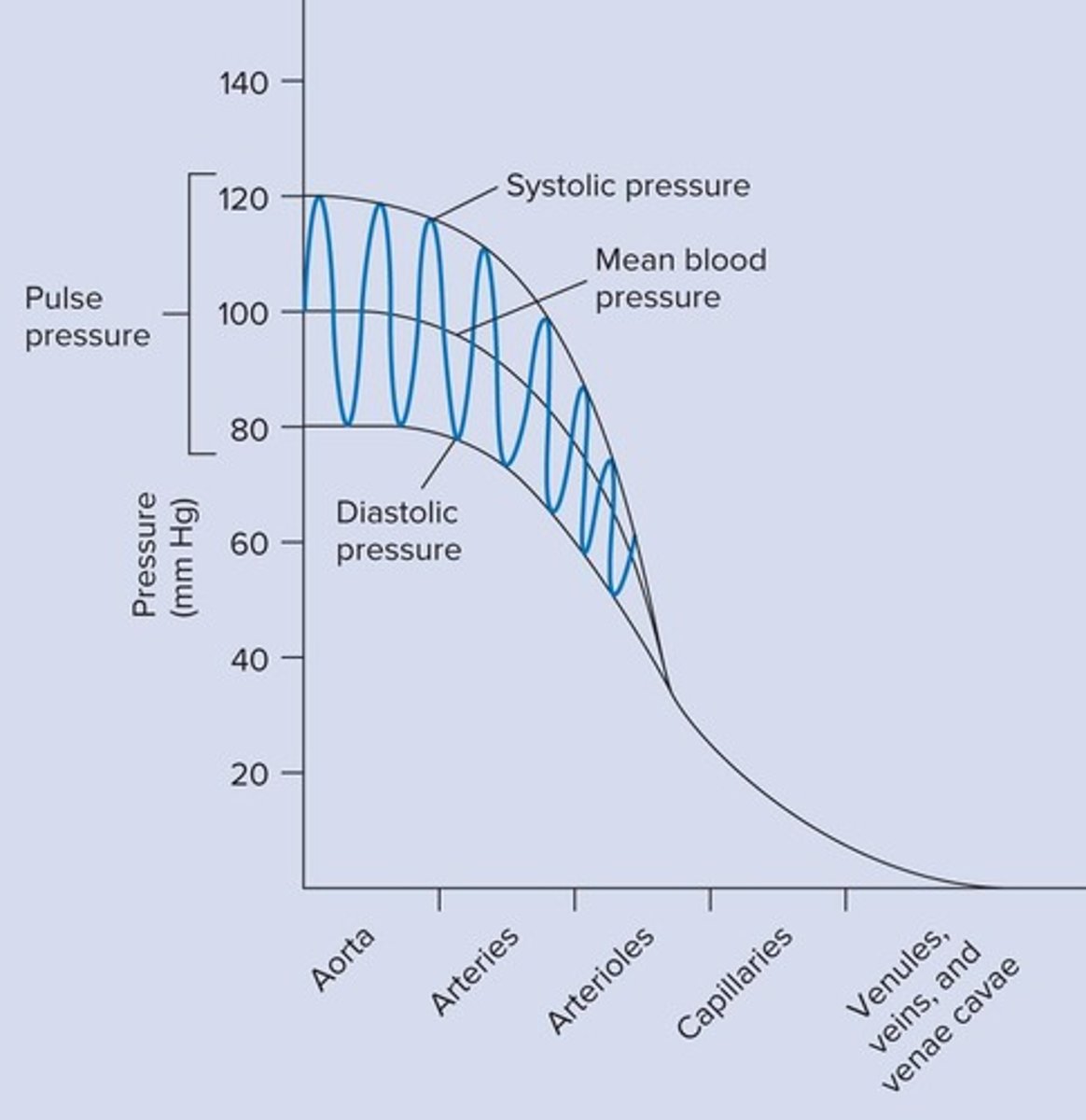
What happens to blood pressure as blood moves from the aorta to the vena cavae?
Blood pressure drops to near zero for the vena cavae.
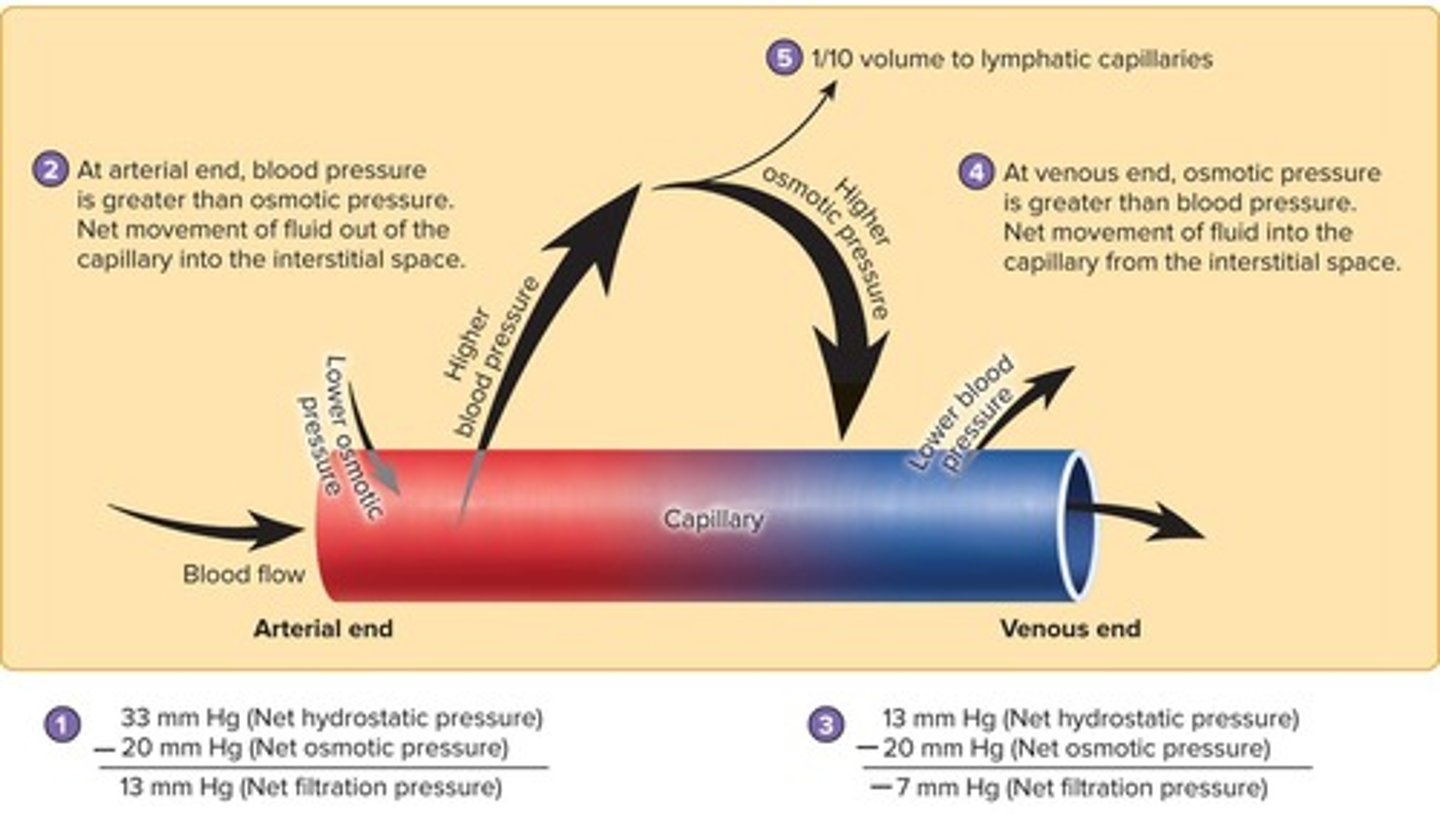
What is capillary exchange?
The movement of substances into and out of capillaries, primarily through diffusion.
What is the effect of gravity on blood pressure in a standing position?
It increases blood pressure below the heart and decreases pressure above the heart.
What is arteriosclerosis?
Degenerative changes in arteries making them less elastic.
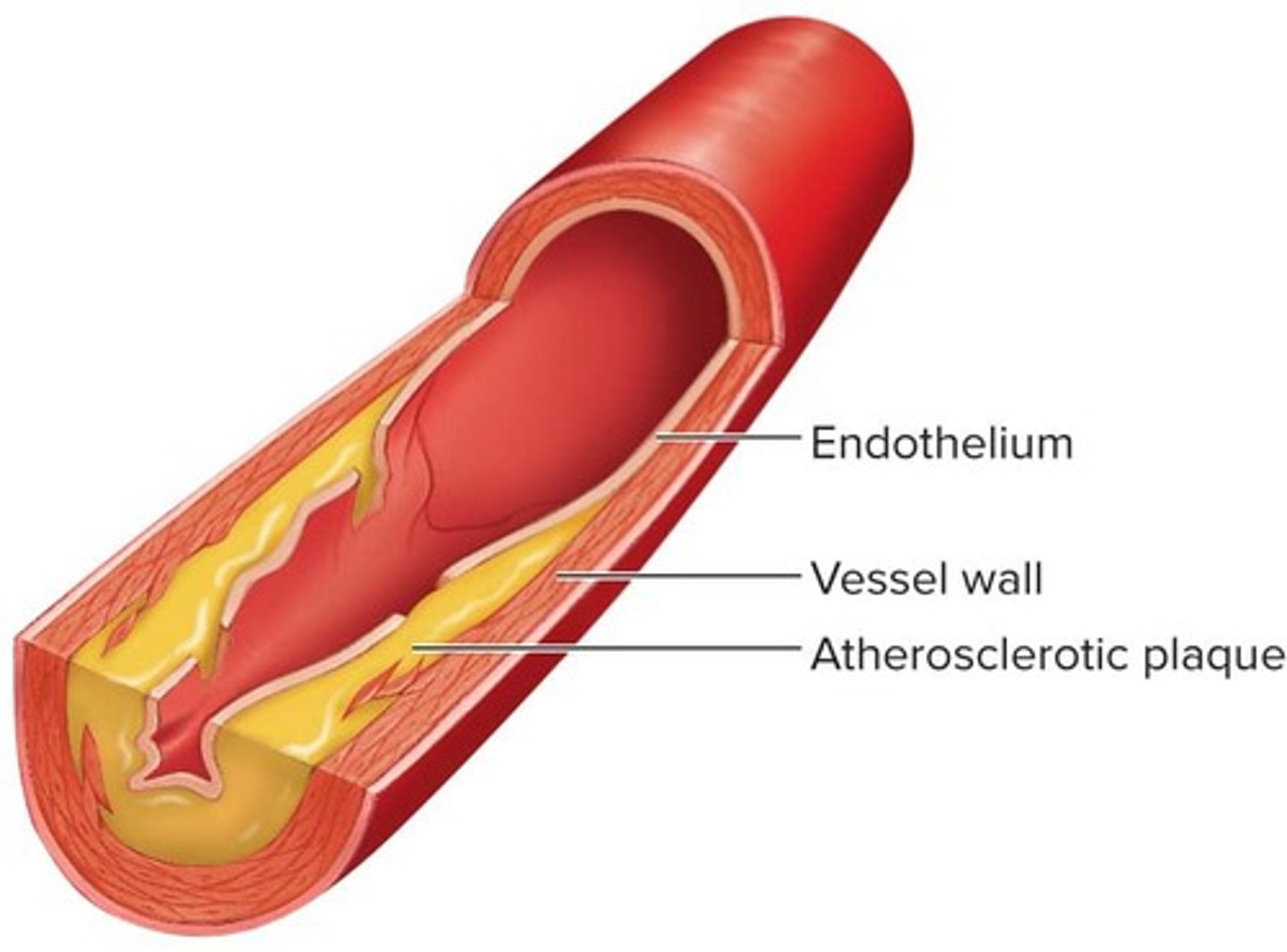
What is atherosclerosis?
Deposition of plaque on the walls of medium and larger arteries, including coronary arteries.
What occurs when blood pressure drops below critical closing pressure?
The vessel collapses.
What is the significance of Korotkoff sounds?
They indicate blood flow and are used to determine systolic and diastolic pressures.