Strategic Management Exam 2
 Call Kai
 Learn
Learn Practice Test
 Spaced Repetition
 Match
Match Flashcards
 Knowt Play
1/93

There's no tags or description
Looks like no tags are added yet.
Name | Mastery | Learn | Test | Matching | Spaced | Call with Kai |
|---|
No analytics yet
Send a link to your students to track their progress
94 Terms
Scope of Customers
broad vs niche
goal to create unique value
Competitive Advantage
cost (low) vs differentiation (premium qualities)
goal to create low cost position
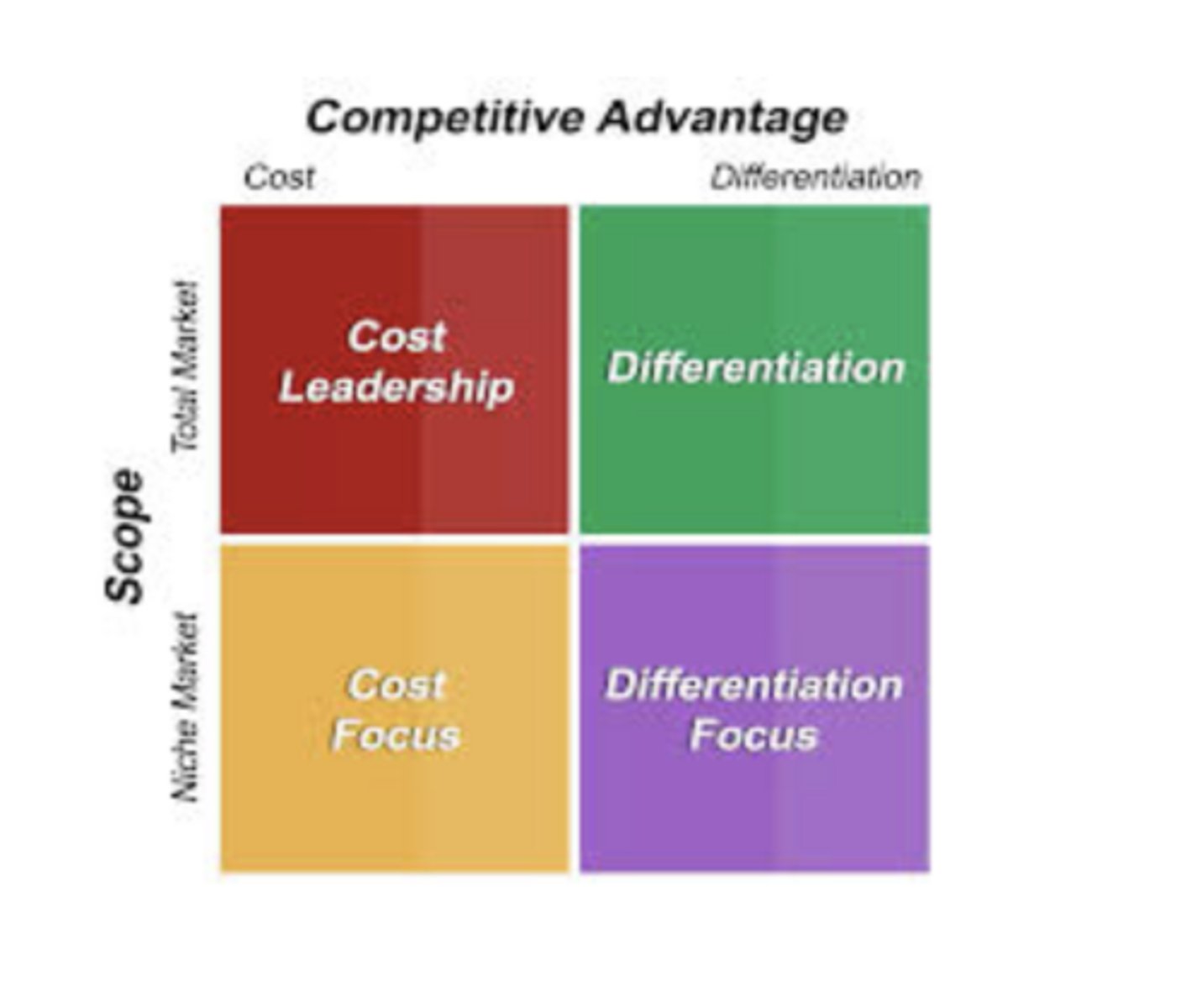
4 Generic Strategies
cost leadership: broad total market and low cost
cost focus: niche market and low cost
broad differentiation: broad total market and high differentiation
differentiation focus: niche market and high differentiation
How to achieve cost leadership:
Economies of Scale
Learning and Experience
Use a Different Business Model
Lower Input Costs (primarily achieved through lowering costs throughout the entire value chain)
Economies of Scale
a proportionate saving in costs gained by an increased level of production
- spread cost of facilities, equipment, advertising, and R&D when they have more customers to purchase and share the cost (try to sell more!)
Ex- Factories production amounts
Learning and Experience
improved skills or firm routines
Ex- Maintenance Cost Reduction:
Using same aircraft, the technicians accumulate experience over time, thus reducing the maintenance cost
Use a Different Business Model
Eliminate activities in the value chain
Ex- Ryanair
Perform different activities altogether
Ex- Amazon
Lower Input Costs
Things that can be lowered:
Raw Materials
Supplies
Parts
Equipment
Labor
Capital
Ex- Toyota and Walmart
To Lower:
Buy in large volume of materials from suppliers so that they can get volume discounts that no other retailers can get.
Build collaborative relationship with suppliers to reduce costs
Source inputs from the lowest-cost location or country
Ex- outsourcing
Does Cost Leadership Mean Lower Quality
achieve primarily through lowering its costs throughout the entire value chain
- not necessarily
How to Achieve Cost Differentiation:
Product features
Relationships
Linkages
Product Features
A product wins because it does a better job
A product wins because it does more jobs
Ex- Apple wasn't selling a better phone; it was selling a phone that could do more jobs.
A product wins because it does unique jobs
Quality: A product wins because it lasts longer; Built to last
Ex- Toyota and Honda
Convenience: A product wins because it is convenient to purchase
Ex- Coca cola is easy to find
Ex- Amazon provides one-stop shopping experience and you can buy any items by one-click
Relationships
between firms and customers including brand image, reputation, customization, service, and subpart
Brand image:
Customers buy these products to feel part of an elite group or club
The social and emotional dimension
make brand image a differentiator
Ex- Chanel and BMW
Linkages
within or across firms
- product mix and distribution channels
Ex- Delta
Business Level Strategies (Internal Analysis)
Basic Considerations:
Who are the customers?
What should be offered to customers?
How can we create more value than competitors?
Choice of Market:
Broad/General
Niche/Focus
Choice of competitive advantage:
Perform different activities
Perform same activities but in a different way
Corporate Level Strategy: Diversification
firm's strategy to expand its operations by entering new businesses
- purpose: Synergy- working together to create greater value
Related Diversification
A firm entering different businesses in which it can benefit from leveraging core competencies, sharing activities, or building market power
Businesses have horizontal relationship: sharing tangible (e.g., production facilities and distributional channels) and intangible resources (e.g., brand, core competencies such as marketing)
Ex- Pepsi
Unrelated Diversification
A firm entering a different business that has little horizontal interaction with other businesses of a firm
Benefits are from hierarchical relationships: Value creation derived from corporate office
Asset, capital, management restructuring by corporate office
Leveraging support activities
Ex- HR management, technology infrastructure
Levels of Diversification
Low Levels of Diversification:
Single business: 95% or more of revenue comes from a single business
Ex- grocery store
Dominant business: Between 70% and 95% of revenue comes from a single business
Ex- Kellog
Moderate to High Levels of Diversification
(Synergies/Economies of Scope)
Related constrained: Less than 70% of revenue comes from the dominant business, and all businesses share product, technological, and distribution linkages
Ex- Proctor and Gamble
Related linked (mixed related and unrelated): Less than 70% of revenue comes from the dominant business, and there are only limited links between businesses
Ex- Nike
Very High Levels of Diversification:
Unrelated: Less than 70% of revenue comes from the dominant business, and there are no common links between businesses
Ex- Samsung
Value Creation Through Related Diversification
Economies of Scope
Market Power
Economies of Scope
refers to cost savings from leveraging core competencies or sharing related activities among businesses in the corporation
The cost advantages that businesses experience when they increase the variety of goods or services they offer
Leveraging core competencies: a firm's strategic resource that reflect the collective learning in the organization
enhance competitive advantage by creating superior customer value
different businesses within a corporate
must share one important element related to its core competency
must be difficult for competitors to imitate or find substitute
Ex- 3М leverages its competencies in adhesives technologies to many industries, including automotive, construction, and telecommunications
Sharing activities: Having activities of two or more businesses done by one to save costs
Common manufacturing facilities
Distribution channels
Sales forces
Ex- Polaris, a manufacturer of snowmobiles, motorcycles, and off-road vehicles, shares manufacturing operations across its businesses. It also has a corporate R&D facility and staff departments that support all of Polaris's operating divisions
Market Power
Firms' abilities to profit through controlling or restricting market supply or coordinating with other firms to reduce investment
Pooled negotiating power: Related diversification allows a firm to combine (pool) demand or supply across its businesses.
This increases bargaining power against suppliers and buyers
Ex- ConAgra is a company that owns a wide range of food companies, including Banquet Fried Chicken, Wesson Oils, Ready Whip, Hunt's Ketchup, Orville Redenbacher's Popcorn, Healthy Choice Meals, and many other brands. ConAgra centralizes its purchasing of basic packaging materials to leverage its size in relation to its suppliers.
Vertical integration: An expansion or extension of the firm by integrating preceding or successive production processes.
When a firm becomes its own supplier and/or distributor
Ex- Amazon
Benefits
A secure source of raw materials or distribution channels.
Protection of and control over valuable assets.
Proprietary access to new technologies developed by the unit.
Simplified procurement and administrative procedures
Risks
Costs and expenses associated with increased overhead and capital expenditures.
Loss of flexibility resulting from large investments.
Problems associated with unbalanced capacities along the value chain. (For example, the in-house supplier has to be larger than your needs in order to benefit from economies of scale in that market.)
Additional administrative costs associated with managing a more complex set of activities.
Value Created Through Unrelated Diversification
Corporate Planning and Parenting
Restructuring
Portfolio Management
Corporate Planning and Parenting
Parenting— creating value within business units
◦ Experience of the corporate office
◦ Support of the corporate office
Corporate Office-
• Plans
• Budgets
• Procurement
• Legal functions
• Financial functions
• Human resource management
Restructuring
Assets restructure: sell unproductive assets or businesses; and acquire valuable ones
Capital restructure: change the debt-equity mix; or mix between different debt or equity
Management restructure: changes of top leaders, organizational structure, and reporting relationships
Ex- General Electric
“Buy low and sell high”
Portfolio Management
Assess the competitive position of a portfolio of businesses within a corporation
Suggest alternatives for each business
Identify priorities for the allocation of resources across the businesses
Ex- BCG Matrix
How to Diversify
Mergers 1b. Acquisitions
Collaborative Venture
a. Joint venture
b. Strategic alliance (Open Automotive Alliance for Android)
Internal development
New products
New markets
New technology
Mergers
The combining of two or more firms into one new legal identity
There are few TRUE mergers because one firm usually dominates in terms of market share, size, or asset value
Ex- United and Continental Merger
1b. Acquisitions
The incorporation of one firm into another through purchase
Ex- Amazon and Wholefoods
Benefits:
Obtain valuable resources to expand product offerings and services
Enter new market segments
Consolidate industry
Drawbacks:
Takeover premium is very high (Amazon-Wholefoods: $13.7B)
Competitors may imitate any resulting advantages or synergies
Managers' credibility and ego negatively impact the value creation through M&As
Cultural issues after M&As
Divestiture
An opposite act to M&A
The exit of a business from a firm's portfolio
Reverse not-so-successful M&A
Enhance competitive position by reducing costs
Divestiture strategy (refer to BCG principles in the textbook)
2a. Joint Ventures (collaborative ventures)
A special case of alliances where new entities formed within a strategic alliance in which two or more firms, the parents, contribute equity to form the new legal entity
Ex Volvo Uber Joint Venture: The ratio would be 50%-50%. As per the agreement, they are doing a $300 million investment for this JV
Ex Google GlaxoSmithKline Joint Venture: The ratio would be 45%-55%, to produce bioelectronic medicines. The two companies got committed for 7 years and Euro 540 million
2b. Strategic Alliances
a cooperative relationship between two or more firms
Ex- Google, Amazon, IBM have a partnership on AI
Benefits of alliances
Develop or diffuse new technologies
Use expertise of two or more companies
Develop products technologically beyond capability of companies acting independently
Introduce successful product or service into a new market
Lacks requisite marketing expertise
Join other firms to reduce costs in the value chain
Pool capital, value-creating activities, facilities
Downside of alliances
Selection of wrong partner:
No complementary strengths
No unique strength for sustained competitive advantage
No trust among partners
Internal Development
Entering a new business through investment in new facilities, shown in corporate entrepreneurship and new venture development
New Products
New Markets
New Technology
Advantages:
No need to share wealth
No need for coordinating or combining activities with other firms
Disadvantages:
Time consuming (Time is gold in competition!)
Portfolio Management
• Assess the competitive position of a portfolio of
businesses within a corporation
• Suggest strategic alternatives for each business
• Identify priorities for the allocation of resources across the
businesses
Resource Allocation Choice - BCG Matrix
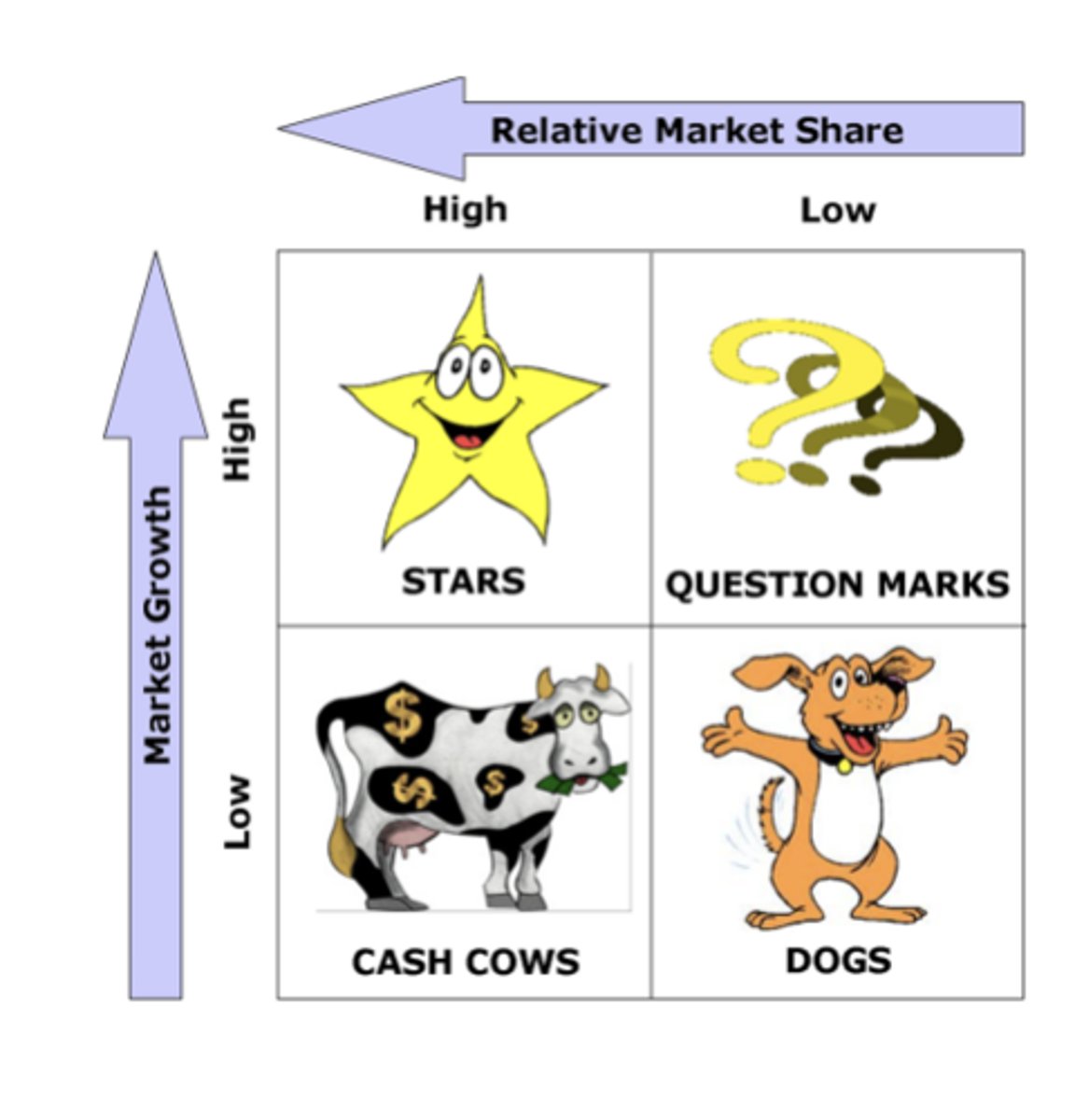
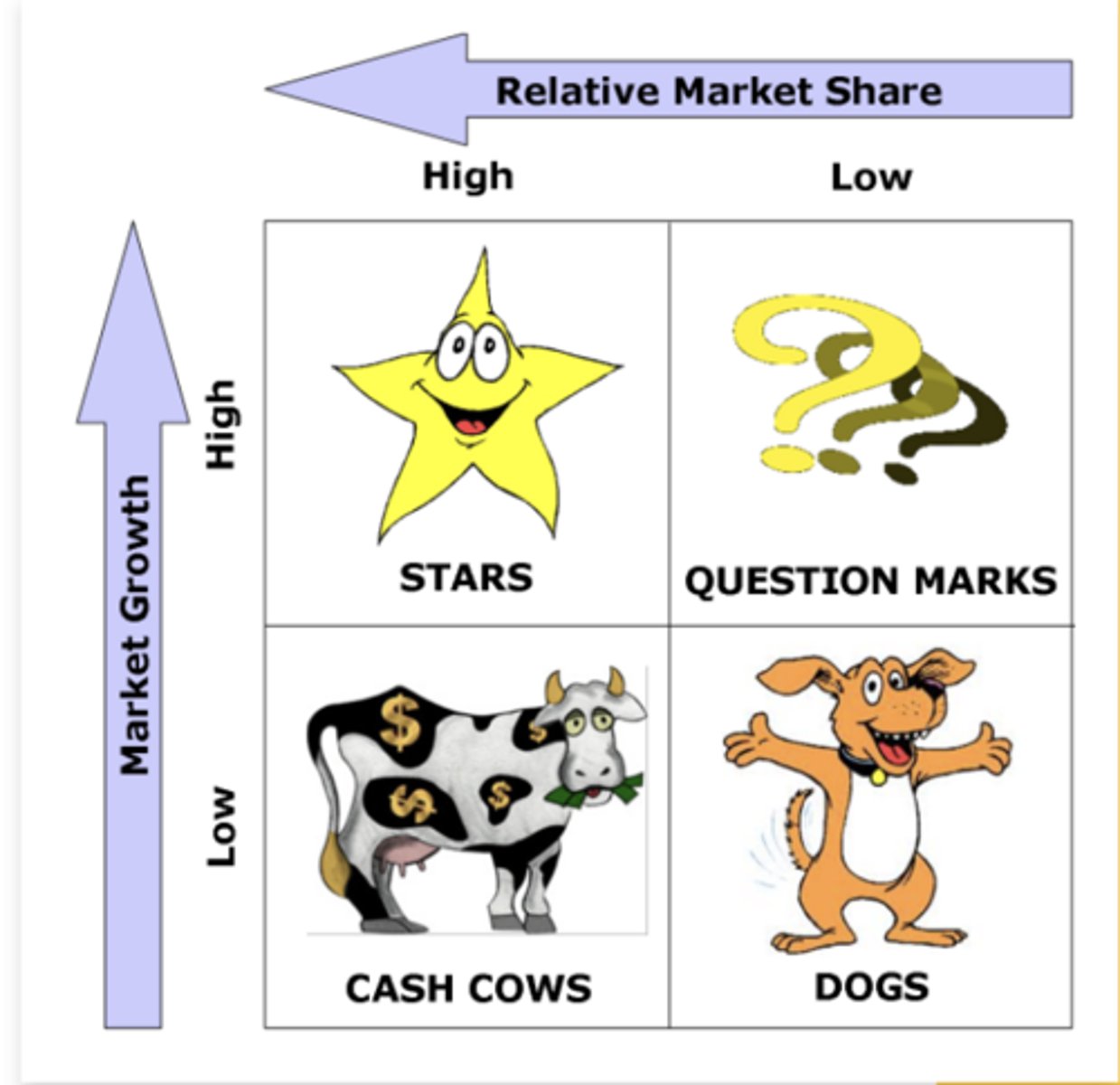
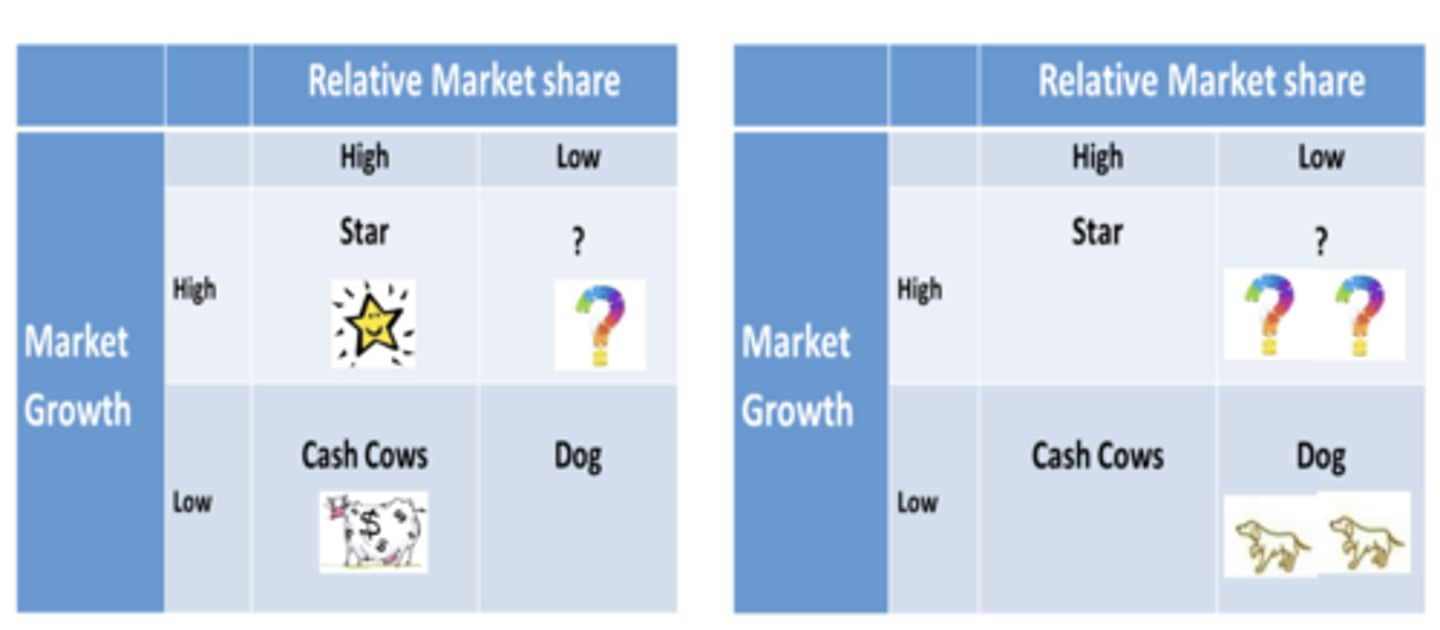
The BCG Matrix is a portfolio planning model - a company's business units can be classified into four categories based on combinations of market growth and relative market share to the largest competitors
It is a heuristic resource allocation and cash flow analysis tool
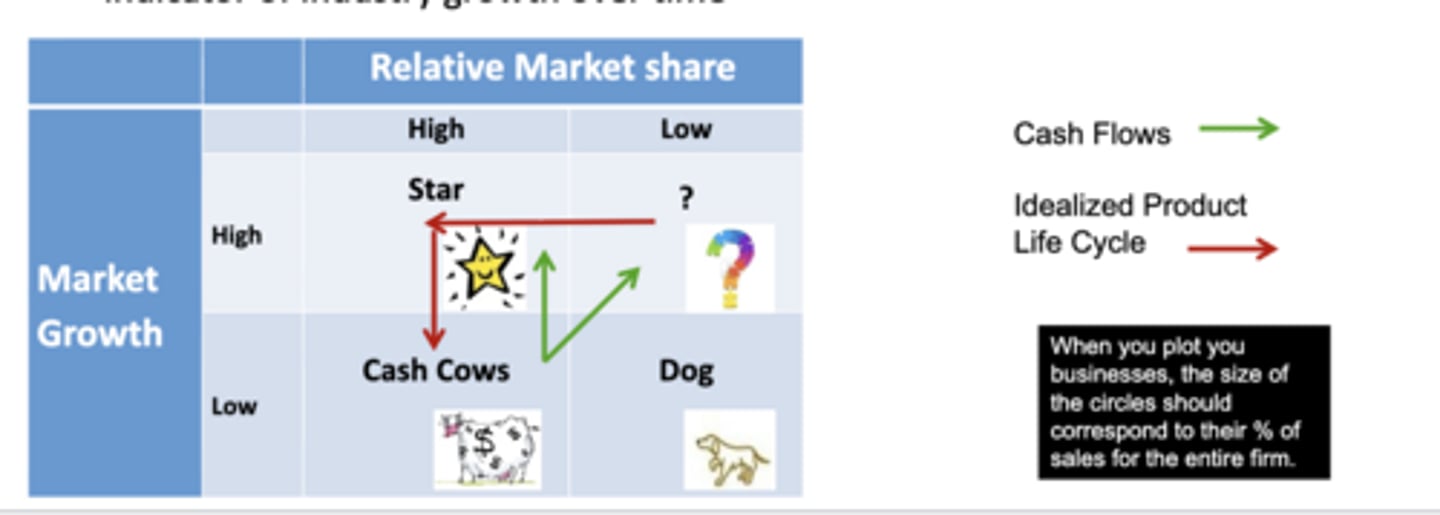
market growth requires significant cash flows
high market share in low growth markets often produces high cash flows
Cash Cow:
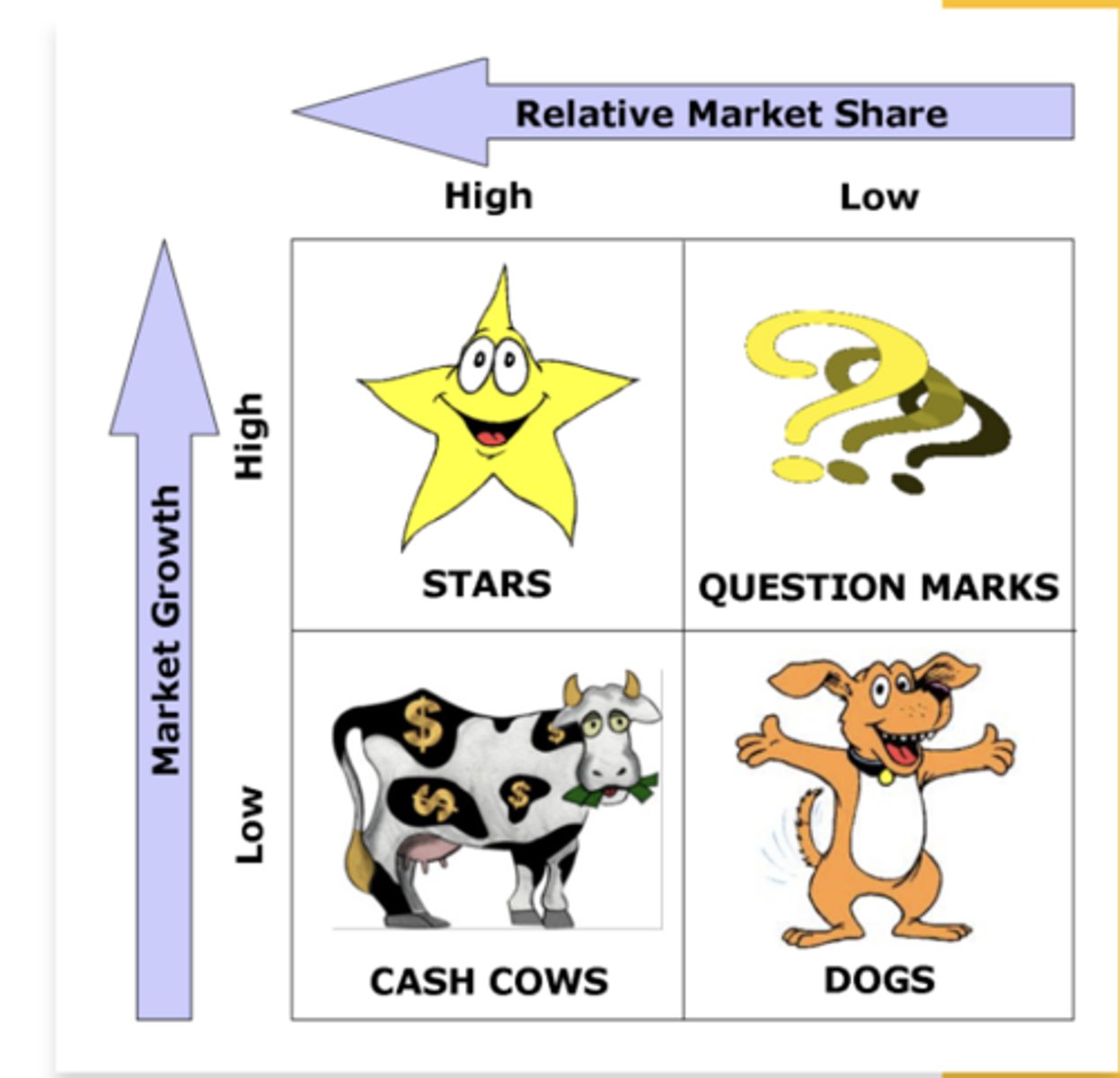
Cash cows are units with high market share in a slow-growing industry
In a "mature" market
They are to be "milked" continuously with as little investment as possible, since such investment would be wasted in an industry with low growth
Stars:
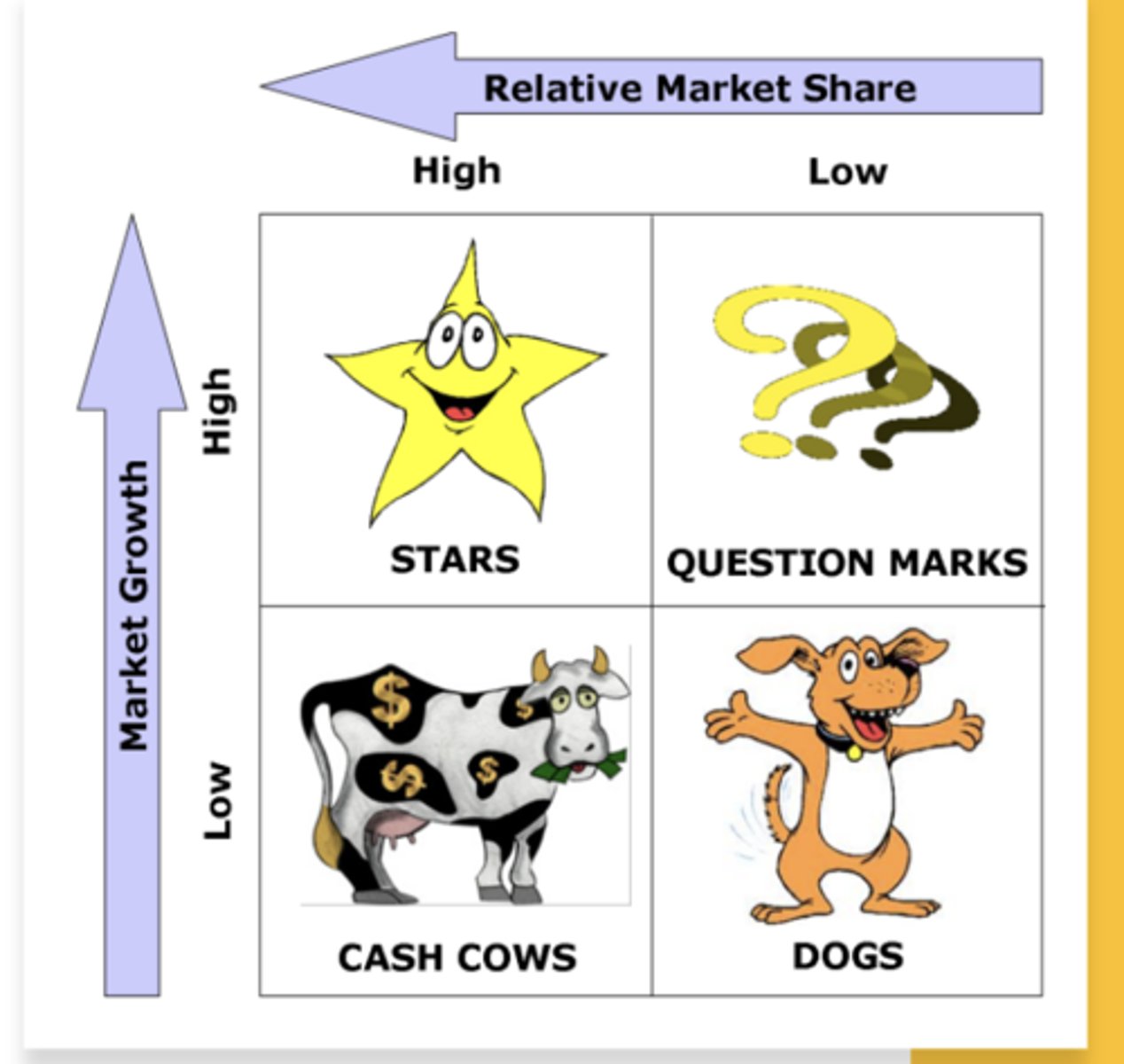
Stars are units/products with a high market share in a fast-growing industry.
Stars become next cash cows.
Stars require high funding to fight competitions and maintain a growth rate
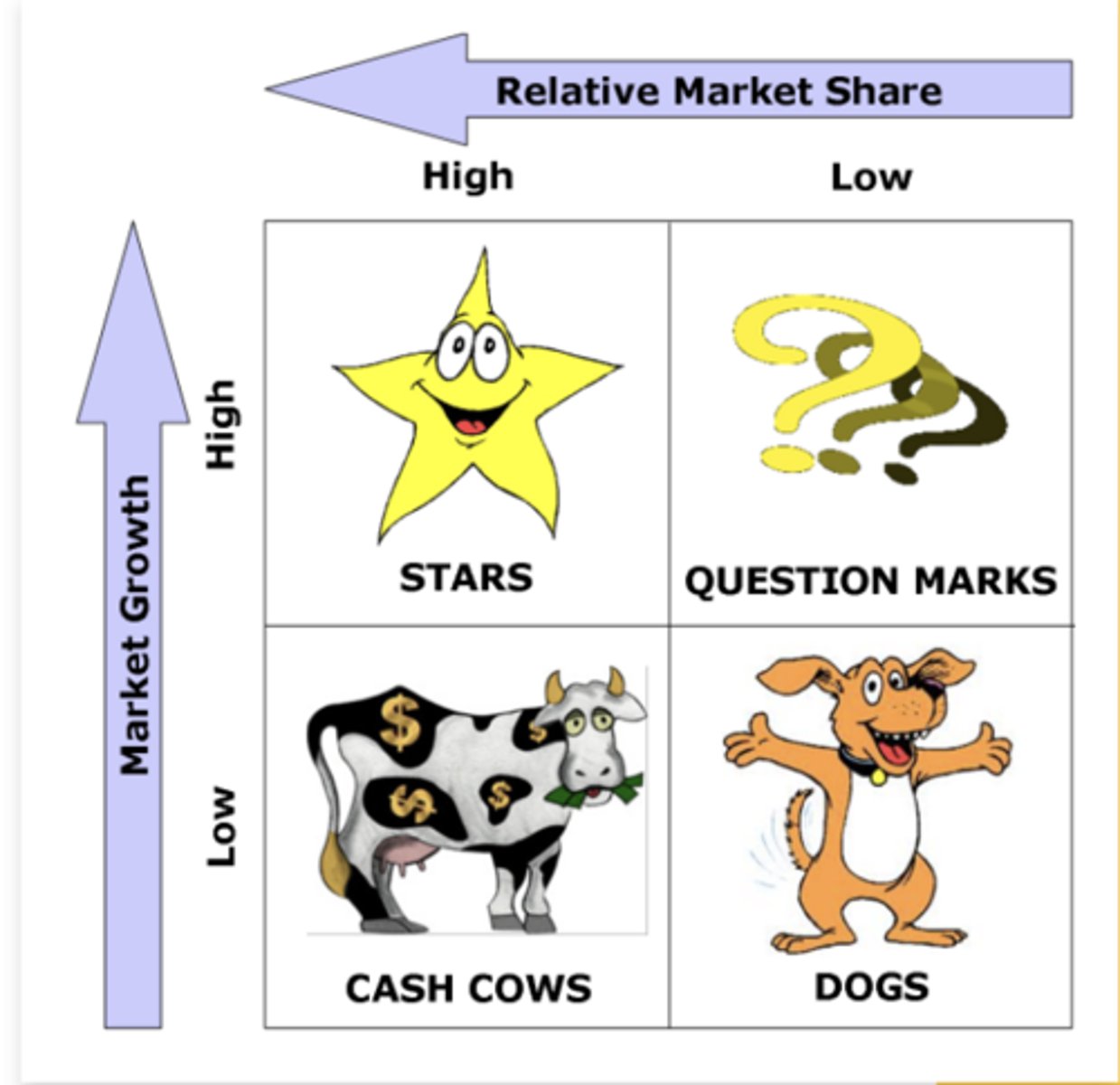
Question Marks:
Question marks refers to the business operating in a high
market growth, but having a low market share.
Have a potential to gain market share and become stars, and eventually cash cows when market growth slows
They must be analyzed carefully in order to determine whether they are worth the investment required to grow market share
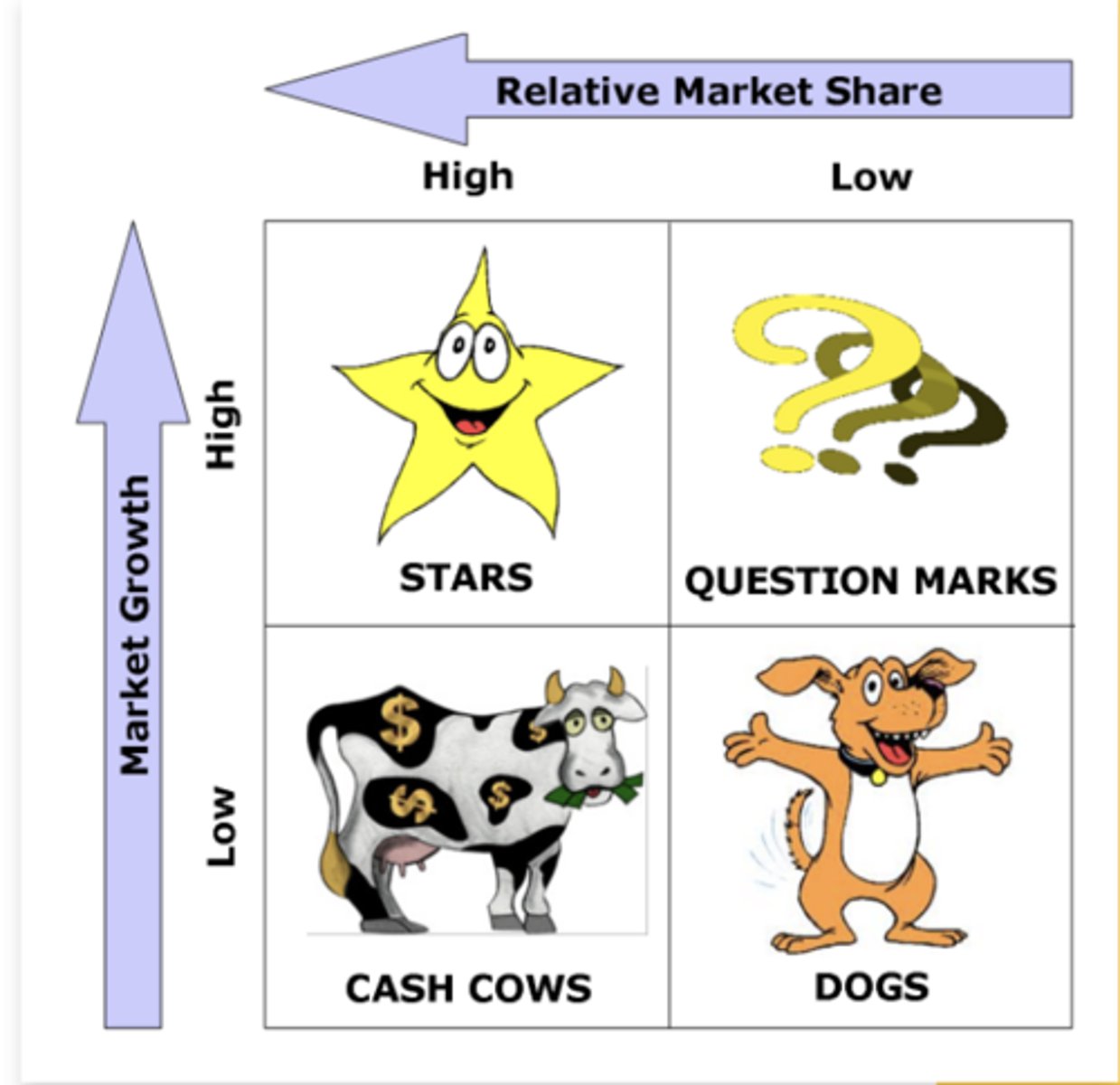
Dogs:
They refer to units with low market share in a mature, slow-growing industry
They do not generate any profit for the company
Should be sold off/divest
Relative Market Share and Market Growth Rate
Relative Market Share = SBU Sales this year divided by leading competitors' sales this year
Market Growth Rate = Industry sales this year - Industry sales last year or some indicator of industry growth over time
Resource Allocation Choices
Invest: build strategy
Maintain: hold strategy
Harvest
Divest
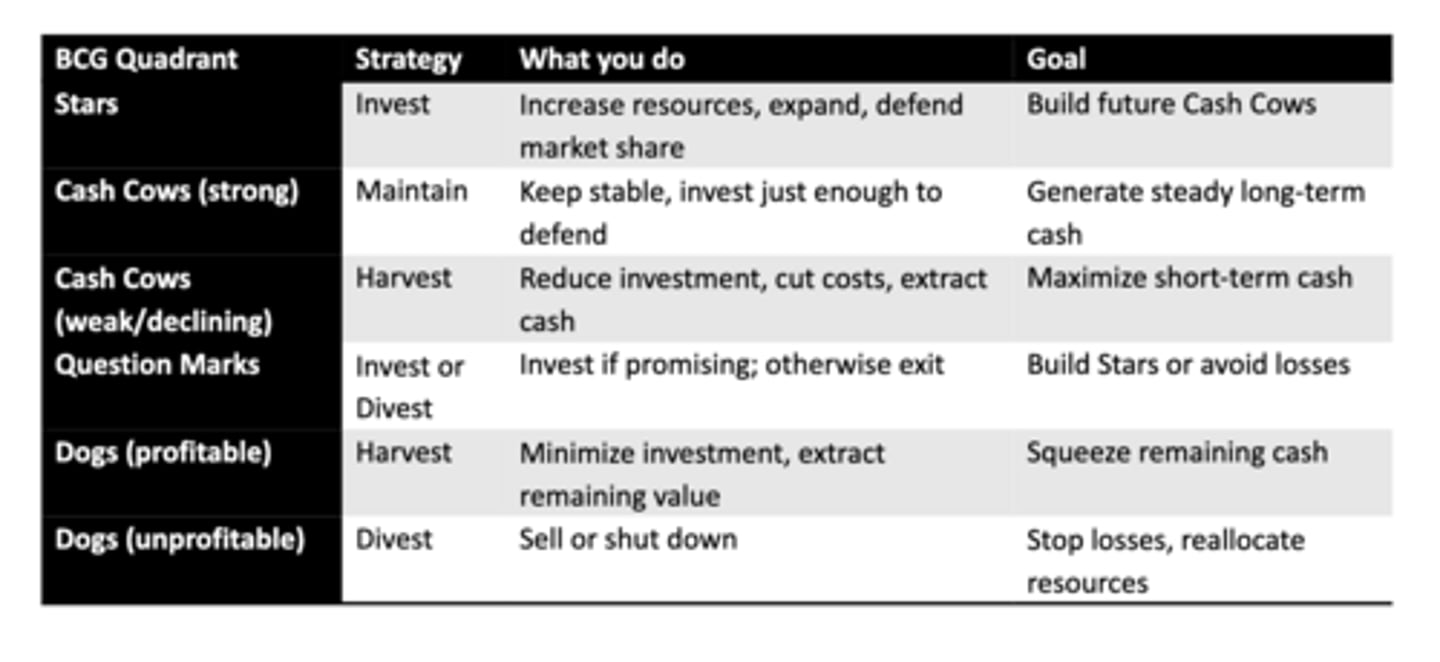
Invest
When used:
Stars (high growth, high share)
Sometimes Question Marks (if promising)
What it means:
Put more resources in
Expand capacity, marketing, R&D
Aim to grow or defend market leadership
Goal:
Turn into (or keep as) a Star → future Cash Cow
Maintain
When used:
Cash Cows (low growth, high share)
What it means:
Keep the business stable
Invest just enough to defend position
Avoid unnecessary expansion
Goal:
Generate steady cash flow
Harvest
When used:
Weak Cash Cows or Dogs
What it means:
Reduce investment
Maximize short-term cash extraction
Cut costs, limit upgrades
Goal:
Get as much cash as possible before decline
Key difference from maintain:
Maintain = protect long-term
Harvest = accept decline, maximize cash now
Divest
When used:
Dogs (low growth, low share)
Poor Question Marks
What it means:
Sell, shut down, or spin off the business
Goal:
Stop wasting resources and reallocate elsewhere
Balanced vs Unbalanced
Balanced - same relative weight on each side of the frame
Unbalanced - more relative weight on one side
Limitations of BCG Matrix
SBUs (single-business units) compared on only two dimensions. Market growth is not the only indicator for attractiveness of a market.
SBUs viewed as stand-alone entities and neglects the effects of synergies between business units.
Process becomes largely mechanical. For instance, it neglects small competitors that have fast growing market shares.
Reliance on "strict rules" regarding resource allocation across SBUs can be detrimental.
For instance, at times, dogs may help other businesses in gaining competitive advantage. They can earn even more than cash cows sometimes.
How to Perform BCG Matrix
Step 1. Choose the business unit
Step 2. Define the market
Step 3. Calculate relative market share
Step 4. Find out market growth rate
Step 5. Draw the circles on a matrix
Key Takeaways from BCG Matrix
Portfolio management help evaluate competitive position of a corporate business portfolio, propose strategies for each unit and the corporate as a whole, and prioritize resource distribution among the units.
BCG matrix is a portfolio management tool which classifies a company's business units into four categories based on market growth and relative market share.
BCG matrix has pros and cons
Competitive Dynamics
actions and reactions of two rivalrous firms within a market
intense rivalry
involve actions and responses
Firms act → competitors respond → cycle continues offers a dyadic perspective to analyze how firms compete through actions and reactions
A Framework of Competitive Dynamics
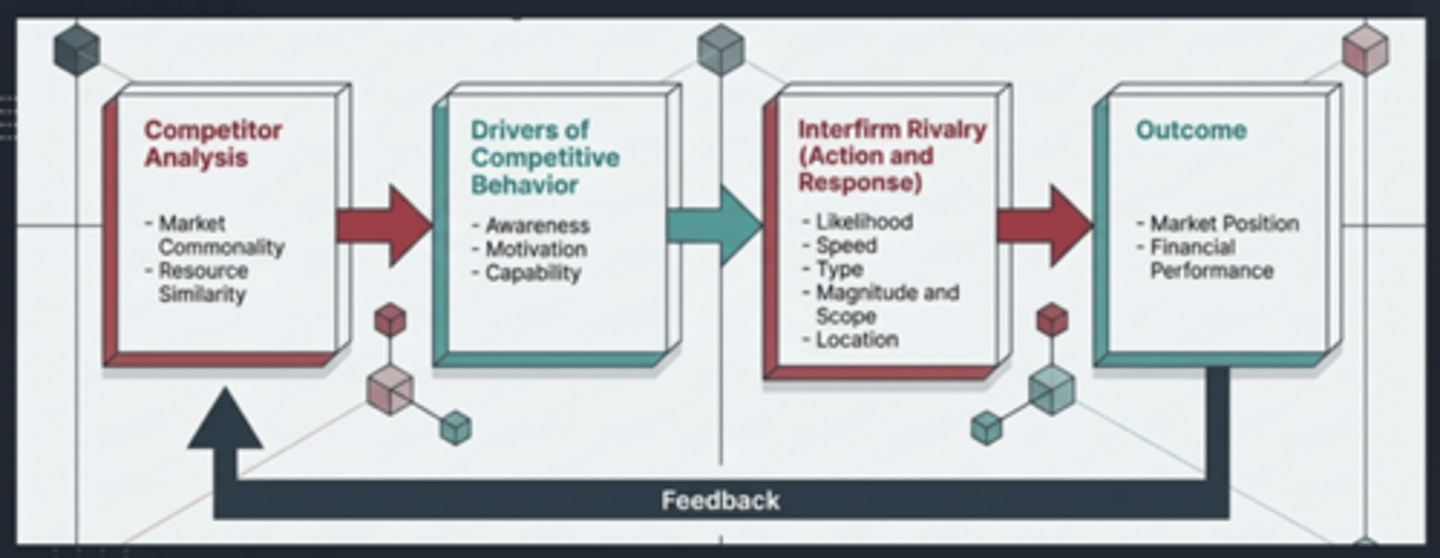
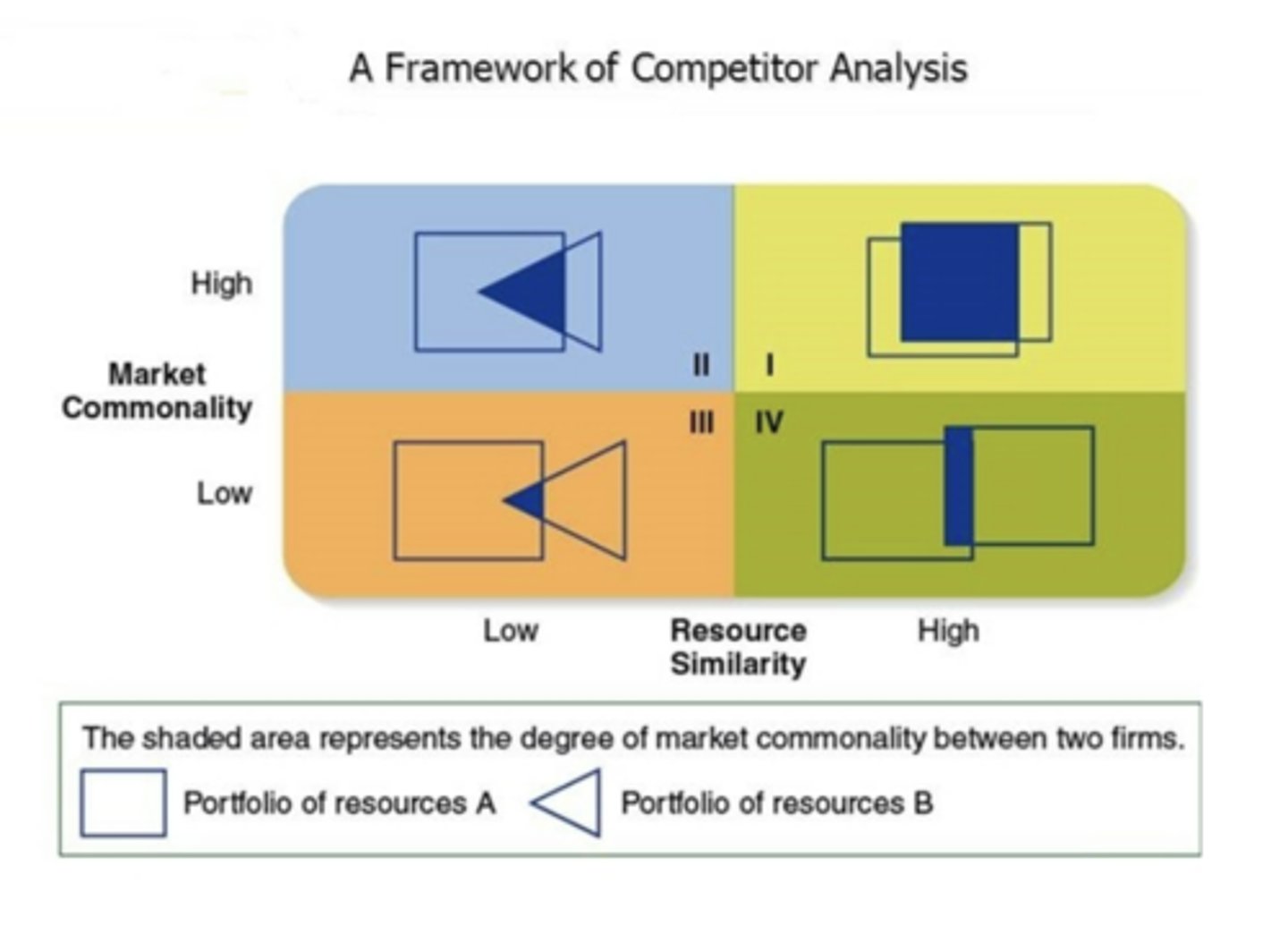
Competitor Analysis
market commonality and resource similarity
Drivers of Competitive Behavior
Awareness: Do they notice?
The extent to which competitors recognize the degree of their interdependence
Motivation: Do they care?
Firm's incentive to attack or to respond to an attack
Unmotivated firms can retain resources for other purposes
Capability: Can they respond?
The extent of firm's ability to organization effective responses
Target may not be able to respond to Amazon's aggressive price cut
Competitive Action Choices (action and response)
likelihood, speed, type, magnitude and scope, location tactical and strategic actions
Types of TACTICAL Competitive Actions
1. Marketing
2. Pricing
3. Distribution e.g., location of warehouse, etc.
4. Product enhancement/update
Small changes
Easy to implement
Easy to reverse
Short-term impact
.
Commitment of Resources= low
Difficulty of Implementation= low
Irreversibility= low
Time Horizon= short
Types of STRATEGIC Competitive Actions
New product introduction(First generation product)
Form alliances
Capacity action Open new branch, stores, factories, etc.
Merger and acquisition: Big commitment, Hard to implement, Hard to reverse, Long-term impact
.
Commitment of Resources= high
Difficulty of Implementation= high
Irreversibility= high
Time Horizon= long
Outcome: Market Position and Financial Performance
• Competitive actions often trigger counteractions
• Being able to predict and prepare for these counteractions is key to gaining a competitive edge
• Analyzing how companies interact and respond to each other helps in forming strategic responses
• Understanding this interplay aids in making informed strategic choices
• These insights are fundamental in developing and implementing solid, effective business strategies
Types of Innovation by Degree:
Incremental innovation (sustaining innovation): exploit existing technologies or forms
are often safer, cheaper, and quicker in materialize input to output
Risk of being unwanted by consumers
Ex- Microsoft's frequent updates of the Office application software
Less likely to change the rules of competitive games
Ex- adding an organic food section in a super-market
/
Radical innovation (disruptive innovation): new to the world and departs from existing technology or methods
May change the basis of competition in favor of the innovator:
focus on long-term impact
may involve displacing current products, altering the relationship between customers and suppliers, and creating completely new product categories
Radical innovation projects are resource demanding because they are risky, expensive, take long time to produce results (average 10 years)
** They go hand in hand BUT Radical innovations are less
frequent than incremental innovations
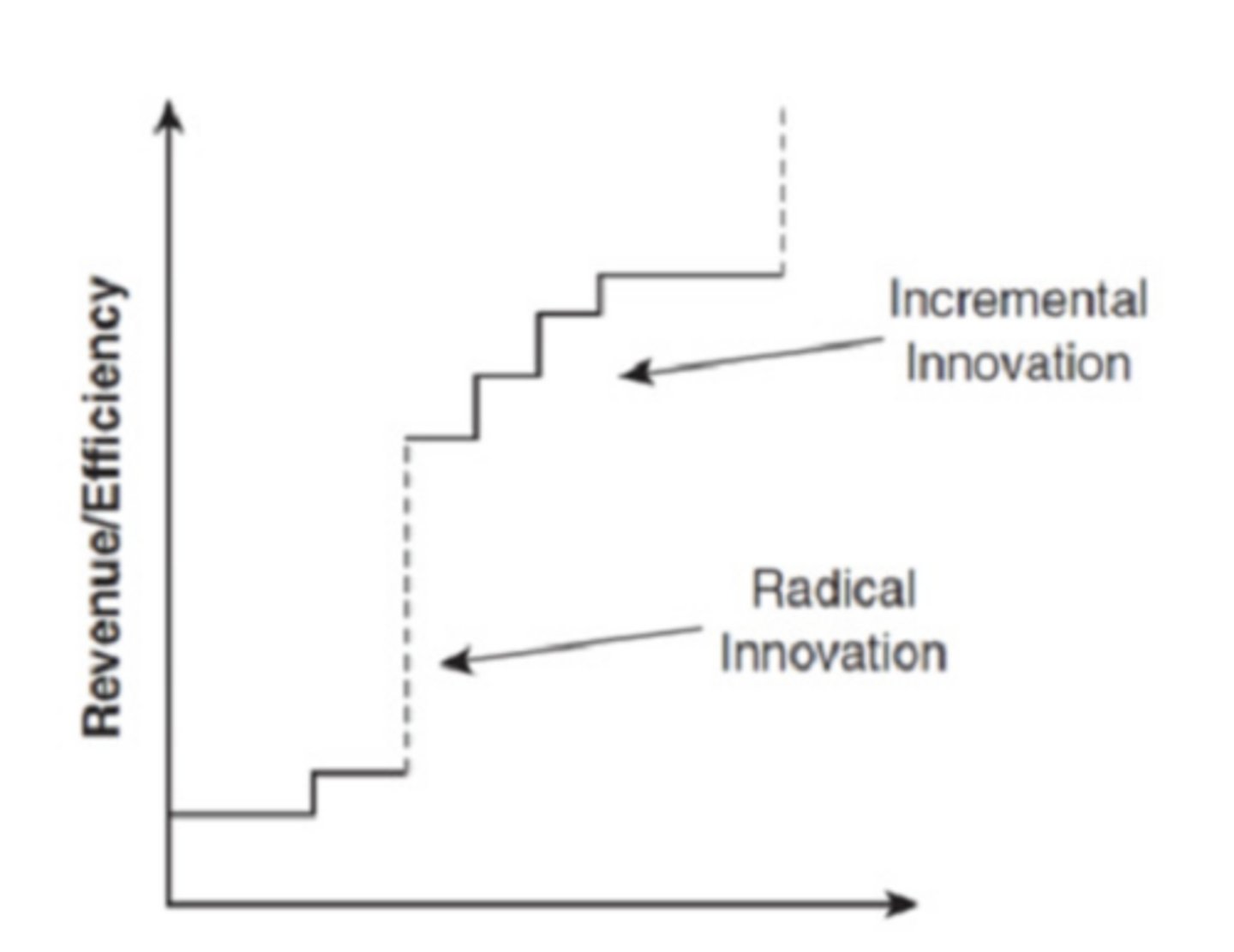
Types of innovation
• Product innovation
• Process innovation
• Service innovation
• Business model innovation
Product Innovation
The introduction of a good or service that is new or significantly improved regarding its characteristics or intended uses.
This includes improvements in technical specifications, components and materials, incorporated software, user friendliness, or other functional characteristics.
They are key for businesses to differentiate themselves in competitive markets, meet new customer needs, or respond to technological advances and changes in market demand
Ex- Cannon and Beyond Meat
Process Innovation
Changes in the technology and equipment used in the design, development, and manufacturing of products or services.
Product innovation and process innovation may go hand in hand.
Ex- Ford Model T
Service Innovation
• Create new or improved services delivered to customers
• Changes the customer experience or functionality
Ex-
Uber → on-demand ride service
Mobile banking apps
Amazon same day/overnight delivery
Business Model Innovation
How a company creates, delivers, and captures value
Changes in
Revenue model
Cost structure
Value chain
Customer segments
Ex-
Subscription model (Netflix, Spotify)
Freemium (Zoom, Dropbox)
Platform model (Amazon Marketplace, Airbnb)
8 Ways to Innovate
1 Internal Development
2 Internal Venturing
3 External Venturing
4 Licensing and Technology Acquisition
5 Open Innovation
6 User or Customer Innovation
7 Spinoffs or Spinins
8 Organizational Restructuring
Internal Development
In-house R&D, internal teams,
Ex- Amazon developing AWS internally
Strength: control, IP ownership
Weakness: slower, path-dependent
Internal Venturing
• A company uses internal ideas and resources to establish a new business.
• Actions such as initiating new ventures without cooperation with external parties.
• Distinct from internal development because it is more entrepreneurial, exploratory, high-risk
Ex- Microsoft Start ups
Skunkworks: small, autonomous teams working on advanced or secret projects
External Venturing
• Actions involving participation of parties outside of the company.
• These include M&As, and strategic projects started up in a joint venture and strategic alliances.
Licensing and Technology Acquisition
• Contract-based external innovation
• Licensing patents or technologies
• Buying intellectual property (without buying the firm)
• Technology transfer agreements: The firm accesses technology without owning the company
Ex- Phone, TV, and laptop makers licensing Dolby Atmos or Dolby VisionBrands can offer better sound or picture by licensing Dolby technology rather than inventing their own audio/visual system.
Open Innovation
Ecosystem approach
Firms intentionally use inflows and outflows of knowledge
Crowdsourcing
Open-source collaboration
Innovation contests
Ex- LEGO Ideas platform
Key idea: innovation is distributed
User or Customer Innovation
• Innovation driven by users or communities
• Firms then adopt or adapt
Example:
Gaming mods by gamers → official features
Social media (e.g., TikTok) driven product usage innovation
Especially important in digital industries
Spin-offs or Spin-ins
• Spin-off: innovation developed inside → becomes separate firm
• Spin-in: external venture reintegrated
Useful for:
Managing risk
Escaping organizational constraints
Organizational Restructuring
• Actions such as reorganizations of organizational structure, consolidation, down-scoping, or closure of functions.
Ex- decentralize decision making (Spotify), flat organizational structure (Zappos), cross functional teams, etc.
Strategic Initiatives
Strategic initiatives are efforts of firms to renew or expand its resources and capabilities in order to substantially impact its evolution and long- term prospects
Adapt to environmental changes that are competence-destroying
Ex- cameras
Develop ambidexterity - build future new businesses (exploration) while leveraging and upgrading existing businesses (exploitation)
Ex- Microsoft and Amazon
Develop dynamic capabilities - "the capacity of a firm to purposely create, extend, or modify its resource base"
Blue Ocean Strategy Value Innovation
Rather than focusing on beating the competition, make the competition irrelevant by creating a leap in value for your customers and your company, thereby opening up new and uncontested market space
Red Ocean Strategy
A strategy which aims to fight and beat the competition.
Red Oceans can be considered as all the existing marketplaces
Red Oceans are crowded by competitors
Red Ocean:
• Compete in existing market space
• Beat the competition
• Attract existing customers
• Make the value-cost trade-off
• Align strategy activity system with
either low cost or differentiation
• Supply side perspective
Limitations:
• Competency Trap and Core Rigidity
•Market Evolution
Blue Ocean Strategy
Blue Ocean Strategy is where a company creates a completely new market space (or market category)
This new market space is created by launching new offerings, with the aim being to make the competition irrelevant so that an organization can grow, uncontested, at least in the beginning.
Blue Oceans can be thought of as markets that do not exist yet.
Blue Ocean:
• Create new uncontested market space
• Make competition irrelevant
• Attract non-customers
• Break the value-cost trade-off
• Align strategy activity system with low cost and differentiation
• Demand side perspective
Limitations:
• Exploration trap
• Organizational/Cultural Misfit
Value Innovation Breaking The Value/Cost Trade-off
Which factors that the industry takes for granted should be eliminated? lower cost structure
Which factors should be reduced well below industry standard? lower cost structure
Which factors should be raised well above industry standards? provide differentiation/value
Which factors should be created that the industry has never offered? provide differentiation/value
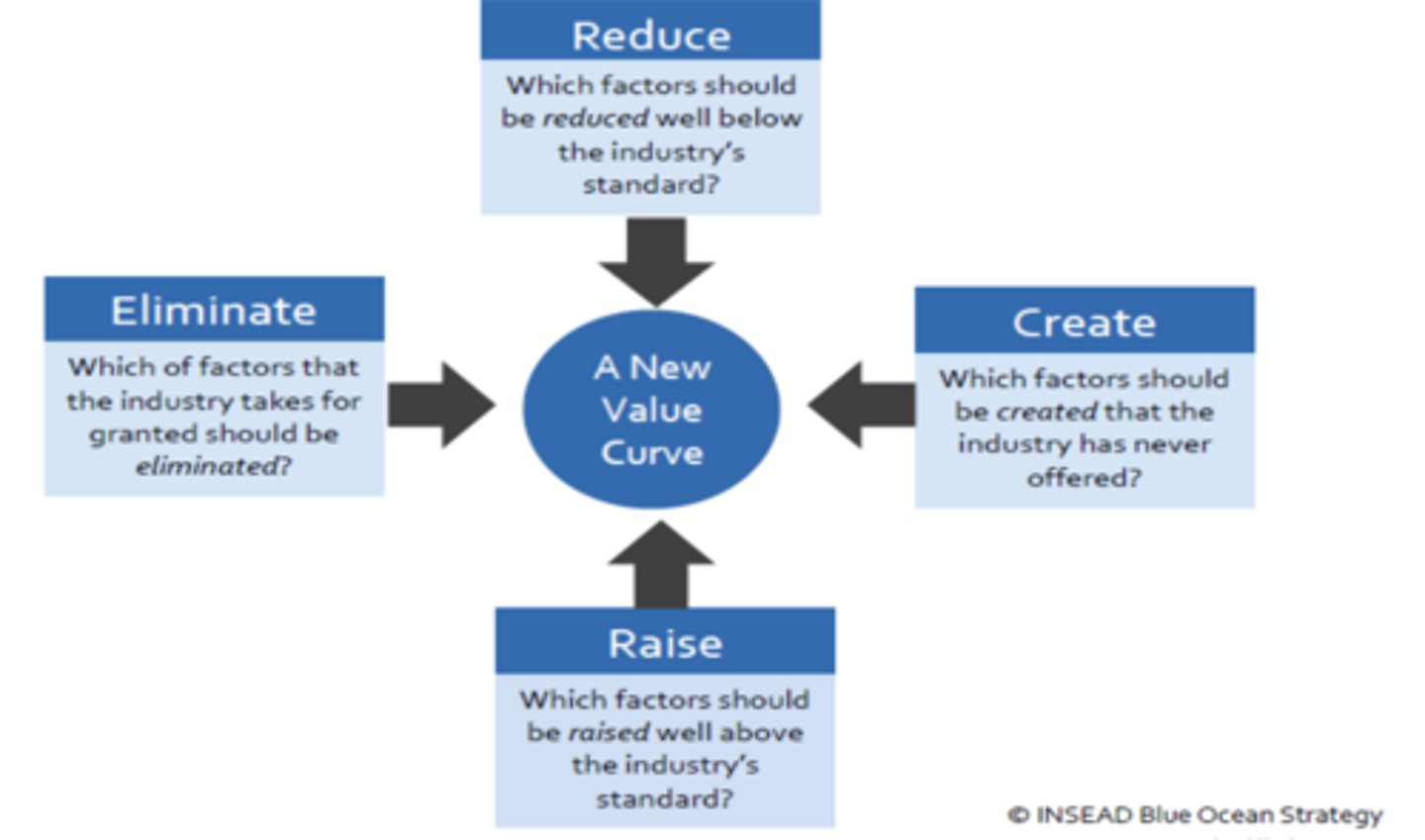
Reduce
which factors should be reduced well below the industry's standard
Eliminate
which factors that the industry takes for granted should be eliminated
Raise
which factors should be raised well above the industry standard
Create
which factors should be created that the industry has never been offered
Identify Executable Strategic Initiatives STEPS
Conduct a comprehensive analysis to identify the issues:
SWOT Analysis: Strengths(firm, internal), weaknesses(firm, internal), opportunities(external), and threats(external)
Classify the issues: Which issue should I focus on?
Imminence is defined in terms of time and asks how soon the issue will have an impact
Importance is defined in terms a firm's objectives and impact on competitive advantage
From analysis to strategic initiatives: How to address the selected issue(s)?
Tie back to the analysis
What strengths the company has can help address the issue?
What opportunities out there may facilitate problem solution?
How to avoid weakness or neutralize the threat?
Tie back to firm strategic options
Product level choice: Generic strategy
Corporate level choice: Diversification strategies
Competitive strategies: What competitive actions should the firm take
Innovation strategies
Blue-Ocean strategy
Evaluate strategic initiatives and select one: Which strategic initiative(s) best addresses the issue?
Identify and define criteria
Evaluate strategic initiatives on each of the criteria
Select your initiatives
Strategic initiative implementation requirements (PARTS + M&M): What will be required to execute the strategic initiative(s) you have chosen?
People - who is involved at various stages of the initiative?
Activities - what activities need to be performed?
Resources - what resources are required to undertake the initiative?
Timing - over what period of time will the initiative occur?
Measurements - what are the key measurements that indicate success?
Milestones - what are key points to check on progress and makeadjustments?
Reasons for Strategic Initiatives Failure
• Initiative overload
• Lack of alignment
• Conflicting initiatives
• Inability to prioritize the initiative pool
• Insufficient resources
• Poor project management
• Too much process, too little process, a lack of participation, inadequate support tools, the wrong people, etc.
• Overall lack of a structured, consistent process and standardized tools to support the initiative investment decision making process as well as ongoing initiative management
What kind of company is Amazon.com?
everything store including online retailing, cloud computing , media, entertainment, diversification, online ads, etc.
- online market place, search engine, Audible, Good Reads, Zappos, Joyo, Kiva, Whole Foods
What is Amazon's business model?
digital platformed, multi-business model, vertically integrated
- online retail sector, hybrid model (wholesale model)
- AWS= pay as you go model
- Prime= subscription model
- Prime Video= entertainment creation
- vertically integrated logistics
What are Amazon's core competencies?
strength to differentiate from competitors
- shipping
- customer data utilization strategy
- technology resources
- workplace culture
- diversity in creating value
Diversifications in Amazon (unrelated vs related)
Prime Video: vertically integrated, unrelated at first, but now Amazon is a leader in media and entertainment; improved market power, now a core competency
Kindle: related, competitive advantage and resource sharing
AWS: related, competitive advantage, market power, core competency
Alexa: related, economies of scope (using already existing technology), resource sharing (using already existing technology), competitive advantage
Wholefoods: related, market power, economies of scope
Which of competitors does Amazon need to pay the most attention to? And how should they respond strategically?
Microsoft Azure: cloud computing
Alphabets Google Advertising: search AI, ecosystems
Walmart: omni-channel retail
Respond strategically: diversify products, lock in bundled services like (Prime, AWS, AI assistants, media), invest in logistics, double down on retail media, pursue partnerships and collaborations
AI and Strategy Case Facts
Apollo Go: autonomous driving cars
- radical innovation
- AI shifts transportation from labor driven TO technology driven (operations, decision making, cost structure)
- partially successful: dependent on user adoption and regulatory compliance
- strategic lessons: AI adoption, innovation strategy, competitive advantage
Imagine a bank developed the ability to effectively leverage Artificial Intelligence to determine if a consumer was worthy of a loan and then bought a number of other banks and implemented the AI algorithm in each of these banks. This would be an example of:
a. Leveraging a core competency
Mergers and acquisitions could help corporations to:
a. consolidate industry by reducing the number of firms in an industry
b. obtain valuable resources to expand product offerings and services
c. all of the above
Pepsi owns a wide range of snacks and drinks that are popular on the market. Pepsi can leverage its size as well popularity in relation to its distributors. In doing so, it is benefiting from:
c. pooled negotiating power
All of the following are examples of tactical actions a firm might take EXCEPT _____________.
c. partner with competitors to reduce competition
Apple’s acquisition of Darwin to develop AI is an example of _______ while Meta’s Hackathons which are held every few months and employees across the organization from different locations and teams come together to brainstorm and create something they believe will add to Meta user experience is an example of_________.
External venturing and internal venturing
One aspect of using a cost leadership strategy is that experience effects may lead to lower costs. Experience effects are achieved by ____________.
A. repeating a process until a task becomes easier