GCSE Chemistry: Atomic Structure, Isotopes, and the Periodic Table
 Call Kai
 Learn
Learn Practice Test
 Spaced Repetition
 Match
Match Flashcards
 Knowt Play
1/42

There's no tags or description
Looks like no tags are added yet.
Name | Mastery | Learn | Test | Matching | Spaced | Call with Kai |
|---|
No analytics yet
Send a link to your students to track their progress
43 Terms
Atoms
Atoms make up all substances and are the smallest part of an element that can exist.
Chemical symbols
Chemical symbols represent an atom of an element e.g. Na represents an atom of sodium.
Compounds
Compounds are formed from elements by chemical reactions.
Chemical reactions
Chemical reactions always involve the formation of one or more new substances, and often involve an energy change.
Fixed proportions in compounds
Compounds contain two or more elements chemically combined in fixed proportions.
Formulae of compounds
Compounds can be represented by formulae using the symbols of the atoms from which they were formed e.g. HCl is a compound containing 1 atom of hydrogen and 1 of chlorine per molecule.
Separation of compounds
Compounds can only be separated into elements by chemical reactions.
Mixture
A mixture consists of two or more elements or compounds not chemically combined together.
Chemical properties in mixtures
The chemical properties of each substance in the mixture are unchanged.
Separation of mixtures
Mixtures can be separated by: filtration, crystallisation, simple distillation, fractional distillation and chromatography.
Physical processes
These are physical processes, so do not involve chemical reactions and no new substances are made.
First model of the atom
Atoms were thought to be tiny spheres that could not be divided.
Plum pudding model
The atom is a ball of positive charge with negative electrons embedded in it.
Alpha particle scattering experiment
Conclusion that the mass of an atom was concentrated at the centre (nucleus) and that the nucleus was charged.
Scattering experiment
A beam of alpha particles was aimed at very thin gold foil and their passage through was detected.
Alpha particle deflection
Some of the alpha particles emerged from the foil at different angles, and some even came straight back.
Nucleus charge
The positively charged alpha particles were being repelled and deflected by a small concentration of positive charge in the atom (nucleus).
Neil Bohr's suggestion
Suggested electrons orbit the nucleus at specific distances (supported by experimental data).
Later experiments on nucleus
The positive charge of any nucleus could be subdivided into a whole number of smaller particles, each particle having the same amount of positive charge (protons).
James Chadwick's work
Provided the evidence to show the existence of neutrons within the nucleus (had been an accepted scientific idea for about 20 years already).
Atomic number
The number of protons in an atom of an element.
Protons in elements
All atoms of a particular element have the same number of protons.
Different elements
Atoms of different elements have different numbers of protons.
Relative charge
The charge associated with subatomic particles.
Proton
+1
Neutron
0
Electron
-1
Overall charge of an atom
An atom has an overall charge of 0, so number of protons = number of electrons.
Size of atoms
Atoms are very small (radius of about 0.1 nm) and the radius of a nucleus is less than 1/10,000 of that of the atom.
Mass of atoms
The nucleus holds almost all of the mass of an atom.
Relative mass of proton
1
Relative mass of neutron
1
Relative mass of electron
Very small
Mass number
The sum of the protons and neutrons in an atom.
Isotopes
Atoms of the same element with different numbers of neutrons.
Relative atomic mass
An average value that takes account of the abundance of the isotopes of the element.
Example question for carbon isotopes
Carbon has 2 isotopes: carbon-14 with abundance 20% and carbon-12 with abundance 80%.
Relative atomic mass calculation
To calculate it: ((isotope 1 mass x abundance) + (isotope 2 mass x abundance)) ÷ 100.
What's the difference between tween a mixtures and a compound?
Mixture can be separated by physical processes unlike compounds
Electronic structure
Electrons occupy the lowest available energy levels (the shells closest to the central nucleus).
Electronic structure of an atom
Tells you how many electrons are in each shell.
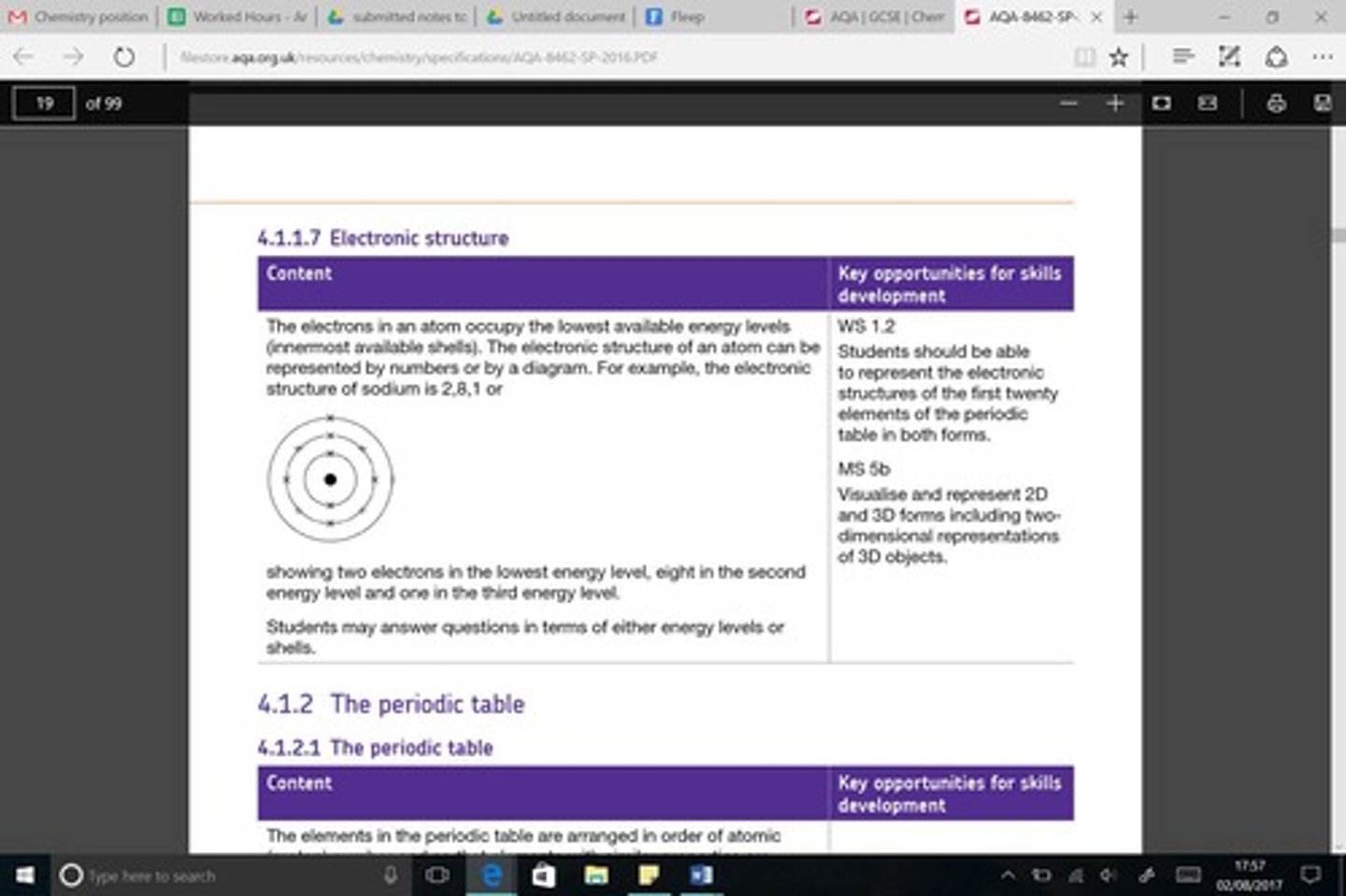
Sodium electronic structure example
For sodium: 2 electrons in shell 1 (closest to nucleus), 8 in shell 2, 1 in shell 3.
Electronic structure notation
Electronic structure = 2,8,1.