DH202 M2 - M3 KC / M4 Q2 - Ch 16 & 18 (",)
 Call Kai
 Learn
Learn Practice Test
 Spaced Repetition
 Match
Match Flashcards
 Knowt Play
1/68

There's no tags or description
Looks like no tags are added yet.
Name | Mastery | Learn | Test | Matching | Spaced | Call with Kai |
|---|
No analytics yet
Send a link to your students to track their progress
69 Terms
Which control type in an experimental study will have participants switch groups after a washout period?
Quasi-experimental
Correlational
Cross-sectional
Crossover
3 multiple choice options
A Cross-sectional study does which of the following?
Studies a section of the population in a limited period of time
Degree to which a research study measured what it was supposed to measure (internal) and can be generalized to the entire population (external)
Validity
Crossover and split mouth controls ___________ the validity of a study because they provide "near perfect similarity".
increase
decrease
no change
remain constant
Increase
3 multiple choice options
_______ measures that results are true or accurate.
Validity
As evidence increases, ________ also increases as you move up the research pyramid?
Validity
Which studies combine descriptive and historical research to establish patterns from the past and present to predict future occurrences?
Correlational study
Survey
Trend
Case study
All of these
Trend studies
3 multiple choice options
Which of the following is a descriptive approach to research?
Correlational study
Survey
Trend
Case study
Case study approach
Descriptive approach to research -
> case study
> natural observations
> population surveys
3 multiple choice options
*What publication is a compilation of cogent issues currently studied?
Mortality and Morbidity Weekly Report
Healthy People 2000
Call to Action
Healthy People 2010
None of these
Mortality and Morbidity Weekly Report
3 multiple choice options
*The theory that a disease can be attributed to many factors is termed ________.
Multifactorial
Cause-and-effect
Dimensional
Naturalization
None of these
Multifactorial
- concept that more than a single cause must be present for a disease or health condition to occur, multiple causation.
Ex: bacteria present, genetic chromosomal disorders, environmental factors, nutrient deficiencies, social and economic factors, health behaviors
3 multiple choice options
_________ is the consistency or reproducibility of a measurement over time.
Reliability
Microbial agent that causes the disease or mechanical cause of the condition, the "WHAT" factor. Ex: type of bacteria, parasite, virus, fungus, or protozoa, for example, plaque biofilm, or misuse of toothpicks to injure interdental papilla.
Environmental
Agent
Host
Epidemiology
Agent
3 multiple choice options
External factors that contribute to disease transmission and severity; the "WHERE" factor. Ex: Environments wherever disease factors occur such as dirty water, warm temperatures, seasons of the year, poverty, and stress, for example, the environmental conditions in the oral cavity and the social factors related to drug and tobacco use.
Environmental
Agent
Host
Epidemiology
Environmental
3 multiple choice options
Organism housing the disease, the "WHO" factor of a disease or condition. Ex: humans or animals
Environmental
Agent
Host
Epidemiology
Host
3 multiple choice options
The study of the amount, distribution, determinants, and control of disease and health conditions among given populations
Epidemiology
Epidemic
Etiology
Epidemiology
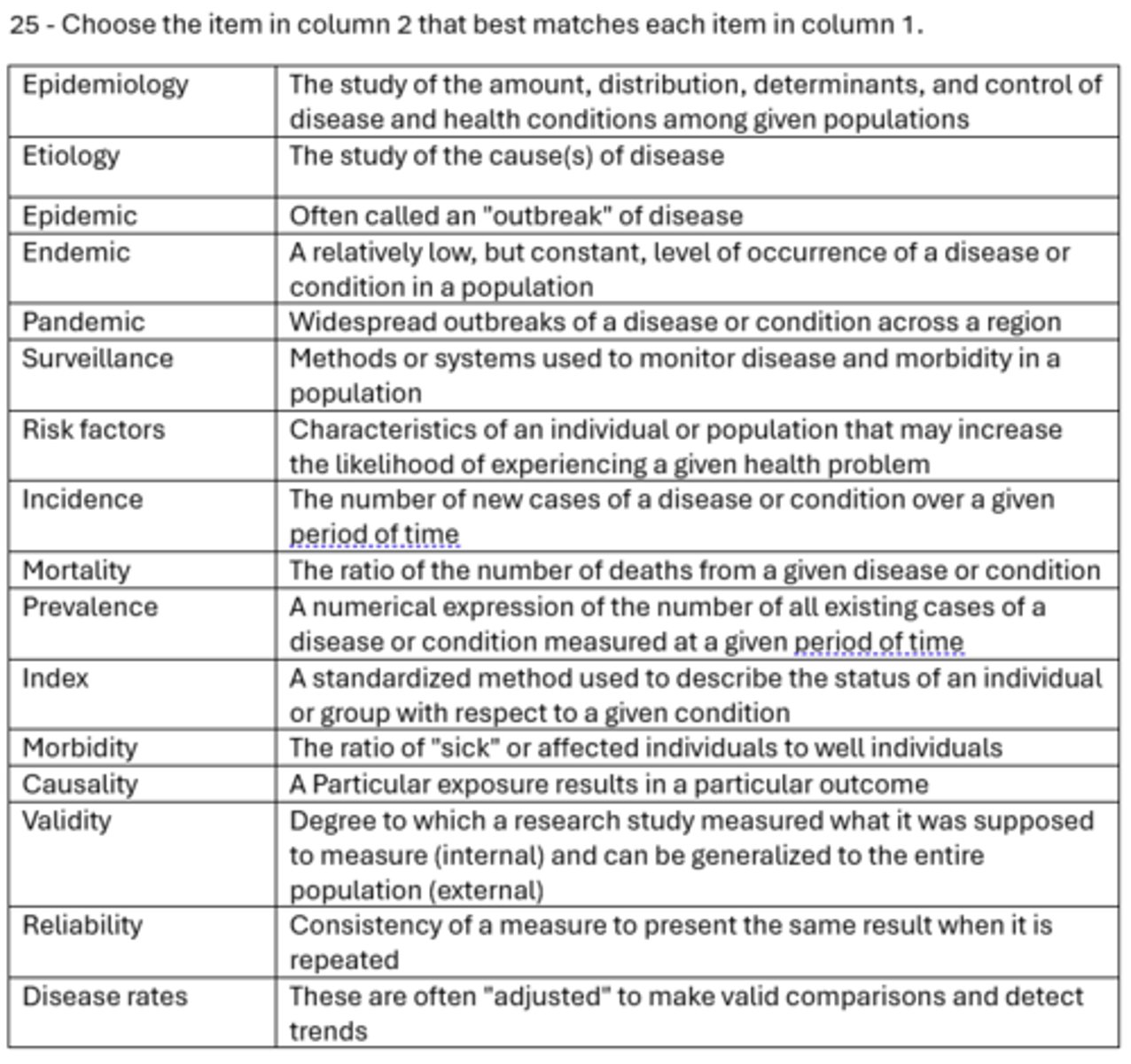
The study of the cause(s) of disease
Etiology
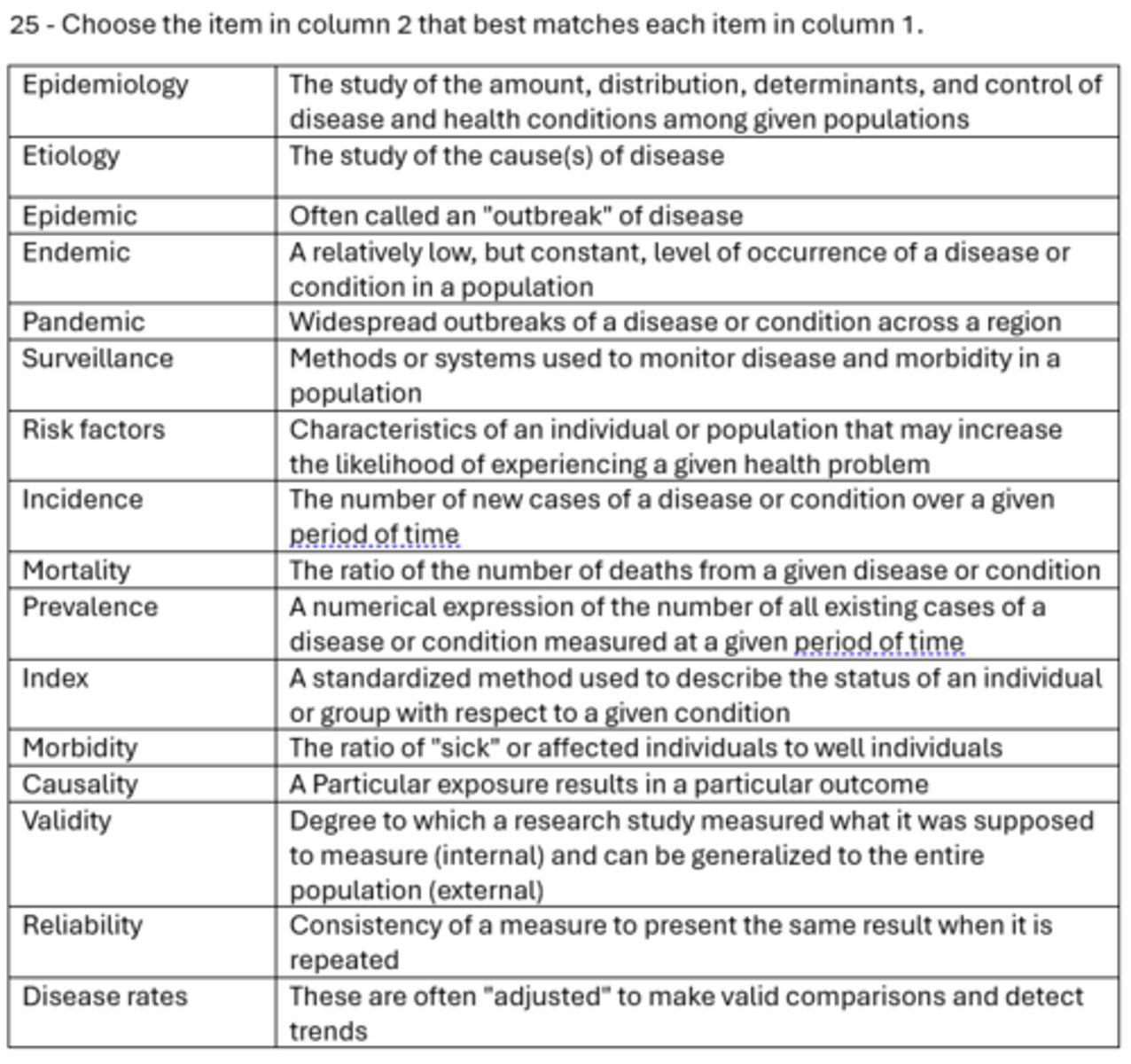
Often called an "outbreak" of disease
the occurrence of disease more than normal in a specific community or region, usually occurring suddenly and spreading rapidly, "outbreak"
Ex: Nine (9) cases of measles occurred in Tarrant County, Texas in August 2013 compared to the normal rate of 0 to 2 each year.
Epidemic
2 multiple choice options
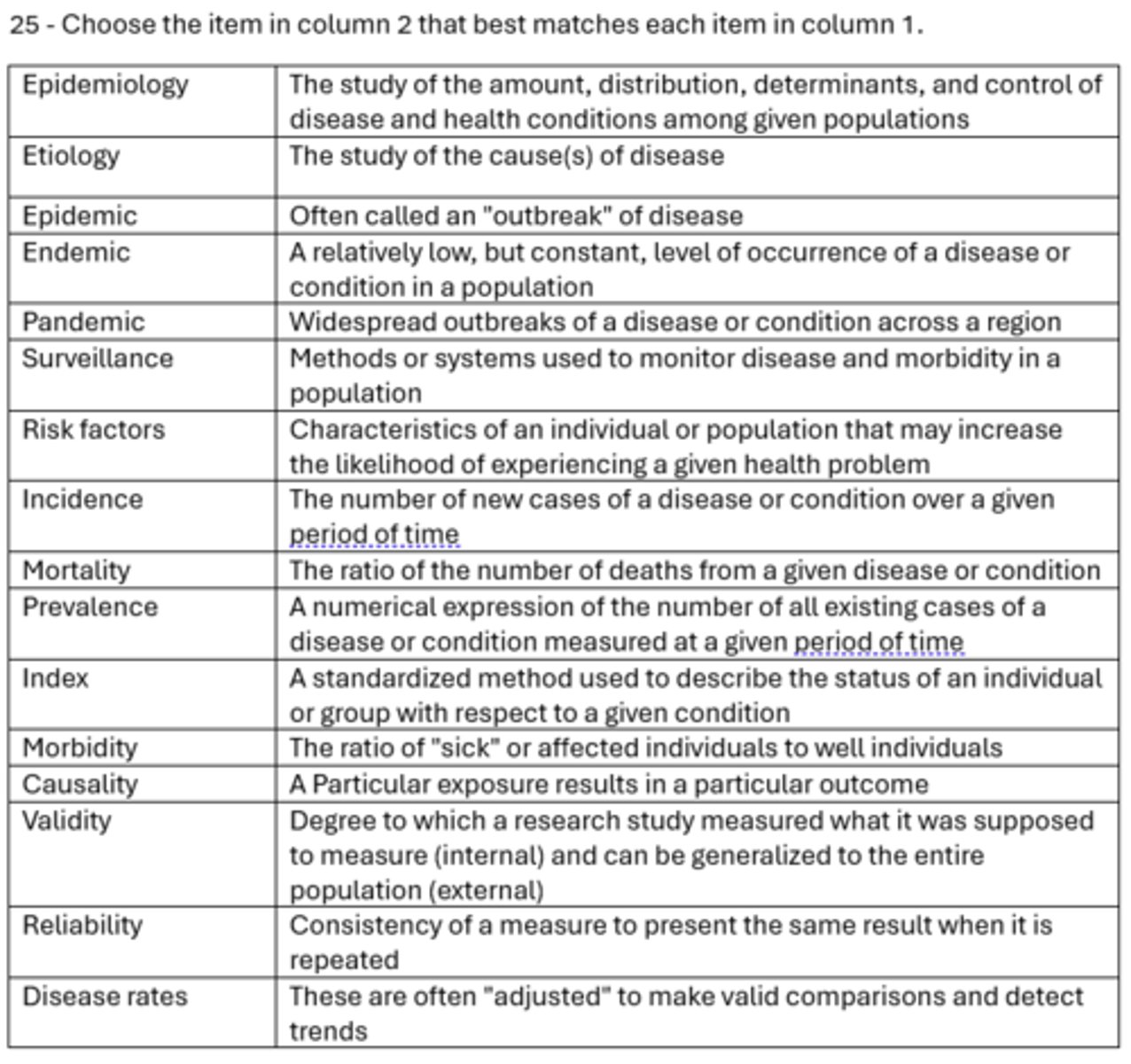
A relatively low, but constant, level of occurrence of a disease or condition in a population
A relatively low, but constant presence of disease or condition in a particular geographic region
Ex: Malaria continues to be a constant concern in parts of Africa
Endemic
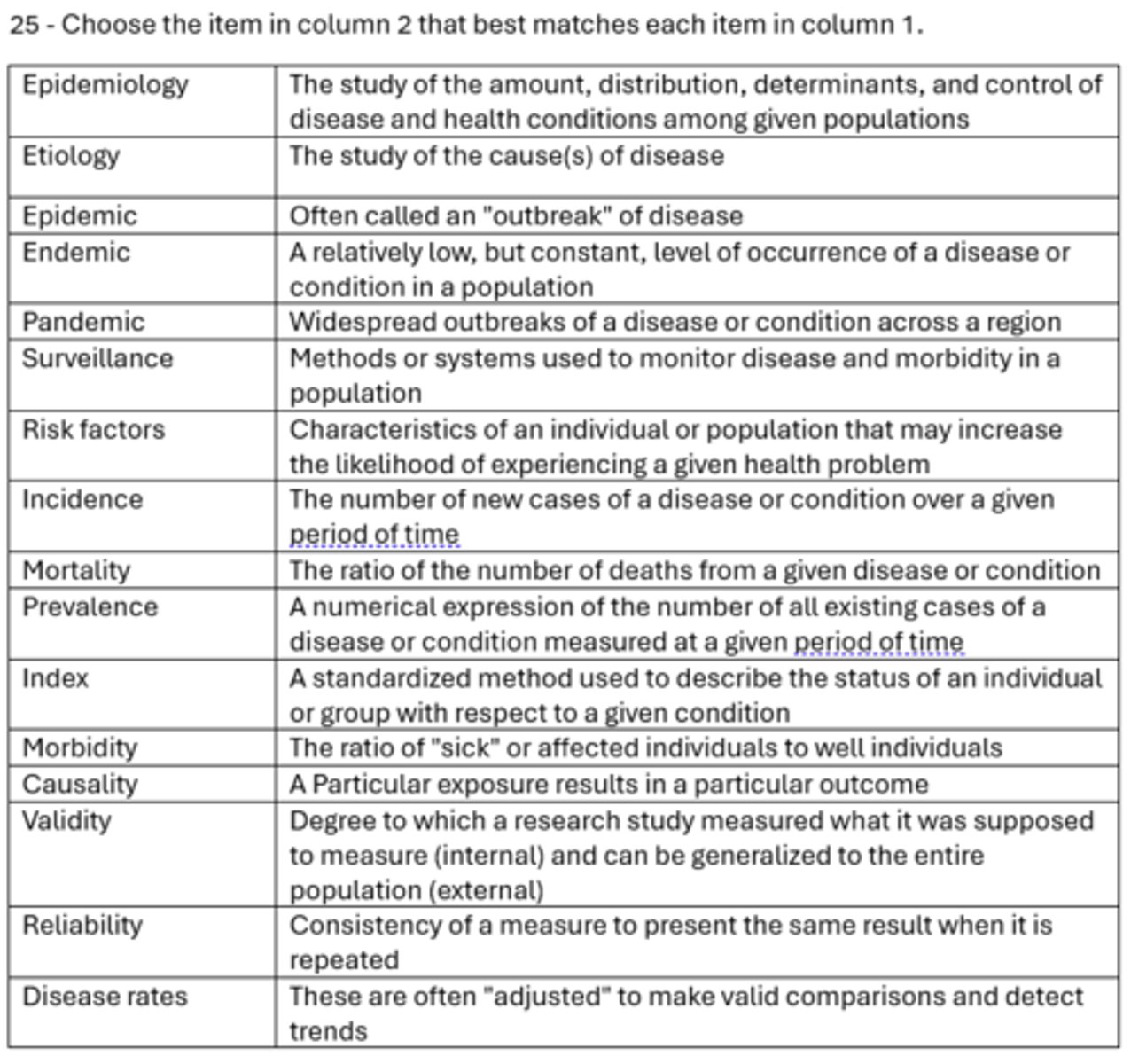
Widespread outbreak of a disease or condition across a region
an epidemic in which the disease may cross international borders to affect several countries or continents.
Ex: Over 20 million people worldwide died from influenza in 1918-1919.
Pandemic
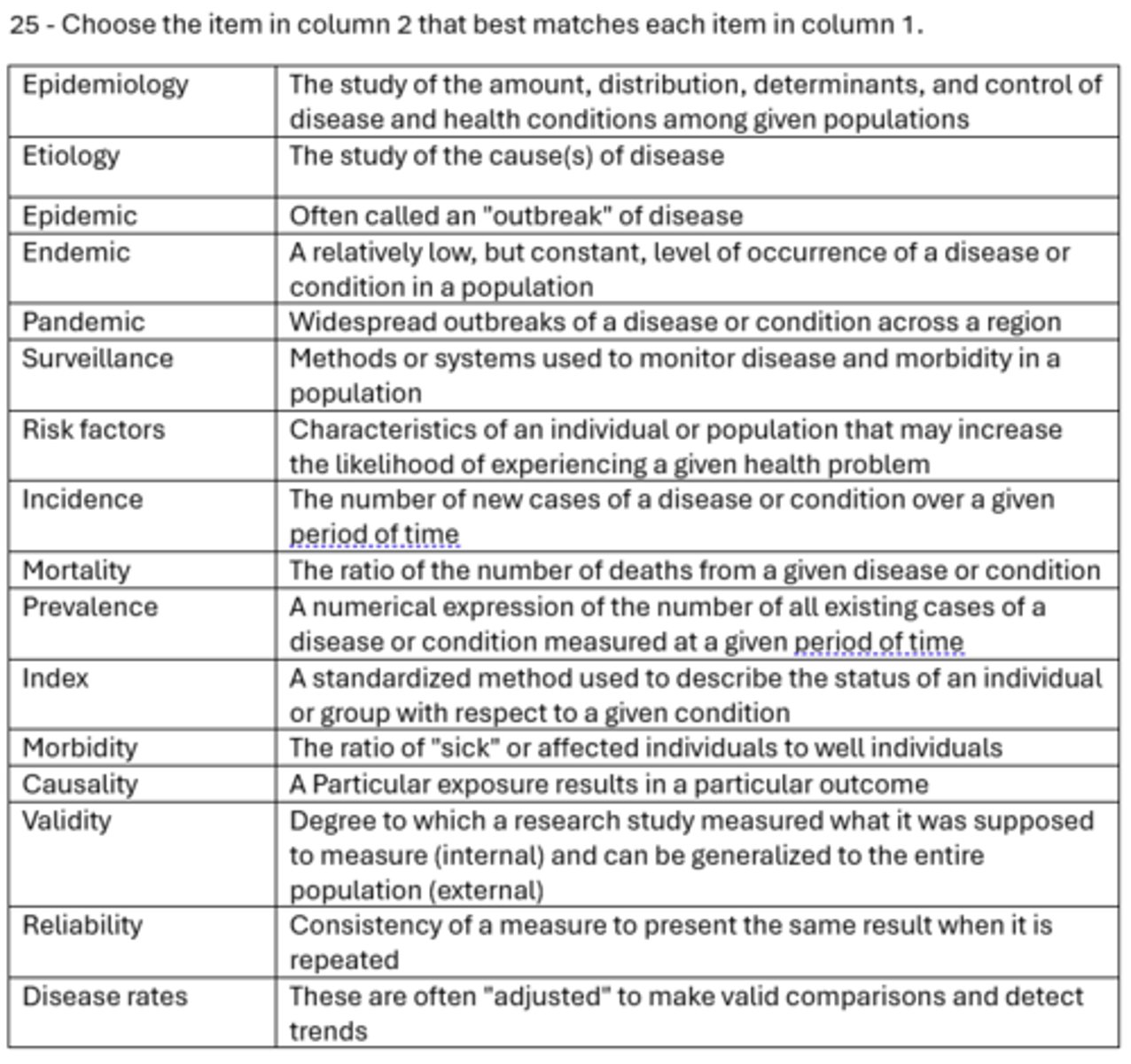
Methods or systems used to monitor disease and morbidity in a population
Surveillance
Characteristics of an individual or population that may increase likelihood of experiencing a given health problem.
Risk factors
the number of new cases of a disease or conditions over a given period of time
Rate of new cases of a disease or over a given time period is defined as?
Incidence
The ratio of the number of deaths from a given disease or condition
Mortality
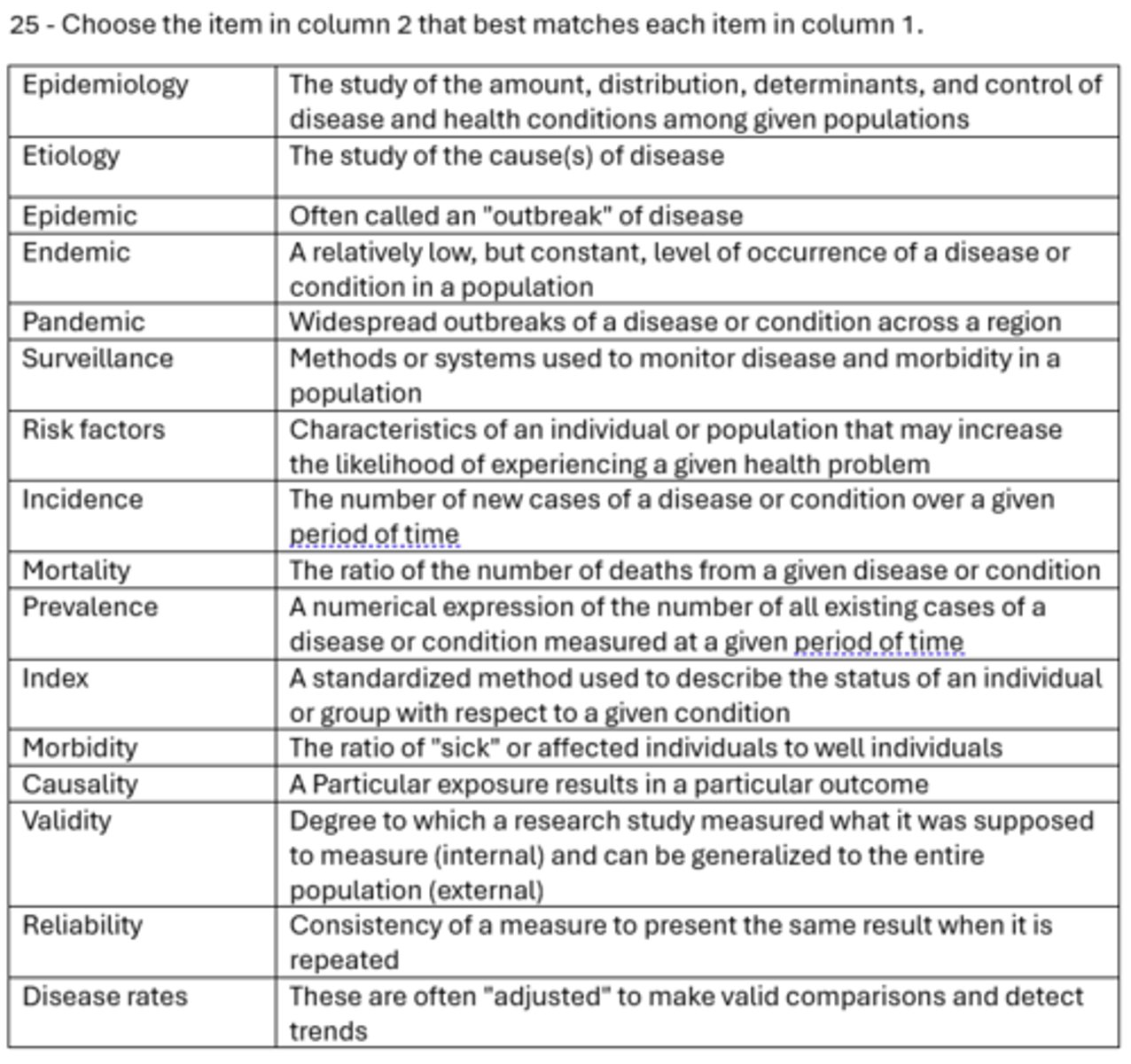
a numerical expression of the number of all existing cases of a disease or condition measured at a given period of time
Prevalence
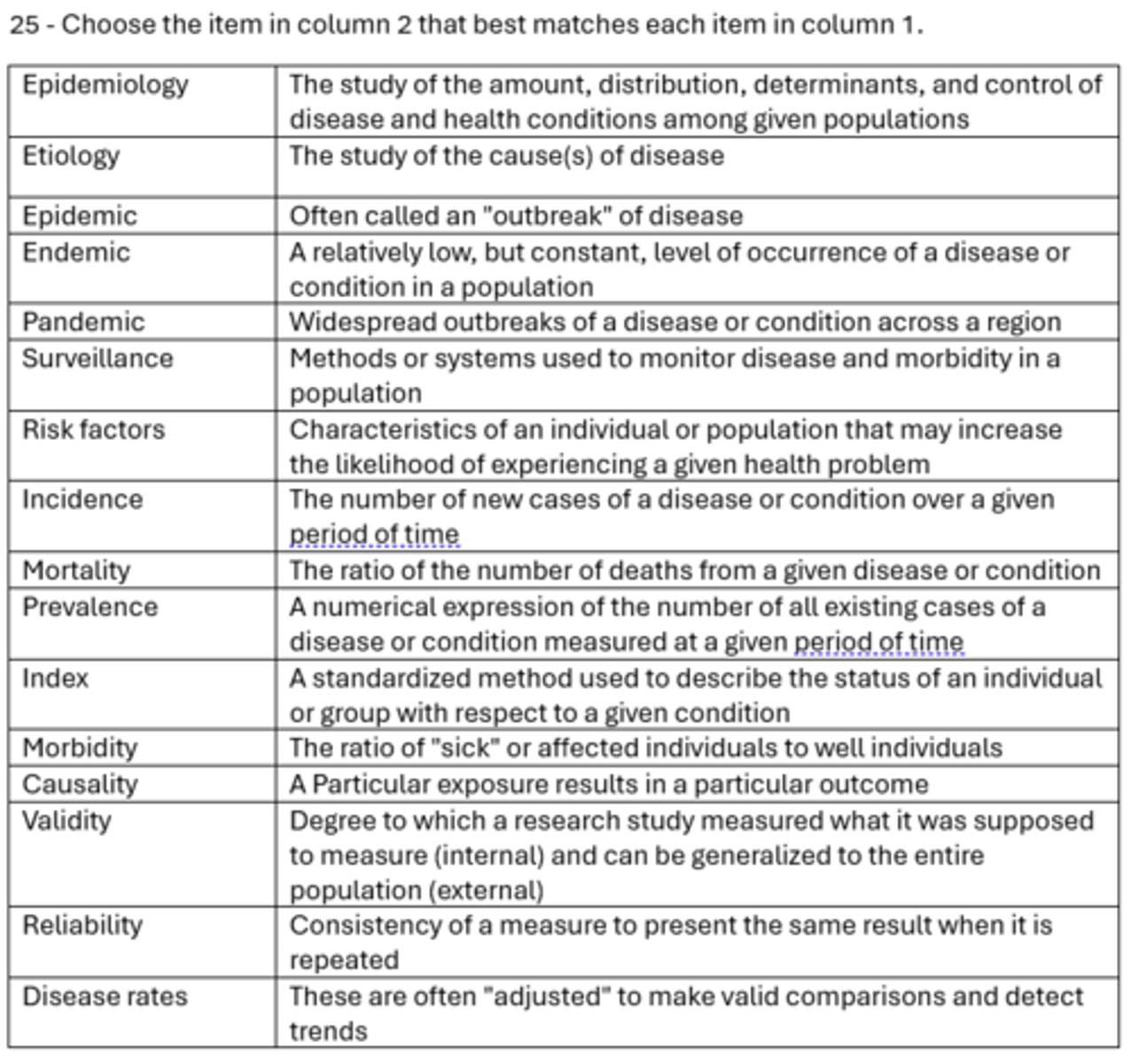
A standardized method used to describe the status of an individual or group with respect to a given condition
Index
3 multiple choice options
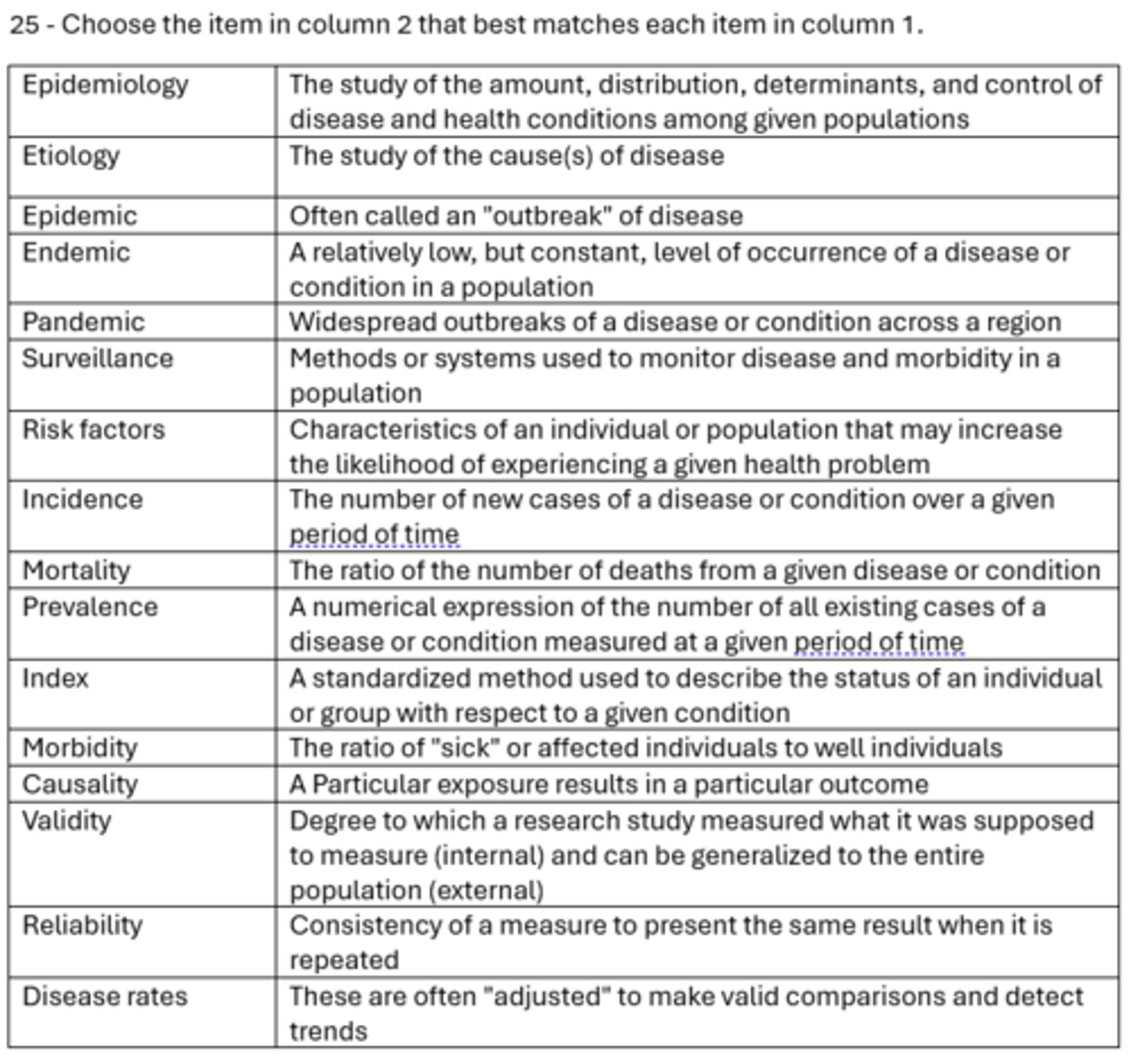
The ratio of "sick" or affected individuals to well individuals.
Morbidity
3 multiple choice options
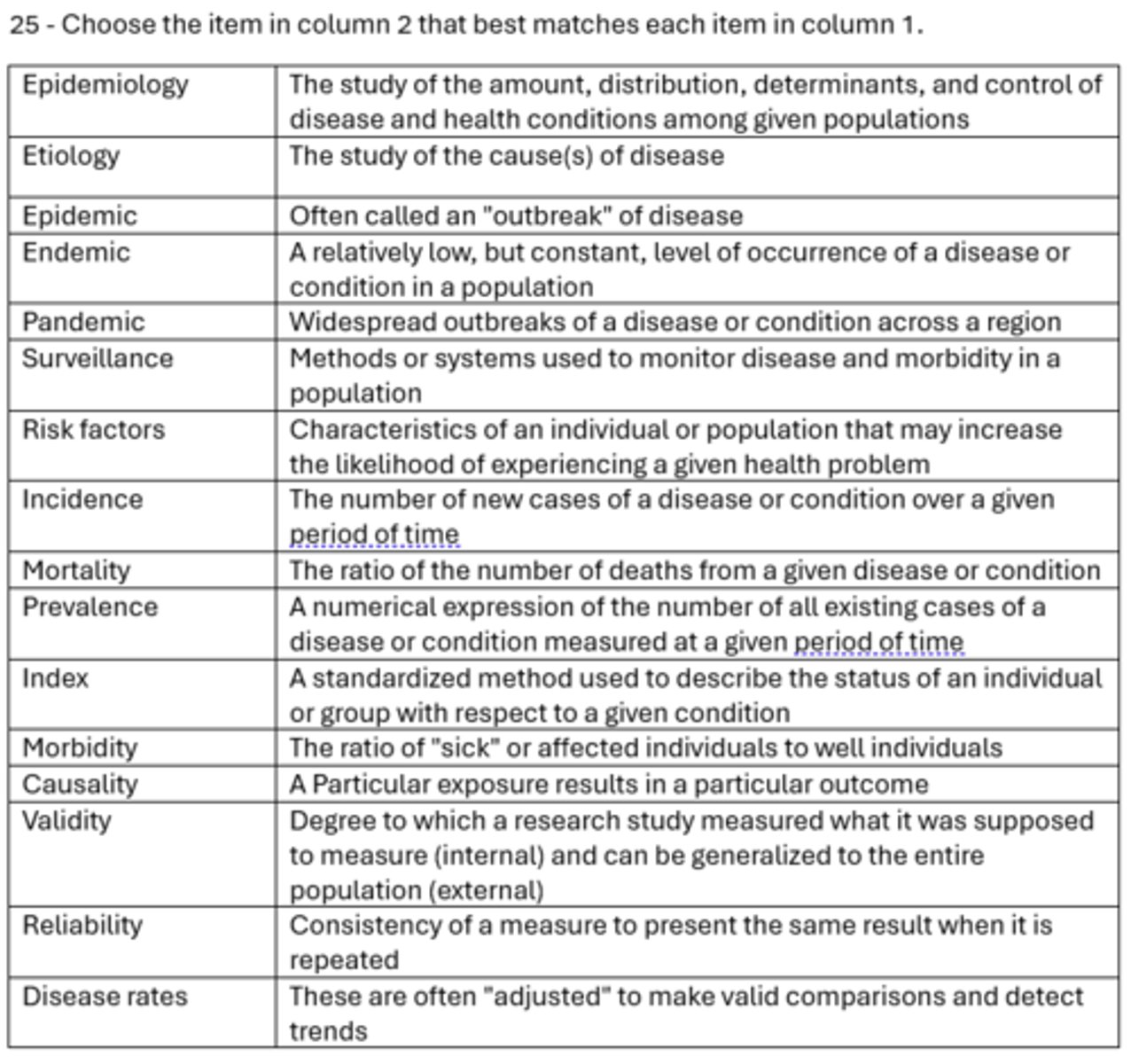
concept that certain exposure will result in a particular outcome
a particular exposure results in a particular outcome
Causality
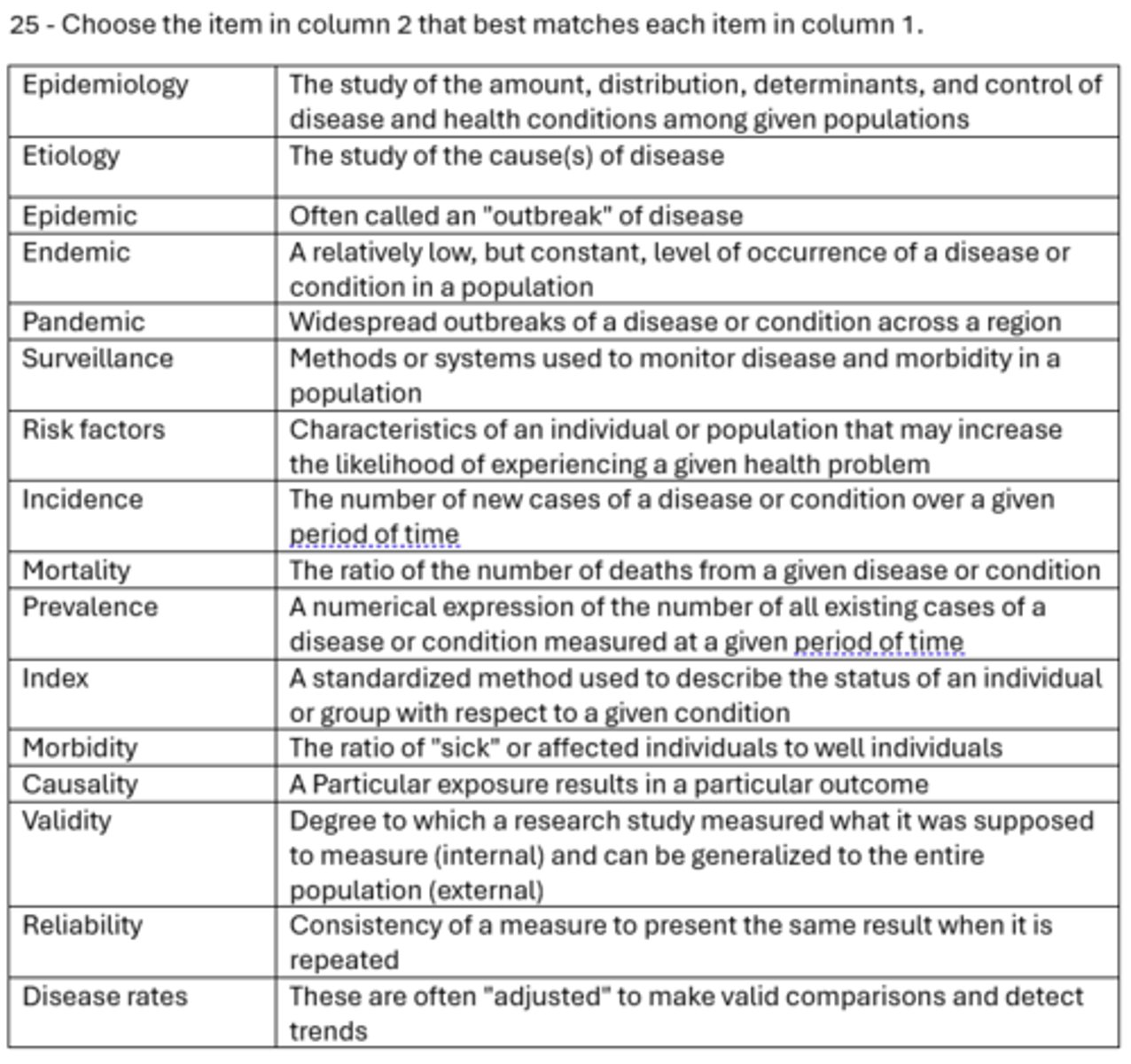
Consistency of a measure to present the same results when it's repeated
Reliability
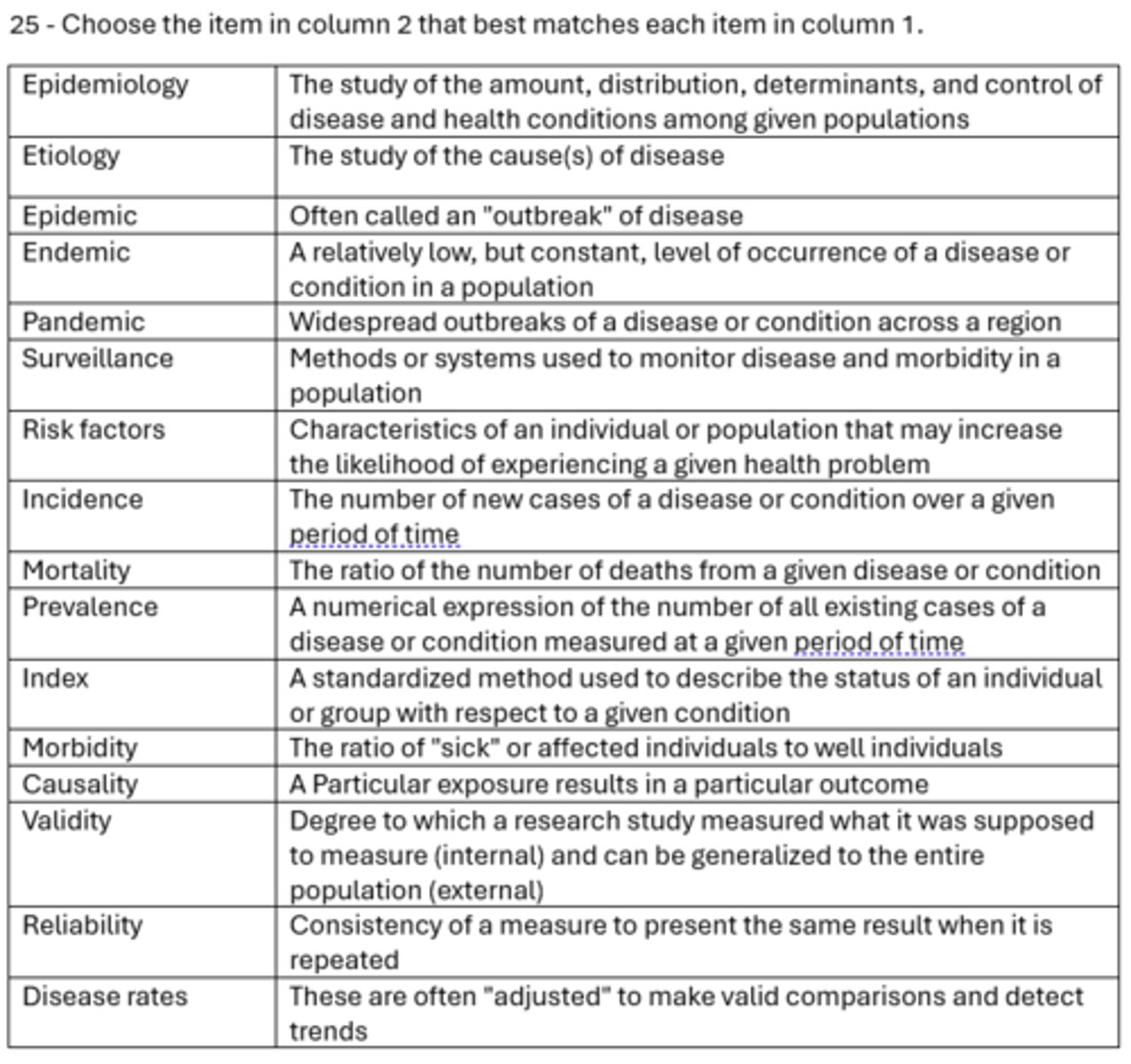
Consistency or degree to which an instrument will produce the same results on repeated trials within the same population every time the characteristic is measured.
Reliability
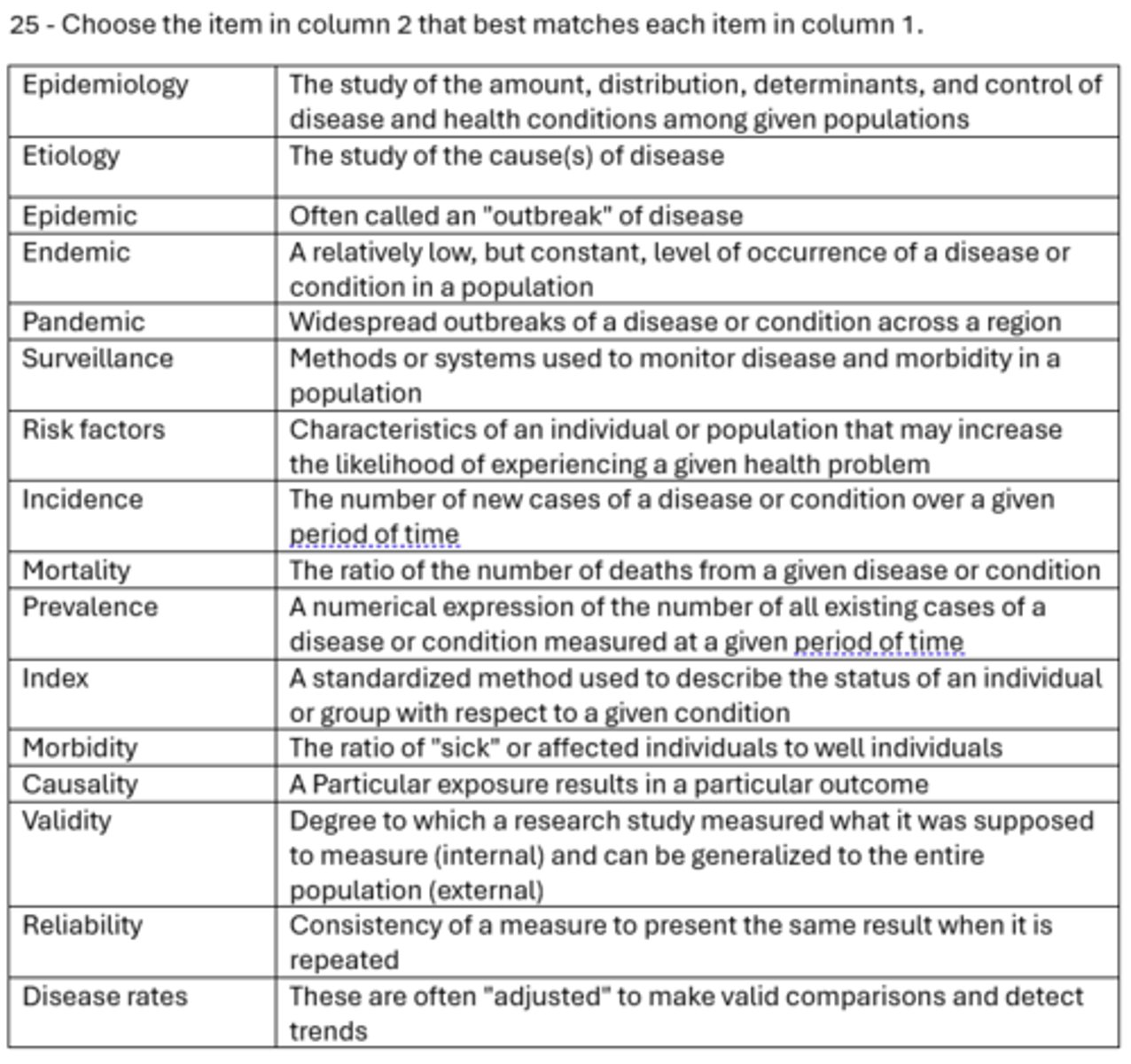
These are often "adjusted" to make valid comparisons and detect trends
Disease rates
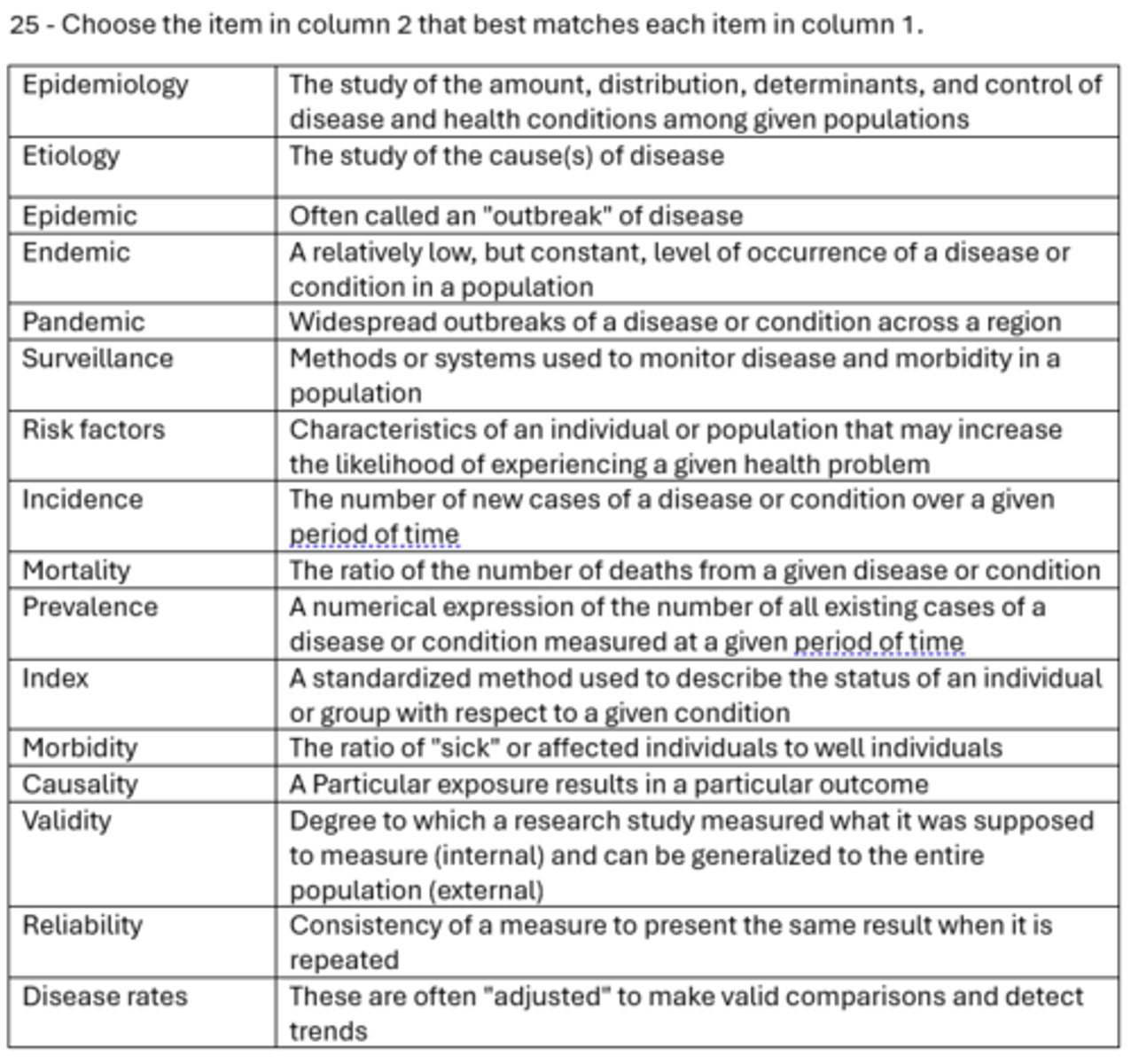
*The prevention agenda for the United States is discussed in which publication?
Morbidity and Mortality Weekly Report
Healthy People 2010
Global Oral Data Bank
Prevention USA
None of these
Healthy People 2010
3 multiple choice options
*Observational studies can be conducted to infer causality.
True
False
True
*The study of disease in a target population is called ________.
Etiology
Causality
Epidemiology
Naturalization
All of these
Epidemiology
3 multiple choice options
*What source contains oral epidemiological data from around the world?
Prevention International
Federation Dentaire Internationale
Global Oral Data Bank
International Federation of Dental Hygienists
None of these
Global Oral Data Bank
3 multiple choice options
*A risk indicator is a modifiable attribute that is known to be associated with a health condition.
True
False
False
*Establishing risk is the same as establishing causality.
True
False
False
*Causality means that a particular exposure results in a particular outcome.
True
False
True
*Which type of approach describes and interprets current events or situations?
Ex post facto
Descriptive
Case cohort
Case control
None of these
Descriptive
3 multiple choice options
16.3 - Which approach studies the meaning of past events?
· Case study
· Case control
· Descriptive
· Historical
· All of these
Historical
- to determine the meaning of past events
3 multiple choice options
* Which study approximates the true experimental approach but lacks the control of true experimentation?
Survey
Quasi-experimental
Clinical
Retroactive
None of these
Quasi-experimental
Methods: same as experimental except lacks the control of a true experimental design
3 multiple choice options
Which of the following studies 'lacks inherent control'?
A. Descriptive
B. Correlational
C. Experimental
D. Quasi-experimental
Quasi-experimental
- Similar to experimental approach minus the random assignment.
- Researchers have lesser control than on the true experimental designs
- Examples include correlational studies and results of case studies
*Posttest sensitization is the effect of the pretest on the outcome of the study.
True
False
False
*In a posttest-only design, the independent variable is introducing and then the dependent variable is measured.
True
False
True
*A risk marker is an attribute that is associated with the increased probability of disease but is not considered to have a causal role.
True
False
True
16.6 - A time series design measures the dependent variable and is done several times over a period of time.
True
False
True
* Stratifying a sample would define information such as age, gender, sex, income level, or educational levels.
True
False
True
* A factorial design is used to study two or more independent variables.
True
False
True
* An investigation that studies the frequency of flossing and periodontal disease is called a ________.
Correlational study
Survey
Trend
Case study
All of these
Correlational study
Which approach measures the relationship between variables?
3 multiple choice options
16.20 - Which approach measures the relationship between variables?
Correlational
Experimental
Ex post facto
Case control
All of these
Correlational
ex: frequency of flossing and periodontal disease
*An investigation that studies the frequency of flossing and periodontal disease is called a ________.
3 multiple choice options
16.9 - The attempt to identify and describe the topic being researched is ________.
Objective
Analytic
Descriptive
Subjective
All of these
Descriptive
the attempt to identify and describe what the topic being researched is.
3 multiple choice options
*Which type of study investigates existing differences to determine possible causes?
Experimental
Ex post facto
Correlational
Quasi-experimental
None of these
Ex post facto
Retrospective (casual-comparative or ex post facto)
< reverse of experimental approach >
3 multiple choice options
This type of research approach is the reverse of experimental approach and tries to investigate existing difference to determine possible causes.
Retrospective (casual-comparative or ex post facto)
TIME INTERVALS:
- Prospective
- Retrospective
- Cross-Sectional
- Longitudinal
* Which type of research, for example, considers the effect of intraoral sodium bicarbonate rinses on the periodontal ligament of laboratory rats?
Case study
Case control
Experimental
Correlational
None of these
Experimental
3 multiple choice options
Experimental research/approach is also known as _____, is probably the research most familiar to the lay person
Clinical trials
3 multiple choice options
16.13 - A study that uses questionnaires, opinionnaires, interviews, and indexes is called a ________.
Survey
Document analysis
Quasi-experimental
Developmental
None of these
Survey
The Descriptive approach includes a variety of studies including surveys, case studies, developmental studies, document analysis, trend studies, and correlational studies.
3 multiple choice options
*Which type of research approach would involve a study of the development of the International Federation of Dental Hygienists' Association?
Case study
Historical
Descriptive
Ex post facto
Both Case study and Historical
Historical
3 multiple choice options
16.15 - Which study tries to investigate cause-and-effect relationships and involves manipulation of variables?
Trend
Experimental
Correlational
Survey
All of these
Experimental (prospective)
Prospective (or exprimental per online search)
Experimental - intended to test CAUSE-and-EFFECT variables
3 multiple choice options
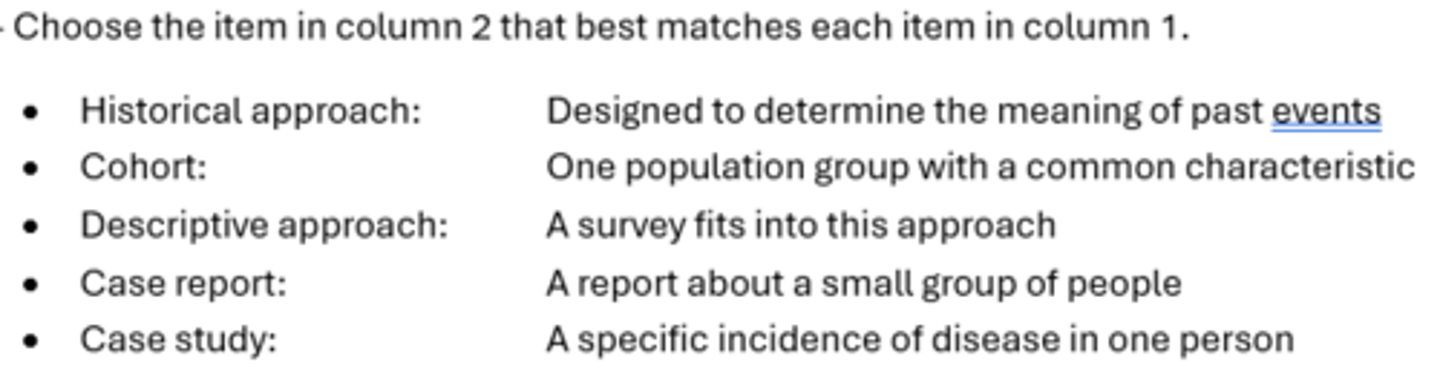
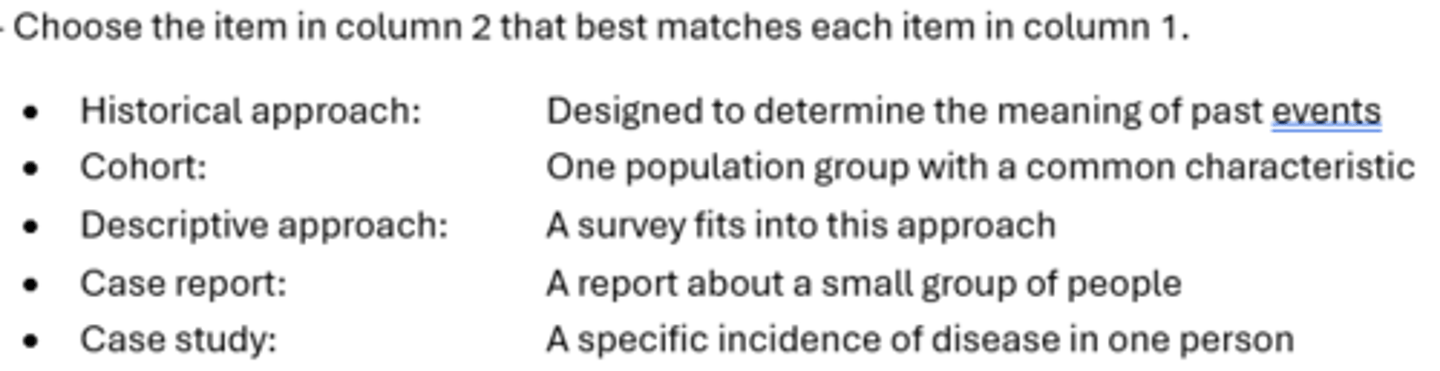
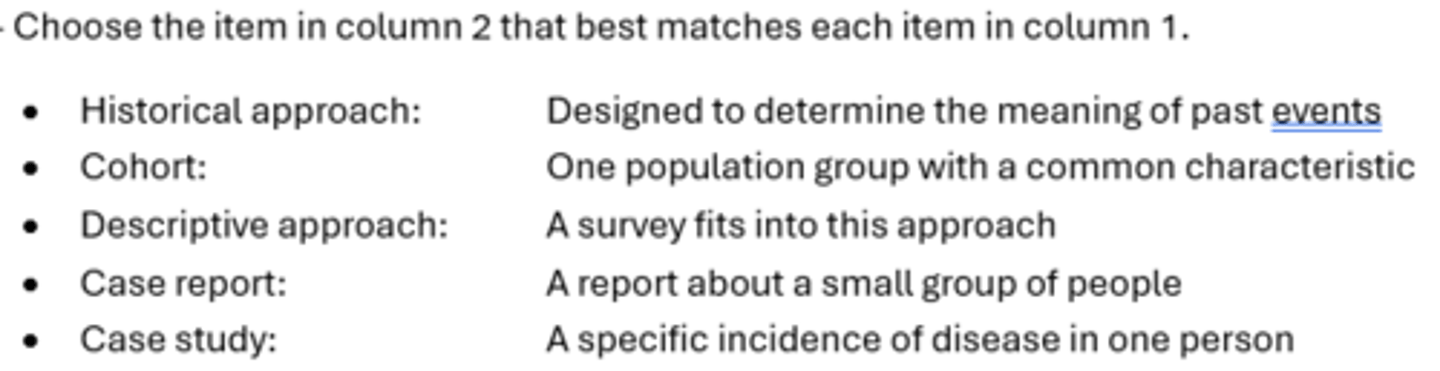
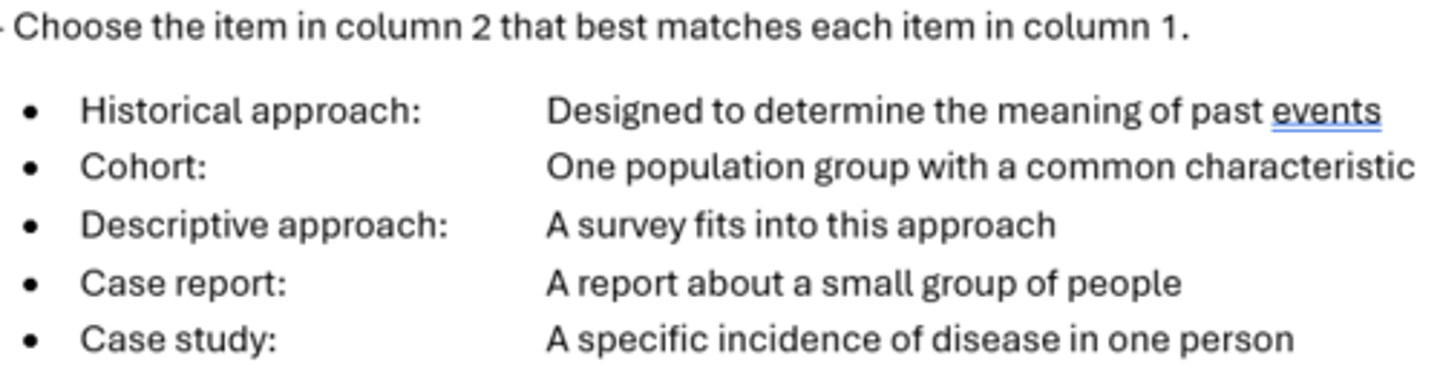
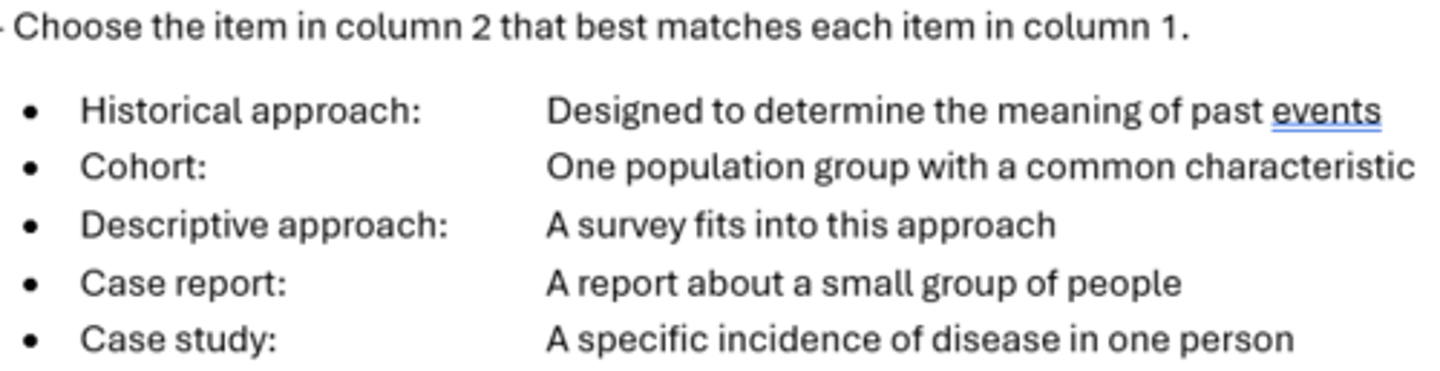
16.16 - Choose the item in column 2 that best matches each item in column 1.
Designed to determine the meaning of past events
Historical approach
Cohort
Descriptive approach
Case report
Case study
Historical approach
3 multiple choice options
16.16 - One population group with a common characteristic
Historical approach
Cohort
Descriptive approach
Case report
Case study
Cohort
3 multiple choice options
16.16 - A survey fits into this approach
Historical approach
Cohort
Descriptive approach
Case report
Case study
descriptive approach
3 multiple choice options
16.16 - A specific incidence of disease in one person
Historical approach
Cohort
Descriptive approach
Case report
Case study
Case study
3 multiple choice options
16.16 - A report about a small group of people
Historical approach
Cohort
Descriptive approach
Case report
Case study
Case report
3 multiple choice options
*Which type of research studies the same population over an extended period of time?
Case control
Longitudinal study
Correlational study
Survey
Both Case control and Longitudinal study
Longitudinal study
Measure the same population over an extended period of time.
3 multiple choice options
16.18 - A small version of a proposed study is called a ________.
Case study
Pilot study
Controlled study
Pivotal study
Both Case study and Controlled study
Pilot study
Version of a proposed study that is on a smaller scale, sometimes an intentionally chosen sample. Trial run to work out any errors in the plan for the study.
- is a small version of a proposed study, and is carried out on a small, sometimes intentionally chosen sample.
Before the research process begins a small version of a proposed study is conducted. This small study is also know as what?
3 multiple choice options
16.19 - A study in which neither the participant nor the researcher knows who is using a product or placebo is termed ________.
Double-blind
Blind
Cross-over
Double cross-over
None of these
Double-blind
Double-blind study - neither investigators nor subjects who is the cotrol (placebo) and who is in the other group (independent variable) that receives experimental treatment.
Highly reliable because it eliminates bias.
3 multiple choice options
* Which type of study is an in-depth report on a single person, group, event, or situation?
Quasi-experimental
Correlationaldescriptive approach
Case study
Experimental
None of these
Case study
>> is a descriptive approach that is used to conduct in-depth reposts on a single person, group, event, or situation.
3 multiple choice options
The research process always begins with a ___________
question
3 multiple choice options
A question to be answered by a study
hypothesis
3 multiple choice options
"Ultrasonic instrumentation is not significantly more effective than hand scaling during periodontal debridement. "Flossing has no effect on preventing caries."
Null hypothesis
3 multiple choice options