BV lab 2
 Call Kai
 Learn
Learn Practice Test
 Spaced Repetition
 Match
Match Flashcards
 Knowt Play
1/39

There's no tags or description
Looks like no tags are added yet.
Name | Mastery | Learn | Test | Matching | Spaced | Call with Kai |
|---|
No analytics yet
Send a link to your students to track their progress
40 Terms
How does someone with a SO palsy often present?
1. will have contralateral head tilt or contralateral head turn
2. may have increased vertical vergence ranges if long standing
what prism can be prescribed to tx a SO palsy?
R hyper → BD in R, BU in L
L hyper → BU in R, BD in L
how to measure torsion?
Maddox rod
Brown's syndrome is often mistaken for?
IO palsy
What is Brown's tendon sheath syndrome?
inflammation of trochlea or SO tendon causes tendon to get stuck in trochlea → overaction of SO and restriction of IO
what is the etiology of Brown's syndrome
1. congenital
2. inflammatory
3. trauma
How does Brown's tendon sheath syndrome present?
normal in primary and downward gazes
in up-gaze looks like an IO palsy
How can you tell if something is an IO palsy or Brown's?
forced duction test: manually push eye
if full with forced ductions → non-restrictive and is IO palsy
if restricted in force duction test → Brown's
How does a CN VI (LR) palsy present?
ipsilateral head turn
eso deviation in primary gaze
What are causes of a CN VI palsy?
1. change in intracranial pressure → pushes nerve against petrous portion of temporal bone
2. diabetes, HTN
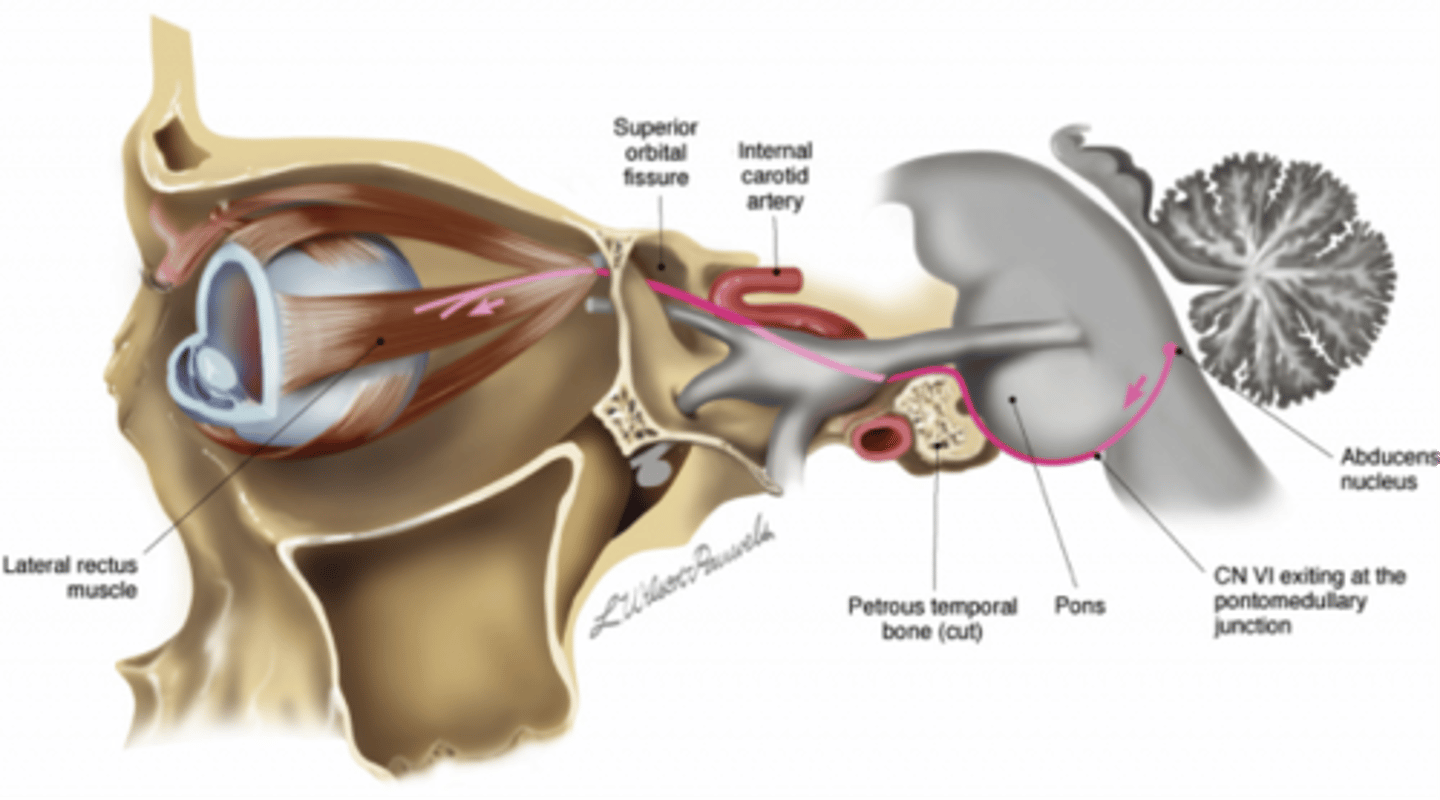
what prism do you use to tx CN VI palsy?
BO prism
What is Duane's Retraction syndrome?
co-contraction of MR and LR causing retraction of the globe on adduction
What is Type 1 Duane's Retraction syndrome?
abduction impaired + retraction on adduction
What is type 2 Duane's Retraction syndrome?
adduction impaired + retraction on adduction
What is type 3 Duanes retraction syndrome?
abduction and adduction impaired + retraction on adduction
what is the tx for a SO palsy, Brown's syndrome, CN VI palsy and Duane's retraction syndrome when pt has no diplopia in primary gaze?
nothing
what is the tx for a SO palsy, Brown's syndrome, CN VI palsy and Duane's retraction syndrome when pt has diplopia in primary gaze?
prescribe prism
What type of muscle is ocular muscle?
striated muscle
What are the layers of the ocular muscles?
global layer
orbital layer
What are the two type of fibers in ocular muscle?
twitch fibers
slow muscle fibers
Which layer of ocular muscle does twitch movements?
global layer
Which layer of ocular muscle does prolonged contraction?
orbital layer
what does the global layer have a lot of?
glycolytic enzymes
what is the orbital layer rich in?
oxidative enzymes
What are muscle pulleys?
muscle tethered to orbit in area other than origin
what is the role of muscle pulleys?
1. keeps EOMs from slipping when eye is moved away from primary gaze
2. alters the non-primary gaze kinematics of classic theory
what is a saccade?
an abrupt voluntary shift in fixation from one point to another, as occurs in reading
what is the stimulus for a saccade?
target displacement on retina
What is the saccadic pathway for a right saccade?
left frontal cortex → right omnipause neurons → right PPRF → right CN VI (right eye turns to right) + left MLF → left CN III (left eye turns to right)
How do both the eyes move at the same time in a saccade, despite the neurons firing from one side of the brain?
the neurons going contralateral move via the MLF which is highly myelinated for fast transmission
What is the general saccadic pathway?
contralateral frontal cortex → ipsilateral omnipause neurons → ipsilateral PPRF → ipsilateral CN nucleus + contralateral MLF → contralateral CN nucleus
What is the PPRF?
paramedian pontine reticular formation
What happens if there is a lesion at the left MLF?
during a right saccade → the right eye turns but the left eye stays @ midline
during a left saccade → both eyes move (may have nystagmus)
What is inter-nuclear ophthalmoplegia?
damage to the MLF
What are the characteristics of inter-nuclear ophthalmoplegia?
1. lag on adduction
2. may have nystagmus of abduction
3. convergence unaffected
What causes inter-nuclear ophthalmoplegia?
1. MS
2. vertebrobasilar disease - poor vascular perfusion of the posterior brain
What does inter-nuclear ophthalmoplegia mimic?
partial III palsy (MR)
What is binocular inter nuclear ophthalmoplegia (BINO)?
damage to both MLF
What does BINO look like/get mistaken as?
binocular MR palsy
What are the characteristic of BINO?
during right saccade → right eye looks to right and left eye stays
AND
during left saccade → left eye looks left and right eye stays
AND convergence is normal