Role of the State in the Macro Economy
 Call Kai
 Learn
Learn Practice Test
 Spaced Repetition
 Match
Match Flashcards
 Knowt Play
1/29

Earn XP
Name | Mastery | Learn | Test | Matching | Spaced | Call with Kai | Chat |
|---|
No analytics yet
Send a link to your students to track their progress
30 Terms
Current expenditure
This is day-to-day expenditure on goods and services, e.g. salaries of teachers, drugs used by the NHS.
Capital expenditure
This relates to expenditure on long-term investment projects such as new hospitals and roads.
Transfer payments
These are payments made by the state (from tax revenues) to individuals in the form of benefits for which there is no production in return; examples include child benefit, state pensions and the jobseekers’ allowance.
Crowding out
The view that a rapid growth of government spending leads to a transfer of scarce productive resources from the private sector to the public sector where productivity might be lower.
Resource crowding out
Occurs when the economy is operating at full employment and an increase in public expenditure results in insufficient resources being available for the private sector.
Financial crowding out
Occurs when increased public expenditure or tax cuts are financed by increased public sector borrowing, so increasing the demand for loanable funds and driving up interest rates. This reduces private sector investment.
Direct taxes
Direct taxation is levied on income, wealth and profit, e.g. Income tax, National insurance contributions, Capital gains tax, Corporation tax
Indirect taxes
Indirect taxes are levied on spending by consumers on goods and services, e.g. VAT, or specific taxes on fuel and alcohol, car tax.
Progressive taxes
As income rises, a larger percentage of income is paid in tax (e.g. UK income tax).
Proportional taxes
The percentage of income paid in tax is constant, no matter what the level of income.
Regressive taxes
As income rises, a smaller percentage of income is paid in tax (for example, excise duties on tobacco, alcohol in the UK).
Fiscal drag
A phenomenon that occurs when inflation pushes taxpayers into higher income tax brackets, resulting in higher tax payments. Fiscal drag can occur because most tax systems use fixed income brackets, which means that as a taxpayer’s income increases due to inflation, a larger portion of their income may be subject to higher tax rates. This can lead to an increase in tax revenue for the government, even if tax rates have not been changed.
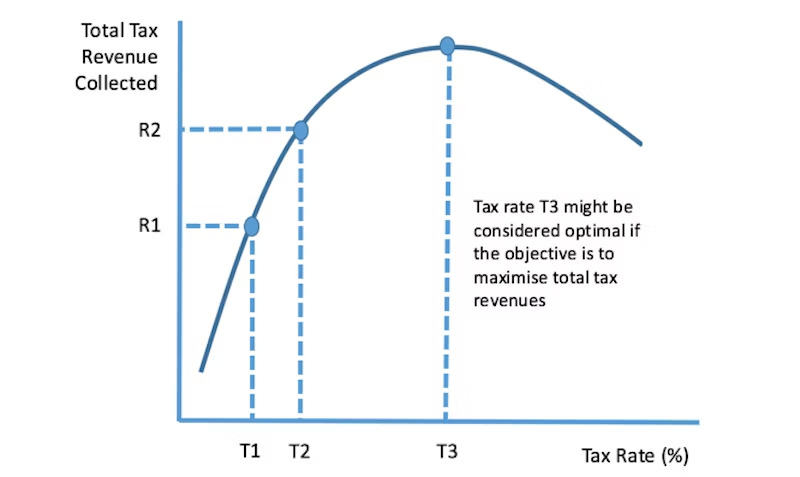
Laffer curve
A curve which shows that at low levels of taxation, tax revenues will increase if tax rates are increased; however, if tax rates are high, then a further rise in rates will reduce total tax revenues because of the disincentive effects of the increase in tax.
Automatic stabilisers
A process by which government expenditure and tax revenue varies with the business cycle, thereby helping to stabilise the economy without any conscious intervention from government.
Demand management
Government use of fiscal or other policies to manipulate the level of aggregate demand in the economy.
Fiscal policy
It is the use of taxation, government spending and government borrowing.
Fiscal (or budget) deficit
Where a government spends more than they receive in tax revenue in one year. The government must therefore borrow money to finance the difference.
National Debt
The total accumulated government debt over time. If the government has a budget deficit the national debt will rise.
Fiscal (or budget) surplus
Where a government receives more in tax revenue than they spend in one year. The government could choose to reduce the national debt or they could cut taxes or raise government spending.
Active or discretionary fiscal policy
The deliberate manipulation of government expenditure and taxes to influence the economy.
Expansionary fiscal policy
Fiscal policy used to increase aggregate demand (cut in taxes or increase in government spending).
Contractionary fiscal policy/ tighter fiscal policy
It is used to reduce aggregate demand (increase taxes or reduce government spending) i.e. shift AD curve left.
Fiscal austerity
Tax rises or government spending cuts designed to reduce a government budget deficit.
Cyclical deficit
That part of the fiscal deficit which is caused by government spending and taxes changing through the trade cycle.
Structural deficit
That part of a fiscal deficit that exists even when the cyclical deficit is zero at the top of a boom.
Primary deficit or surplus
The actual fiscal deficit or surplus not taking into account interest payments on the National Debt.
Current budget deficit
Occurs when government revenues are less than current expenditure. It does not include government capital expenditure.
Monetary policy
The use of changes in the rate of interest, the money supply and the exchange rate to influence the rate of growth of aggregate demand and the rate of inflation.
Quantitative easing (QE)
Where the BoE electronically creates money and uses this to purchase assets in the economy. The Bank of England increased the money supply by £200 billion on Thursday 19 th March 2020 following the coronavirus pandemic. QE is an expansionary monetary policy.
Quantitative Tightening (QT)
Reverse QE. The BoE could reduce the money supply by selling their bonds to private sector organisations. The goal is to reduce the amount of money in circulation and to increase interest rates.