Opto Test 2 Questions
 Call Kai
 Learn
Learn Practice Test
 Spaced Repetition
 Match
Match Flashcards
 Knowt Play
1/31

There's no tags or description
Looks like no tags are added yet.
Name | Mastery | Learn | Test | Matching | Spaced | Call with Kai |
|---|
No analytics yet
Send a link to your students to track their progress
32 Terms
Resolution of an interferometric optical encoder depends on:
Diffraction grating pitch
In interferometric optical encoder, the diffraction grating is iluminated by two inclined light beams. What is the angle between the grating normal direction and light beam direction?
equal to +/- first diffraction order for the grating and for the wavelength used
In the single frequency interferometer used for precise measurement of displacement of corner cube, in the case of corner cube velocity equal zero, the signals on the detectors are:
constant
In the single frequency interferometer two detection channels are used in order to:
establish the cube corner displacement direction
In the single frequency and two-frequency interferometers, where polarization beam splitters are used to slip and recombine the interfering beams, the interference phenomena will occur after propagating through:
polarizer
In a two-frequency interferometer system used for precise measurement of displacement of corner cube, in the case of static corner cube, the signals on the detectors are:
alternating with the frequency equal to the difference of the laser beam frequencies
In the pre-objective and post-objective scanning system, lenses usually introduce field curvature. In order to compensate for this effect, one uses
toroidal and cylindrical lenses
The main advantage of acousto-optic modulators are:
no moving parts, high accuracy and linearity, speed of scanning;
The increase in resolution of the acousto-optic modulator leads to:
increase in the acoustic transient time across the aperture
The width of transmission peaks in Fabry-Perot etalon depends on:
Reflection coefficients of the etalon mirrors
The increase in the distance between Fabry-Perot etalon mirrors leads to the following:
decrease in the distance between transmission peaks (in the frequency domain)
The interferogram produced in Fabry-Perot etalon for single wavelenght is in the form of:
thin non-equidistant linear fringes
Free Spectral Range (FSR) is an important feature of the Fabry-Perot etalon. To enlarge its value for a specific wavelenght range, one needs to:
decrease the lenght of etalon
The best focus of the point object, in the system employing the astigmatism detection method and quadrant photodetector, is achieved when:
signal is equalized in horizontal and vertical quadrants
Two different imaging systems are considered:
1) with the focal lenght 200 mm and 0,4 numeral aperture for imaging in 400 nm wavelength
2) with the focal length 500 mm and 0,3 numerical aperture for imaging in 600 nm wavelength
Which imaging system is characterized by better lateral resolution:
system no 1.
In the acousto-optic modulators (employing Bragg diffraction), the maximum interaction efficiency is obtained if:
divergence angles of optical and acoustic waves are similar
In the pre-objective scanning system, f-0 optical lenses are used. In this type of lens the relation between the scanning angle and light spot position is
described with linear function
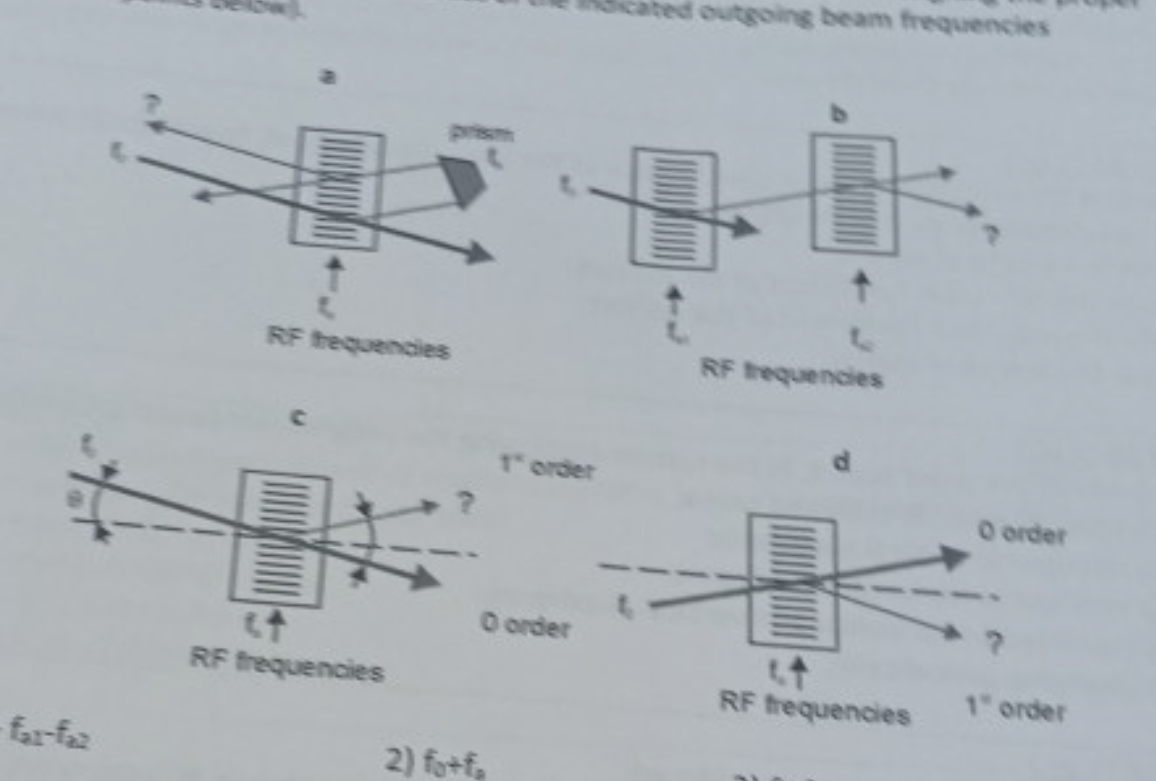
Match
a 4 (f0+2fa)
b 1 (f0+fa1-fa2)
c 2 (f0+fa)
d 3 (f0-fa)
Every optical system is characterized by the finite lateral and axial resolutions. What is the relation between these resolutions?
There is no relation between axial and lateral resolutions
What is the role of the beam splitter plate in the point source imaging systems?
it introduces astigmatic aberration for quick measurement of focusing quality on the detector
In the post objective scanning systems, the scanning surface is lying on the sphere. In the systems without dynamic compensation of scanning point axial position, in order to hold beam diameter dimension constant, the following phenomena is used:
natural small change of Gaussian beam dimension in the close vicinity of the best focus plane
In the scanning systems with polygonal mirrors, increasing the number of mirror facets, and holding other parameters of the system leads to:
decrease in scanning resolution
Galvanometric scanners used in optical scanning systems frequently requiere a feedback loop to ensure precise control of the scanning angle. As sensors in such systems, one may use:
optical coders
Despite optical resolution, numerical aperture partially defines the brightness of the imaged spot. For the objects located at a considerable distance from optical systems, one may define brightness rather with the:
f-number
The resolution of the Fabry-Perot etalon may be greatly improved if:
etalon length is increased
Rayleigh resolution criterion is met when:
MAXIMUM intensity of one point source image coincides with the MAXIMUM of the other
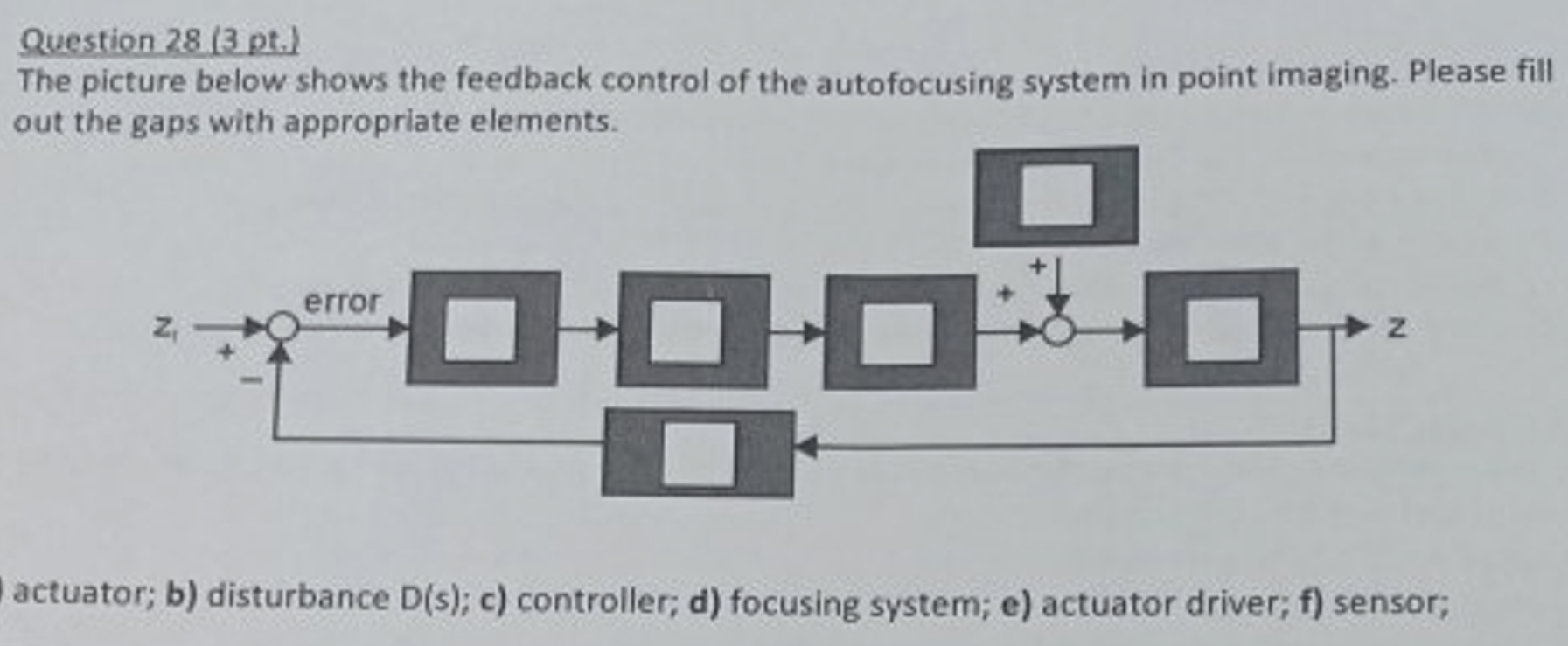
Feedback control
Controller
Actuactor Driver
Actuator
Focusing System
Entering the sum node: Disturbance
Feedback: Sensor
The interaction of acoustic and optical waves provides:
light beam deflection, light frequency shifting, amplitude modulation
Polarization optics is used in many different optical systems. A quarter wave plate is one often used. Its main role is to:
switch linear polarization to circular one and vice versa
Arrange the light sources shown below in order of increasing width of the spectral power density distribution (from narrowest to broadest spectrum)
1 He-Ne Laser
2 Semiconductor Laser
3 LED
4 Halogen source
The following type of illumination must be used in order to obtain a sharp reproduction of the contours of the object (steel nut) in the image registration system:
diffuse illumination from BELOW and a diffuse surface on which the object is placed
Frequency interferometer with laser wavelength
Δfmax=42 MHz−40 MHz=+2 MHz
Δfmin=38 MHz−40 MHz=−2 MHz
Δf=λ2v
v=2Δf⋅λ
v=2±(2×10⁶ Hz)⋅(500,0×10⁻⁹ m)
=2±10−2 m/s=±0,5 m/s