Math 61 - Graph Vocabulary
 Call Kai
 Learn
Learn Practice Test
 Spaced Repetition
 Match
Match Flashcards
 Knowt Play
1/13

There's no tags or description
Looks like no tags are added yet.
Name | Mastery | Learn | Test | Matching | Spaced | Call with Kai |
|---|
No analytics yet
Send a link to your students to track their progress
14 Terms
Graph
Denoted by letter G; a set of vertices of V(G) and edges E(G) ⊆ {(u, v) | u, v ∈ V}
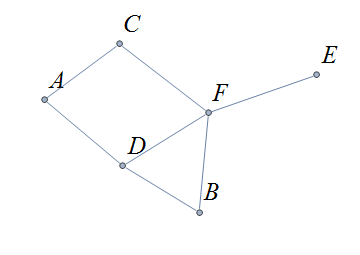
Incident
When an edge e ∈ E(G) is denoted by (u, v). In this case, u and v are called adjacent vertices.
Loop
An edge denoted by (u, u)
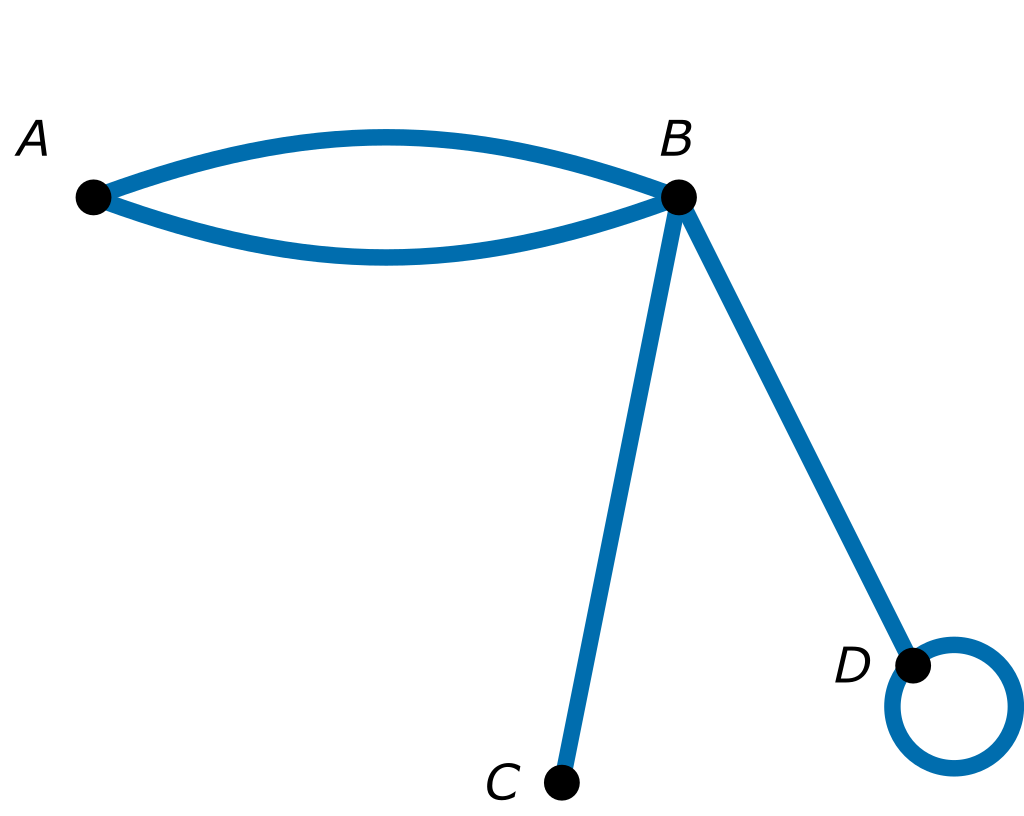
Parallel
Multiple loops between {u, v} ⊆ V
Isolated
If u ∈ V is not adjacent to any w ∈ V, we say that v is isolated
Simple Graph
Graph G has no loops or parallel edges
Complete Graph
Denoted by Kn, where n is the number of vertices. This is a simple graph where |V(Kn)| = n, and there is an edge between each pair of vertices
Bipartite Graph
Graph composed of 2 separate subsets of vertices, where the vertices of one subset connect the other. However, elements in each subset do NOT connect each other
Complete Bitarte Graph
Denoted Km,n, where the graph is bipartite AND every vertex is one set is connected to ALL the vertices in the other
Simple Path
For (u, w) ∈ V(G), a simple path from u to w is a path from u to w with no repeated vertices.
Cycle
A path of non-zero length w/ no repeated edges from u to v, where u, v ∈ V(G).
Simple Cycle
Cycle from u to v in which there are no repeated vertices other than the first and last vertex
Eulerian Cycle
Cycle which includes all edges and all vertices in G
Hamiltonian Cycle
Cycle in G that contains each vertex exactly once (except for the start and end)