Lecture 31: ECG Interpretation
 Call Kai
 Learn
Learn Practice Test
 Spaced Repetition
 Match
Match Flashcards
 Knowt Play
1/12

There's no tags or description
Looks like no tags are added yet.
Name | Mastery | Learn | Test | Matching | Spaced | Call with Kai |
|---|
No analytics yet
Send a link to your students to track their progress
13 Terms
How does an ECG work?
ion movement in cells create electric currents → movement of these currents through cardiac tissue stimulates muscle contraction → muscle pumps the blood
ECG = graphical representation of this electrical activity
Describe the physiology of a cardiac action potential.
sodium enters cell causing rapid depolarization → potassium leaks out causing initial repolarization → calcium enters the cell causing a prolonged plateau phase and stimulating muscle contraction → more potassium leaves the cell repolarizing the cell
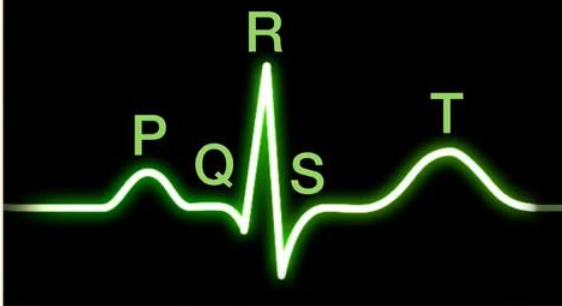
What is this?
normal sinus rhythm
What is the first important question to ask when reading an ECG?
does this rhythm have a pulse associated with it
What 5 questions should be asked in the same order every time when reading an ECG?
1. Is it FAST or SLOW (Rate)?
2. Is it REGULAR or IRREGULAR (nothing to do with sick/healthy)
3. Are the QRS complexes WIDE or NARROW/NORMAL
4. Is there a P wave for every QRS wave
5. Is there a QRS wave for every P wave
What type of pattern is sinus arrhythmia?
regularly irregular
What type of ECG pattern do atrial fibrilations, VPCs, and AV blocks have?
irregularly irregular (random)
How do you identify waves on an ECG?
• Identify first the QRS complexes (bigger amplitude)
• Identify the T waves after QRS complexes
• Identify P waves by exclusion of other waves
True or false: QRS complexes can have different morphology.
true
What is the most likely origin of normal QRS complexes?
supraventricular
What is the most likely origin of abnormal or wide QRS complexes, such as this one?
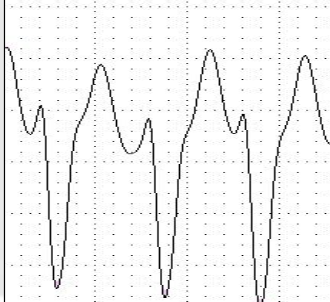
ventricular
How do you interpret P wave morphology?
Can you CONSISTENTLY identify P waves?
Yes = the rhythm starts with the word “Sinus” (tachycardia, rhythm or bradycardia)
No = then it can be:
Supraventricular tachycardia
Atrial Fibrillation
Junctional Tachycardia
Atrial Standstill
Ventricular Tachycardia
How do you interpret P waves and QRS complexes together?
Check if every P wave has a subsequent QRS
Check if every QRS is preceeded by a P wave