IBDP BIOLOGY Unit 5: Power and Productivity in Cells
 Call Kai
 Learn
Learn Practice Test
 Spaced Repetition
 Match
Match Flashcards
 Knowt Play
1/57

Earn XP
Description and Tags
Topics: C1.3, C1.2
Name | Mastery | Learn | Test | Matching | Spaced | Call with Kai |
|---|
No analytics yet
Send a link to your students to track their progress
58 Terms
producers (plants) can take _____ energy and convert it into _____ energy
light, chemical
chemical energy can be in the form of ….
carbohydrates, lipids, proteins, nucleic acids
What is the photosynthesis equation.
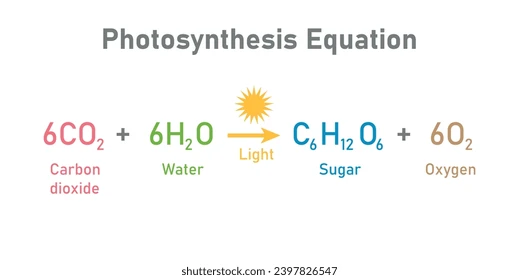
what is photolysis?
photo = light
lysis = break
using light energy to split water molecules.
in photosynthesis, the O2 byproduct is the result of he photolysis of water.
what is chromatophy?
Chromatography is the separation of pigments. Pigments absorb different wavelengths of light. This is how this process works:
Transfer plant pigments to chromatography paper
Allow chromatography solvent to be absorbed upward through the paper
separates pigments
Measure the distance that the solvent traveled and the distance each pigment traveled
Calculate the Rf value
Rf = distance pigment/distance solvent
what is the difference between colors and pigments?
Colors: different wavelengths of light
Pigments: absorb certain wavelengths of light.
The wavelengths that pigments reflect are what we see.
What is the absorption spectrum?
shows the wavelength of light a pigment absorbs
chlorophyll is great at absorbing _____, terrible at absorbing _____, and great at absorbing _______
blue, green, red
What is an action spectrum?
A spectrum that shows not only what it can absorb, but also what it can do with it. It shows photosynthesis rates at different wavelengths.
What is the difference between the absorption spectrum and the action spectrum
Absorption: measures the percentage of the light that can be absorbed by chlorophyll
Action: looking at the photosynthesis rates — what is the plant doing with different wavelengths of light? usually expressed as a % of the maximum photosynthesis level.
How can you measure photosynthesis rates?
Look at oxygen production rates.
Look at carbon dioxide consumption.
What are limiting factors? What are the 3 limiting factors of photosynthesis?
things that can limit the rate of photosynthesis.
carbon dioxide
light intensity
temperature.
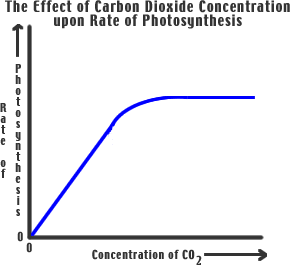
Explain how the limiting factor of carbon dioxide works in photosynthesis.
Carbon dioxide is one of the substrates for photosynthesis. Therefore, the higher the concentration, the faster the rate will be, until it reaches a maximum rate, and then it begins to plateau. This is because after a certain amount, all active sites are occupied.
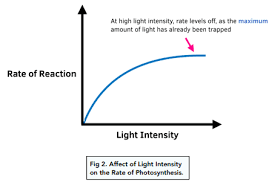
Explain how the limiting factor of light intensity works in photosynthesis.
We need light for photolysis and other processes, so the more intense the light, the faster the photosynthesis will go until it reaches a maximum rate. Then, even if the light gets brighter and brighter, the rate will plateau.
Explain how the limiting factor of temperature works in photosynthesis.
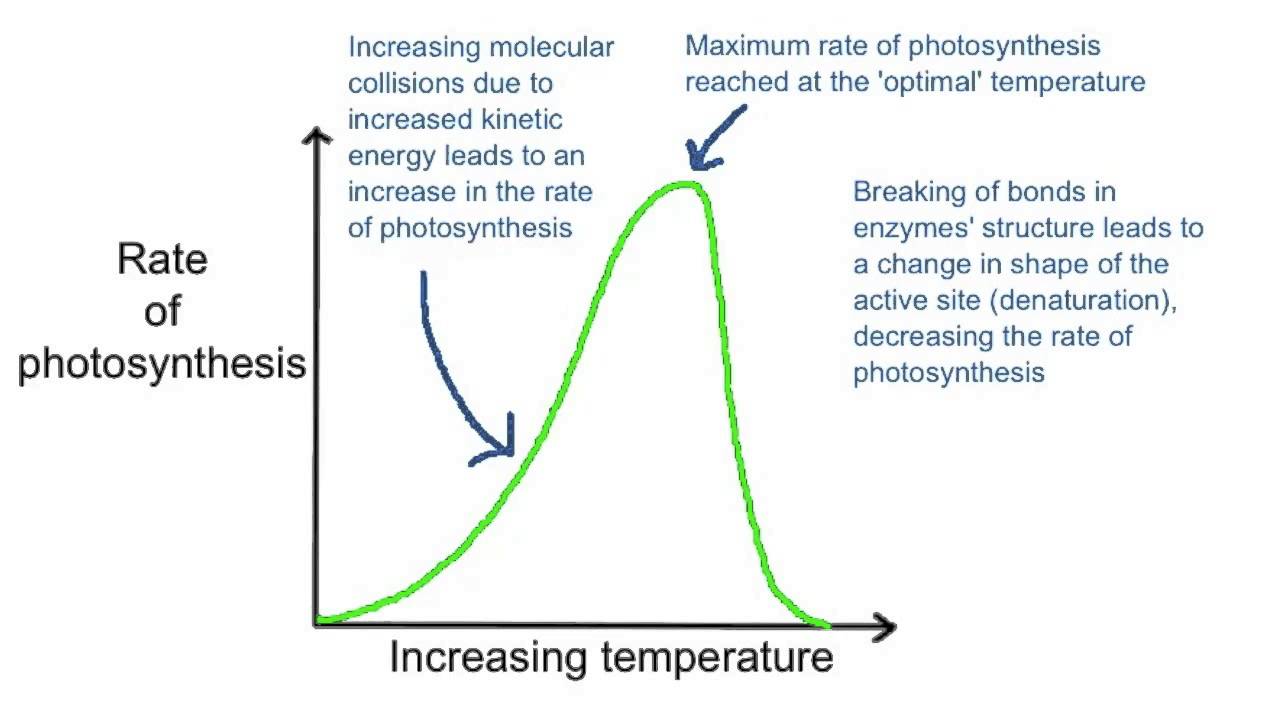
As the temperature increases, processes become faster and faster, until a certain point where it hits a peak and then falls. This is because photosynthesis is catalyzed by enzymes. After a certain temperature, the enzymes begin to denature.
What is technique that you can use to measure the rate of photosynthesis?
By using aquatic plants, oxygen gas is a byproduct of photosynthesis. If you use an aquatic plant, you can put it underwater and then measure the rate/how many bubbles of oxygen gas are produced.
Where are pigments found?
They are found in photosystems.
Where are photosystems found?
inside the thylakoid membrane.
Where is the reaction center found and what is the point of a the reaction center?
The reaction center is found inside photosystems, and reaction systems are full of chlorophyll and have a lot of electrons that can be excited when chlorophyll absorbs photons of light.
There are two different photosystems and they both excite electrons and then need the electron to be replaced. What is the difference between them?
Photosystem II: the lost electron comes from the photolysis of water
Photosystem I: the electron being lost is replaced by photosystem II
** Just remember that PS II comes FIRST and helps produce ATP
PS I comes SECOND and produces reduced NADP
Why are the different pigments in photosystems important
different pigments absorb different wavelengths of light. This allows it to absorb more different kinds of wavelengths.
Explain how the light-dependent reaction works.
Photoactivation of Photosystem II: Photosystem II is going to absorb a photon of light that excites an electron inside the photosystem’s reaction center from the chlorophyll a within it.
Photolysis of Water: The electron needs to be replaced. The electrons from the photolysis of water will be used to replace the excited electron that just came from the reaction center in photosystem II. Two water molecules are going to be split up into a molecule of O2, 4 H+ ions, and 4 electrons. The oxygen being produced is a byproduct of the reaction.
Electron Passed through ETC: Now the electron will be passed through a system of carriers called the Electron Transport Chain (ETC) that is embedded in the thylakoid membrane. Every time the electron is passed, it liberates energy that will be used to power active transport in the form of proton pumps.
Active Transport: Protons (H+ from the hydrolysis of water) are now being actively pumped into the thylakoid space. Because the thylakoid space (aka lumen) is very small, a very high concentration of protons is created quickly.
Facilitated Diffusion: Now, because there is such a high concentration internally, these H+ molecules will move through ATP synthase passively. ATP synthase is a protein that acts as a channel for facilitated diffusion and as an enzyme. As these protons are moving through ATP synthase, it creates kinetic energy, and this catalyzes the conversion of ADP to ATP. That is how photosystem II helps to generate ATP.
Photosystem I/Creation of NADPH: Photosystem I absorbs a photon of light that helps excite an electron. That electron needs to be replaced. The electron comes from the old electron of Photosystem II. Meanwhile, this electron that was just excited from photosystem I will be passed to an enzyme NADP+ reductase enzyme. It uses that electron to reduce NADP+ into NADPH
Where do light dependent reactions occur in a chloroplast
In the thylakoid discs.
Where do light independent reactions occur in a chloroplats
In the stroma
What is another name for light independent reactions
Calvin Cycle
What is carbon fixation?
the attachment of a carbon (Co2) molecule
What is the end goal of the Calvin cycle
to produce glucose (C6 H12 O6)
What are the 3 big general phases of the Calvin Cycle?
carbon fixation
reduction
regeneration
Explain the Calvin Cycle
Carbon fixation: An enzyme called Rubisco attaches. A molecule of carbon dioxide to a molecule of RuBP. RuBP is a 5-carbon molecule, and carbon dioxide is a 1-carbon molecule. When they are attached together, this creates a 6-carbon molecule. What Rubisco will do is attach the two molecules, creating a 6-carbon molecule. This molecule is extremely unstable and immediately breaks apart into 2 compounds that each have 3 carbons. These molecules of three carbons are called glycerate 3 phosphates (G3P)
Reduction: The G3P created is going to be reduced to create triose phosphate. This is done by using the ATP produced during the light-dependent reaction to take the electron from NADPH (produced during the light-dependent reaction) and add it to that G3P. This then causes NADPH to be oxidized and turned back into NADP+. This TP is now much more energized than the G3Ps from earlier.
Regeneration: 1 molecule (of the 3) goes to produce glucose. The rest of the molecules go back to regenerate RuBP (a 5-carbon molecule). Energy is needed to regenerate the RuBPs, and this comes from ATP (produced in the light-dependent reaction). for t he 5 carbon RuBP to be regenerated, the Calvin cycle must repeat 6 times to create 6 new RuBPs because 6 of the 36 will go back to make glucose and the other 30 will go to make RuBP (30/5 = 6 new RuBPs)
What will be the limiting factor of organisms in a low light enviornment?
ATP and NADPH limit the amount of photosynthesis that can happen (if there is no light, light-dependent reaction cannot occur, no ATP or NADPH is produced)
What will be the limiting factor for organisms in a low-carbon environment
carbon dioxide will be the limiting factor because they will not have enough carbon dioxide to carry out the initial steps of the Calvin cycle (carbon fixation).
what is the charged version of ADP
ATP
what is the charged version of NADP+
NADPH
Oxidation and reduction refer to the addition or subtraction of electrons from a molecule.
Oxidation: molecules ______ electrons
Reduction: molecules ______ electrons
lose
gain
What are the general 4 steps of Aerobic cellular respiration?
Glycolysis
Link Reaction
Krebs Cycle
Electron Transport Chain
Explain how glycolysis in anaerobic cellular respiration works.
** Step occurs in the cytoplasm. At the end, you’ll end up with 2 ATP, 2 molecules of pyruvate, and 2 reduced molecules of NAD (NADH)
Phosphorylation: You start with a 6-carbon compound (glucose), and the problem is that glucose is extremely stable and difficult to break apart. In order to break it, it must be destabilized. This is done by adding a phosphate group (phosphorylation). This comes from ATP—ATP “donates” one of its phosphate groups, turning it into ADP. We have 2, 3 carbon molecules, so we need two molecules of ATP.
Lysis: the actual splitting of the 6-carbon glucose is lysis. During this breaking apart, the molecule is phosphorylated a second time. Each of the 3-carbon molecules has 2 phosphate groups attached.
Oxidation: now, one of the 3 carbon molecules will be oxidized, meaning it will lose an electron. Something must gain that electron (be reduced). The molecule that gets it is NAD. After gaining the electron, it becomes NADH. This step happens twice, so two molecules of NADH are produced.
ATP formation: one of the two phosphate groups is taken off the 3-carbon molecules to turn ADP back into ATP. We have two phosphate groups on each NADH, meaning that 4 molecules of ADP can be turned into ATP. Because we started out by having to use 2 ATP, and we make 4 ATP at the end, there is a net gain of 2 ATP. The 3 carbon molecules, once the phosphate groups have been taken off of them, are pyruvate.
Products: 2 ATP, 2 NADH, 2 pyruvate
If no oxygen is still available, the pyruvate must be converted into lactate. the lactate uses the two NADH to produce two NAD to fuel the Anaerobic respiration cycle up again. This means that the only thing left is the 2 ATP.
How is energy released from AT
By breaking the bond between the second and third phosphate groups. This now creates ADP.
what is the term respiration mean?
A biochemical process that releases energy from carbon compounds to produce ATP. It does not mean breathing—this is actually ventilation.
what are the two kinds of respiration
Aerobic and Anaerobic
When does Aerobic and Anaerobic respiration occur?
Aerobic: when there is the presence of O2 and results in Co2 + H20
Anaerobic: when there is no presence of O2. The products depend on what kind of organism: yeast creates Co2 + ethanol, humans create LACTATE (lactic acid)
Holistically, what is the difference between Aerobic and anaerobic respiration?
Aerobic:
With oxygen.
Carbohydrates, lipids, amino acids
Cytoplasm then mitochondria
create carbon dioxide and water
creates 30 ATP
Anaerobic:
Without oxygen
Only carbohydrates (glucose)
Cytoplasm only
create lactate (in humans)
creates 2 ATP
If oxygen is available, organisms will always send cells through the aerobic respiration because per molecule of glucose, it produces 30 ATP, whereas Anaerobic only creates 2 ATP
When anaerobic respiration occurs and lactate is created, what must happen later to break it down?
Oxygen must be added back.
what is oxygen debt?
The amount of O2 that must be absorbed following anaerobic respiration in order to break down the lactate.
What is the chemical equation of aerobic respiration?
glucose + oxyen = carbon dioxide + water + energy
C6 H12 O6 + 6O2 = 6Co2 + 6H20 + energy
What are ways you can measure cell respiration rates?
Measure decline in oxygen concentration
Measure decline in glucose concentration
Measure increase in carbon dioxide concentration
What is called when an oxidation and reduction reaction occur simultaneously
REDOX reaction
Why is anaerobic cell respiration important for yeast?
Yeast is used for bread making. When you cover yeast, it goes into anaerobic respiration, but still produces carbon dioxide. Carbon dioxide bubbles get trapped in the bread dough, causing it to rise and create a fluffy texture. The ethanol that is created as a product of the anaerobic respiration of yeast is burned. off during baking.
It can also be used to brew alcohol. You add yeast to grapes or grains and let it go through anaerobic respiration, which will produce carbon dioxide and ethanol. The carbon dioxide will be seen as bubbles. The more sugar you add, the higher percentage of alcohol will result (up to 15%)
Where do all of the reactions occur in the process of aerobic respiration
Glycolysis - cytoplasm
Link reaction - matrix of mitochondria
Krebs cycle - matrix of the mitochondrion
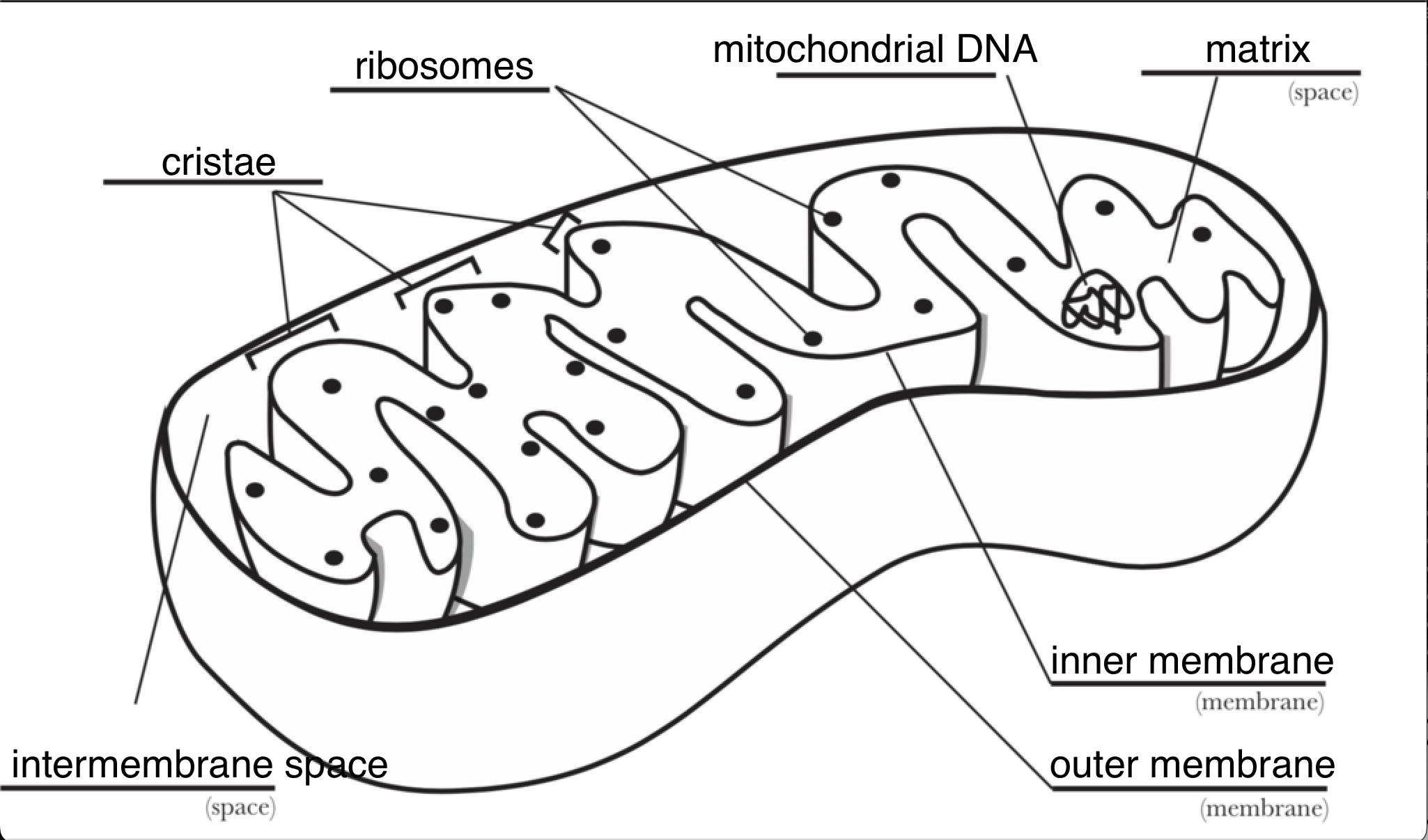
ETC/chemiosmosis - fold of the inner membrane, the cristase
explain the link reaction in Aerobic respiration.
** Recall that the product of glycolysis is pyruvate. At the end, you should end up with a 2-carbon molecule with an acetal CoA molecule attached. If oxygen is present after glycolysis, the cell will enter aerobic respiration. Pyruvate enters the matrix of the mitochondria via active transport. This happens twice because there are 2 pyruvates created during glycolysis.
Decarboxylation: the removal of a carboxyl group (COOH). One of the carbons of pyruvate (a 3-carbon molecule) is broken off and comes out in the byproduct form of carbon dioxide.
The two 2-carbon molecules are oxidized (removal of an electron), and the NAD+ receives the electrons (is reduced) to create NADH.
Finally, the two carbons (acetyl groups) combine with the coenzyme A (CoA) to create the final product of acetyl-CoA. This acetyl-CoA will enter the Krebs cycle.
Explain the Krebs cycle in Aerobic respiration.
** Occurs in the mitochondrial matrix and is a cycle, meaning you will start and end with the same molecule. The final products include: carbon dioxide, reduced NAD (NADH), reduced FAD (FADH2), and ATP.
You start with acetyl-CoA, which we got from the link reaction, and a 4-carbon molecule named oxaloacetate (OAA) attaches to it. The Coenzyme A is going to come off—kind of just chaperones to get the Krebs cycle started. After the Coenzyme A is removed, a 6-carbon molecule is left (2 from acetyl CoA and 4 from OAA
Now a series of decarboxylation and oxidation reactions will occur. This 6-carbon molecule is decarboxylated, making it now a 5 carbon molecule. That removed carbon will become a carbon dioxide molecule. The intermediary 6-carbon compound is oxidized (loses an electron), causing the reduction of NAD into NADH. Both of these things happen once again to the now 5-carbon compound. It loses another carbon (released as CO2) and is oxidized again to reduce another molecule of NAD. It is now a 4-carbon compound that looks very similar to oxaloacetate (OAA).
After being decarboxylized and oxidized twice, the 4-carbon compound still has enough residual electrons so it can reduce another molecule of NAD, another electron carrier called FAD into FADH2, and one ADP back into ATP.
The things made during the Krebs Cycle: 2 molecules of carbon dioxide, 3 molecules of NADH, 1 molecule of FADH2, and 1 molecule of ATP.
This entire process will occur TWICE per molecule of glucose because we had two pyruvates and two acetyl-CoA.
All of the original carbons that were in glucose are now gone. They have all been picked apart either through the link reaction or decarboxylation reactions in the Krebs Cycle.
While energy at this point has been created through the creation of 4 ATPs, most of the energy is actually being stored in those electron carriers. There is a bunch of NADH and FADH2 that will carry electrons to the final step of cell respiration—ETC
Explain the Electron Transport Chain (ETC) in Aerobic respiration.
**Electron carriers are proteins embedded in the inner membrane that are easily reduced and oxidized (gain and donate electrons). NADH or FADH2 will donate electrons to the electron carriers, making that NADH or FADH2 oxidized back into NAD or FAD. Electrons can be passed from carrier to carrier, and every time it does so, it liberates some of the energy from the electron. That energy will be used for active transport. Embedded in the inner membrane, there are proton pumps that will pump protons from the matrix into the intermembrane space. Every time an electron is passed, protons will be pumped into the intermembrane space. The electron is passed to the next carrier, then the next carrier, are continues. This activates proton pumps and brings those protons into the intermembrane space. The intermembrane space is very small, creating a high concentration of protons inside the space.
The electron carried by the NADH is a little more powerful than that carried by the FADH2. NADH has the ability to pump 10 proteins into the intermembrane space, whereas FADH2 only has enough energy to pump in 6 protons.
Most of the ATP in aerobic cell respiration is from chemiosmosis—the movement of protons back into the matrix, passively, through ATP synthase.
The greater the concentration gradient of the protons, the more kinetic energy in the ATP synthase, and the more ATP produced.
At the end of the ETC, all the energy from the electron has been used up to power the protein pumps. Oxygen is the final electron receptor. Oxygen is a great receptor because it has a very high affinity for electrons. In the matrix, there is still a very high concentration of those protons (H+ ions). When the oxygen is near those protons, they will all combine to make water. The CO2 byproduct of cell respiration has come from the decarboxylation reactions in the link and Krebs cycle. H20 is the byproduct of the ETC. This last step (creation of water) is the only reason why oxygen is needed for aerobic cell respiration.
What is chemiosmosis?
The movement of protons from a high concentration to a low concentration through ATP synthase via facilitated diffusion in order to convert ADP to ATP.
What are the differences between carbohydrates and lipids as things that can be used for energy?
Energy Content: Carbs-4 cal per gram. Lipids-9 cal per gram.
Reason: Carbs-lots of oxygen. Lipids-lots of carbon and hydrogen bonds.
Glycolysis required?: Carbs-yes. Lipids-no.
Anaerobic possible?: Carbs-yes. Lipids-no.
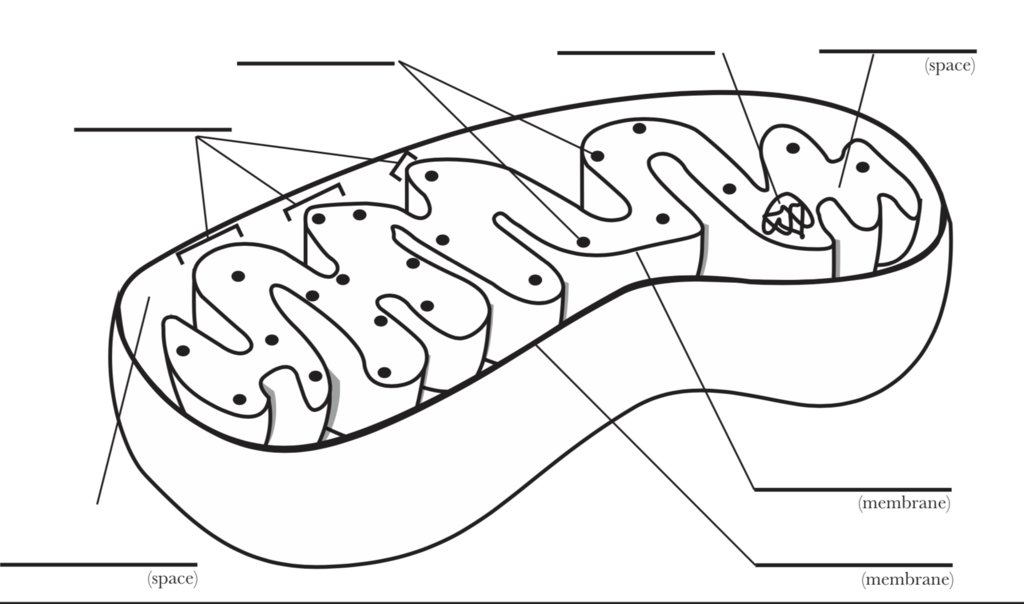
The inner membrane has many folds called cristae. The inner membrane is the location of the ETC. Why are the many folds important for the ETC?
The more folds the membrane has the more surface area there is for enzymes and molecules to associate with the ETC (more ezymes=more ATP)
Why does the outer membrane have many trasnport proteins?
so that it can easily move pyruvate and NADH into the mitochondria. This is for the glycolysis step.
Why is the small inter membrane space important?
It allows for chemiosmosis because it is easier to build up the concentration gradient required of H+ to make ATP in a smaller space.
Which steps occur inside the matrix?
link reaction, Krebs cycle, and oxidative phosphorylation.
fill out the structures of the mitochondria