Plant terminology
 Call Kai
 Learn
Learn Practice Test
 Spaced Repetition
 Match
Match Flashcards
 Knowt Play
1/70

There's no tags or description
Looks like no tags are added yet.
Name | Mastery | Learn | Test | Matching | Spaced | Call with Kai |
|---|
No analytics yet
Send a link to your students to track their progress
71 Terms
Carl Linnaeus
Father of botany
Developed binomial system
Family suffix
-aceae
tribe suffix
-eae
Native plant
Historically occurs in a region without human involvement
Introduced plant
brought to a region through human involvement
Invasiveness depends on
harm to environment, economic or human health
Why does introduced not mean invasive
Not all introduced species cause issues in the environment or negatively affect human health or economics
Why does lacking vascular tissue constrain plant size or habitat?
Plant has less structure so it can only get nutrients and water with osmosis. Amount of intake is severely limited. With vascular tissue, it can control the flow of nutrients
Non vascular plants are restricted to moist environments because they can’t take up water and push it into extremities
Xylem
transports water and minerals UP
Phloem
transports water & minerals UP and DOWN
Vascular plants
Vascular tissue
Larger
true roots, stems, leaves
moves water up and down
Seeds and spores
Nonvascular plants
no vascular tissue
smaller, lower to ground
no true roots, stems or leaves
moves water/nutrients thru osmosis
just has spores
Gymnosperms
No flowers or fruits
gymno - naked
appeared 200 mya
Angiosperms
Have flowers and fruit
Most diverse group of plants
Monocot
One cotyledon
Fibrous roots
parallel veins
leaves in 3
always herbaceous
Vascular bundle is scattered
Pith and cortex not clearly separated
No vascular cambium = no secondary growth
Dicots
2 cotyledons
taproot
netted veins
leaves in 5
woody or herbaceous
Vascular bundle in a circle
Distinct pith in center & cortex on outside
Vascular cambium present = secondary growth
Agrostology
branch of botany focused on grasses (Family Poaceae)
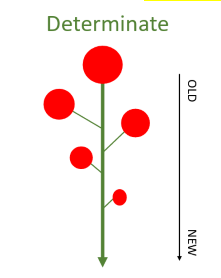
Determinate growth
Oldest tissue at tip, youngest toward the base
Growth stops when the apical meristem differentiates into flower or inflorescence
Simple cyme
Compound cyme
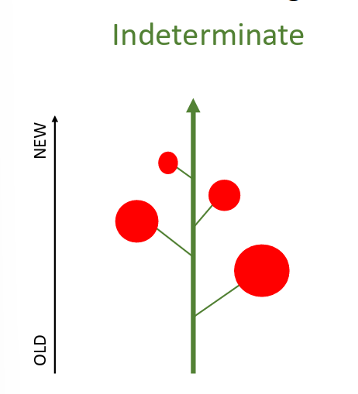
Indeterminate growth
Youngest tissues at the apex, oldest toward base
Apical meristem remains active and continues to elongate
Raceme
Simple umbel
corymb
spike
panicle
head
culm
Hollow or pithy stalk or stem
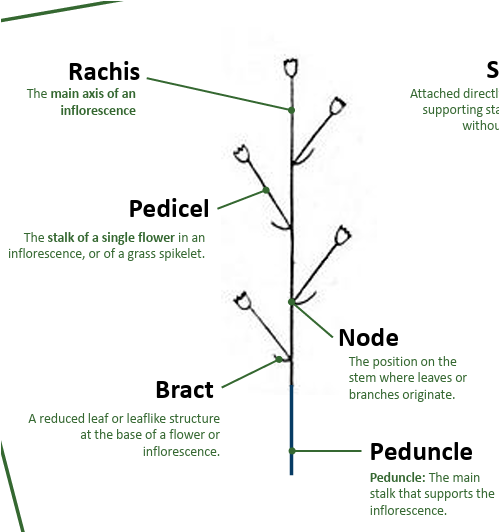
Peduncle
main stalk that supports inflorescence
Inflorescence
arrangement of flowers on floral axis
Rachis
main axis of inflorescence
Pedicel
stalk of single flower in inflorescence
Sessile
something attached directly without a supporting stalk
leaf without a petiole
Spikelet without a pedicel
Spikelet
Made of a glumes and florets (lemma & palea)
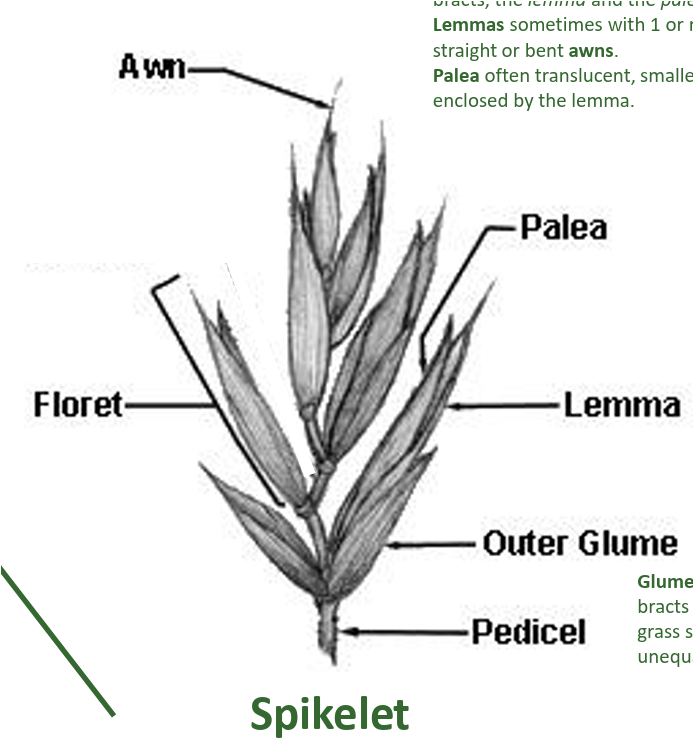
Glume
pair of bracts at base of grass spikelet. Can be equal/unequal in size
Floret
1 to many per spikelet. Made of 2 bracts: lemma & palea
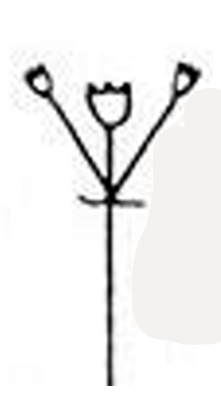
Simple cyme
Determinate inflorescence
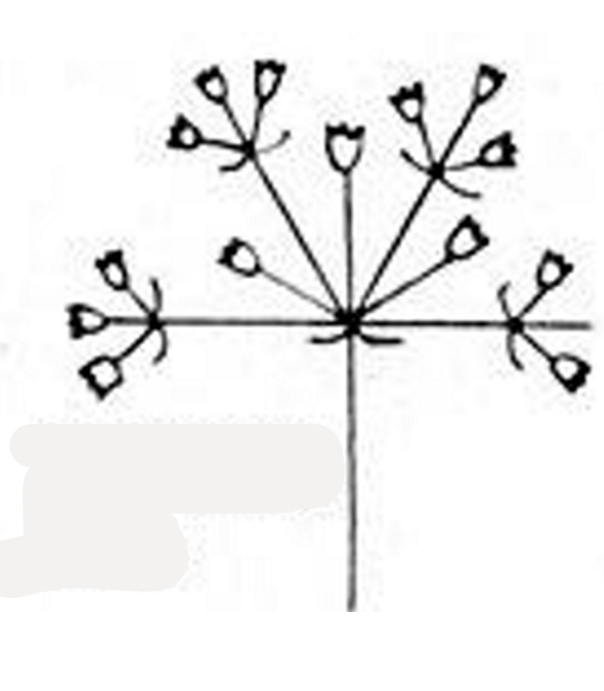
Compound cyme
Determinate inflorescence
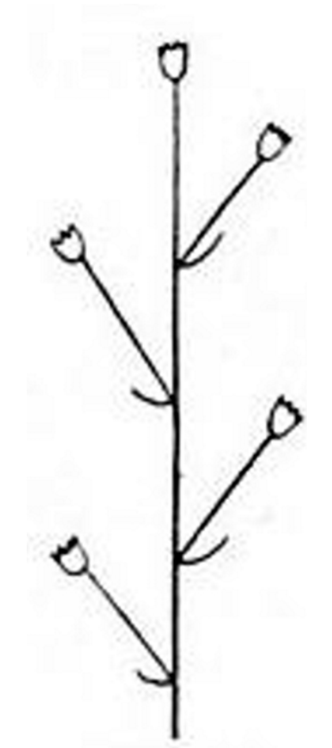
unbranched, elongated inflorescence with pedicellate flowers
Raceme
indeterminate inflorescence
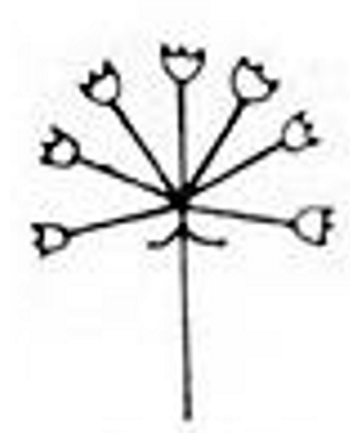
No rachis, pedicle come from single point
Simple umbel
indeterminate inflorescence
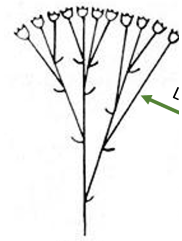
lengthened pedicel
Corymb
indeterminate inflorescence
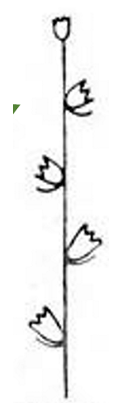
lacking pedicel
Spike
indeterminate inflorescence
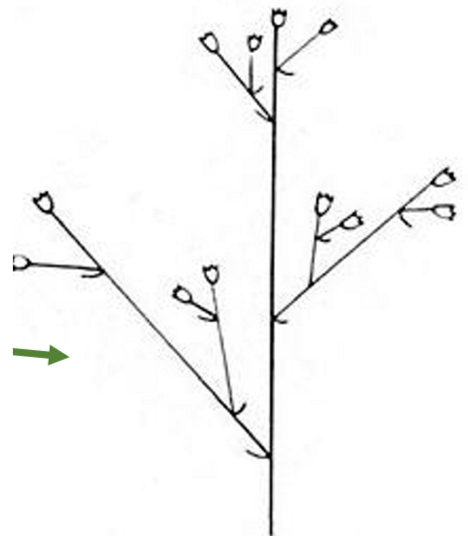
branched
Panicle
indeterminate inflorescece
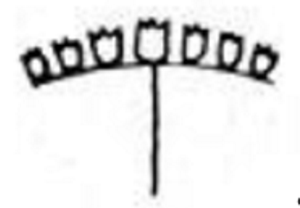
Dense cluster of sessile/subsessile flowers
Head
Indeterminate inflorescence
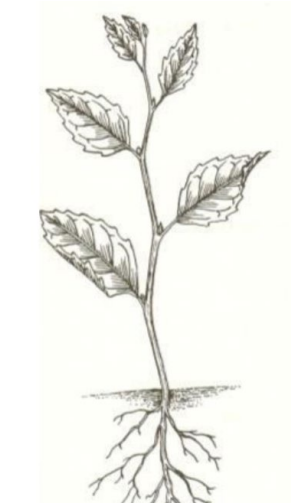
Caulescent
above-ground stem with leaves
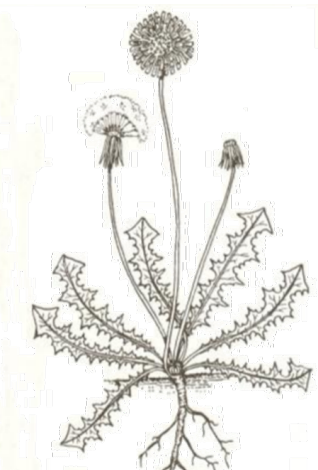
Acaulescent
short stem with leaves close to the ground/basal leaves
Thorns
Modified stem. Comes from leaf axil
Spines
Modified leaves. Axillary bud at base
Prickles
Modified hair. Grows from epidermal tissue
Petiole
stalk joining leaf and stem
Simple leaf
Single leaf blade
Axillary bud at leaf-stem junction
Compound leaf
Multiple leaflets attached to petiole
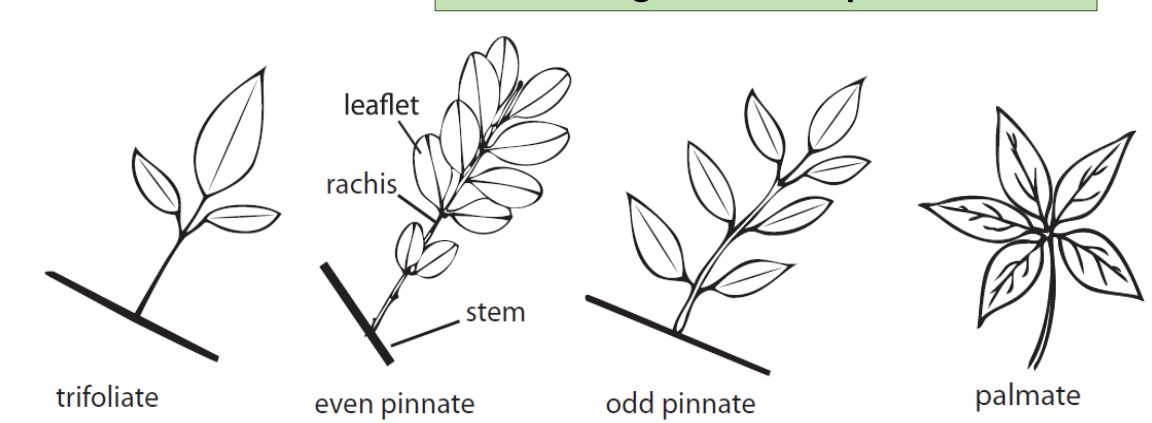
Compound leaf types
Trifoliate: 3 leaflets
Even pinnate: no terminal leaflet
Odd pinnate: terminal leaflet
Palmate: leaflets from single point
Leaf arrangements
Alternate
Opposite
Whorled
Leaf venation
Pinnate: single main vein from base to tip (dicots)
Palmate: several main veins radiate from single point on leaf base
Parallel: veins run parallel to each other (monocots)
Leaf margins
Entire
Dentate: indents perpendicular to margin
Serrate: teeth point up
Revolute: leaf margin curls inward
pinnately lobed
Palmately lobed
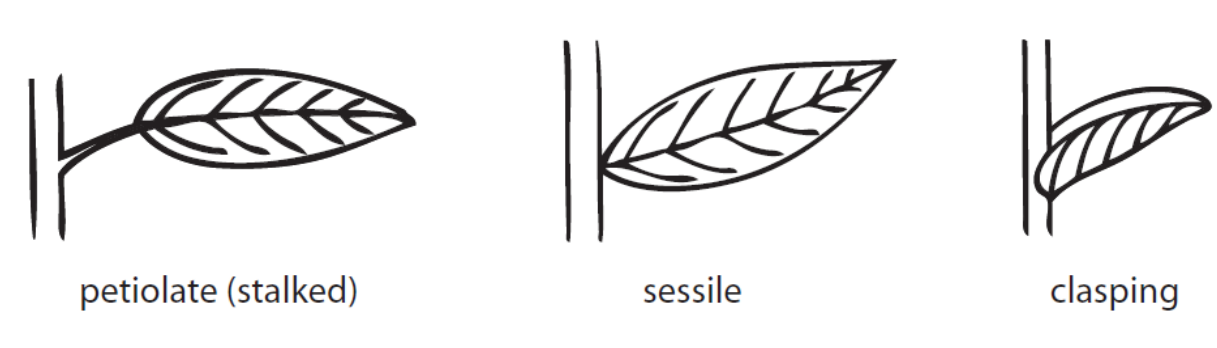
Leaf attachment
Petiolate: stalk/petiole
Sessile: no petiole
Clasping: leaf grabs stem
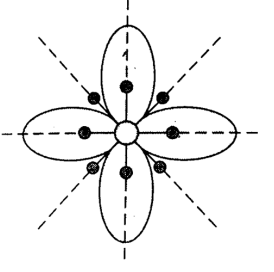
Id floral symmetry?
Actinomorphic (radial)
2 or more planes of symmetry
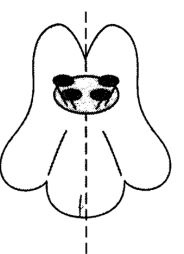
Id floral symmetry?
zygomorphic (bilateral)
1 plane of symmetry
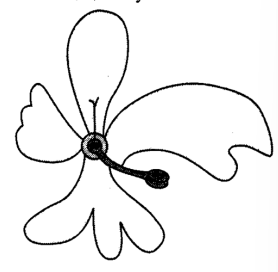
Id floral symmetry?
Asymmetrical
no plane of symmetry
The petals and sepals together makes the
Perianth
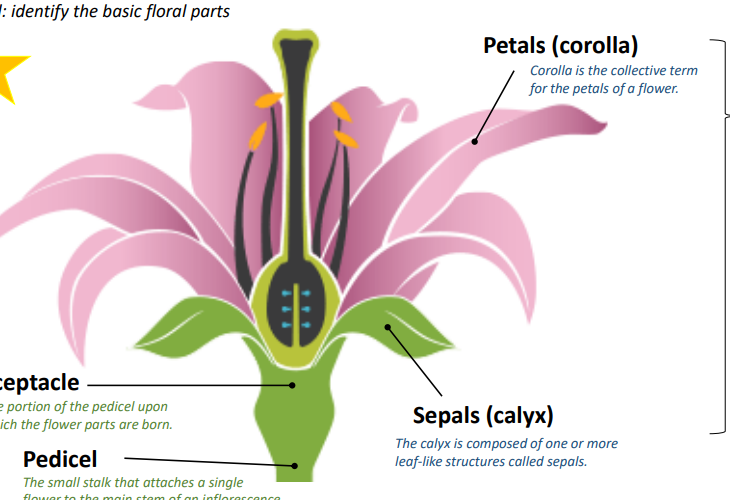
When the perianth is undifferentiated between petals and sepals is is
Tepals
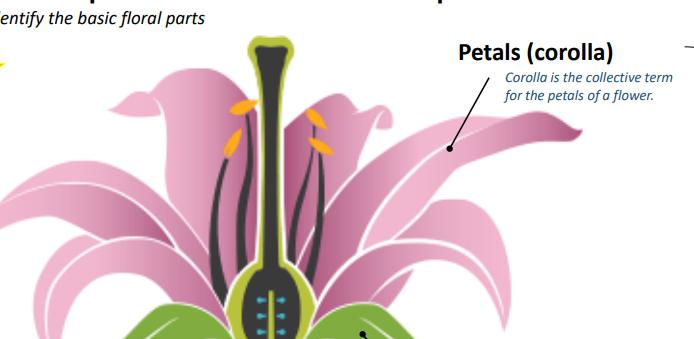
group of petals
Corolla
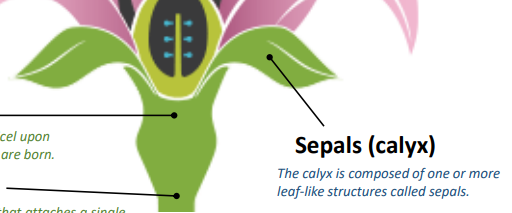
Group of sepals
Calyx
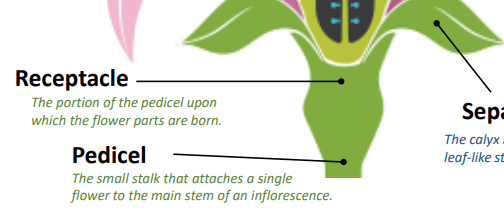
Portion of pedicel upon which flower parts are born
Receptacle
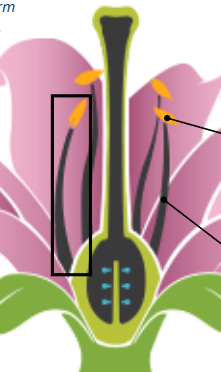
Collective term for all male parts
Androecium
stamen
(anther & filament)
Female part of a flower
Pistil/carpel
a pistil may consist of one or more carpels
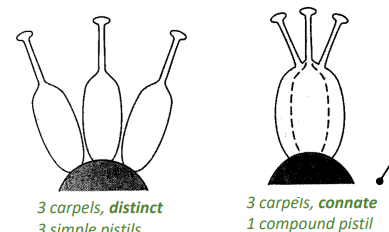
Collective term for all pistils (carpels) parts
Gynoecium
stigma
style
ovary: part of pistil where ovules develop into seeds after fertilization
ovule: fertilized ovule develops into a seed
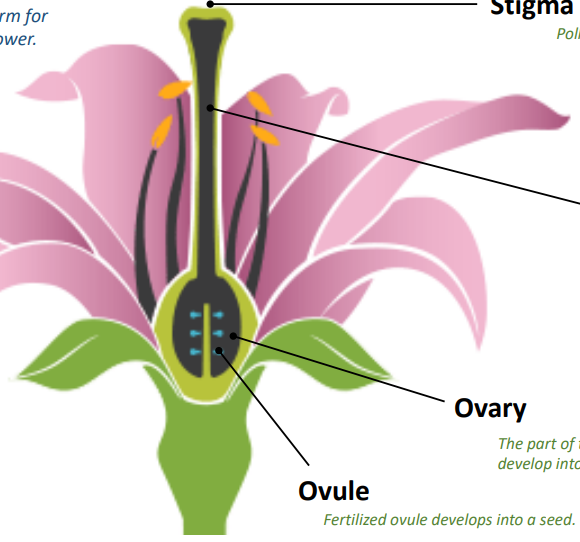
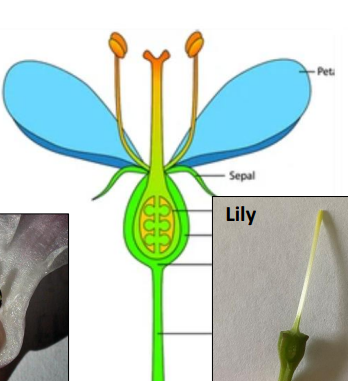
Ovary attached above point of attachment of the other floral whorls
Superior ovary (Hypogynous)
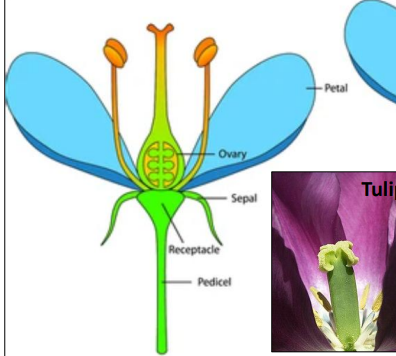
Ovary is attached beneath the point of attachment of other floral whorls
Inferior ovary (Epigynous)
the arrangement of ovules within a flower’s ovary
Placentation
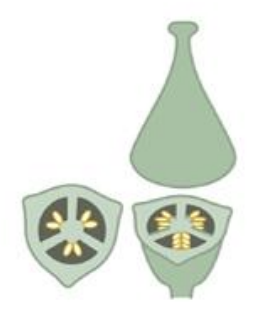
Type of placentation?
Axile
# of locules = # of carpels
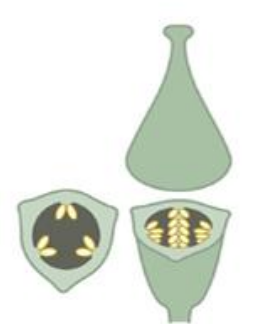
Type of placentation?
Parietal
# of locules = # of carpels
Floral formula order
Symmetry, Sepals, Petals, Stamens, Carpels
EX: *KCAG
ovary wall differentiates into 3 parts
exocarp
mesocarp
endocarp
Simple fruit
develop from single ovary of a single flower
EX: peaches, tomatoes, acorns
Aggregate fruit
Develop from multiple ovaries within a single flower
EX: blackberries, raspberries
Multiple fruits
develop from many flowers in an inflorescence that fuse together
ex: pineapples and figs
Accessory fruits
include non-ovarian tissue in structure
fleshy portion includes hypanthium or receptacle
EX: apples and strawberries