Conceptual Art - 7.3
 Call Kai
 Learn
Learn Practice Test
 Spaced Repetition
 Match
Match Flashcards
 Knowt Play
1/21

There's no tags or description
Looks like no tags are added yet.
Name | Mastery | Learn | Test | Matching | Spaced | Call with Kai |
|---|
No analytics yet
Send a link to your students to track their progress
22 Terms
Relationship between Minimalism and Conceptual Art
Conceptualism is understood as developing directly from Minimalism, inheriting its focus on the viewer's active interaction with the work while moving from physical objects to mental concepts
What is "Dematerialization"?
A term coined by Lucy Lippard and John Chandler in 1968 to describe a trend where the thinking process is emphasized so exclusively that the physical art object may become "obsolete"
Argument for dematerialisation in art
It may counter the commodification of art, breaking away from the idea of the artistic ‘genius’
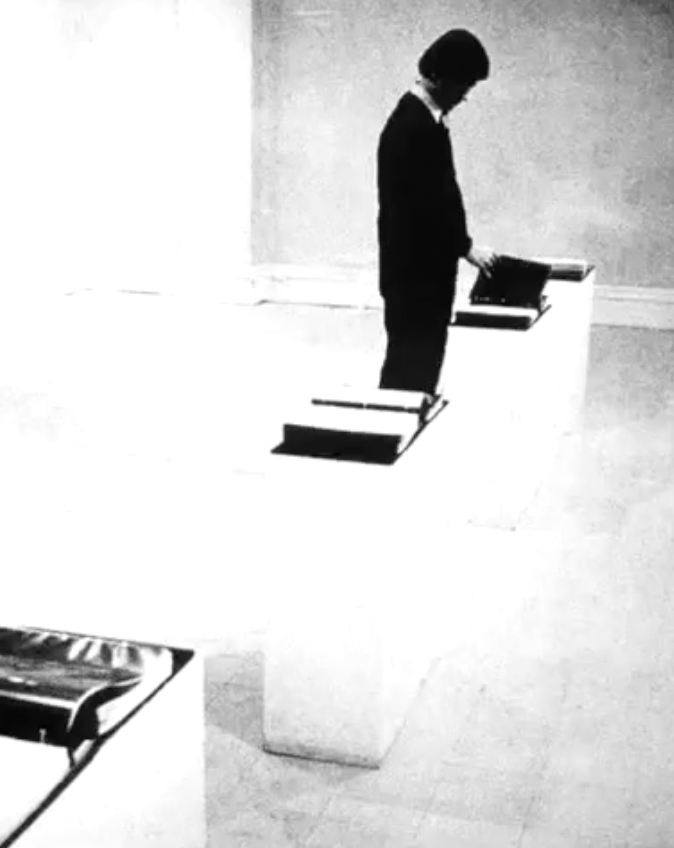
The signature "Conceptual Look" in Mel Bochner and Douglas Huebler
Rather than traditional galleries, it often has the aesthetic of an office or publisher's lobby, featuring typed texts, photocopies, maps, and ring binders
Who are the 4 key conceptual artists?
Joseph Kosuth, Lawrence Weiner, Douglas Huebler, Robert Barry
Sol LeWitt's core philosophy
Coined the term conceptual art in 1967 Paragraphs on Conceptual Art. The aim is to make work that engages the mind, not the viewer’s emotion, objective work that avoids physicality.
Goal of Institutional Critique
A strand of conceptualism that uses art to criticize the gallery system, museum boards, and the wider political/economic structures that support them
Anti-Commercialism in Conceptual Art
Many artists avoided making permanent objects to resist "economic materialism" and commodification, hoping art could be "free" and "accessible to everyone"
Role of the Grid and Seriality
Like Minimalism, Conceptualism used repetition and grids to avoid "subjectivity" and the visible "touch" of the artist, focusing instead on logic and systems
Lawrence Weiner’s 1969 Statement
A foundational concept stating that a work of art "need not be built"—it can exist as a set of instructions or simply as an idea in the viewer's head
Mel Bochner, Working Drawings
1966 An early exhibition of photocopied studio scraps (like Donald Judd’s hardware store receipt) displayed in ring binders, establishing the movement’s "office" aesthetic
Robert Barry, Inert Gas Series
1969 The artist released invisible argon gas into the atmosphere, exemplifies radical equality of artist and viewer.
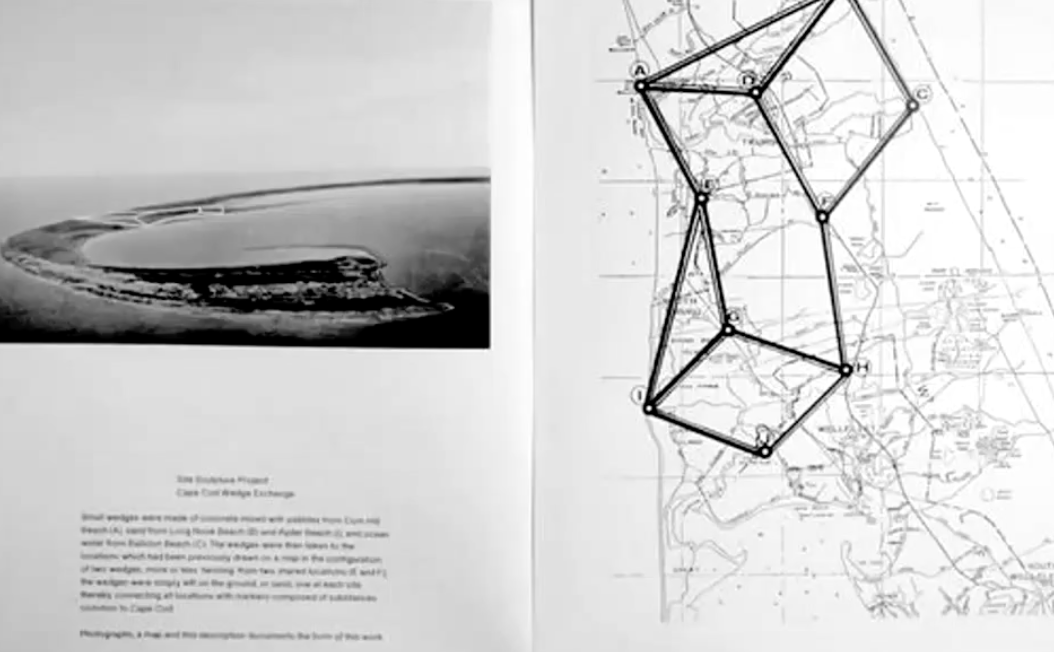
Douglas Huebler, Site Sculpture Project
1968, map with a drawing, photograph and text. Dug up sand at certain points and reburied at others. The drawing shows connections between these points. Multi-positional aspect, connecting viewer with work with world.
Douglas Huebler, Duration Piece #5, 1969
A series of photographs taken in Central Park whenever a bird sang
Douglas Huebler, Location Piece #13, 1969
Documentation of the artist burying containers of spring water in the desert
Dan Graham, Homes for America, 1965–70
Originally a magazine piece, it used minimalist-style photographs of New Jersey housing developments to show that "neutral" formal structures relate to real social situations
Hans Haacke, Condensation Cube, 1963–65
A Perspex box of water that cycles through condensation
Hans Haacke, Shapolsky et al
1971 A work of "Institutional Critique" documenting the slum holdings of a New York landlord clan
Hans Haacke, MoMA Poll, 1970
An installation of ballot boxes where museum visitors voted on Governor Rockefeller’s stance on the Indochina policy, directly involving the viewer in a political statement
Charles Gaines, Faces, Set #4, 1978
A series of photographs and graph-paper drawings that use systems of marks to probe how human identity is constructed through social signs
Charles Gaines, Numbers and Faces: Multi-Racial/Ethnic Combinations, 2020
Layered contour maps of different faces that explore how racial categories are created to gain or maintain political power
Hanna Darboven, 2 Blatt 1-2, 1971
Pencil and marker on graph paper using serial systems of marks that appear orderly but remain private and uncommunicative, inviting subjective interpretation