BIME410 Final (Ear and Hearing)
 Call Kai
 Learn
Learn Practice Test
 Spaced Repetition
 Match
Match Flashcards
 Knowt Play
1/35

There's no tags or description
Looks like no tags are added yet.
Name | Mastery | Learn | Test | Matching | Spaced | Call with Kai |
|---|
No analytics yet
Send a link to your students to track their progress
36 Terms
Auditory Perception
mechanosensation that enables us to perceive sounds
Detect time dependent changes in the pressure (vibrations) of our surrounding medium
Ear
the organ where sound is transduced into nerve impulses that are perceived by the brain
Outer ear
starts with flesh visible pinna, then the ear canal (auditory canal) and ends at the ear drum (tympanic membrane)
Pinna
serves to focus sound waves through the ear canal toward the eardrum
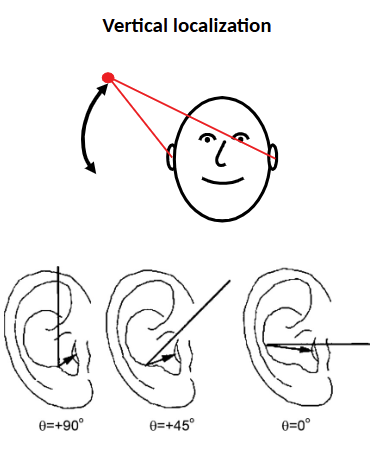
Asymmetrical shape of the outer ear filters sounds into the ear (modifies after reflection) differently depending vertical direction
Tympanic Membrane
A thin membranous sheet of tissue that seals the ear canal at its internal end and separates the outer ear from the middle ear.
Middle ear
Includes air-filled cavity with three small bones (ossicles) and the opening to the mouth (Eustachian tube)
Contains bones that transfer the vibrations of the eardrum into waves in inner ear fluid
Eustachian Tube
Normally collapsed to seal off the middle ear, but opens transiently to allow middle ear pressure to equilibrate with atmospheric pressure during mouth functions (chewing, swallowing, and yawning)
Malleus
One end of this middle ear bone is attached to the tympanic membrane
Known as a hammer bone
Stapes
Stirrup end of the stapes is attached to the thin membrane that separates the middle ear from the inner ear
Inner ear
Complex cavity (membranous labyrinth encased in the bony labyrinth) where mechanoreceptors are responsible for converting vibrations into AP impulses
Vestibular Apparatus (with semicircular canals)
the sensory organ in the temporal bone that provides the sense of balance and spatial orientation for coordinating movement with balance
canals independently sense rotations
Cochlea
contains sensory receptors for hearing
Is a membranous tube that lies coiled within a bony cavity
Oval Window
2 membranous disks to which the stapes is attached
separate the liquid-filled cochlea from the air-filled middle ear
Round window
separates the liquid-filled cochlea from the air-filled middle ear
Scala vestibuli
separates from the Scala media (middle section) by a thin vestibular (Reissner’s) membrane
Scala Media
separates from Scala tympani (lower section) by the basilar membrane, containing the organ of Corti
Organ of Corti
Houses mechanosensitive hair cells responsible for generating nerve impulses
Sound
The combination of one or more compressional waves in a deformable medium
Pressure fluctuations from a reference pressure oscillate between higher and lower pressures to move sound through the medium
Amplitude
for the sinusoidal pressure function, equal to the maximum change in pressure, pmax, from the reference pressure
Wavelength
Spatial periodicity (fixed time)
Period
Equal to the inverse of the frequency (fixed position)
Sound localization
the process of determining the location of a sound source
Pinna filtering effect
gives us the ability to localize sound vertically
Horizontal Sound Localization
Signaled in one of three ways:
Difference in arrival times between the ears
Relative amplitude of high-frequency sounds (shadow effect)
asymmetrical spectral reflections from various body parts
Interaural Time Difference (ITD)
Sound from the right side reaches the right ear earlier than the left
Tympanic cavity
Hollow space of middle ear
Tympanic Bone
part of the temporal bone, surrounds the tympanic cavity has an even higher impedance than the cochlea fluid
Resonance
a phenomenon in which an acoustic system amplifies or produce sound waves whose frequency matches one of its own natural (resonant) frequencies of vibration determined by its size, shape, and composition
Organ of Corti
the receptor organ that generates nerve impulses in response to vibration of the membrane
Frequency of sounds
determined by the activation of the hair cells, and thus cochlear nerves, from a particular location in the cochlea
Intensity of sounds
Determined by:
amplitude of vibration of inner hair sounds in response to different intensities
Recruitment of a higher number of inner hair and nerve cells in basilar membrane (spatial summation)
Hair cell and nerve cells at fringes of basilar membrane often recruited only at higher amplitudes
Prestin
a motor protein located in the plasma membrane of cochlear outer hair cells (OHCs) which drive electromotility, rapid length changes in response to depolarization (shorten) and repolarization (lengthen)
Subjective Tinnitus
the most frequent type of tinnitus
Objective Tinnitus
Rarer form of tinnitus that creates pulsating/clicking/buzzing sounds generated by internal body mechanisms.
Utricle and Saccule
sense translations of the head