A&P Last Exam not including crainial nerves (Ch 11-13)

0.0(0)
Studied by 0 people
call kaiCall Kai
learnLearn
examPractice Test
spaced repetitionSpaced Repetition
heart puzzleMatch
flashcardsFlashcards
GameKnowt Play
Card Sorting

1/145

flashcard set

Earn XP

Description and Tags

Ch11-13 rn - numbers indicate which prompt it lines up to in the SG

Last updated 1:55 PM on 5/6/26
Name
Mastery
Learn
Test
Matching
Spaced
Call with Kai

No analytics yet

Send a link to your students to track their progress

146 Terms

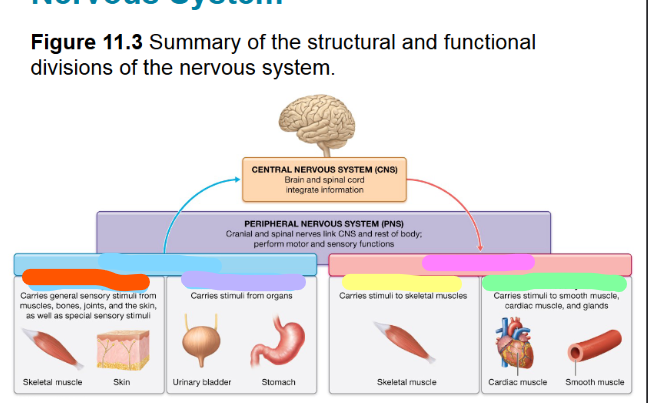
1
New cards

 sympathetic nervous system or Thoracolumbar division

fight or flight system,

2
New cards
3
New cards

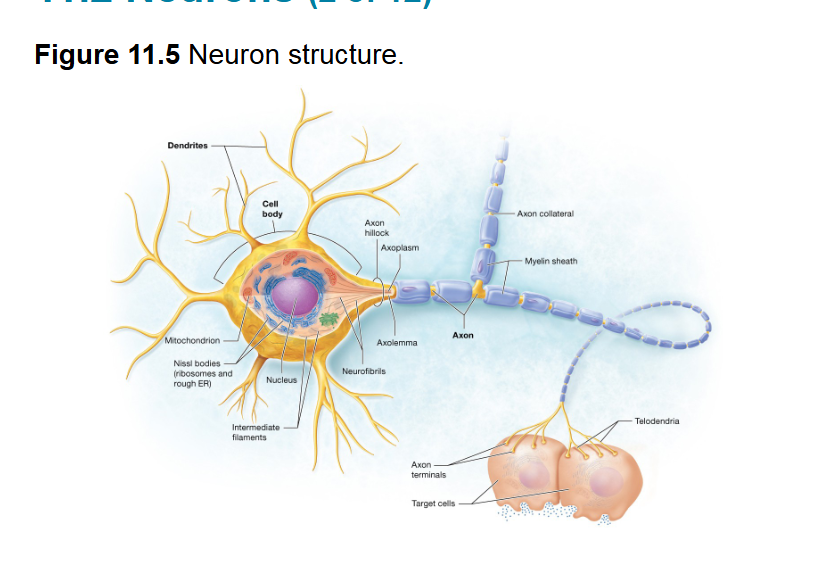
parasympathetic nervous system - Craniosacral division

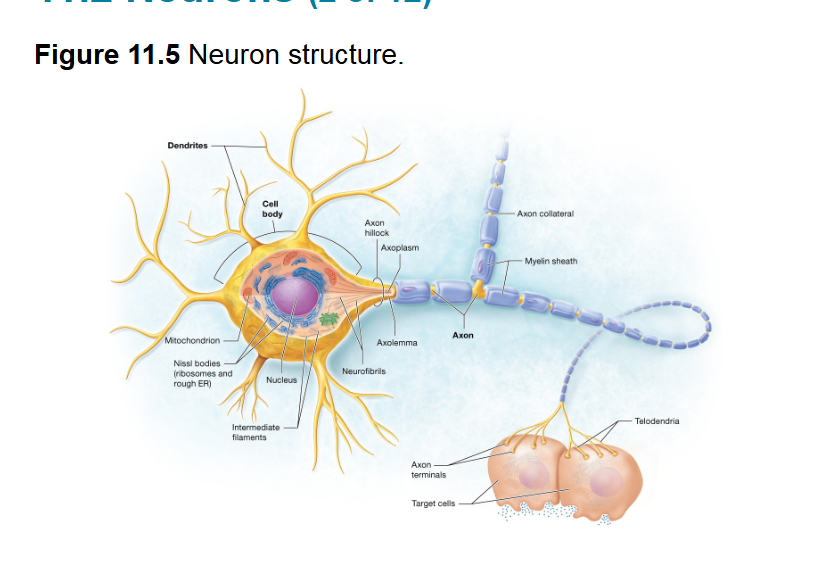
rest and Digest system,

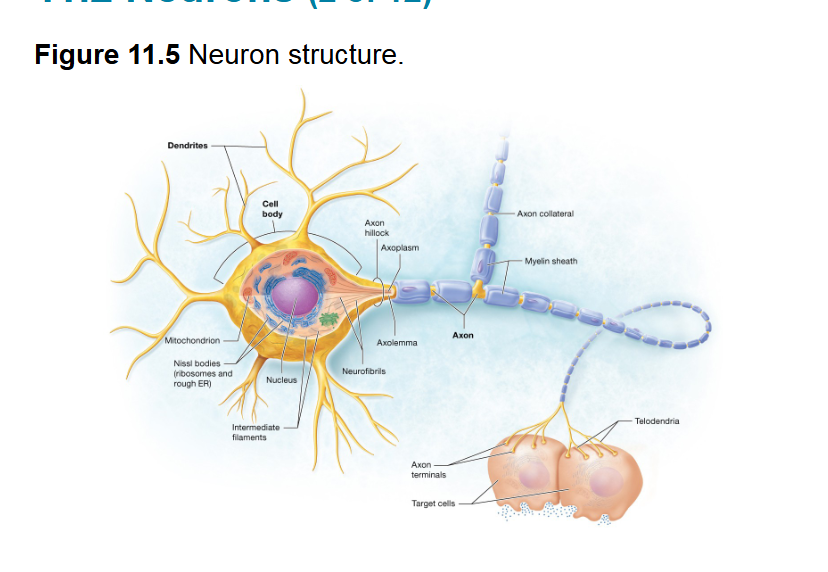
4
New cards

peripheral nerves

Many axons bound together innervate most structures of the body,  mixed nerves

5
New cards

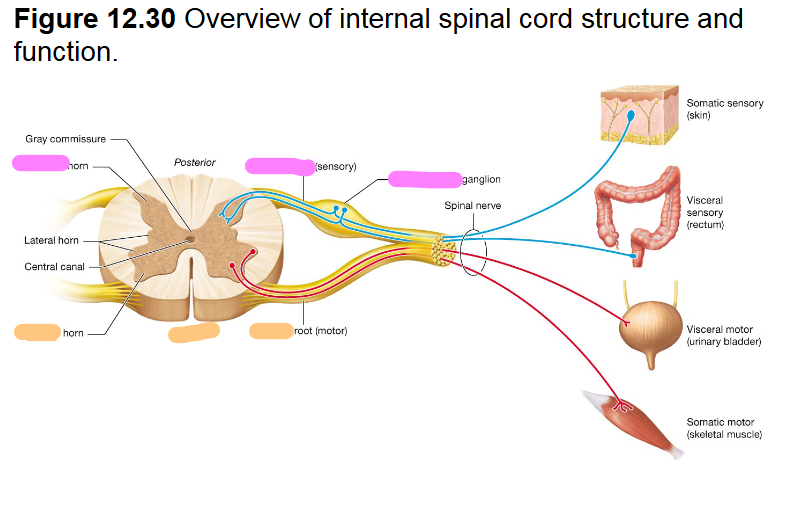
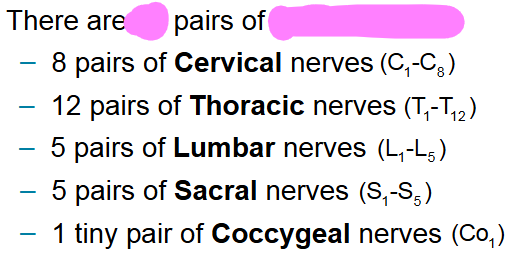
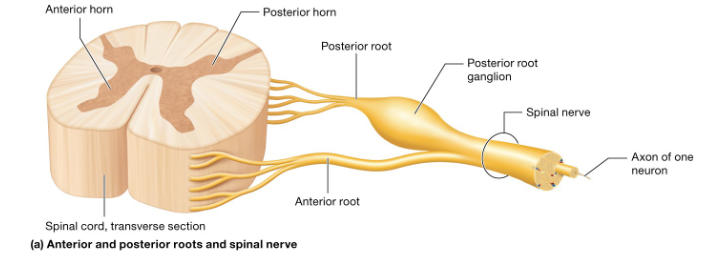
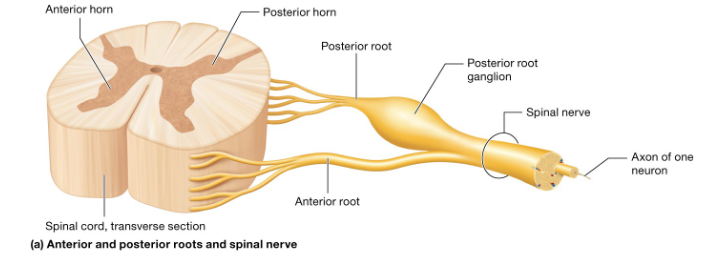
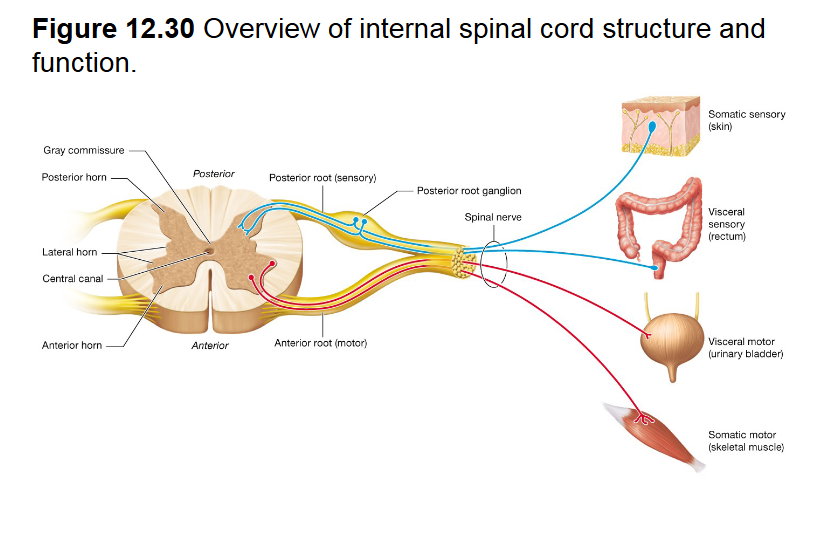
14 spinal nerves -

31 pairs, Branch from the spinal cord Axons are housed within posterior and anterior root
<p></p>
6
New cards

anterior root

side of the spinal cord, houses axons of motor neurons
<p><span style="background-color: transparent; font-family: &quot;Times New Roman&quot;, serif;">side of the spinal cord, houses axons of motor neurons</span></p>
7
New cards

posterior root

side of the spinal cord, houses axons of sensory neurons
<p><span style="background-color: transparent; font-family: &quot;Times New Roman&quot;, serif;">side of the spinal cord, houses axons of sensory neurons</span></p>
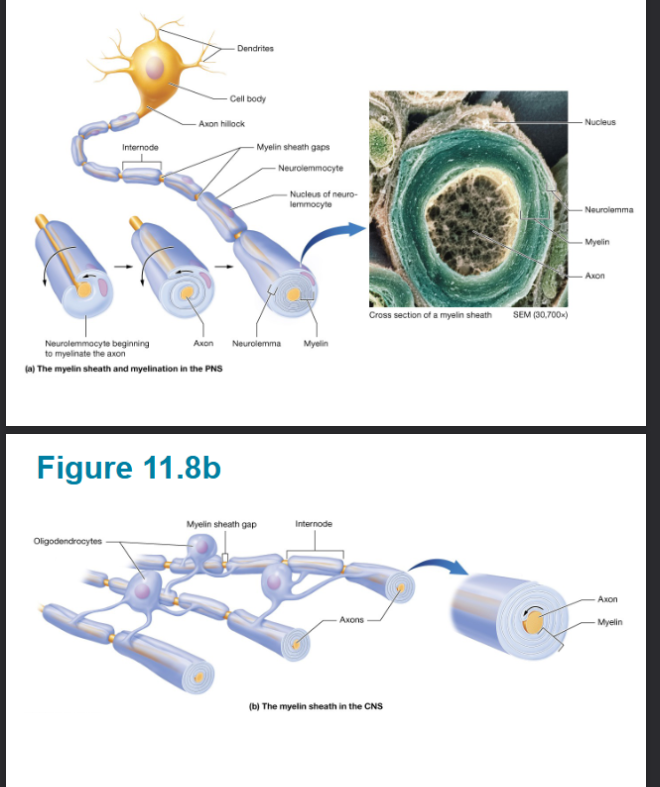
8
New cards

cranial nerves

There are 12 that we are concerned with, they attached to the brain and innervate the structures of the head and neck

9
New cards

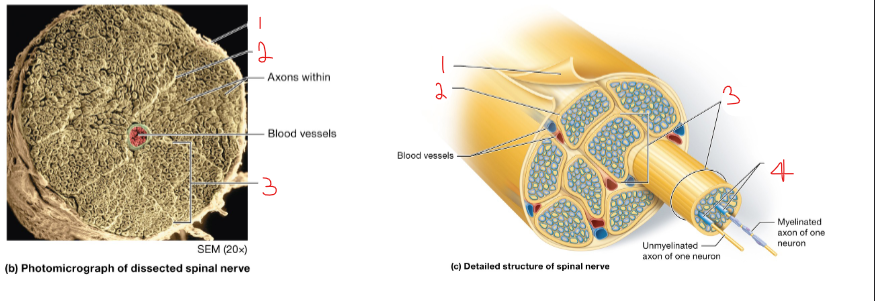
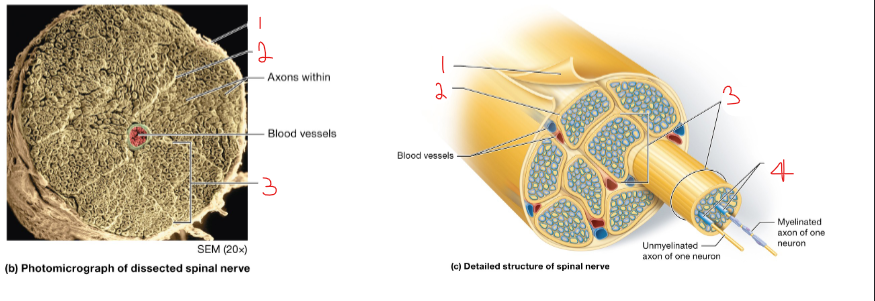
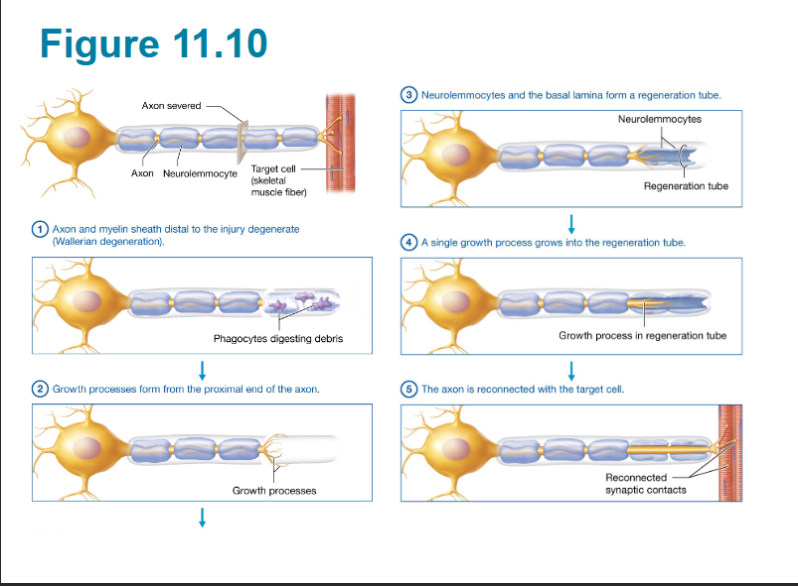
Epineurium

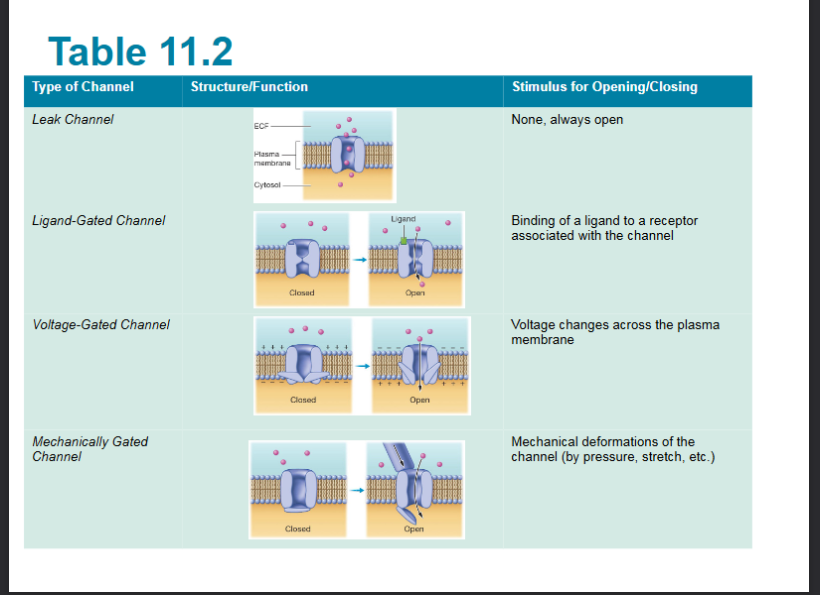
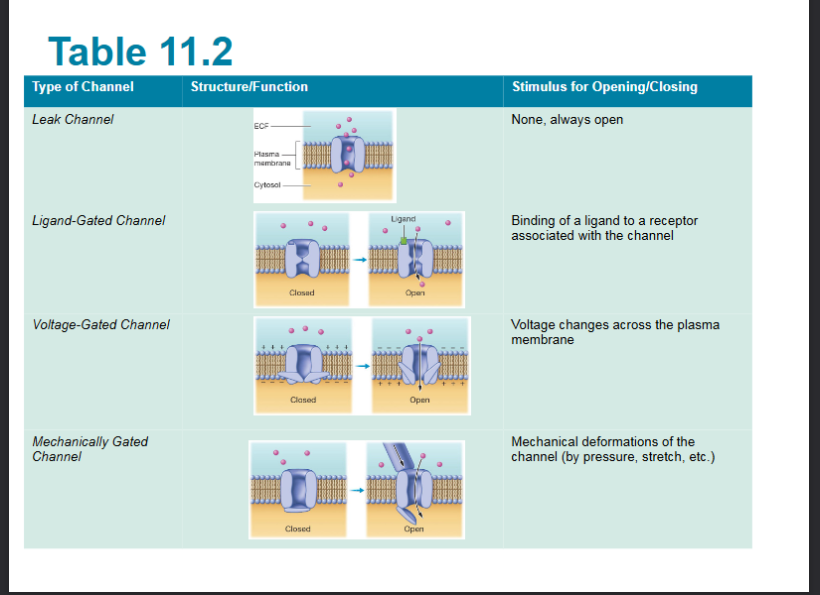
1- Sheath surrounding each spinal nerve
<p><span style="background-color: transparent; font-family: &quot;Times New Roman&quot;, serif;">1- Sheath surrounding each spinal nerve</span></p>
10
New cards

Fascicles

3- group of axons surrounded by perineurium
<p><span style="background-color: transparent; font-family: &quot;Times New Roman&quot;, serif;">3- group of axons surrounded by perineurium</span></p>
11
New cards

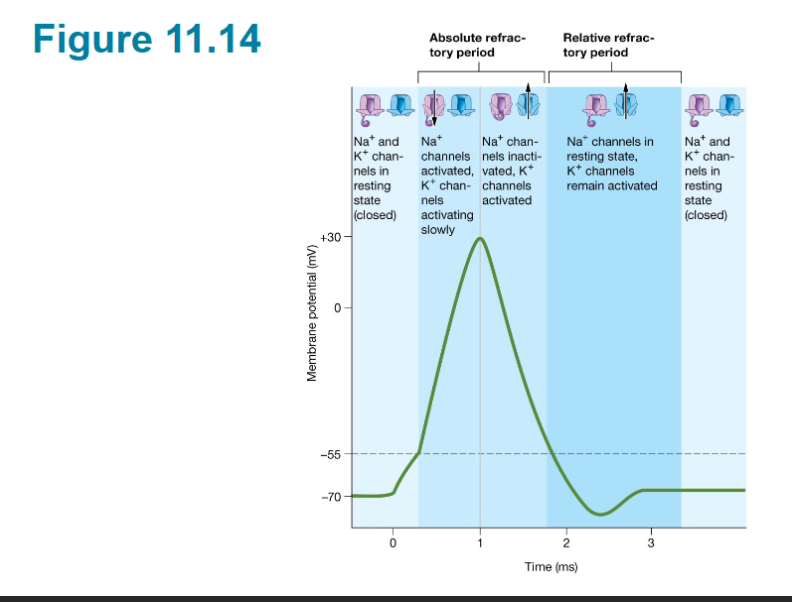
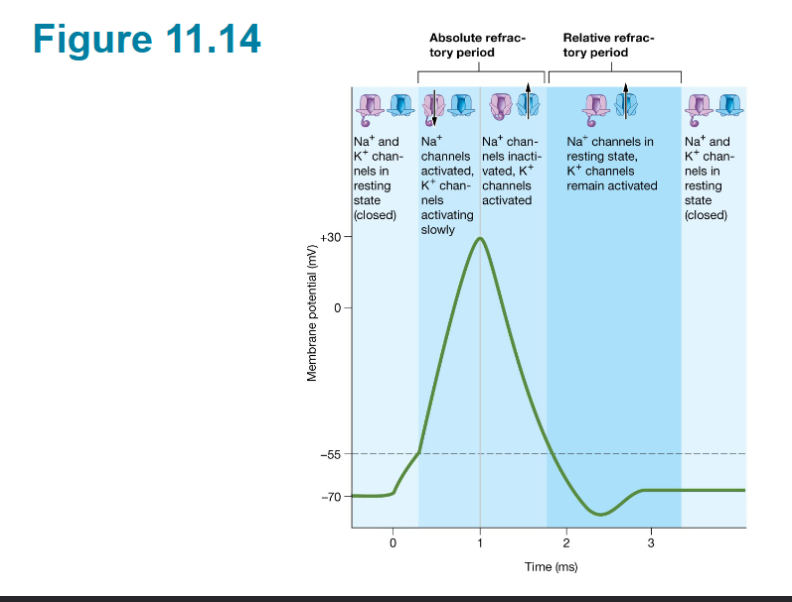
Perineurium

2- sheath that surrounds each fascicle
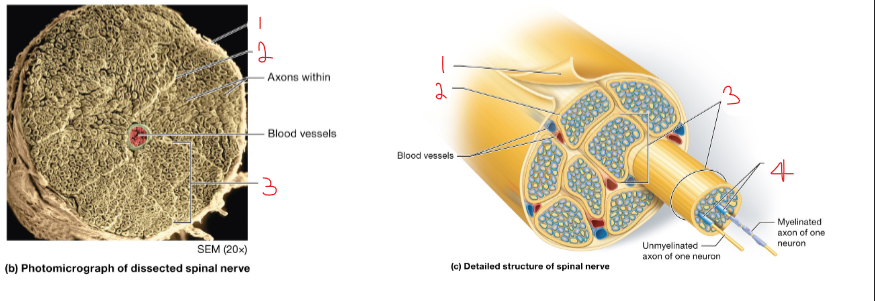
<p><span style="background-color: transparent; font-family: &quot;Times New Roman&quot;, serif;">2- sheath that surrounds each fascicle</span></p>
12
New cards

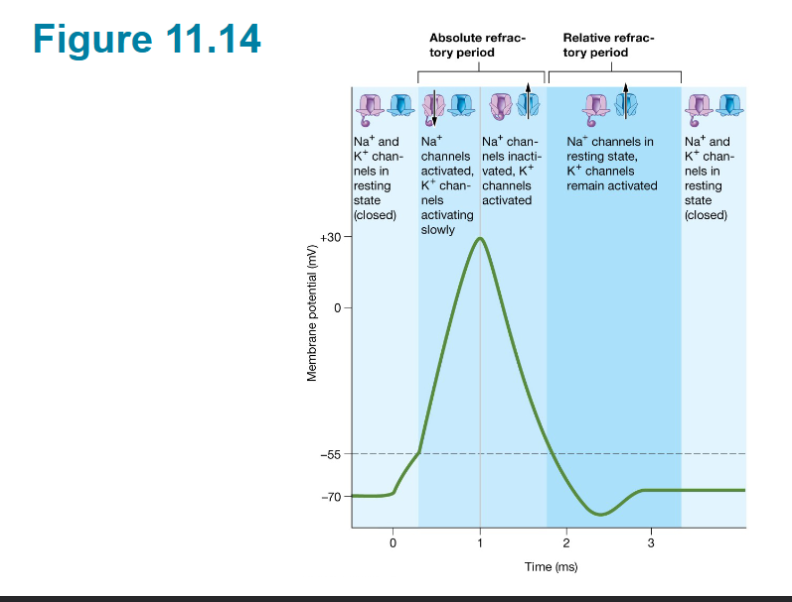
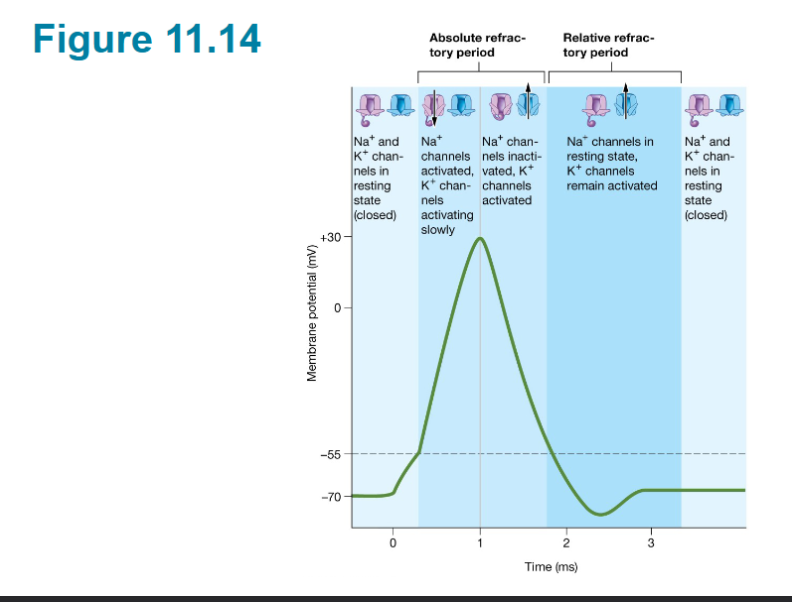
Endoneurium

4-  sheath surrounding each Axon
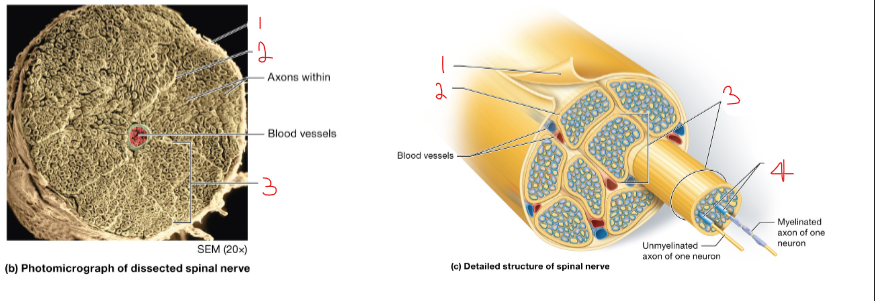
<p><span style="background-color: transparent; font-family: &quot;Times New Roman&quot;, serif;">4- &nbsp;sheath surrounding each Axon</span></p>
13
New cards

anterior (orange) and posterior (pink) ramus - Spinal nerves leaving the vertebral  cavity split into two major nerves the posterior and anterior ramus

  • Posterior Ramus—Travels to posterior side of the body

  • Anterior Ramus—Travels to anterior side of the body and/or
    the upper and lower limbs

pink and orange
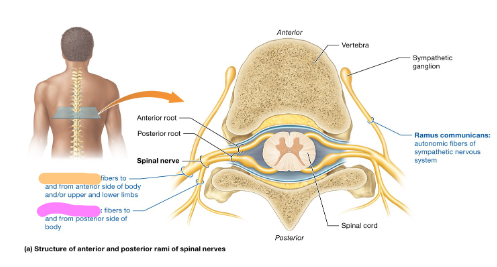
<p>pink and orange</p>
14
New cards

anterior ramus

orange

<p>orange</p>
15
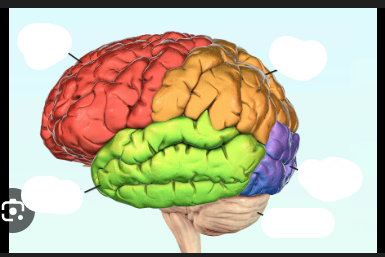
New cards

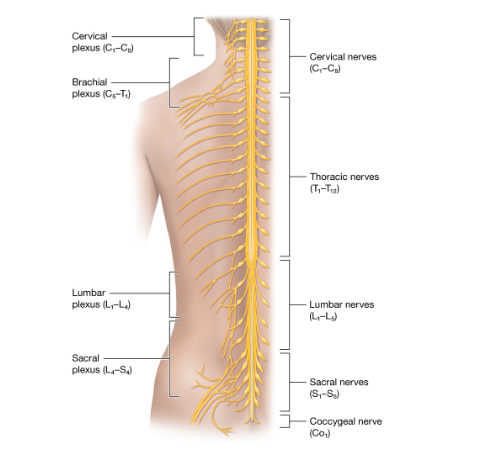
 nerve plexuses

highly branched set of nerves the first exit from the spinal nerve Highway
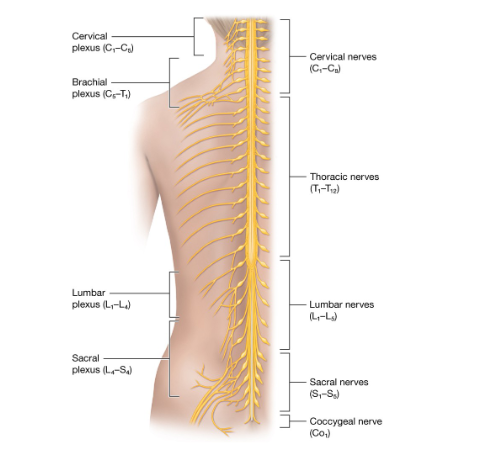
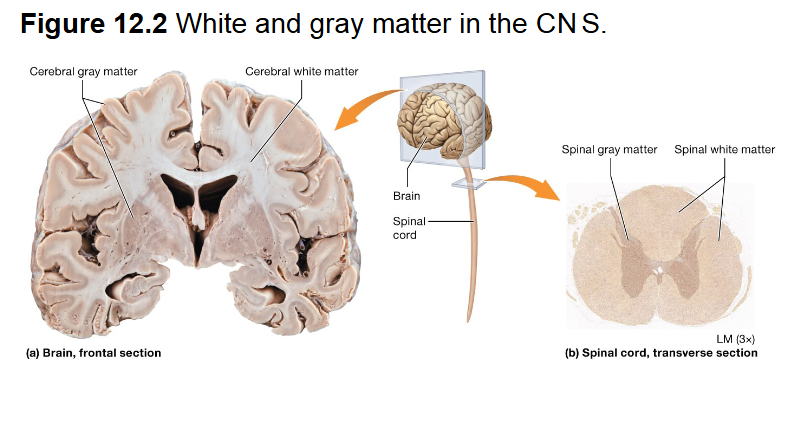
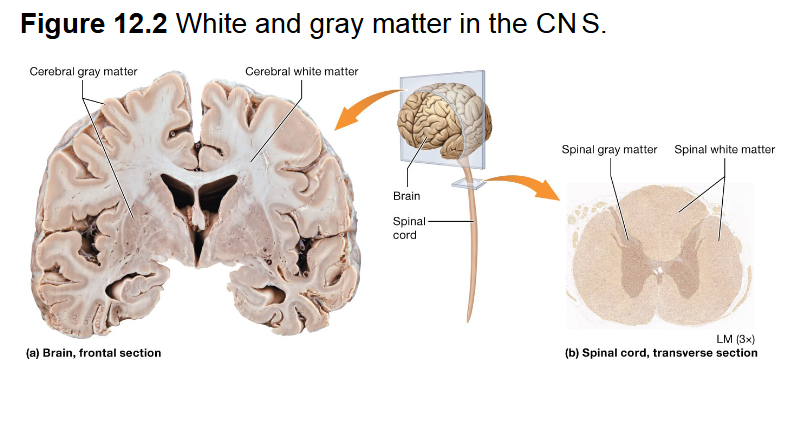
<p><span style="background-color: transparent; font-family: &quot;Times New Roman&quot;, serif;">highly branched set of nerves the first exit from the spinal nerve Highway</span></p>
16
New cards

 cervical plexuses

In the neck area

<p><span style="background-color: transparent; font-family: &quot;Times New Roman&quot;, serif;">In the neck area</span></p>
17
New cards

Brachial plexuses

in the break of region just below the cervical
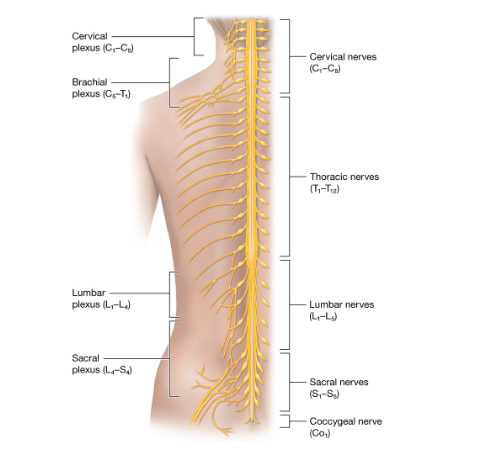
<p><span style="background-color: transparent; font-family: &quot;Times New Roman&quot;, serif;">in the break of region just below the cervical</span></p>
18
New cards

lumbar plexuses

in the lower back area above the sacral
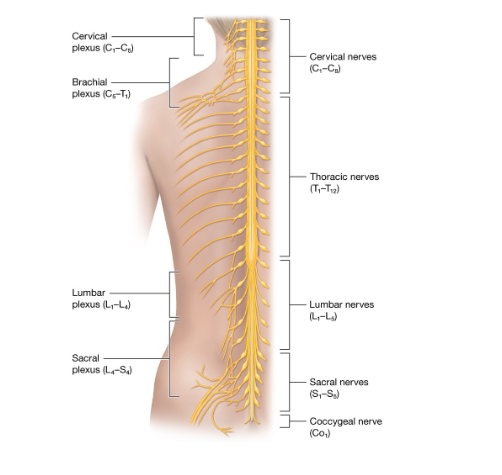
<p><span style="background-color: transparent; font-family: &quot;Times New Roman&quot;, serif;">in the lower back area above the sacral</span></p>
19
New cards

sacral plexuses

lowest back area  just before the end of the spinal nerves
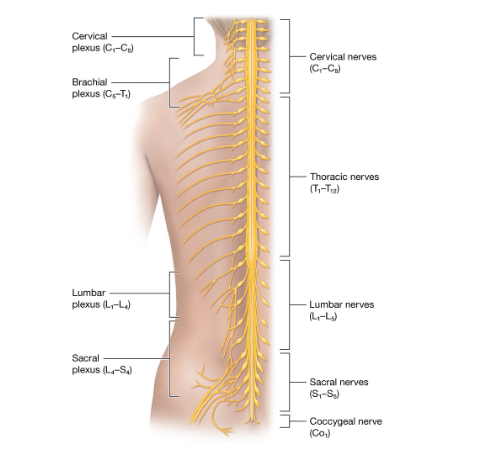
<p><span style="background-color: transparent; font-family: &quot;Times New Roman&quot;, serif;">lowest back area&nbsp; just before the end of the spinal nerves</span></p>
20
New cards

Visceral reflex arcs

 The steps of reactions in the ANS

  1.  sensory signals from  organs are sent by aference Sensory neurons to brain or spinal cord

  2.  stimuli are integrated by CNS

  3.  motor impulses from CNS are sent via efferent motor neurons and cranial and spinal nerves to autonomic ganglia

  4.  autonomic ganglia send impulses via other efferent motor neurons to Target organs where they trigger motor response in Targeted cells

21
New cards

Autonomic ganglia

Connection point between pre and post ganglionic nerves in efferent neurons

22
New cards

Preganglionic neuron

Part of efferent nerve that connects to the CNS before the ganglia,  uses acetylcholine only

23
New cards

Postganglionic neuron

part of nerve which connects to  target cell, uses more than just acetylcholine as a neurotransmitter

24
New cards

Central Nervous System (CNS)

Functions for integrative interpreting sensory info from PNS and tells PNS how to respond

includes brain and spinal cord
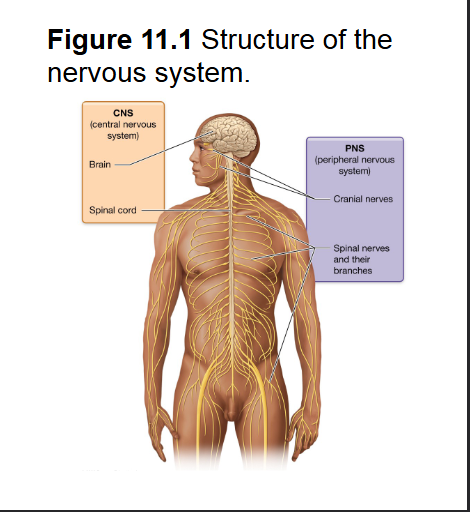
<p><span style="background-color: transparent;">Functions for <em>integrative </em>interpreting sensory info from PNS and tells PNS how to respond</span></p><p><span style="background-color: transparent;">includes brain and spinal cord</span></p>
25
New cards

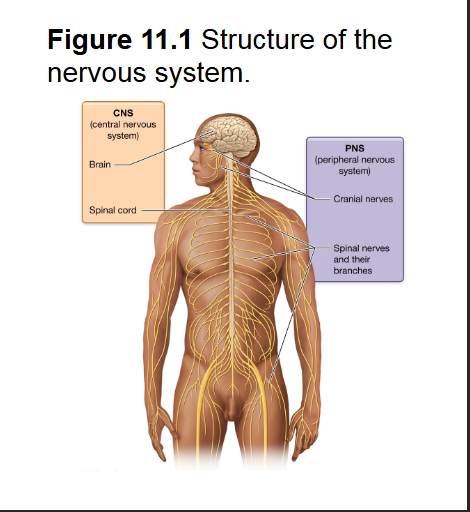
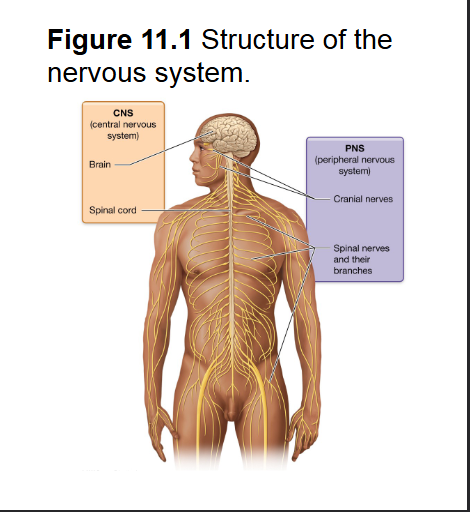
Peripheral Nervous System (PNS)

 functions for sensory input sends to CNS which assess the info and tells PNS how to respond with motor responses

Has cranial nerves - shoot off of brain with 12 pairs

and Spinal nerves branch off of spinal cord 31 pairs
<p><span style="background-color: transparent;"><u>&nbsp;</u>functions for sensory input sends to CNS which assess the info and tells PNS how to respond with motor responses</span></p><p><span style="background-color: transparent;">Has cranial nerves - shoot off of brain with 12 pairs</span></p><p><span style="background-color: transparent;">and Spinal nerves branch off of spinal cord 31 pairs</span></p>
26
New cards

Nerves

 carry signals to and from CNS made of Bundles of long neurons or arms packed with Blood vessels surrounded by CT sheaths 

Also the name for bundles of axons in The PNS 

12 pairs of cranial 

31 pairs of spinal
<p><span style="background-color: transparent;"><u>&nbsp;</u>carry signals to and from CNS made of Bundles of long neurons or arms packed with Blood vessels surrounded by CT sheaths&nbsp;</span></p><p><span style="background-color: transparent;">Also the name for bundles of axons in The PNS&nbsp;</span></p><p><span style="background-color: transparent;">12 pairs of cranial&nbsp;</span></p><p><span style="background-color: transparent;">31 pairs of spinal</span></p>
27
New cards

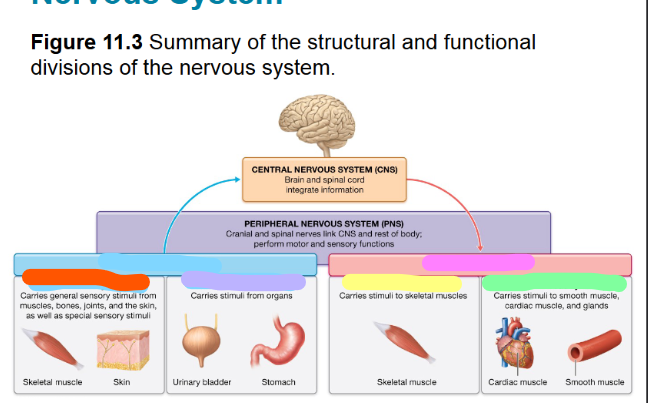
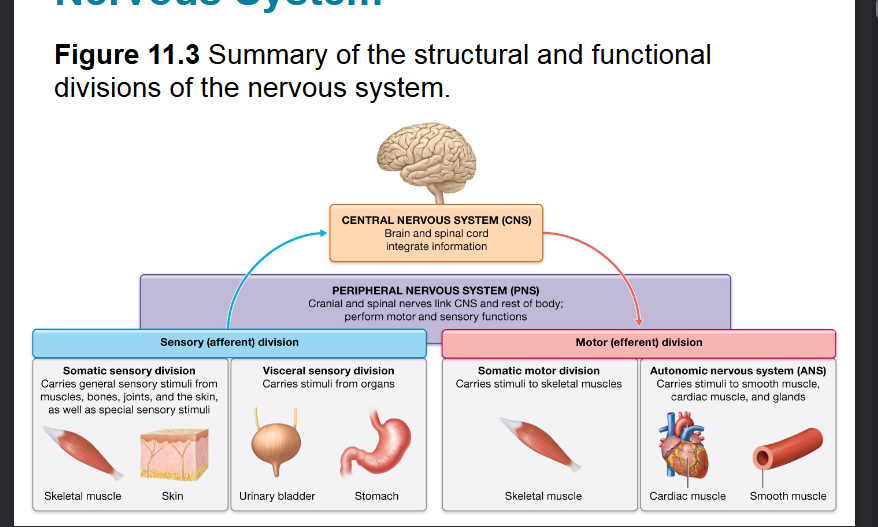
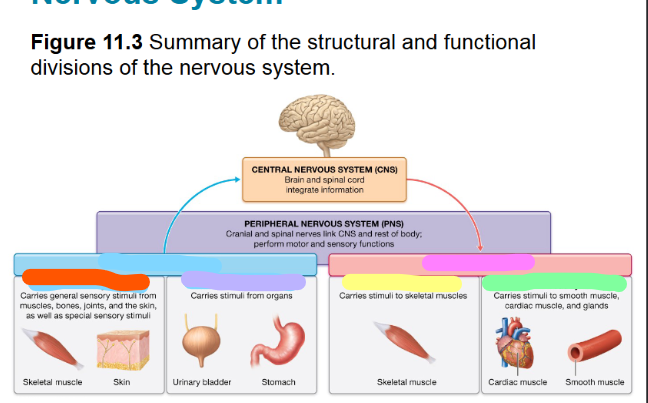
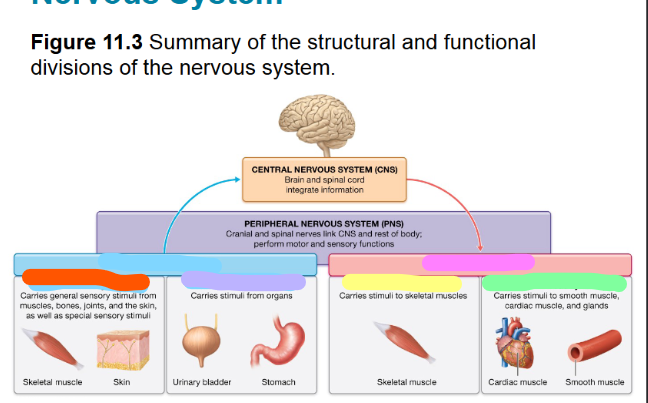
1 Sensory (afferent) division - Sensory stimuli are detected by sensory receptors (varies from small tips of neurons to complex receptors)

 contains somatosensory Division orange -  external sensory - Neurons carry signals from skeletal muscles, bones, joints and skin including Sensory neurons from organs for vision hearing taste and smell ( special sensory)

And visceral sensory division purple -   internal sensory- neurons carry signals from visceral / organs such as heart lungs stomach intestines Etc

Includes the somatic and visceral sensory division,  deals with Sensations from Sensory neurons

light blue and its 2 sub divisions
<p>light blue and its 2 sub divisions</p>
28
New cards

Sensory receptors

Detect sensory stimuli- varies from small tips of neurons to complex receptors
<p><span style="background-color: transparent;">Detect sensory stimuli- varies from small tips of neurons to complex receptors</span></p>
29
New cards

1 Somatic sensory division - external sensory- Neurons carry signals from skeletal muscles, bones, joints and skin including Sensory neurons from organs for vision hearing taste and smell ( special sensory)

orange
<p>orange</p>
30
New cards

1 Visceral sensory division –Internal sensory- neurons carry signals from visceral / organs such as heart lungs stomach intestines Etc

Sensory neurons carry signals from organs to CNS
<p></p>
31
New cards

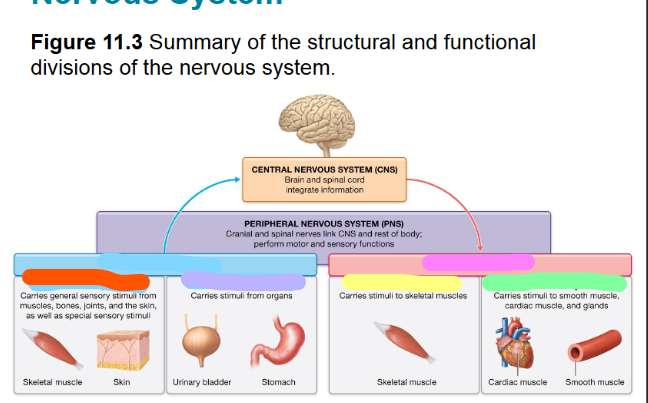
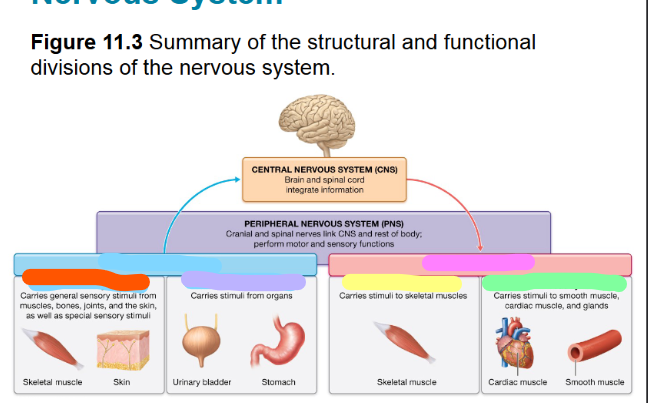
1 Motor (efferent) division -

Carry out motor functions such as muscle contraction and gland secretion, organs that carry out the effects are effecters

 contains somatic motor division yellow-  voluntary movement - neurons transmit signals to skeletal muscles

 and visceral motor division green (autonomic nervous system ANS) -  involuntary movement -  neurons carry signals to thoracic and abdominal viscera regulating secretion, controls smooth and  cardiac muscle

Light pink

contains what 2 sub divisions
<p>Light pink </p><p>contains what 2 sub divisions</p>
32
New cards

Effectors

organs that carry out the effects of the motor division

33
New cards

1 Somatic motor division - voluntary movement, motor neurons carry signals to skeletal muscles - voluntary movement - neurons transmit signals to skeletal muscles

yellow
<p>yellow</p>
34
New cards

1 Autonomic nervous system (ANS) or visceral motor division- involuntary movement,  motor neurons carry signals to the cardiac, smooth muscles and glands

green
<p>green</p>
35
New cards

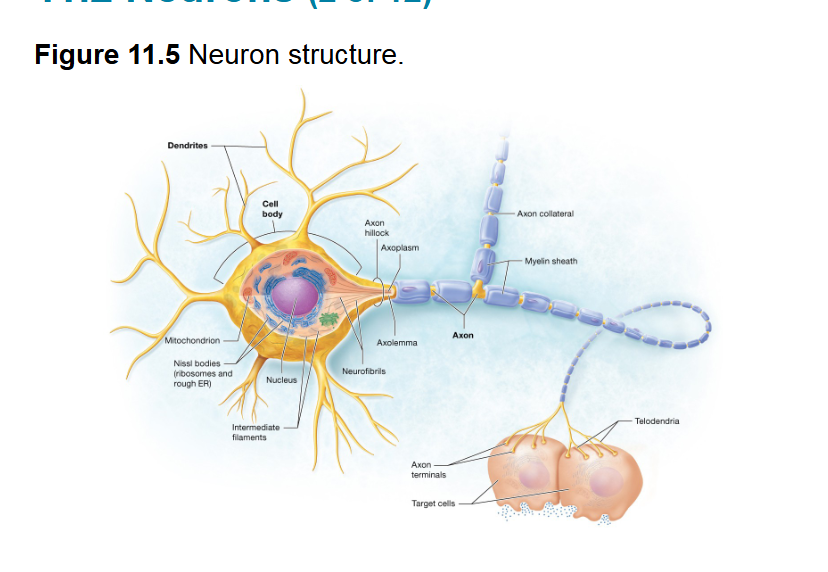
Neurons

Excitable cell type, Send and receive signals called Action potentials - responsible for sensory integrative and motor functions of nervous system,  long living cells generally amitotic, very in size,  have cell body one or more dendrites (receives signal) and one Axon (sends signal from cell)
<p><span style="background-color: transparent;">Excitable cell type, Send and receive signals called <em>Action potentials</em> - responsible for sensory integrative and motor functions of nervous system,&nbsp; long living cells generally amitotic, very in size,&nbsp; have<em> cell body</em> one or more <em>dendrites </em>(receives signal) and one <em>Axon </em>(sends signal from cell)</span></p>
36
New cards

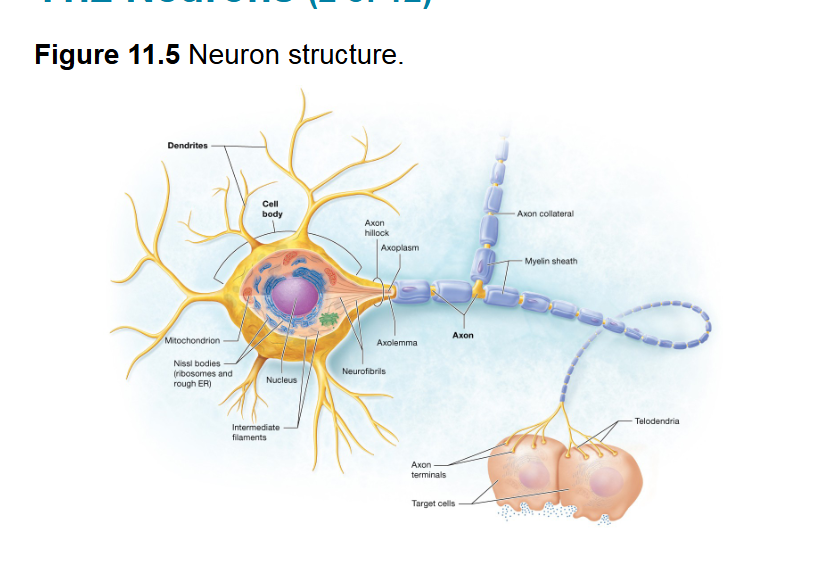
Cell body

most metabolically Active part of neuron,  manufacturers proteins,  contains a lot of the same organelles as regular cells although the rough ER appears in clusters called nissl bodies
<p><span style="background-color: transparent;">most metabolically Active part of neuron,&nbsp; manufacturers proteins,&nbsp; contains a lot of the same organelles as regular cells although the rough ER appears in clusters called nissl bodies</span></p>
37
New cards

Neurofibril

 Filaments of the neuronal cytoskeleton of the neurons cell body are called neurofibrils these extend into dendrites and axon microtubules
<p><span style="background-color: transparent;"><u>&nbsp;</u>Filaments of the neuronal cytoskeleton of the neurons cell body are called <em>neurofibrils </em>these extend into dendrites and axon microtubules</span></p>
38
New cards

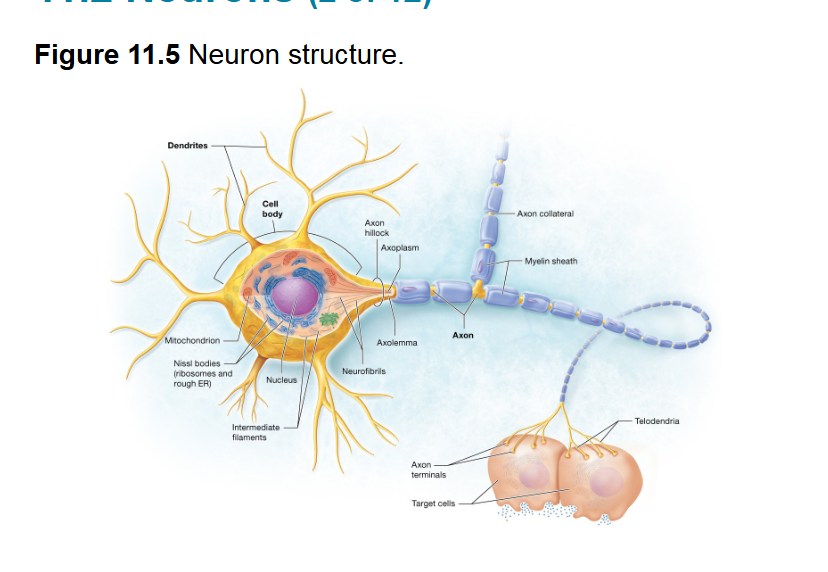
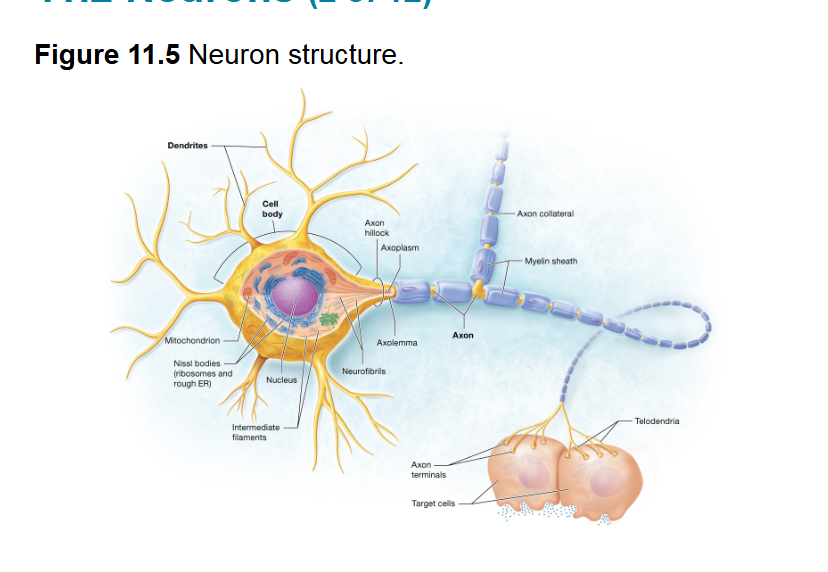
Dendrites

Short  and forked, receive input from other neurons transmit it in the form of electrical pulses to cell body
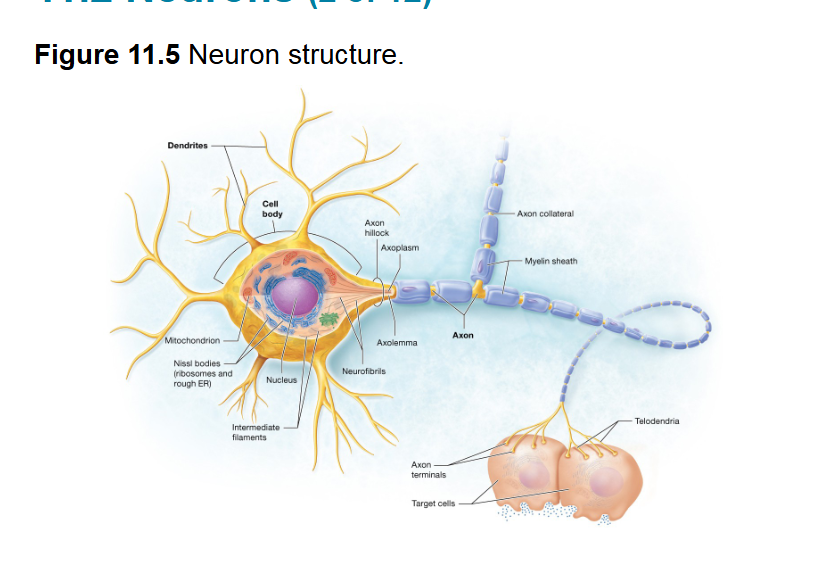
<p><span style="background-color: transparent;">Short&nbsp; and forked, receive input from other neurons transmit it in the form of electrical pulses to cell body</span></p>
39
New cards

Axon

Can generate and conduct Action potentials sending messages to other neurons contains axon hillock, axon collaterals, telodendria, axon terminals / synaptic knobs,  Axolemma,  axoplasm
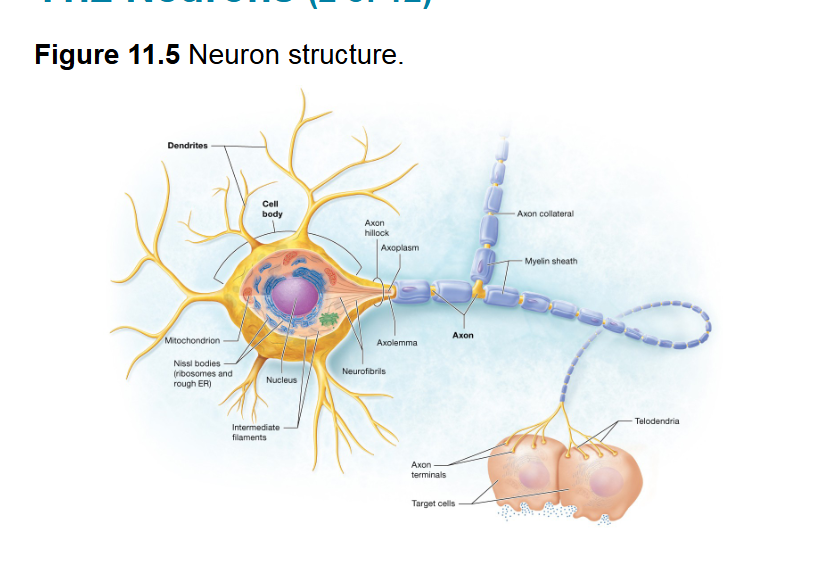
<p><span style="background-color: transparent;">Can generate and conduct Action potentials sending messages to other neurons contains axon hillock, axon collaterals, telodendria, axon terminals / synaptic knobs,&nbsp; Axolemma,&nbsp; axoplasm</span></p>
40
New cards

Axon Hillock

Area of cell body where the axon begins to Branch off
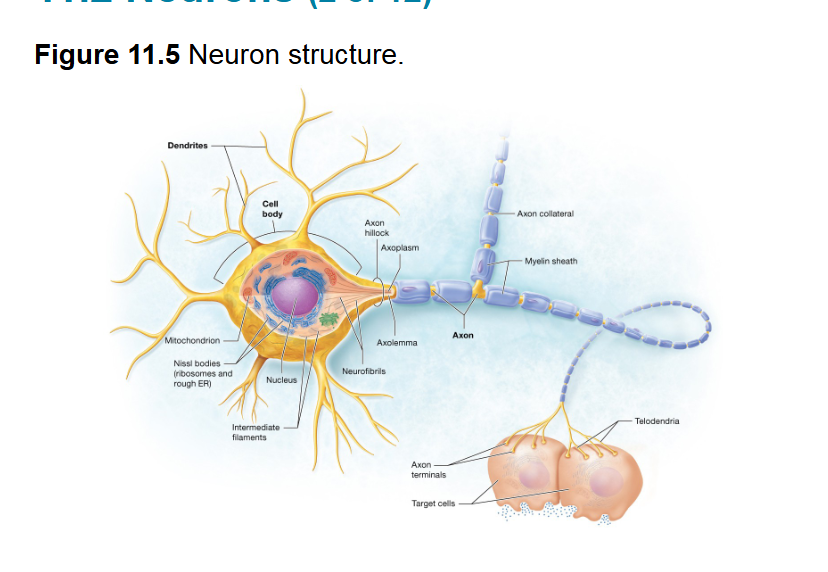
<p><span style="background-color: transparent;">Area of cell body where the axon begins to Branch off</span></p>
41
New cards

Axon collaterals

branches of the Axon
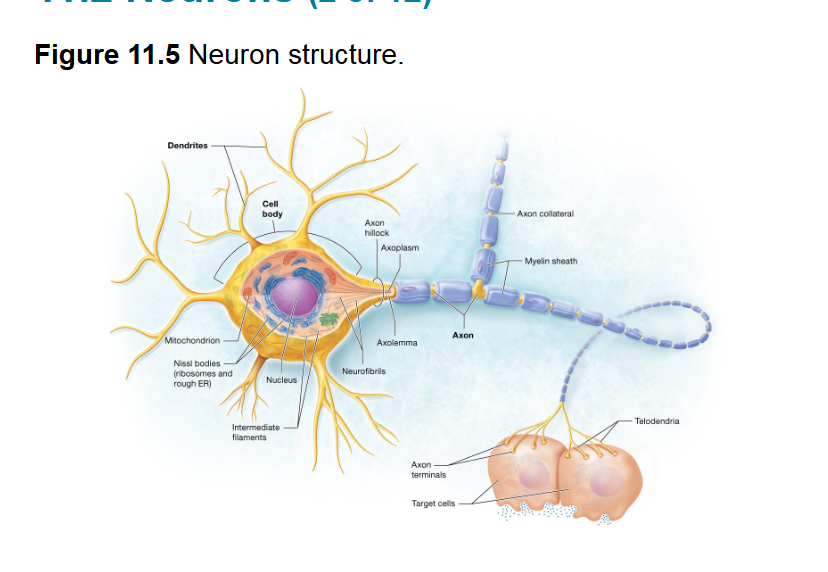
<p><span style="background-color: transparent;">branches of the Axon</span></p>
42
New cards

Telodendria

 small segments of axon that Branch off  and form the end for connections it also has collaterals
<p><span style="background-color: transparent;">&nbsp;small segments of axon that Branch off&nbsp; and form the end for connections it also has collaterals</span></p>
43
New cards

Axon terminals / Synaptic Knobs -

-the very end of the telodendria these communicate with target cells
<p><span style="background-color: transparent;">-the very end of the telodendria these communicate with target cells</span></p>
44
New cards

Axolemma

 Plasma membrane  of Axon

<p><span style="background-color: transparent;"><u>&nbsp;</u>Plasma membrane&nbsp; of Axon</span></p>
45
New cards

Axoplasm

cytoplasm of Axon, 

 contains mitochondria intermediate filaments vesicles and lysosomes but no protein making organelles
<p><span style="background-color: transparent;">cytoplasm of Axon,&nbsp;</span></p><p><span style="background-color: transparent;">&nbsp;contains mitochondria intermediate filaments vesicles and lysosomes but no protein making organelles</span></p>
46
New cards

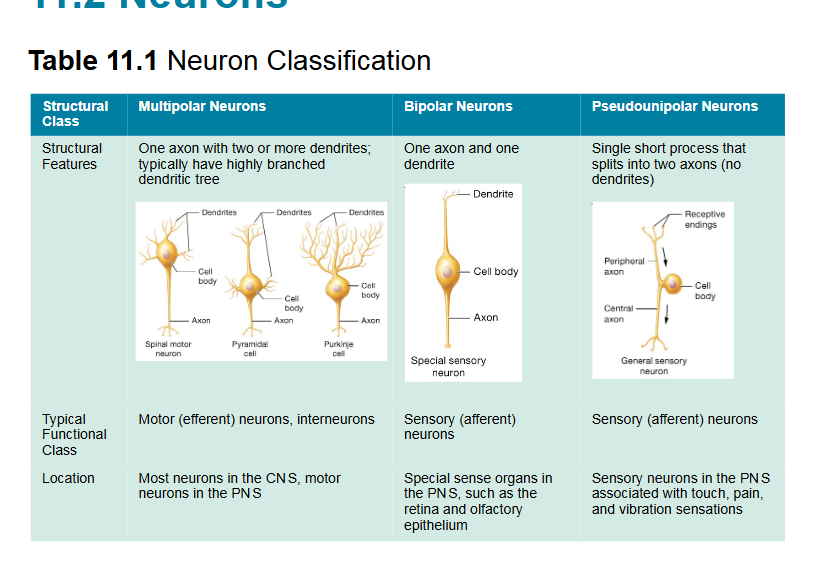
multipolar neurons

Over 99% of neurons,  single axon with highly branched dendrites wide variety of shapes and sizes
<p><span style="background-color: transparent;">Over 99% of neurons,&nbsp; single axon with highly branched dendrites wide variety of shapes and sizes</span></p>
47
New cards

bipolar neuron-

one axon and one dendrite most are sensory, found in retina of eye and olfactory epithelium
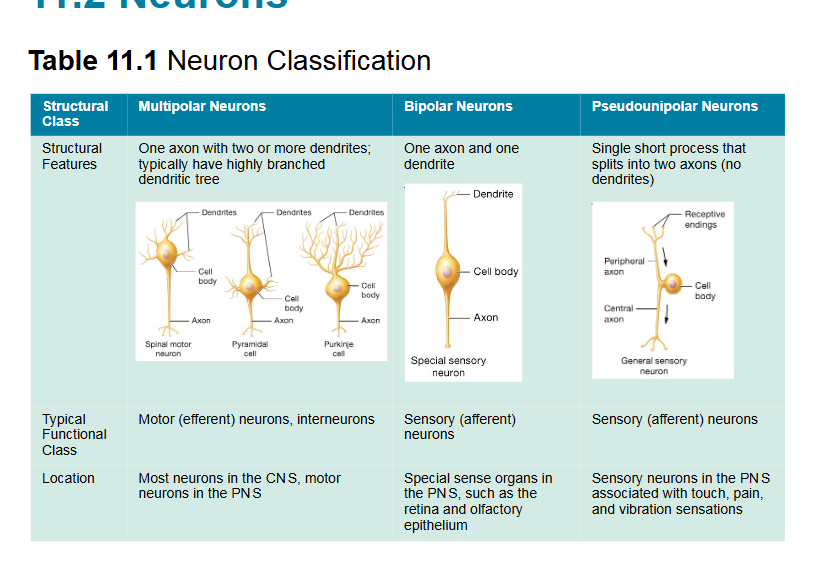
<p><span style="background-color: transparent;">one axon and one dendrite most are sensory, found in retina of eye and olfactory epithelium</span></p>
48
New cards

Pseudounipolar neuron

single axon with one part that brings sensory stimuli to cell body and one part that carries stimuli spinal cord, detect touch Pleasure and Pain
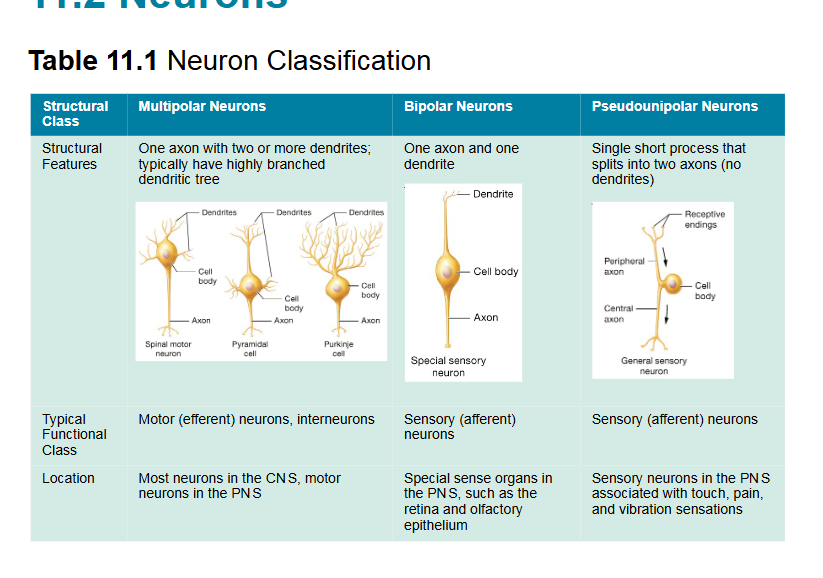
<p><span style="background-color: transparent;">single axon with one part that brings sensory stimuli to cell body and one part that carries stimuli spinal cord, detect touch Pleasure and Pain</span></p>
49
New cards

Sensory/afferent Neurons

 Carry signals towards CNS (pseudounipolar or bipolar)  detect input from internal and external environments and facilitate motor coordination

50
New cards

Motor / efferent neurons

carry signals away from cell bodies in CNS to muscles and glands,  most are multipolar

51
New cards

Nuclei

Clusters of cell bodies in the CNS

52
New cards

Ganglia

clusters of cell bodies in the PNS

53
New cards

Tracts

Bundles of axons in the CNS

54
New cards

Neuroglia / neuroglial cells

Part of nervous tissue hold neurons together, maintain the environment around neurons, protect and assist neurons and function. can undergo mitosis and fuel in gaps when neurons die

 there's six different types four in the CNS (Astrocytes, Oligodendrocytes , microglia, Ependymal cells) and two in The PNS (Neurolemmocytes and satellite cells)

55
New cards

Astrocytes

 CNS Star-shaped, 

anchor neurons and blood vessels in place, 

facilitate nutrient transport, regulate extracellular environment and brain, 

 remove unneeded stuff,

 Assist information of blood-brain barrier, 

 repair damaged brain tissue ( divide rapidly but may impede the growth of neurons leading to more damage)
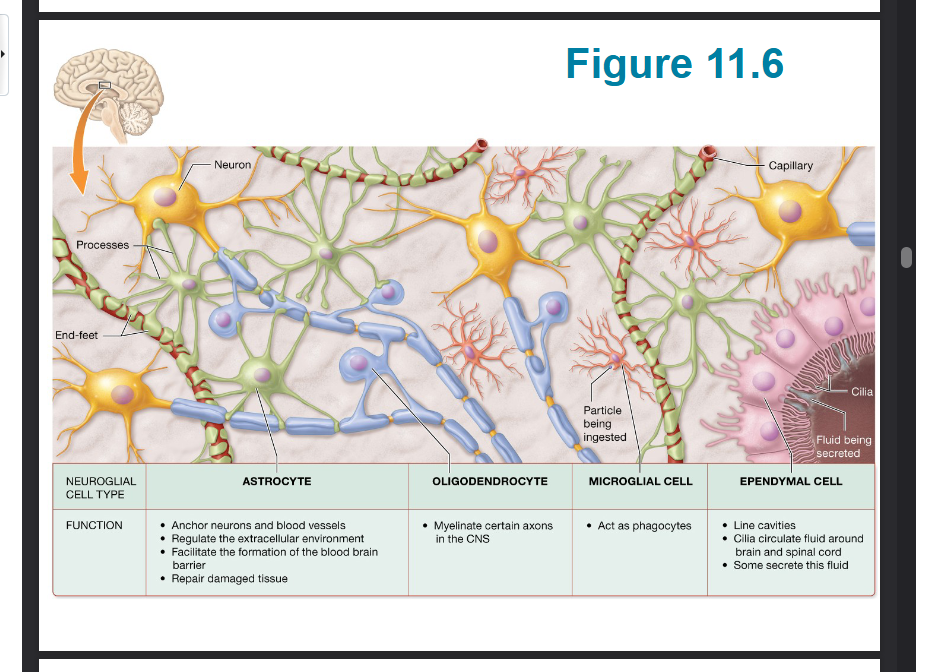
<p><span style="background-color: transparent;"><u>&nbsp;CNS </u>Star-shaped,&nbsp;</span></p><p><span style="background-color: transparent;">anchor neurons and blood vessels in place,&nbsp;</span></p><p><span style="background-color: transparent;">facilitate nutrient transport, regulate extracellular environment and brain,&nbsp;</span></p><p><span style="background-color: transparent;">&nbsp;remove unneeded stuff,</span></p><p><span style="background-color: transparent;">&nbsp;Assist information of blood-brain barrier,&nbsp;</span></p><p><span style="background-color: transparent;">&nbsp;repair damaged brain tissue ( divide rapidly but may impede the growth of neurons leading to more damage)</span></p>
56
New cards

Oligodendrocytes

CNS Wrap around part of axons in certain neurons of the CNS,  form layers of plasma membrane called myelin repeating segments of myelin form the myelin sheath which insulates an increases speed of nerve impulses

One cell has branches which wrap different parts of the axon so that one cell can make multiple wrappings
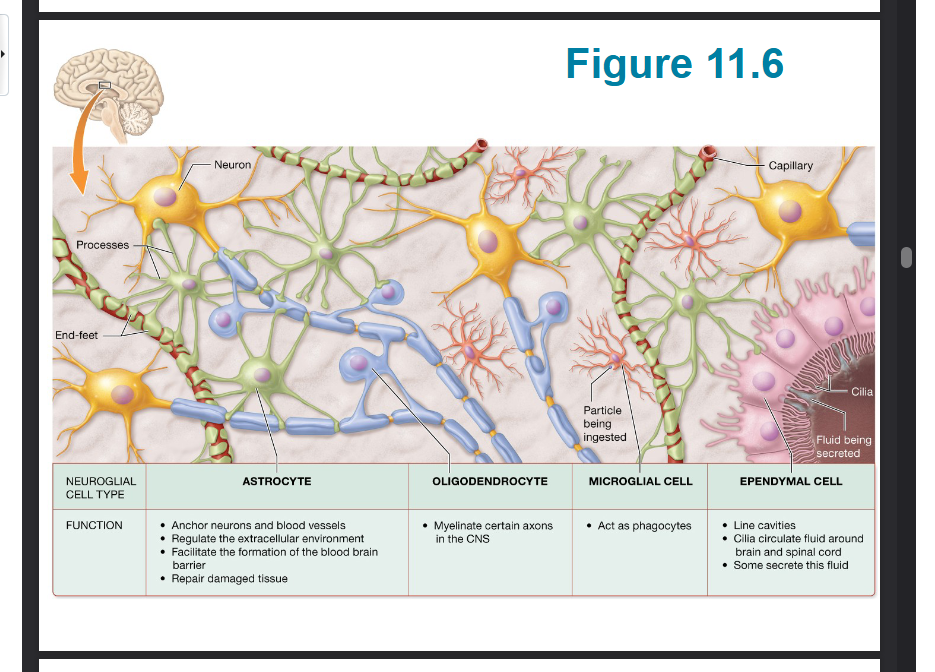
<p><span style="background-color: transparent;"><u>CNS </u>Wrap around part of axons in certain neurons of the CNS,&nbsp; form layers of plasma membrane called myelin repeating segments of <strong><em>myelin </em></strong>form the <em>myelin sheath </em>which insulates an increases speed of nerve impulses</span></p><p><span style="background-color: transparent;">One cell has branches which wrap different parts of the axon so that one cell can make multiple wrappings</span></p>
57
New cards

Myelin

 cells wrap around axon of neurons insulating and allowing for increased nerve impulse conduction (Oligodendrocytes and Neurolemmocytes)
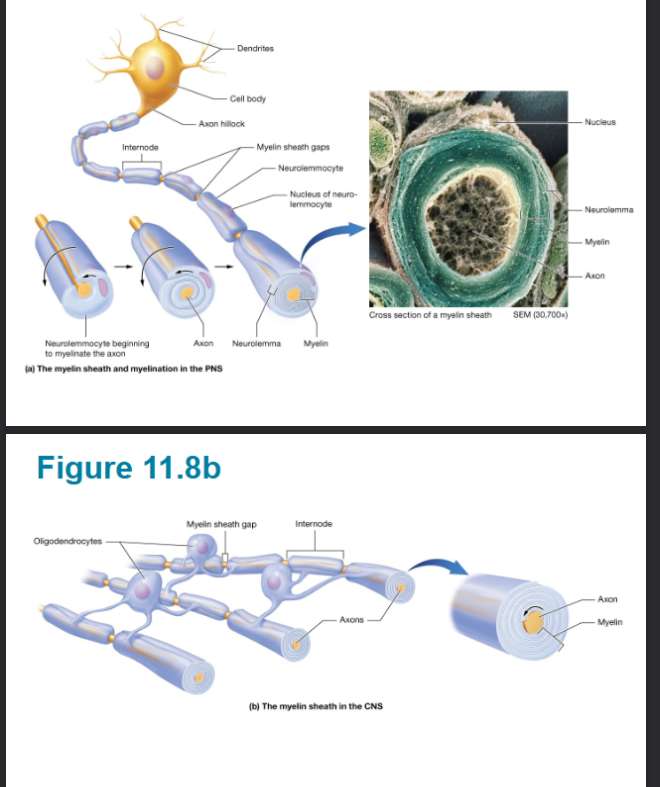
<p><span style="background-color: transparent;">&nbsp;cells wrap around axon of neurons insulating and allowing for increased nerve impulse conduction (Oligodendrocytes and Neurolemmocytes)</span></p>
58
New cards

Microglia

CNS Tiny branching cells that are activated by brain injury, become phagocytes that in just disease causing organisms, did neurons and cell debris also stimulate inflammation
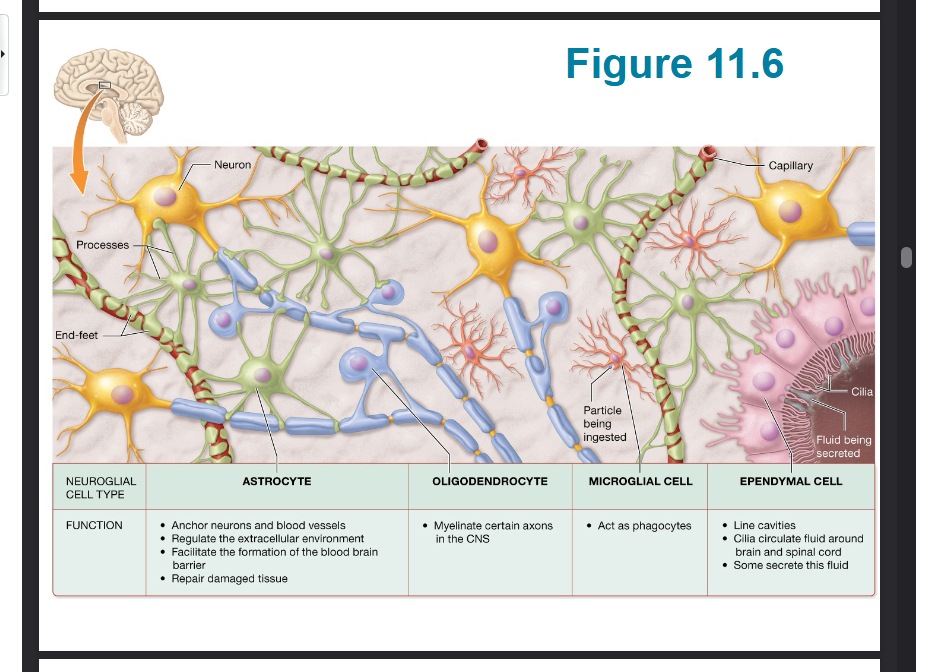
<p><span style="background-color: transparent;">CNS Tiny branching cells that are activated by brain injury, become phagocytes that in just disease causing organisms, did neurons and cell debris also stimulate inflammation</span></p>
59
New cards

Ependymal cells

CNS Ciliated cells, main function is circulating cerebral fluid moved with cilia
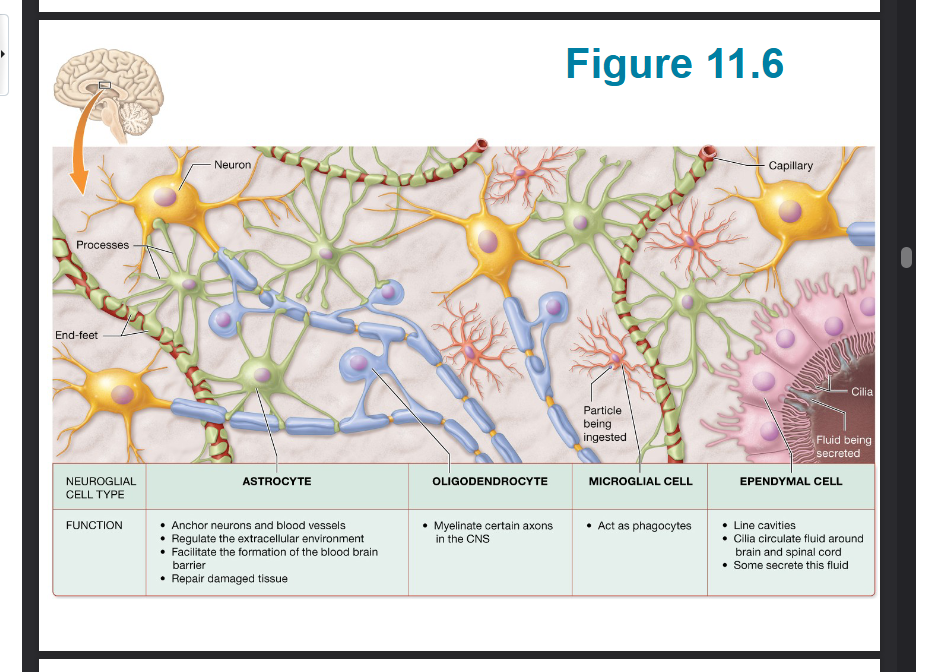
<p><span style="background-color: transparent;">CNS Ciliated cells, main function is circulating cerebral fluid moved with cilia</span></p>
60
New cards

Internodes

 segments of axon covered by myelin sheath
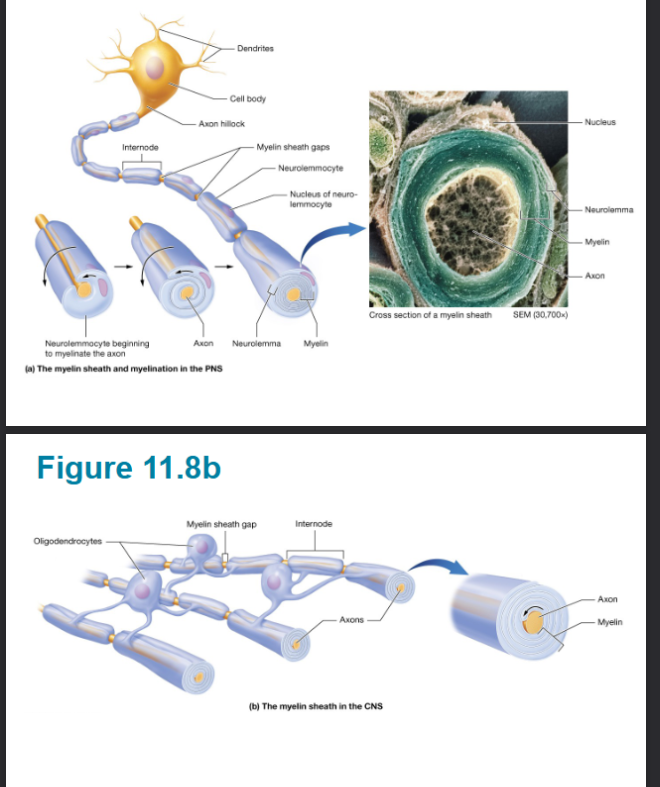
<p><span style="background-color: transparent;">&nbsp;segments of axon covered by myelin sheath</span></p>
61
New cards

Gap/node of Ranvier

spaces in between internodes of myelin
<p><span style="background-color: transparent;">spaces in between internodes of myelin</span></p>
62
New cards

Regeneration

CNS-  dendrites and axons Almost Never regenerate all good danger sites inhibit neural growth, astrocytes create scar tissue

PNS -  capable of regeneration if the cell body remains intact and conditions are ideal
<p><span style="background-color: transparent;">CNS-&nbsp; dendrites and axons Almost Never regenerate all good danger sites inhibit neural growth, astrocytes create scar tissue</span></p><p><span style="background-color: transparent;">PNS -&nbsp; capable of regeneration if the cell body remains intact and conditions are ideal</span></p>
63
New cards

Ligand gated channels

Open and response to chemical ( ligand)  binding with Channel or receptor associated with Channel
<p><span style="background-color: transparent;">Open and response to chemical ( ligand)&nbsp; binding with Channel or receptor associated with Channel</span></p>
64
New cards

Ligand

chemical,  binds to Channel or receptor to open ligand gated channels
<p><span style="background-color: transparent;">chemical,&nbsp; binds to Channel or receptor to open ligand gated channels</span></p>
65
New cards

Voltage gated channels

open or close and response to change in cells membrane potential
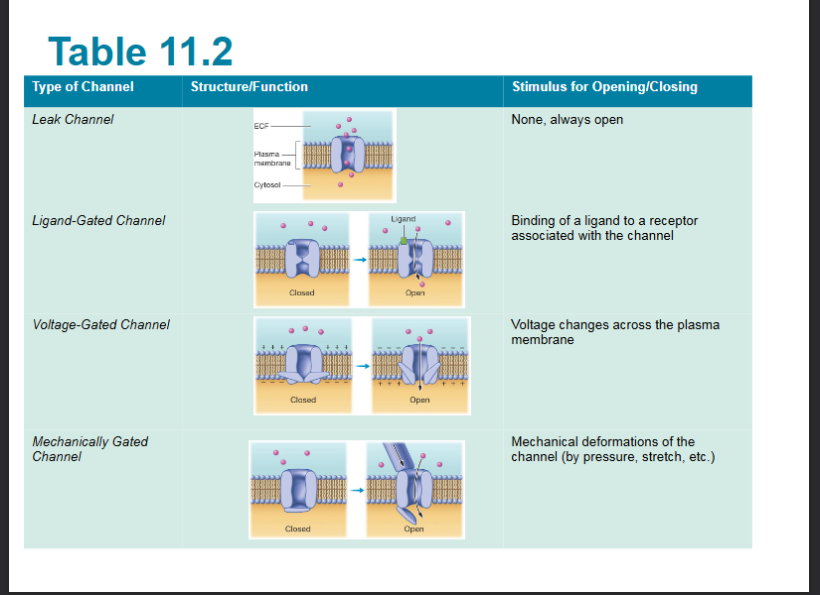
<p><span style="background-color: transparent;">open or close and response to change in cells membrane potential</span></p>
66
New cards

Mechanically gated channels

open or close and response to Mechanical stimuli, (stretch pressure or vibration)
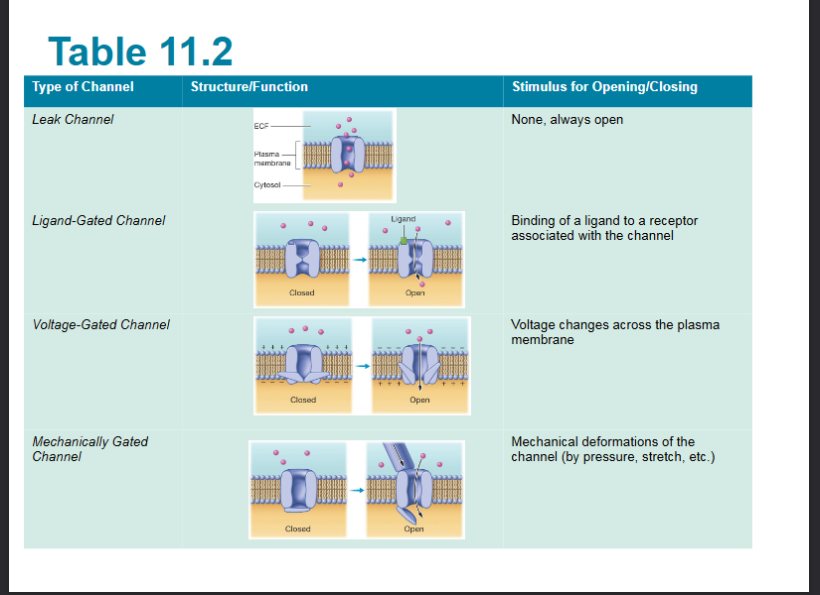
<p><span style="background-color: transparent;">open or close and response to Mechanical stimuli, (stretch pressure or vibration)</span></p>
67
New cards

Sodium-potassium pump (Na/K ATPase)

 Moves ions against their gradient helps balance back to normal after hyperpolarization,  moves two potassium onto cytosol and three sodium ions into extracellular fluid

68
New cards

Depolarization

Opening a ligand-gated  cat on Channel causing an influx of catons such as sodium, making membrane potential less negative
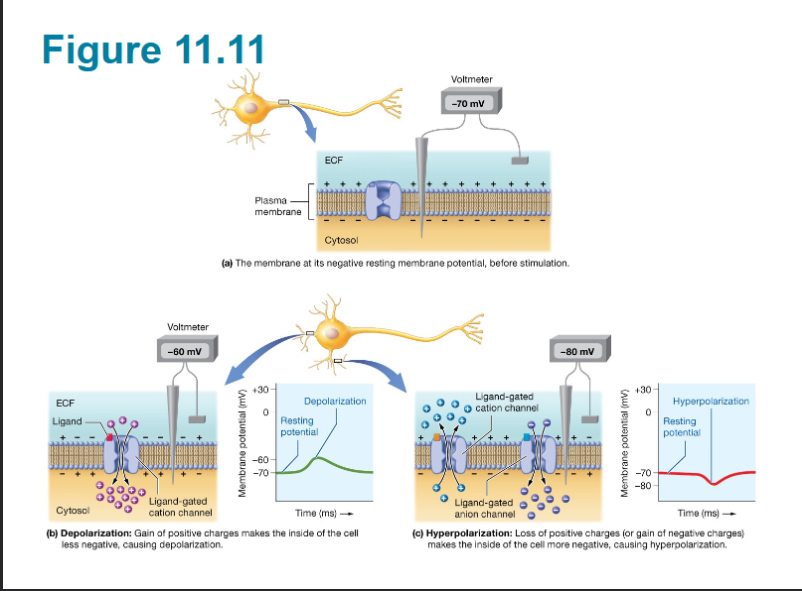
<p><span style="background-color: transparent;">Opening a ligand-gated&nbsp; cat on Channel causing an influx of catons such as sodium, making membrane potential less negative</span></p>
69
New cards

Repolarization

when a cell returns to its arresting membrane potential

70
New cards

Hyperpolarization

when a cell becomes more negative than it is at rest,  loss of positive charges or gain of negative charges
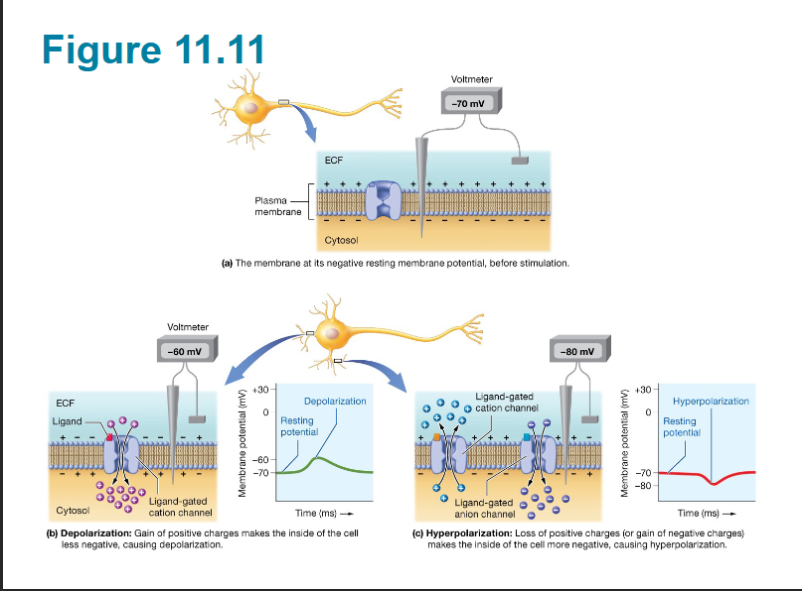
<p><span style="background-color: transparent;">when a cell becomes more negative than it is at rest,&nbsp; loss of positive charges or gain of negative charges</span></p>
71
New cards

Local potential -

 Travel short distances,  reversible, when a charge does not reach high enough to set off action potential
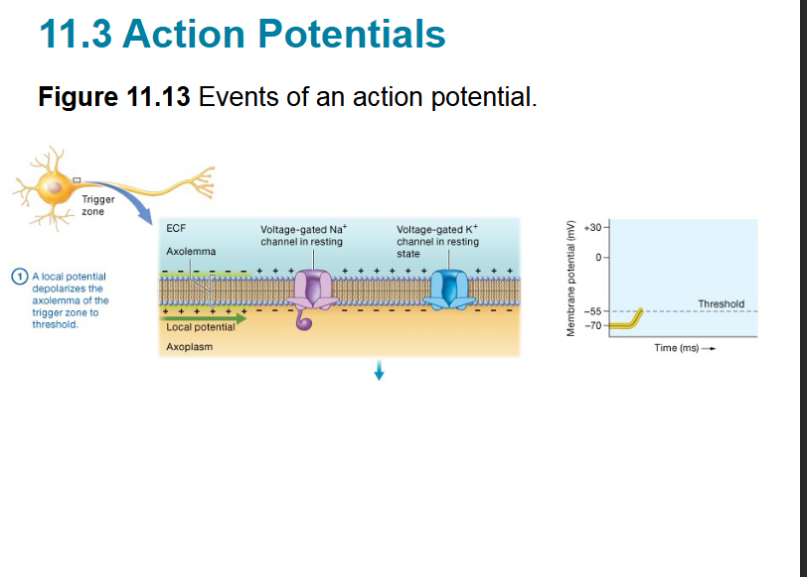
<p><span style="background-color: transparent;">&nbsp;Travel short distances,&nbsp; reversible, when a charge does not reach high enough to set off action potential</span></p>
72
New cards

Action potential

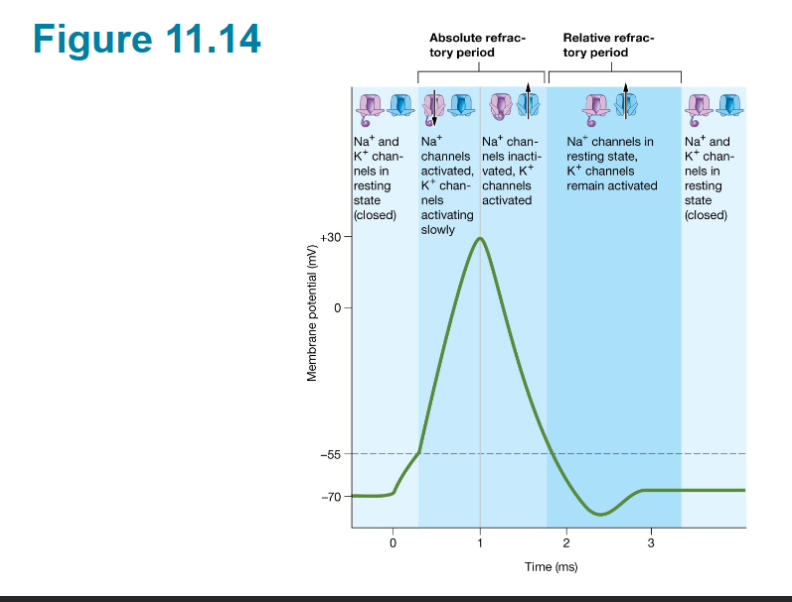
irreversible, travels entire length of axon, Begins at -55mV, ends at +30mV  includes depolarization, repolarization and  hyperrepolarization phases as well as refractory periods
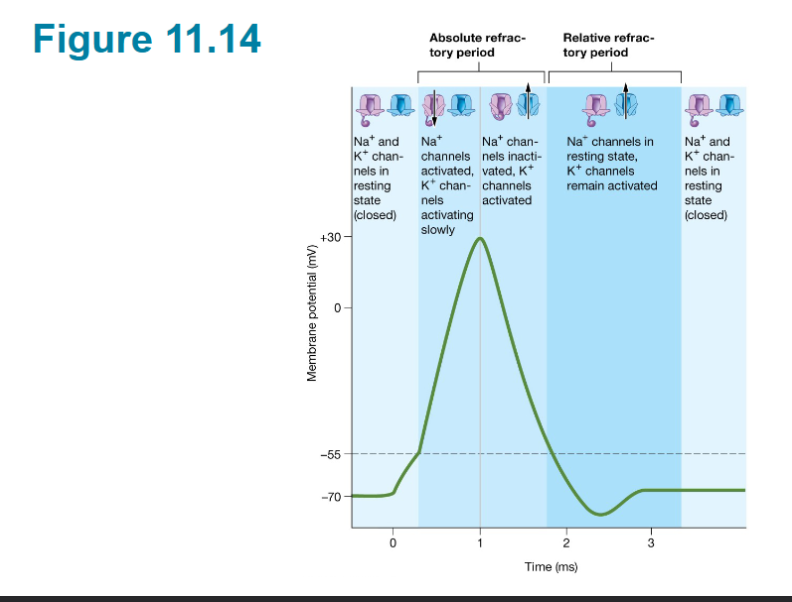
<p><span style="background-color: transparent;">irreversible, travels entire length of axon, Begins at -55mV, ends at +30mV&nbsp; includes depolarization, repolarization and&nbsp; hyperrepolarization phases as well as refractory periods</span></p>
73
New cards

Depolarization phase

First step of action potential,  voltage-gated sodium ion channels open at threshold of -55mV causing rapid increase in cell membrane charge
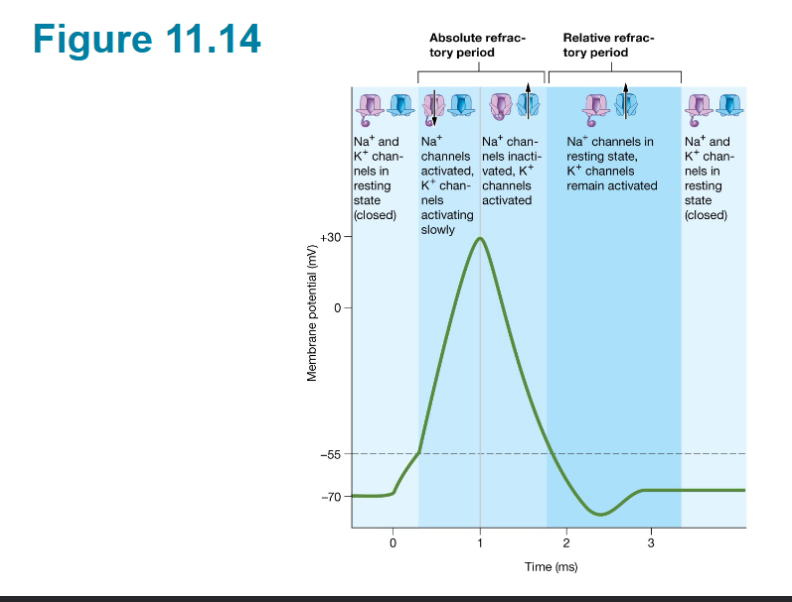
<p><span style="background-color: transparent;">First step of action potential,&nbsp; voltage-gated sodium ion channels open at threshold of -55mV causing rapid increase in cell membrane charge</span></p>
74
New cards

Repolarization phase

once cell membrane potential hits positive 30mV  potassium channels open allowing cell electronegativity to decrease back to the normal negative 70mV
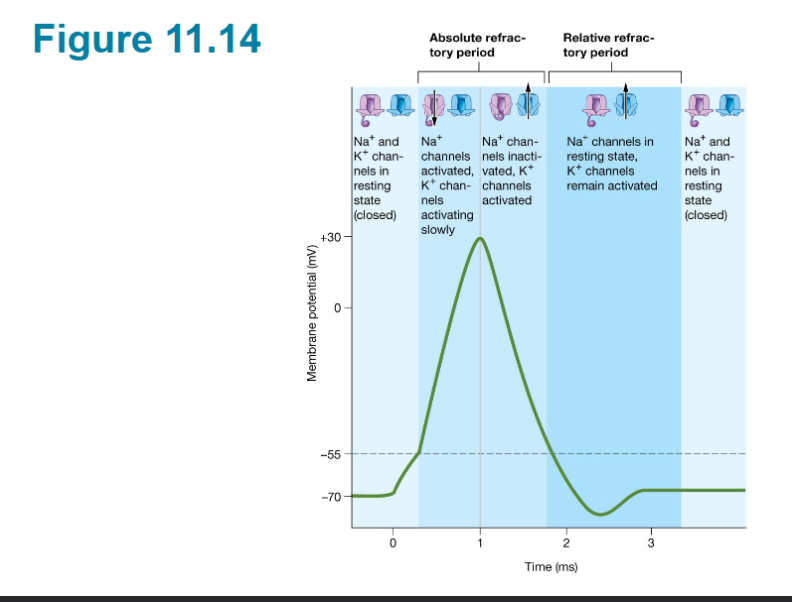
<p><span style="background-color: transparent;">once cell membrane potential hits positive 30mV&nbsp; potassium channels open allowing cell electronegativity to decrease back to the normal negative 70mV</span></p>
75
New cards

Hyperpolarization phase

 potassium channels close slowly meaning that sometimes too many of them get out dropping  cell membrane potential below the typical threshold until  it can return to normal (Na+/K+  pump helps with this)
<p><span style="background-color: transparent;">&nbsp;potassium channels close slowly meaning that sometimes too many of them get out dropping&nbsp; cell membrane potential below the typical threshold until&nbsp; it can return to normal (Na+/K+&nbsp; pump helps with this)</span></p>
76
New cards

Threshold

negative 55mV, Is the cell membrane charge required to open sodium channels which begins in action potential and the depolarization phase
<p><span style="background-color: transparent;">negative 55mV, Is the cell membrane charge required to open sodium channels which begins in action potential and the depolarization phase</span></p>
77
New cards

Refractory period

Brief time after a neuron has produced action potential in which the membrane cannot be stimulated to fire another one it has two phases
<p><span style="background-color: transparent;">Brief time after a neuron has produced action potential in which the membrane cannot be stimulated to fire another one it has two phases</span></p>
78
New cards

 absolute refractory period -

 during depolarization and repolarization no stimulus will be able to create an action potential
<p><span style="background-color: transparent;">&nbsp;during depolarization and repolarization no stimulus will be able to create an action potential</span></p>
79
New cards

 relative refractory.

a stronger than normal stimulus is required to overcome the fact that the membrane is  repolarizing
<p><span style="background-color: transparent;">a stronger than normal stimulus is required to overcome the fact that the membrane is&nbsp; repolarizing</span></p>
80
New cards

All-or-none principle

 If the neuron does not depolarize to threshold an action potential does not occur.

81
New cards

Propagated

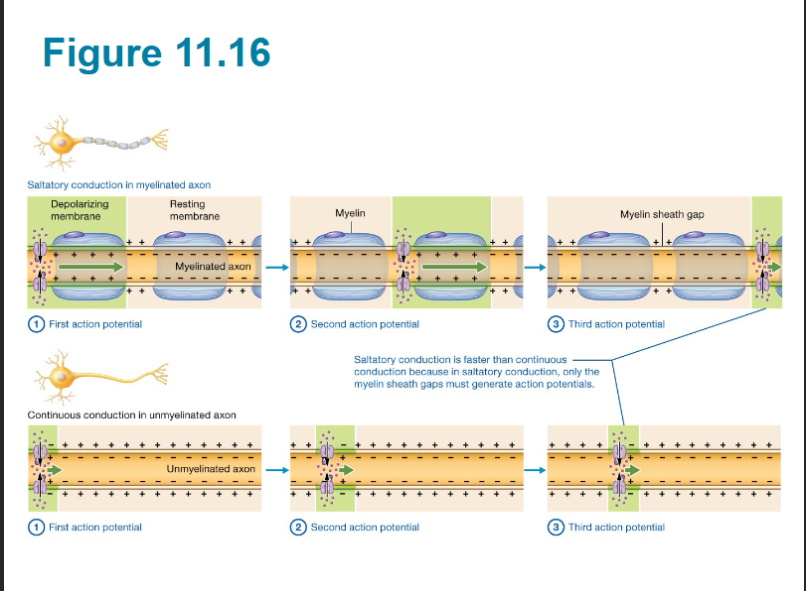
Action potentials must act as a method of long distance signaling so they can be conducted or propagated down the length of the axon, they are self propagating one sets off another all the way down the axon like a chain reaction
<p><span style="background-color: transparent;">Action potentials must act as a method of long distance signaling so they can be conducted or propagated down the length of the axon, they are self propagating one sets off another all the way down the axon like a chain reaction</span></p>
82
New cards

Conduction speed

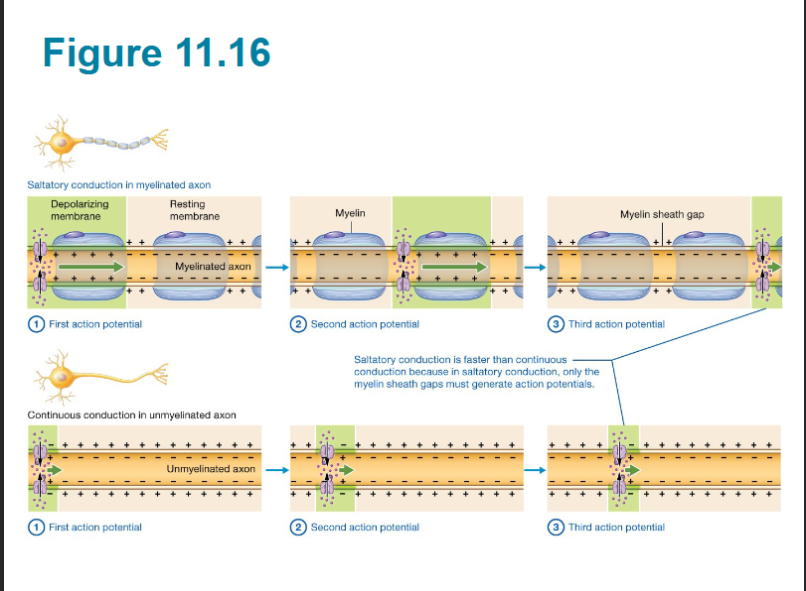
The rate at which propagation occurs, determines how rapid signaling can occur within the nervous system, this is influenced by the diameter of the axon, and the presence or lack of my lawn sheath

 if there is no myelin sheath continuous conduction occurs where the action potential must be created all the way down the  Axon 

 if there is a myelin sheath then saltatory conduction happens  where Action potentials only occur in the gaps between the sheath making things quicker
83
New cards

Saltatory conduction

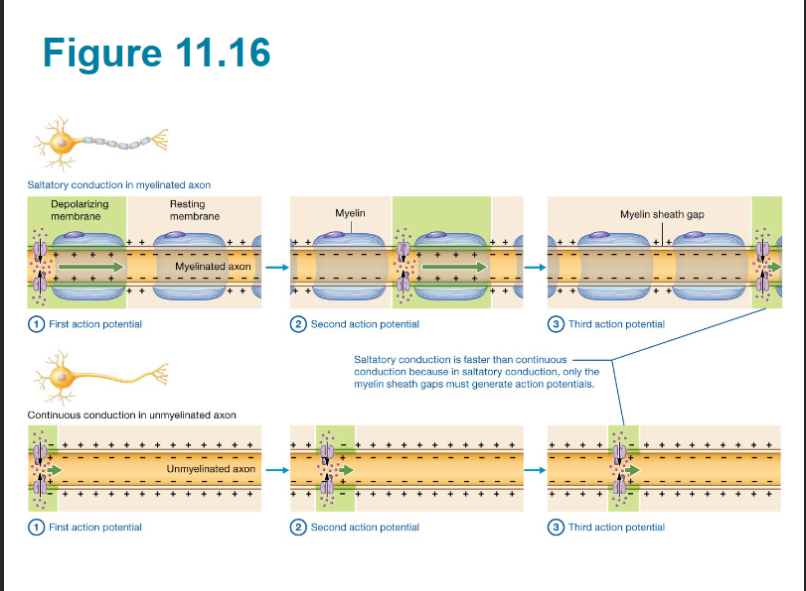
if there is a myelin sheath then saltatory conduction happens  where Action potentials only occur in the gaps between the sheath making things quicker

<p><span style="background-color: transparent;">if there is a myelin sheath then <strong>saltatory conduction </strong>happens&nbsp; where Action potentials only occur in the gaps between the sheath making things quicker</span></p>
84
New cards

Continuous conduction

 if there is no myelin sheath continuous conduction occurs where the action potential must be created all the way down the  Axon
<p><span style="background-color: transparent;">&nbsp;if there is no myelin sheath <strong>continuous conduction</strong> occurs where the action potential must be created all the way down the&nbsp; Axon</span></p>
85
New cards

Presynaptic neuron

The neuron that is sending the message from its axon terminal

86
New cards

Postsynaptic neuron

 the dendrite, cell body, or axon that is receiving the message from the presynaptic neuron

87
New cards

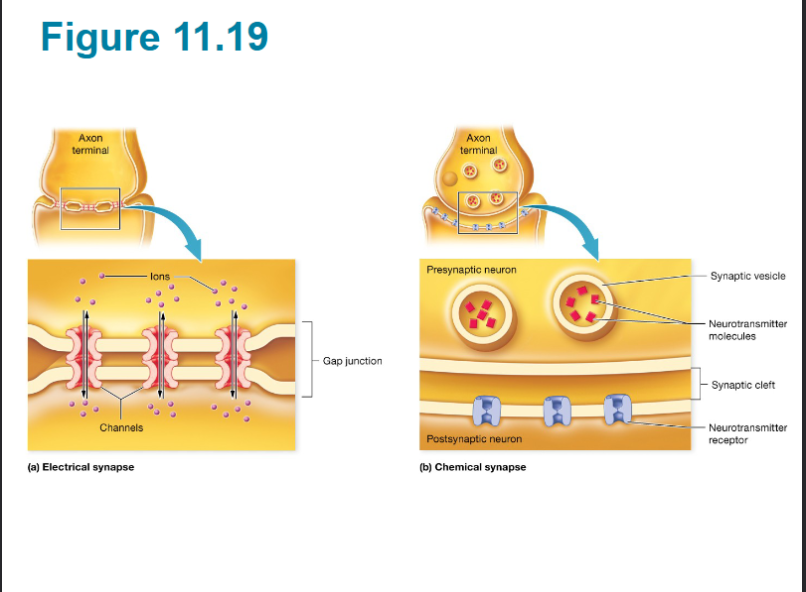
Synaptic transmission

the transfer of chemical or electrical signals between neurons at a synapse
<p><span style="background-color: transparent;">the transfer of chemical or electrical signals between neurons at a synapse</span></p>
88
New cards

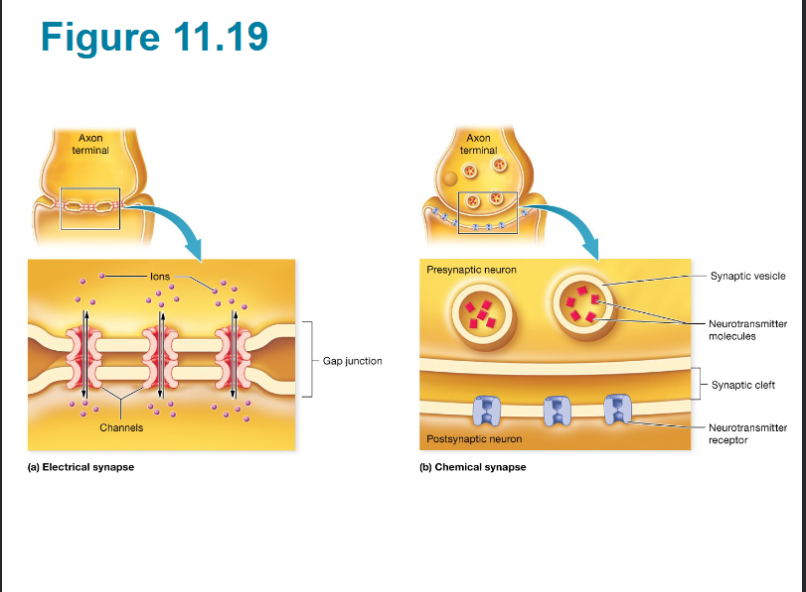
Chemical synapse

 Very in size unlike electrical synapses, slower than electrical, use various neurotransmitters and receptors for different effects

Steps 

  1. Action potential in presynaptic neuron triggers calcium ion channels  in axon terminal to open

  2.  calcium ion influx causes synaptic vesicles diffuse with the membrane of the presynaptic neuron and release neurotransmitters into synaptic cleft

  3.  neurotransmitters bind to the receptors on the  postsynaptic neuron

  4.  ion channels open, leading to local potential and possibly an action potential
<p><span style="background-color: transparent;">&nbsp;Very in size unlike electrical synapses, slower than electrical, use various neurotransmitters and receptors for different effects</span></p><p><span style="background-color: transparent;">Steps&nbsp;</span></p><ol><li><p><span style="background-color: transparent;">Action potential in presynaptic neuron triggers calcium ion channels&nbsp; in axon terminal to open</span></p></li><li><p><span style="background-color: transparent;">&nbsp;calcium ion influx causes synaptic vesicles diffuse with the membrane of the presynaptic neuron and release neurotransmitters into synaptic cleft</span></p></li><li><p><span style="background-color: transparent;">&nbsp;neurotransmitters bind to the receptors on the&nbsp; postsynaptic neuron</span></p></li><li><p><span style="background-color: transparent;">&nbsp;ion channels open, leading to local potential and possibly an action potential</span></p></li></ol><p></p>
89
New cards

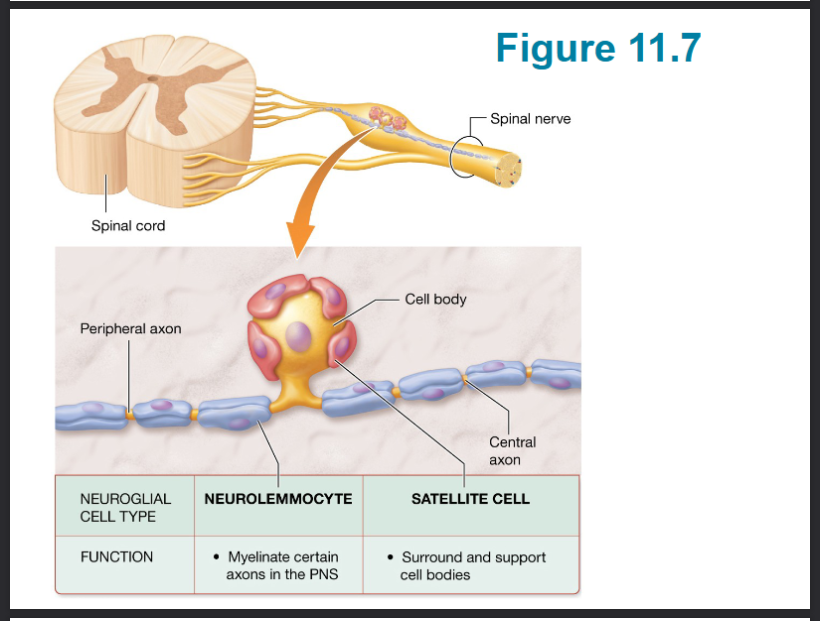
Neurolemmocytes

mylenates axons of PNS
<p>mylenates axons of PNS</p>
90
New cards

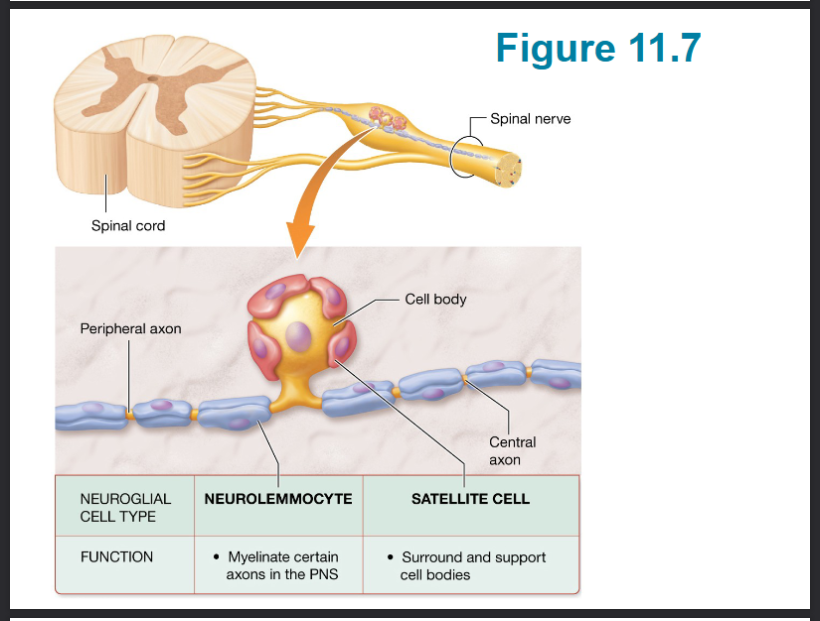
Satellite Cell

surround and support cell bodies of PNS
<p>surround and support cell bodies of PNS</p>
91
New cards

Cerebrum

only portion with conscious / voluntary control
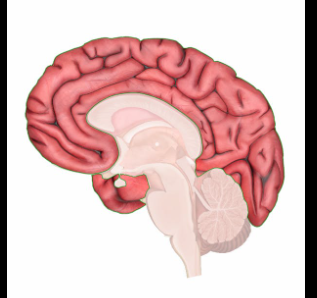
<p><span style="background-color: transparent;">only portion with conscious / voluntary control</span></p>
92
New cards

Diencephalon -  small brain in brain center has 4 parts 

Thalamus - Lg central, “main entry point / mail center” into the cerebrum for sensory input except for smell, sends sensory input to where it needs to go in the brain to be decoded

Hypothalamus- inferior, receives sensory input, boss of autonomic nerves system (ANS), involuntary functions, connects to Pituitary gland controls temp. BG, BP, sleep and thirst NOT the HR (controlled by brainstem), has Mammillary bodies that regulate sleep and wake signals that communicate with pineal gland to produce melatonin. 

Epithalamus - Posterior and superior, has pineal gland which secretes melatonin 

Subthalamus - has role in mvmt
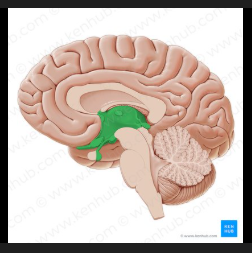
<p></p>
93
New cards

Cerebellum

it has the Arbor Vitae (tree of life) white matter being folded into tree shape, function- reduces motor error, helps with precise / complex movements, sits in the back base by brain stem. 
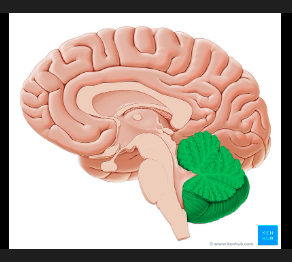
<p><span style="background-color: transparent;">it has the<u> </u><em>Arbor Vitae </em>(tree of life) white matter being folded into tree shape, function- <em>reduces motor error</em>, helps with precise / complex movements, sits in the back base by brain stem.&nbsp;<u><br></u></span></p>
94
New cards

Cerebral hemispheres

the two sides of the brain has 4 lobe types plus the insulas
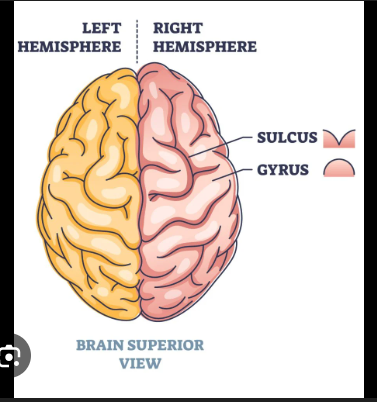
<p><span style="background-color: transparent;">the two sides of the brain has 4 lobe types plus the insulas </span></p>
95
New cards

Frontal Lobes

 frontmost lobe, posterior boundary is the central sulcus, Precentral gyrus (plural for gyri which is the peak in between folds of brain (the folds/creases)) is anterior to the central sulcus

- front most lobe has premotor cortex with planning, movement and coordination front eye fields,  has broca’s area with movement making language, lobe of cerebral hemisphere 

Function movement and reasoning 

red
<p><span style="background-color: transparent;">&nbsp;frontmost lobe, posterior boundary is the central sulcus, Precentral gyrus (plural for gyri which is the peak in between folds of brain (the folds/creases)) is anterior to the central sulcus</span></p><p></p><p><span style="background-color: transparent;">- front most lobe has <em>premotor cortex </em>with planning, movement and coordination <em>front eye fields, </em>&nbsp;has broca’s area with movement making language, lobe of cerebral hemisphere&nbsp;</span></p><p><span style="background-color: transparent;">Function movement and reasoning&nbsp;</span></p><p><span style="background-color: transparent;">red </span></p>
96
New cards

Spinal cord

 contains neurons, connect with brain at foramen magnum, brain bod communication
<p><span style="background-color: transparent;"><u>&nbsp;</u>contains neurons, connect with brain at foramen magnum, brain bod communication</span></p>
97
New cards

White matter -

Unmyelinated, On inside of spinal cord and outside of brain tissue
<p><span style="background-color: transparent;">Unmyelinated, On inside of spinal cord and outside of brain tissue</span></p>
98
New cards

Grey matter

Myelinated, on outside of spinal cord and inside of brain tissue
<p><span style="background-color: transparent;">Myelinated, on outside of spinal cord and inside of brain tissue</span></p>
99
New cards

Sulci

shallow grooves, deep grooves are called fissures
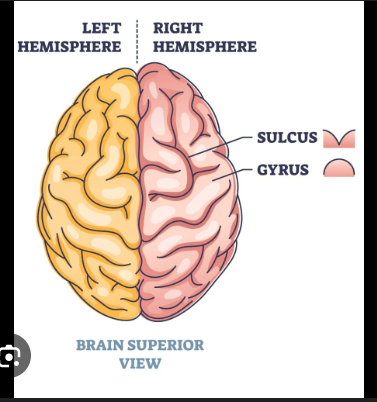
<p><span style="background-color: transparent;">shallow grooves, deep grooves are called <em>fissures</em></span></p>
100
New cards

Longitudinal fissure

separates the two halves of the brain
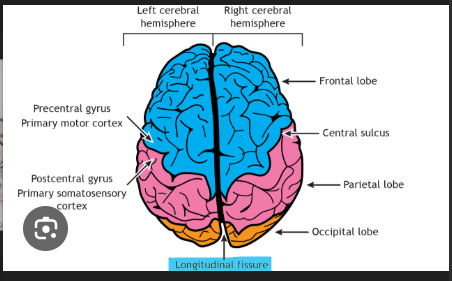
<p><span style="background-color: transparent;">separates the two halves of the brain</span></p>