Environmental science 1401 exam3
 Call Kai
 Learn
Learn Practice Test
 Spaced Repetition
 Match
Match Flashcards
 Knowt Play
1/73

There's no tags or description
Looks like no tags are added yet.
Name | Mastery | Learn | Test | Matching | Spaced | Call with Kai |
|---|
No analytics yet
Send a link to your students to track their progress
74 Terms
Traditional Ag
Cyclical Cycle.
Traditional agriculture is designed to “live off the
interest” (reuse). based on achieving
reasonable yields of a DIVERSITY of species.
Convential Ag
Linear.
Based on maximizing the output of a narrow range of species.
Conventional agriculture is ultimately
UNSUSTAINABLE because it is based on capital
depletion and massive additions of external inputs (e.g. energy, water, chemicals).
Major Environmental Concerns of Conventional Agriculture
Rely on heavy chemical pesticide use to ctrl bugs & weeds.
Intensive soil manipulation/application of chemical
fertilizers to maintain crop productivity.
Heavy relies on external inputs of energy and water.
Impacts of Conventional Ag
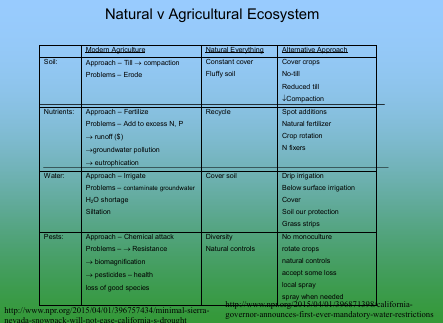
Industrial agriculture views the farm as a factory with “inputs” (such as pesticides, feed, fertilizer, and fuel) and “outputs” (corn, chickens). The goal is to increase yield and decrease costs of production.
Depends on expensive inputs from off the
farm (pstcds and frtlizr) which generate
harmful wastes and uses large quantities of
nonrenewable fossil fuels.
Tends toward concentration of production, driving out small producers and undermining rural communities.
Land used for
Pasture, forest, cropland, special use (parks, highways, bases), other misc use (for us, stores), and urban. Highest to lowest.
environmental and public health concern of CA
monocultures are eroding biodiversity. Inputs are polluting soil, water and air. soil is eroding much faster than it can be replenished, taking with it the land’s fertility and nutrients. Too much water is consumed. Lots of fossil fuel energy is required to maintain ag system.
Heavy pesticide use
Due to farms growing large areas of a single crop (monocropping- makes ideal conditions for pests), which is easier to manage with machines.
Irrigation also allows the same crop to be grown year-round. These conditions make it easier for pests to thrive, especially since natural predators are often reduced or removed, so farmers rely on pesticides to control them.
Soil formation/erosion
corn crops are highly erosive.
Soil = rocks + water + plants/organisms + TIME
Typical soil = 500 years per inch
Current ag. soils = 13,000 years old
Soil Manipulation
Modern farming often relies on heavy soil tilling and lots of chemical fertilizers to boost crop growth. However, using too much fertilizer can pollute groundwater and run off into lakes and oceans, causing problems like Eutrophication (such as the Gulf of Mexico dead zone) and health problems. Over time, this approach also damages soil by compacting it, reducing organic matter, increasing erosion, and harming water quality.
Fertilizer
They consist mostly of nitrogen and Phosphorus. Nitrogen is mostly lost to runoff since not all fertilizer is taken up by plants or retained in soil.
Not sustainable. Use of fertilizers to substitute for lost topsoil is only a temporary solution.
Soil Manipulation: Sustainable ALT
Strip cropping and crop rotation depend on the crop
DIVERSITY as a means of maintaining soil fertility
and pest resistance. doing one round first, then a second with a different plant to use excess nutrients. Makes it hard for pests to adjust.
>Use natural means = N-fixing plants
Contour farming and terracing to help prevent soil erosion by working as barriers. Waves.
Introducing livestock gives advantage of manure.
barriers to sustainable alternatives
strip farming and ideal crop rotation takes time
May result in initial declines in output per acre. Fertilizers are cheap and easily available (for now...).
Currently, government subsidy programs reward
mono-cropping and penalize inter-cropping, strip
cropping and crop rotation
Dichlorodiphenyltrichloroethane (DDT
1939) It’s a synthetic chemical pesticide that was widely used to kill insects. DDT is a much larger, man-made molecule with very different properties.
Pesticides
Saved lives by killing malaria. Increased food supply, which benefits our growing population. Increases profits and is an easy fix for high-producing areas.
Pest Problems
In natural ecosystems, there is lg diversity of species, so pests are kept in check and spread out in smaller, scattered areas.
In agricultural systems, farms often grow just one crop (monoculture) in large, uniform fields. This creates the perfect environment for pests to spread quickly, like a “buffet” with plenty of the same food in one place.
Rachel Carson
She was a biologist who noticed biological prblm associated with pesticides in the songbird population due to DDT
Pesticide use
Pesticide use was highest in 1982, when a record amount of land was being farmed. This was due to more crops being planted, more fields being treated, and higher amounts of chemicals used—especially herbicides. After 1982, pesticide use dropped by 1990 because crop prices fell and government programs reduced how much land was farmed.
Pesticide Problems: mobility
Carried into nearby ecosystems. Has moved into groundwater, misipi rvr, and ddt found in Antarctica
Pesticide Problems: persistence
Pesticide residue remains on most fruits and vegetables
Pesticide Problems: biomagnification
As food moves up the food chain, the compounds are increasingly concentrated
Reach levels toxic to higher organisms
Even if not toxic to organisms low on food chain
Pesticide Problems: resitance
Pests develop resistance to pesticides. Farmers then have to use stronger or more chemicals to control them, which leads to even more resistance. This cycle is called the pesticide treadmill because it keeps going without solving the problem long-term.
Refugia- alt to pesticide use
Refugia are areas where pests are not exposed to pesticides or other control methods.
These “safe zones” allow some pests that are still susceptible (not resistant) to survive. When they reproduce with resistant pests, it slows down the spread of resistance in the overall population.
#New york water supply
By 1842, New York City was drawing fresh water from the Croton River Watershed.
By the early-1900s, additional water supplies were developed in the Catskill/Delaware River Watersheds.
Today, 90% of New York City’s drinking water comes from the Catskill region.
Ecological economics
Ecological economics studies how human economies depend on and interact with natural ecosystems. It brings together ideas from both natural and social sciences.
Ecological economics addresses the interdependence between human economies and natural ecosystems. Ecological economics connects different disciplines within the natural and social sciences. A key idea is natural capital.
natural capital
natural resources that provide ongoing benefits, like a stock that produces a flow of useful goods and services over time.
Human Capital
physical, intellectual, emotional and
spiritual capacities of any individual.
Manufactured Capital
the built environment, infrastructure, tools, equipment, machinery and technology
Social Capital
social networks of family and community, the “social glue” that holds society together
Financial Capital
monetary assets (really a form of social capital)
Natural Capital
any part of the natural world that humans make use of or benefit from, including resources, waste sinks and ecosystem services
Capital: Stocks and Flows
Human: stock of knowledge and experience yields a flow of work skills
• Manufactured: stock of circuitry, metals and plastics (computer) yields a flow of computing services
• Social: stock of family and personal friends yields a flow of support and relationships
• Financial: stock of monetary assets yields a flow of interest earnings
• Natural: stock of trees, soil, and microorganisms (forest) yields a flow of timber, non-timber forest products, clean water, oxygen, CO2 sequestration, recreation, aesthetic enjoyment.
Basic economic rule:
maintain capital intact in order to maintain the flow
(INCOME) of useful goods and services from that capital stock
Overlooked natural capital
Natural capital is often overlooked because some resources are sold in markets (like oil and lumber), but many important ones are not, such as pollination or water purification. A lot of natural capital is also a public good, meaning it can be used by everyone and doesn’t run out easily in the same way private goods do. In the past, it seemed so abundant that people assumed human-made or industrial resources could replace it, which led to underestimating its true value.
Ignoring Natural capital
Ignoring natural capital has led societies to focus too much on manufactured, financial, and human capital, supported by policies and economic measures like GDP that often ignore environmental loss or even count it as positive growth. As a result, natural resources have been overused and are now becoming the most limited or “scarce” factor in production. Economic logic suggests we should invest most in whatever is scarce, meaning natural capital should now be a higher priority than in the past.
investing in natural capital
Investing in natural capital starts by trying to assign economic value to ecosystem services, like clean water, pollination, and climate regulation. Then, management focuses on using resources sustainably—for example, not harvesting renewable resources faster than they can regrow and not polluting faster than ecosystems can absorb it. It also involves using money from non-renewable resources to develop renewable alternatives, improving technology to use resources more efficiently, and allowing overused ecosystems, like fisheries, time to recover.
Policy Implications
Ecological economics suggests changing how we measure and pursue progress. Instead of relying only on GDP, it recommends using better indicators that reflect overall well-being and environmental health. It also proposes changing tax systems so they don’t encourage harming natural capital, but instead reward protecting and investing in it. Owners of ecosystems could even be paid for providing benefits like clean water or carbon storage. Overall, it argues that policy should focus less on endless economic growth and more on sustainable development and quality of life.
#Sprawl
For every 100 acres of new residential development, an
additional 38 acres is lost to roads and 18 acres to utilities
Habitat fragmentation
leads to decrease in interior habitat and species. edge habitat increases.
Loss of ecosystem functions and services associated with land conversion.
When more land is covered by roads and parking lots, less rainwater can soak into the ground. This increases runoff, which can cause flooding and carry pollution from streets and lawns into waterways, lowering water quality. It also reduces infiltration, which means less water enters the ground to refill groundwater supplies.
Higher infrastructure costs
highways, sewage, water, schools. Results in higher taxes for ALL residents
• Social segregation, loss of community
Energy consumption houses
multi family complexes uses less energy and therefor carbon than ppl living in single homes located in suburbs.
Smart Growth Policies as an Alternative to Suburban Sprawl
• Make developers and their clients (not taxpayers) pay for the
expansion of infrastructure into un-built areas
• Balance government investment dollars between suburban and
existing urban areas, including balancing spending on mass
transit and highway/road construction
• Promote more REGIONAL planning including development of
growth boundaries
New Urbanism as an Alternative to Suburban Sprawl
• Multiple use zoning allows residential and commercial
activities to take place in the same area
• Higher density housing reduces the amount of land
needed to support a given population
• Sidewalks, bike paths, nearby stores and community
gathering areas increase social interaction.
• Houses designed with reduced setbacks, front porches
and shared common areas to increase social
interactions.
#Biodiversity
Number and variety of Earth’s organisms
Three components:
Genetic diversity
Species richness
Ecosystem diversity
Need for biodiversity
Ecological and agricultural processes
Food, medicines
Biological processes
Organisms are interdependent
Decline in bd
modern extinctions are occurring at a rate much faster than is biologically sustainable.
•Natural extinction vs. accelerated extinction
–Evolutionarily extinct, but genetically still active (active descendants)
–Truly extinct (eliminated)
–Accelerated extinction is when humans impact (speed up) the process
factors contribute to the loss of species, but the
two most important are:
– the destruction and alteration of habitat #1
– commercial harvesting
Physical Alteration of Habitat
The most dramatic changes occur in
biologically rich areas:
– Tropical rain forests
– Wetlands
– Estuaries
– Coral reefs
Commercial Hunting and Harvesting
Commercial hunting and harvesting is the second biggest cause of animal species decline worldwide. It includes both past practices like whaling and current activities such as overfishing, poaching endangered animals, and capturing wildlife for the pet trade. has been occurring for centuries
Commercial Hunting cont
thers overexploitation (zoos, laboratores, circuses, petstore. not just pets but plants too
Extinction of a species
99% of all previous species are extinct
Currently accelerated by human activities
100–1000 times natural rate
Value of Species
Agriculture: Provide food, Pollination
Industry: oils, lubricants, Perfumes, dyes
Intrinsic Value: for us paintaings photos etc
Where Is Biodiversity Declining?
Tropical rain forests
– Being destroyed faster than most other
ecosystems
– Disruptive effect on evolution
biodiversity hotspots
caribbean, madagascar, sundaland, philippines. at high risk from human activity
Introduction of Foreign Species
Plant and animal species introduced into new
regions may thrive because of the favorable
conditions and low environmental resistance.
They often out-compete and eliminate native
species.
• Islands are especially vulnerable to foreign
species.
human impact of biodiversity cont
Chemical pesticides, sprayed on farms and other areas to control insect pests, and predator control programs have had a profound impact on native species.
human impact of biodiversity cont
Pollution alters the physical and chemical nature of
the environment in ways that impair the survival of
many species.
• Pollution and climate change (caused by pollution)
may be altering the health of the world’s coral reefs.
– This may cause widespread decimation
Biological Factors that Contribute to Extinction
the number of offspring they produce
– the size of their range
– their tolerance for people
– their degree of specialization
#industrial ecology
• Study of material flows through industrial systems.
• Industrial Ecology considers:
– impacts of industry on environment, natural resource use, sustainability, energy, materials, waste, technology, socio-economics, etc. (anything else???)
Industrial ecology connotes an
industrial system that operates
much like a natural ecosystem
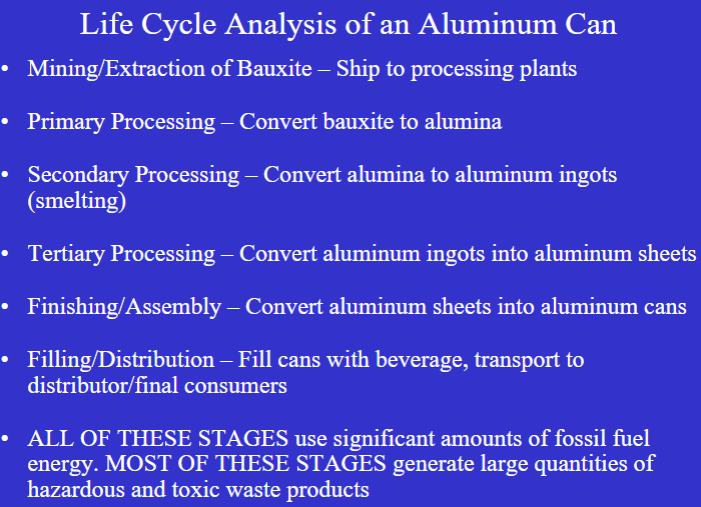
Problems with a Linear Production System
At each step in production process, wastes are generated
– over 95% of the materials extracted for use in manufacturing durable products
becomes waste BEFORE the product reaches the consumer.
– 32 tons of waste for every 1 ton of product!
and too much fossil fuel consumed
Left/right
On “left” need to keep “going back to the well” to extract more and more raw
material.
• On “right” need to keep finding new places to dump regular solid waste and the
hazardous wastes generated by many production practices.
Alternatives to Linear Production
Industrial Ecology – design industrial system that operates like a natural system.
Product as Service
Design for Disassembly / Take-Back Programs /Cradle-to-Cradle
eco-industrial park
is "a community or network of companies and other organizations in [a physical park] who choose to interact by exchanging and making use of byproducts and/or energy in a way that provides one or more... benefits over traditional, non-linked operations
major characteristics of a successful eco-
industrial park
The five major characteristics are:
• 1) material, water, and energy flows;
• 2) companies within close proximity;
• 3) strong informal ties between plant managers;
• 4) minor retrofitting of existing infrastructure; and
• 5) one or more anchor tenants
Industrial Ecology in Kalundborg
Saves resources:
– 30% better utilization of fuel using combined heat + power than
producing separate
– Reduced oil consumption
– 3500 less oil-burning heaters in homes
– Does not drain fresh water supplies
The Waste Electronic and Electrical Equipment (WEEE)
European directive
• WEEE requires electronics manufacturers to take back their products when customers are finished with them
– (no charge to the customer).
– By 2006 the E.U. will ban sales of electronic equipment containing lead, mercury, cadmium, chromium and brominated flame retardants.
Outcomes of a Shift to a Product as Service /
Cradle-to-Cradle Economy
• Focus placed SERVICE, not PRODUCT
– Forces changes in the way both customers and businesses perceive their
product.
• Emphasis placed on durability over built-in obsolescence.
– Manufacturers will want a product to last as long as possible.
• Products designed for dis-assembly and reuse
– move to MODULAR design (Panasonic TV example).
• Manufacturers forced to adopt cyclic way of thinking about production
process.
• Reduced extractive and processing activity upstream from the consumer
– reduced disposal downstream.
• Employment shift from extraction/disposal industries to service, collection
and re-processing industries.
Toxicants
• Mutagens cause mutations in the DNA of organisms
• Teratogens affect development of human embryos in the womb
– can cause birth defects.
• Allergens overactivate the immune system
– cause immune response when one is not necessary
– Asthma in recent years is an increase in allergenic synthetic chemicals in our environment.
• Neurotoxins assault the nervous system
– E.g. lead, mercury, and cadmium
• Endocrine disruptors interfere with the endocrine system
– The herbicide atrazine may instead induce production of the enzyme aromatase,
which converts male sex hormones to female ones.
Industrial Ecology considers
impacts of industry on environment
natural resource use
energy and waste
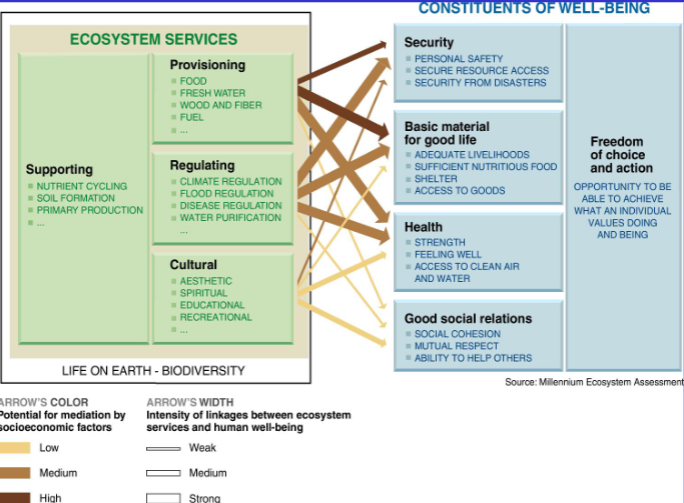
eco econmcs- All of the following are factors of human well-being
security, shelter, good social relations
All of the following are ecosystem services except which?
provisioning, regulating, cultural
Protecting biodiversity will be best achieved by efforts that address the root causes of the crisis of unsustainability: which of the following is not one of these?
preservation efforts, our inefficient use of resources, population growth, and reliance on fossil fuels