B2.1 membranes and membrane transport
 Call Kai
 Learn
Learn Practice Test
 Spaced Repetition
 Match
Match Flashcards
 Knowt Play
1/36

There's no tags or description
Looks like no tags are added yet.
Name | Mastery | Learn | Test | Matching | Spaced | Call with Kai |
|---|
No analytics yet
Send a link to your students to track their progress
37 Terms
what is the structure of a phospholipid?
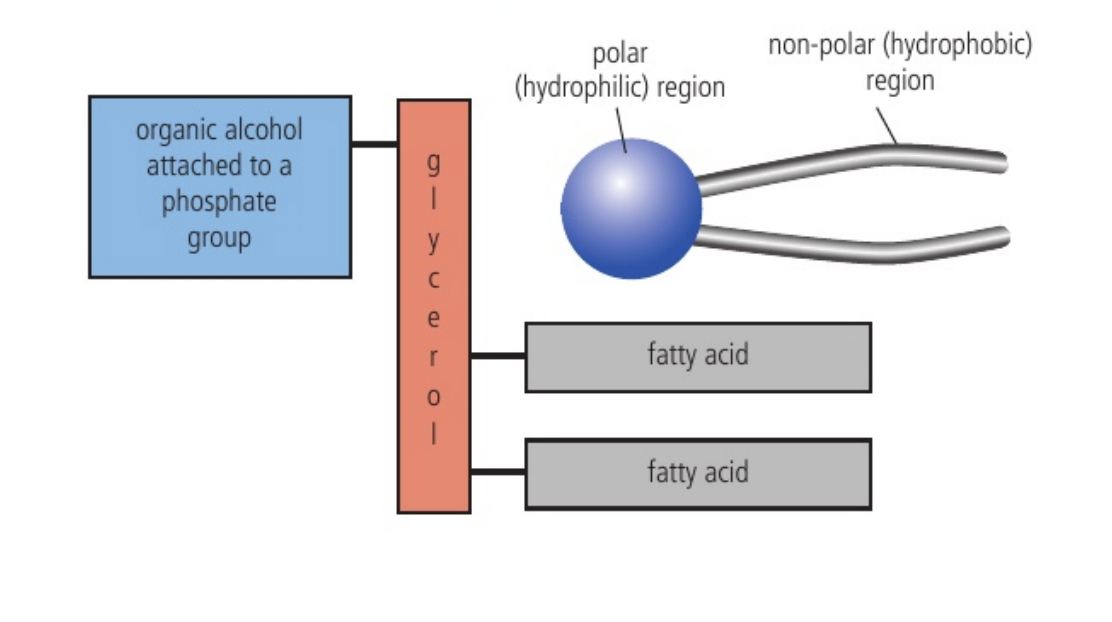
each phospholipid is composed of 3 glycerol. two of the glycerol carbons have fatty acids combined with them. the third carbon is attached to a highly polar organic alcohol that includes a bond to a phosphate group. hence, phospholipids have two distinct areas, where the head is hydrophilic (alcohol) and the tail is hydrophobic, making it amphipathic.
how does the phospholipid bilayer act as a barrier?
the hydrophobic and hydrophilic regions cause phospholipids to naturally align as a bilayer when in an aqueous solution. the hydrophobic regions are attracted to each other and the hydrophilic are attracted to the water. the membrane is fluid/flexible because the fatty acid tails don’t attract to each other strongly. this allows animal cells to have variable shape and allow endocytosis.
what molecules can pass through the phospholipid bilayer?
large molecules cannot pass through it easily because the molecules are tightly packed. hydrophilic molecules like ions are smaller but also find it difficult to move through the membrane because of the hydrophobic regions. therefore, the bilayer forms an effective barrier and allows the cell to control what passes through it.
what is diffusion?
when particles move without energy from a region of higher concentration to a region of lower concentration, following the concentration gradient.
what is an example of simple diffusion?
oxygen is used by cells in respiration. therefore, there is less oxygen concentration inside the cell than outside it, so oxygen diffuses into the cell easily because it is small and uncharged.
what are integral proteins?
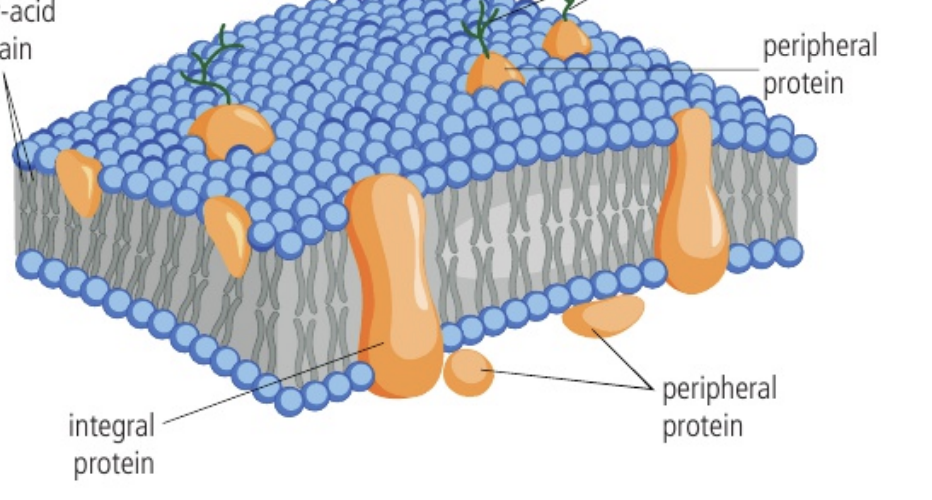
they are amphipathic proteins, where their hydrophobic region is in the mid-section of the phospholipid backbone and their hydrophilic region is exposed. to the water on either side of the membrane. they form channels, act as receptors for transport and signaling, and catalyze reactions on the membranes surface.
what are peripheral proteins?
peripheral proteins do not protrude into the middle hydrophobic region but remain bound to the surface on both the inner and outsides of the membrane. they are often anchored to an integral protein they act as anchoring points with the internal cytoskeleton, and work with the integral protein to relay messages and catalyze reactions.
what is passive transport?
cellular transport that does not require ATP energy, taking place when a substance moves along the concentration gradient with the source of energy coming from the kinetic energy of the molecules.
what is active transport?
cellular transport where the substance moves against the concentration gradient, therefore requiring ATP energy.
what is osmosis (passive transport)?
the passive movement of water across a partially/selectively permeable membrane, which allows only certain substances to pass through. the concentration gradient of water is moving from a high concentration of solutes to a low concentration.
how can water travel through hydrophobic regions in the cell membrane?
water can move quickly through protein channels called aquaporins, allowing water molecules to pass despite the presence of hydrophobic regions.
what are the properties of a hypertonic solution?
when a solution has a higher concentration of solutes outside of the cell, therefore causing the cell to lose water & killing plant cells but shriveling animal cells.
what are the properties of a hypotonic solution?
when the solution outside of the cell has less concentration of solutes than inside it, causing the cell to become full for plant cells but burst for animal cells.
what are the properties of an isotonic solution?
when the solution on either side of the membrane has equal concentration of solutes, achieving equilibrium.
what is facilitated diffusion (passive transport)?
diffusion through protein channels. some molecules need them because of polarity and size
what are carrier proteins?
they carry substances along the concentration gradient or against them in active transport. they can carry both polar and non-polar molecules and change shape to carry specific substances.
what are channel proteins?
proteins with pores in which molecules of appropriate size and charge can pass. they don’t change shape, and they just open and close a channel. they only carry water-soluble molecules and are specific for the ion they carry. it’s what makes the membrane selectively permeable because specific ions are allowed at certain times.
what is the sodium potassium pump (membrane pump, active transport)?
the membrane pump uses ATP to move ions directly against the concentration gradient. its like a carrier protein but using energy.
what allows selectivity in membrane permeability?
diffusions of small, simple molecules are not selective. the cell is selectively permeable to large, charged, molecules because they must travel through proteins. facilitated diffusion and active transport is selective where as simple diffusion isnt.
what are glycolipids?
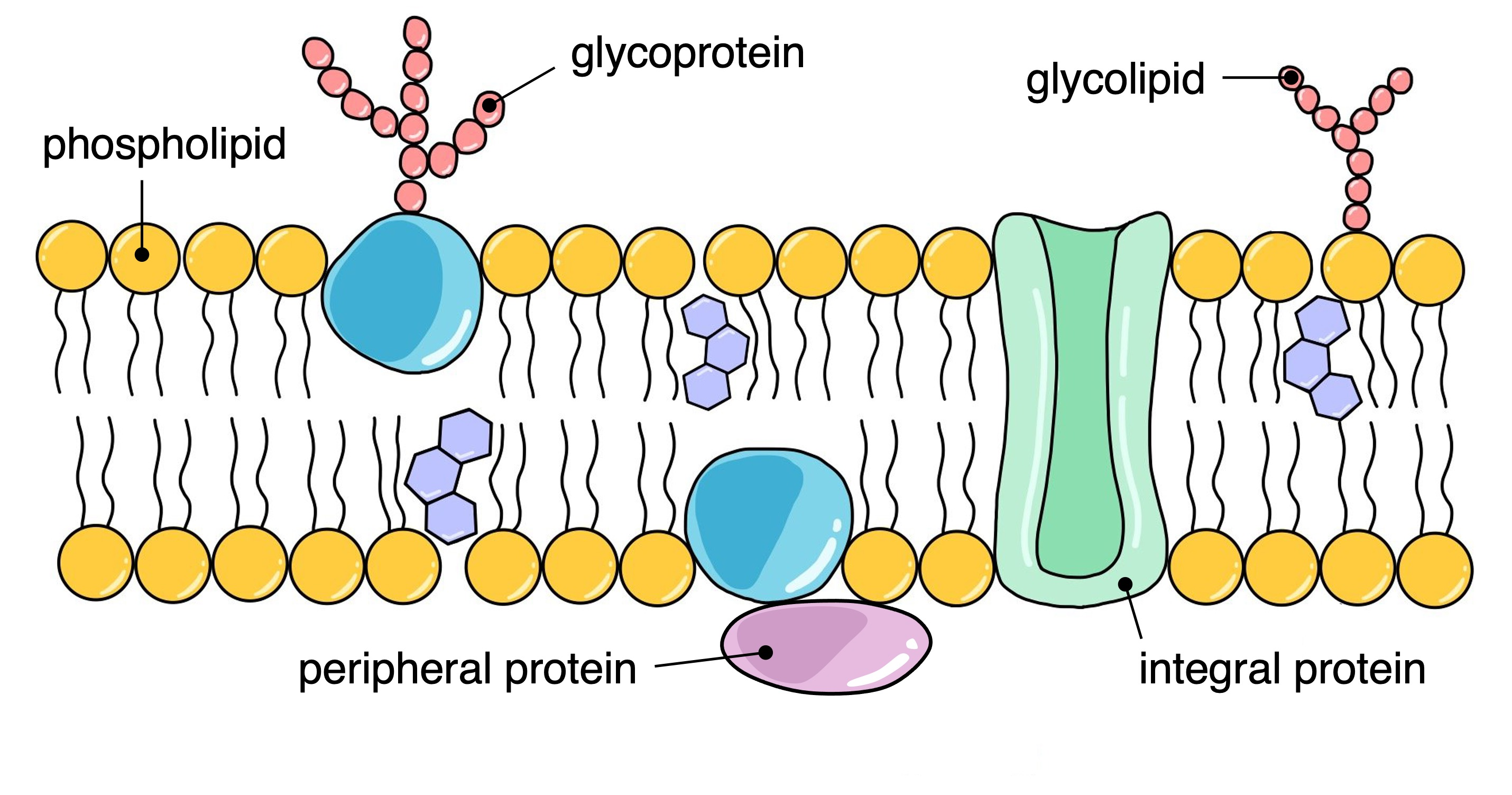
when phospholipids have carbohydrate chains attached to them on the surface of a cell membrane.
what are glycoproteins?
cell membrane proteins that have chains of carbohydrates attached to them on the surface of the membrane.
what is the role of glycolipids and glycoproteins?
cell identification and adhesion (sticking cells together)
what is an example of carbohydrate chain cell identification? (i think u can skip if u want but im not sure)
carbohydrate chains allow the body to work out which cells blood types ABO belong to the body and which cells are from outside of it. if the carbohydrate chains of a transplanted tissue or organ are not compatible, the receiving patient’s immune system attacks the foreign cells which results in the possible failure of the transplant (this is called rejection)
know how to draw the fluid mosaic model of membrane structure (2D). include peripheral and integral proteins, glycoproteins, phospholipids and cholesterol. indicate the hydrophobic and hydrophilic regions.
how do the bonds in fatty acid tails help with membrane fluidity?
the unsaturated double bonds in the fatty acid tails cause the molecules to be less straight, so they don’t pack together as tightly. they have lower melting points which help them survive cool temperatures and when surrounded by high temperatures the fatty acids have saturated bonds, meaning that they’re straighter in shape and increase density which makes the membrane stronger and remain effective at high temperatures.
what is the role of cholesterol in the plasma membrane?
they help determine membrane fluidity, which changes with temperature. cholesterol molecules allow membranes to function effectively at a wider range of temperatures by interacting with the tails of the phospholipids.
what is endocytosis?
a process that allows macromolecules to enter the cell, occurring when a portion of the plasma membrane is pinched off to enclose macromolecules within a vesicle in the cell. this involves a change in the shape of the membrane which results in a vesicle that enters the cytoplasm of the cell. the ends of the membrane reattach because they’re hydrophobic and hydrophilic.
what is exocytosis?
the reverse of endocytosis. an example is proteins in the cytoplasm that eventually are excreted.
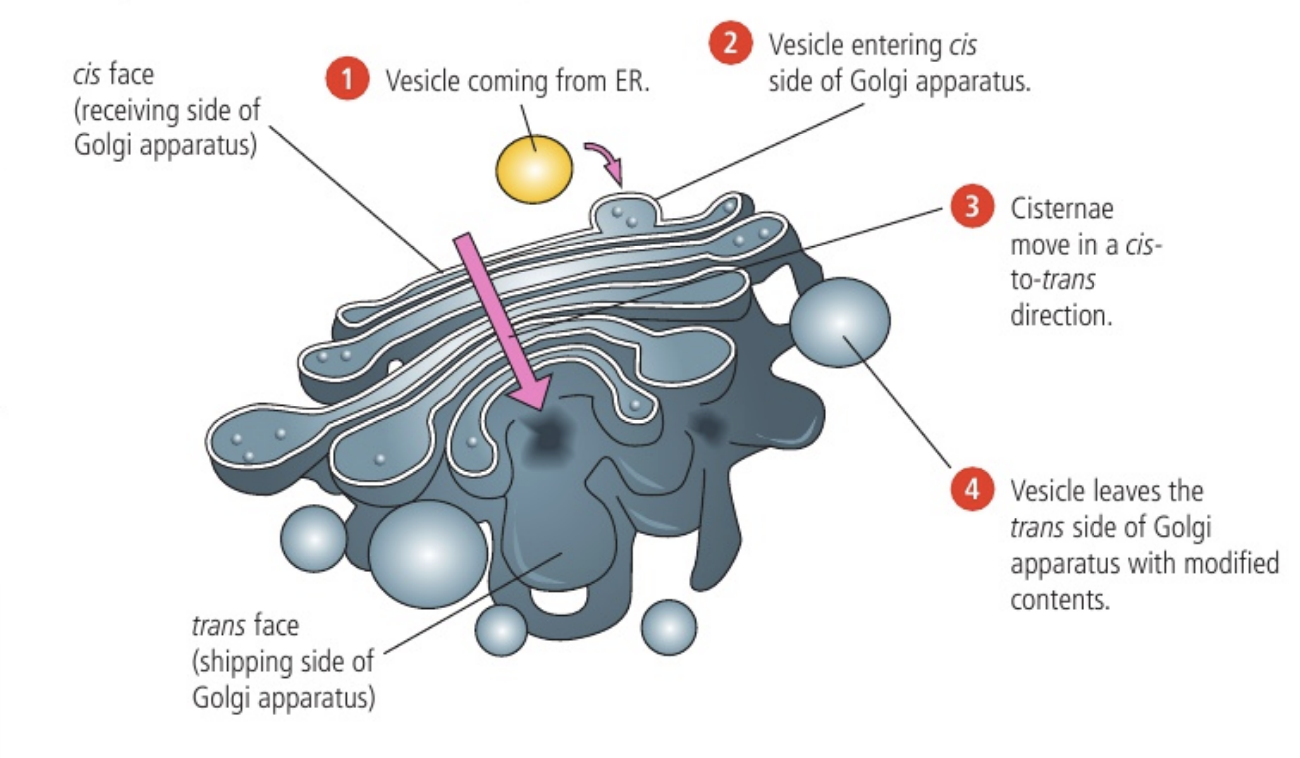
protein produced by the ribosomes of rough ER enters the inner part of the ER and packed into a vesicle
the vesicle carries the protein with the cis (receiving) side of the golgi apparatus
it exists on the trans (shipping) face inside another vesicle
the vesicle with the protein moves to and fuses with the membrane, secreting the protein from the cell. the vesicle membrane becomes part of the plasma membrane.
what are gated ion channels?
specialized channels that allow ions to pass quickly through cell membranes. most have openings that can be opened or closed due to chemical and electrical stimuli, aka gated. movement of ions through these channels controls the electrical/voltage difference inside and outside of the cell across membranes, especially neurons and muscles.
how are nicotinic acetylcholine receptors an example of neurotransmitter-gated/chemically gated ion channels?
neurotransmitters are chemicals that allow signals to pass between two nerves at junctions, including between nerves and muscles. when acetylcholine attaches to a nicotinic acetylcholine receptor, the channel is opened and positive ions can pass through.
how are sodium and potassium channels examples of voltage-gated protein carriers/channels?
an electrical stimulus opens & closes the gates on these proteins. they only remain for a very short time, but they allow the specific ion to move inside, depolarizing the membrane. the sodium channels close quickly and potassium channels open slowly, but once they are open potassium ions move from inside to outside of the cell & the membrane returns to its normal voltage potential because sodium and potassium have the same charge. this is called repolarization
what is membrane potential?
the electrical charge difference between the interior and exterior of the cell
how does the sodium-potassium pump maintain membrane potential?
6 stages
the pump protein with attached ATP binds to three intracellular sodium ions.
the sodium ions cause the pump to split ATP, providing energy and leaves one phosphate from ATP attached to the carrier, so ATP becomes ADP
the phosphorylation (attaching phosphate to carrier) changes the protein’s shape, expelling sodium ions into extracellular fluid.
at that point, the protein pump has low affinity for sodium ions but the shape change results in high affinity for potassium ions
two extracellular potassium ions bind to different regions of the protein, releasing the phosphate group
the loss of the phosphate restores the proteins original shape, releasing the potassium ions into the intracellular space. afterwards the carrier repeats the process.
what is indirect active transport?
uses energy produced by the movement of one molecule down a concentration gradient to transport another molecule against a gradient. for example, some processes use a protein carrier called sodium-dependent glucose transporter (SGLT)
how is glucose absorption by cells in the small intestine an example of indirect active transport?
there are more sodium ions outside than inside the intestinal cell
sodium ions and glucose molecules bind to a specific transport protein (SGLT) on the extracellular surface
sodium ions pass through the carrier to the inside of the cell, with the carrier capturing the energy released by the movement
the captured energy is used to transport the glucose molecule through the same protein into the cell.
how is glucose absorption by cells in the nephron an example of indirect active transport?
the SGLT in intestinal cells is SGLT1, while the one in nephron is SGLT2. SGLT2 is responsible for glucose reabsorption in the kidney and works the same way as in the intestine where it needs the sodium ion to transport energy. in the kidney, the carrier decreases glucose in the urine by allowing the uptake of glucose from the kidney filtrate.
what is a cell adhesion molecule (CAM)?
glycoproteins that act as molecular glue for the adhesion of cells, for example skin and muscle cells. there are many types of CAM used for different cell adhesion, for example desmosomes help form sturdy but flexible sheets of cells in the heart, stomach and bladder. plasmodesmata are tubes connecting the cytoplasm with adjacent cells.